
 Worksheets
UNIT 1 & 2- FINAL REVIEW
Total questions: 79
Worksheet time: 1hrs 12mins
Name
Class
Date
1.
A student is planning an experiment to find out how the height from which he drops a ball affects how high the ball bounces. The responding variable is the _____.
a)
Diameter of the ball
b)
Force acting on the ball
c)
Height that the ball bounces
d)
Height from which the ball is dropped
2.

What is a result or conclusion?
a)
step by step directions on how to complete the experiment
b)
a statement of the outcome of the experiment
c)
the purpose of your experiment
3.
The X axis is _______?
a)
vertical
b)
diagonal
c)
criss-cross
d)
horizontal
4.
The Y axis is _______?
a)
Vertical
b)
Horizontal
c)
criss-cross
d)
diagonal
5.
Which of the following is NOT one of the five senses?
a)
Taste
b)
Sight
c)
Thinking
d)
Hearing
6.
In a hypothesis, you should see the words _____ and then.
a)
if
b)
that
c)
now
d)
when
7.
Which variable do you measure?
a)
Manipulated
b)
Responding
8.
Which variable do you change in an experiment?
a)
Manipulated
b)
Responding
9.
An experiment is performed on plants to see how different liquids affect plant growth. Each plant in the experiment is given a different liquid; water, apple juice, or milk. Each plant has the same amount of soil, sunlight, and listens to the same music. In this investigation, the manipulated variable is ...
a)
The type of plant
b)
The amount of sunlight
c)
The type of music
d)
The type of liquid
10.
An experiment is performed on plants to see how different liquids affect plant growth. Each plant in the experiment is given a different liquid; water, apple juice, or milk. Each plant has the same amount of soil, sunlight, and listens to the same music. In this investigation, the responding variable is ...
a)
The plant's growth
b)
The amount of sunlight
c)
The type of music
d)
The type of liquid
11.
An experiment is performed on plants to see how different liquids affect plant growth. Each plant in the experiment is given a different liquid; water, apple juice, or milk. Each plant has the same amount of soil, sunlight, and listens to the same music. In this investigation, the controlled variable(s) is/are....
a)
The amount of soil
b)
The amount of sunlight
c)
The type of music
d)
All of the above
12.
This part of the experiment serves as a basis of comparison; the one variable being tested has not been included in this group.
a)
experimental group
b)
control group
c)
data
d)
variables
13.
In a controlled experiment, how many variables can be worked with at a time?
a)
one
b)
none
c)
two or more
d)
how ever many makes sense.
14.

Which statement is an inference about this picture?
a)
The van is tan.
b)
The van ran into KFC.
c)
The driver was hungry.
d)
Red and white are part of the KFC building.
15.

The boy is in the water.
a)
inference
b)
observation
16.
The branch is broken.
a)
inference
b)
observation
17.

The boy fell from the tree into the water because the branch broke.
a)
inference
b)
observation
18.
The curved surface at the top of water is called
a)
life
b)
meniscus
c)
temperature
d)
unit
19.
The amount of matter in an object is called
a)
meniscus
b)
temperature
c)
unit
d)
mass
20.
The measurement of a distance in called
a)
length
b)
life
c)
meniscus
d)
temperature
21.
This measures mass
a)
graduated cylinder
b)
meter stick
c)
triple beam balance
d)
thermometer
22.
This measures volume.
a)
graduated cylinder
b)
meter stick
c)
triple beam balance
d)
thermometer
23.
This measures length.
a)
graduated cylinder
b)
meter stick
c)
triple beam balance
d)
thermometer
24.

Squidward found new reeds to tryout for his clarinet. He used an APPLAUSOMETER to measure applause after playing Under the Sea with each reed. The results were put in the table.
What was controlled?
What was controlled?
a)
The Song
b)
The Reed Size
c)
The Applause
25.

Squidward found new reeds to tryout for his clarinet. He used an APPLAUSOMETER to measure applause after playing Under the Sea with each reed. The results were put in the table.
What was the manipulated variable?
What was the manipulated variable?
a)
The Song
b)
The Reed
c)
The Applause
26.

Squidward found new reeds to tryout for his clarinet. He used an APPLAUSOMETER to measure applause after playing Under the Sea with each reed. The results were put in the table.
What was the responding variable?
What was the responding variable?
a)
The Song
b)
The Reed
c)
The Applause
27.
"cm3" is a unit of _____
a)
Volume
b)
Mass
c)
Density
d)
Time
28.
"g" is a unit of _____
a)
Volume
b)
Mass
c)
Density
d)
Time
29.
"g/mL" is a unit of _____
a)
Density
b)
Mass
c)
Weight
d)
Volume
30.
The amount of space occupied by an object
a)
Volume
b)
Mass
c)
Density
d)
Time
31.
The relationship between mass and volume.
a)
Density
b)
Mass
c)
Volume
d)
Weight
32.
"mL" is a unit of _____
a)
Volume
b)
Mass
c)
Weight
d)
Density
33.
"m" is a unit of __________
a)
Mass
b)
Weight
c)
Length
d)
Time
34.

What is the volume of Object X?
a)
10.0 cm3
b)
15.0 cm3
c)
20.0 cm3
d)
25.0 cm3
35.

What is the name of this instrument?
a)
Graduated Cylinder
b)
Pipet
c)
Triple Beam Balance
d)
Beaker
36.

Read this instrument to the nearest tenth
a)
613.37 g
b)
163.7 g
c)
163.5 g
d)
163 g
37.
Jack has a rock. The rock has a mass of 14g and a volume of 2cm3. What is the density of the rock?
a)
7 mL
b)
7 g/cm3
c)
28 g/cm3
d)
1/7 g/cm3
38.
Which units of measurement are used for volume?
a)
grams
b)
centimeters
c)
grams/milliliter
d)
milliliter
39.
Which lab tool might you use to measure the volume of a liquid?
a)
electric scale
b)
bunsen burner
c)
test tube
d)
graduated cylinder
40.
The tool used to measure the mass of a substance or object is a ______________.
a)
triple beam balance
b)
graduated cylinder
c)
ruler
d)
thermometer
41.

What is the volume?
a)
50.0 cm3
b)
53.0 cm3
c)
54.0 cm3
42.

What is the length of the eraser?
a)
3 cm
b)
2 cm
c)
5 cm
d)
7 cm
43.

Calculate the volume of the rock
a)
10.0 cm3
b)
16.0 cm3
c)
30.0 cm3
d)
40.0 cm3
44.
Using your senses to gather information.
a)
hypothesis
b)
observation
c)
seeing
d)
guessing
45.
Always read a graduated cylinder at the _____________ of the meniscus.
a)
top
b)
middle
c)
bottom
46.

Calculate the volume of a box that is 12 cm long, 0.6 cm wide, and 4 cm high.
a)
28.8 centimeters
b)
26 centimeters
c)
25.8 centimeters
d)
28.8 centimeters cubed
47.
How do you measure the volume of an irregular shaped object?
a)
length times width times height
b)
water displacement method
c)
using a pan balance
d)
using a triple beam balance
48.

What is the volume shown?
a)
0.6 mL
b)
0.3 mL
c)
0.7 mL
d)
0.8 mL
49.

What is the volume shown?
a)
0.7 mL
b)
7 mL
c)
0.8 mL
d)
0.9 mL
50.

What is the volume shown?
a)
1.2 mL
b)
1.0 mL
c)
1.1 mL
d)
11 mL
51.

What is the volume shown?
a)
1.2 mL
b)
1.4 mL
c)
1.6 mL
d)
1.3 mL
52.

What is the volume shown?
a)
2.0 mL
b)
2.2 mL
c)
2.1 mL
d)
21 mL
53.

What is the volume shown?
a)
2.3 mL
b)
2.2 mL
c)
2.6 mL
d)
23 mL
54.

What is the volume shown?
a)
10 mL
b)
9 mL
c)
8 mL
d)
1.9 mL
55.

What is the volume shown?
a)
27 mL
b)
20.7 mL
c)
28 mL
d)
20.8 mL
56.

What is the length shown?
a)
8 cm
b)
0.8 cm
c)
0.7 cm
d)
7 cm
57.

What is the length shown?
a)
1.3 cm
b)
1.2 cm
c)
13 cm
d)
1.4 cm
58.

What is the length shown?
a)
2.1 cm
b)
2.2 cm
c)
2.0 cm
d)
22 cm
59.

What is the length shown?
a)
3.7 cm
b)
3.6 cm
c)
3.8 cm
d)
36 cm
60.

What is the length shown?
a)
5.4 cm
b)
5.3 cm
c)
5.5 cm
d)
5.2 cm
61.

What is the mass shown?
a)
99.1 g
b)
991 g
c)
99 g
d)
99.2 g
62.

What is the mass shown?
a)
228.4 g
b)
22.8 g
c)
228.5 g
d)
88.4 g
63.

What is the mass shown?
a)
455 g
b)
455.5 g
c)
95 g
d)
95.5 g
64.

What is the mass shown?
a)
472.2 g
b)
472.1 g
c)
472.3 g
d)
492.2 g
65.

What is the volume of liquid in this graduated cylinder?
a)
40.0 mL
b)
40.3 mL
c)
43.0 mL
d)
44.0 mL
66.
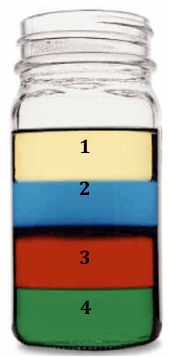
Put the liquids in order from most dense to least dense?
a)
4, 3, 2, 1
b)
1, 2, 3, 4
c)
3, 4, 2, 1,
d)
4, 3, 1, 2
67.

Which box has a higher density?
a)
Box A
b)
Box B
c)
cannot be determined
d)
they are the same
68.
Frank has an eraser. It has a mass of 4g, and a volume of 2cm3. What is its density?
a)
8 g/cm3
b)
2 g/cm3
c)
1/2 g/cm3
d)
24 g/cm3
69.
Frank has a paper clip. It has a mass of 9g and a volume of 3cm3. What is its density?
a)
3 g/cm3
b)
1/3 g/cm3
c)
27 g/cm3
d)
39 g/cm3
70.

Calculate the density of the cube.
a)
2 g/cm3
b)
4 g/cm3
c)
6 g/cm3
d)
8 g/cm3
71.

Calculate the density of the cube.
a)
2 g/cm3
b)
4 g/cm3
c)
6 g/cm3
d)
8 g/cm3
72.

Calculate the density of the cube.
a)
.33 g/cm3
b)
.4 g/cm3
c)
.6 g/cm3
d)
.5 g/cm3
73.

Calculate the density of the cube.
a)
3 g/cm3
b)
4 g/cm3
c)
2 g/cm3
d)
5 g/cm3
74.
Find the volume: L = 3cm W = 4cm H = 3cm
a)
36 cm3
b)
360 cm3
c)
168 cm3
d)
120 cm3
75.
Sink or Float
Mass = 150
Volume (cm3)= 175
Mass = 150
Volume (cm3)= 175
a)
Sink
b)
Float
76.
Sink or Float
Density= .92 g/cm3
Density= .92 g/cm3
a)
Sink
b)
Float
77.
Sink or Float
Density= 1.34 g/cm3
Density= 1.34 g/cm3
a)
Sink
b)
Float
78.

Which object has the least density?
a)
bolt
b)
cherry tomato
c)
soda cap
d)
ping pong ball
79.
Which object has the highest density?
a)
bolt
b)
cherry tomato
c)
soda cap
d)
ping pong ball
100 %

