wayground logo

Free Printable Worksheets

NEW

Font size

S
M
L
XL
Worksheets

Cell Processes

Total questions: 78

Worksheet time: 1hrs 3mins

Name
Class
Date
1.
Cells of organism must replicate for ?
a)
growth
b)
repair of damaged cells
c)
replacement of dying cells.
d)
All of the above
2.
Before cells can divide, what must be copied?
a)
mitochondria
b)
cytoplasm
c)
DNA
d)
Cell Wall
3.
Humans have ________ pairs of chromosomes.
a)
21
b)
23
c)
46
d)
None of the above
4.
Eukaryotic cells store their genetic information(DNA) in __________.
a)
Chromosomes
b)
Centromeres
c)
karyotypes
d)
Proteins
5.
The individual strands on duplicated chromosomes are called_____________
a)
Centromeres
b)
daughters
c)
Chromatids
d)
Karyotypes
6.
The ___________ holds the replicated sister chromatids together.
a)
centriole
b)
chromosomes
c)
centromere
d)
cycles
7.

The cell spends most of it's life in ________________.

a)

mitosis

b)

cytokinesis

c)

Interphase

d)

None of the above

8.
What is a series of events a cell goes through as they grow and divide?
a)
Cell Division
b)
Cell Cycle
c)
Cytokinesis
d)
Mitosis
9.
What is the longest stage of the cell cycle called?
a)
Cytokinesis
b)
M phase
c)
Interphase
d)
G1 Phase
10.
Put the following actions in order: DNA replicates, cell grows, cell divides, cell prepares for mitosis. 
a)
DNA replicates, cell grows, cell prepares for mitosis, cell divides
b)
cell grows, cell prepares for mitosis, DNA replicates, cell divides
c)
cell grows, DNA replicates, cell prepares for mitosis, cell divides
d)
DNA replicates, cell prepares for mitosis, cell grows, cell divides
11.
Why would it be important to replicate DNA before a cell divides in mitosis or meiosis?
a)
In order for genetic information to be transferred into daughter cells.
b)
In order for the cell to be able to increase in size.
c)
In order for the DNA to be contained in the nucleus.
d)
In order for the cell to re-order the DNA sequencing in the new cells.
12.
Which is Metaphase?
a)
A
b)
E
c)
C
d)
F
13.
The phase in mitosis where chromosomes move away and are pulled apart by spindles to opposite sides of the cell.
a)
prophase
b)
anaphase
c)
metaphase
d)
telephase
14.
The process by which the nuclear material is divided equally between two new cells
a)
mitosis
b)
cancer
c)
spindle
d)
centromere
15.
In mitosis, the two resulting cells are
a)
different from the starting cell and identical to each other.
b)
different from the starting cell and different from each other.
c)
identical to the starting cell and different from each other.
d)
identical to the starting cell and identical to each other.
16.
Fruit fly body cells have 8 chromosomes. After mitosis, you would expect a resulting fruit fly daughter cell to have -
a)
16 chromosomes.
b)
46 chromosomes.
c)
8 chromosomes.
d)
4 chromosomes.
17.

Where does a cell contain it's genetic material?

a)

nucleus

b)

nucleolus

c)

cytoskeleton

d)

golgi

18.

The dark "spider" looking things on opposite sides of the cell are called "Spindle Fibers". What is their job?

a)

Eating the chromosomes

b)

Pulling the chromosomes apart

c)

Putting the chromatids together

19.

The cell membrane pinches in, cutting the cytoplasm into 2 cells

a)

Metaphase

b)

Anaphase

c)

Telephase

d)

Cytokinesis

20.
When cells divide they make two ____ cells.
a)
daughter
b)
son
c)
Mom
d)
Dad
21.
Identify the Cell Cycle Stage.
a)
Prophase
b)
Interphase
c)
Anaphase
d)
Telophase
22.
Identify the Cell Cycle Stage.
a)
Anaphase
b)
Cytokinesis
c)
Telophase
d)
Metaphase
23.
Identify the Cell Cycle Stage.
a)
Cytokinesis
b)
Interphase
c)
Anaphase
d)
Metaphase
24.
Identify the Cell Cycle Stage.
a)
Anaphase
b)
Cytonkinesis
c)
Interphase
d)
Prophase
25.
Identify the Cell Cycle Stage.
a)
Interphase
b)
Anaphase
c)
Telophase
d)
Prophase
26.
The time between cell divisions in the life cycle of the cell is called
a)
anaphase
b)
interphase
c)
prophase
d)
metaphase
27.
Chromatin is found during which phase?
a)
Prophase
b)
Metaphase
c)
Interphase
d)
Telophase
28.
The cells produced via meiosis are called:
a)
sex cells
b)
somatic cells
c)
body cells
d)
skin cells
29.
This produces 2 identical cells.
a)
mitosis
b)
meiosis
30.
What causes genetic variation in meiosis?
a)
chromosomes lining up
b)
crossing over of chromosomes
c)
separation of chromosomes
d)
chromosomes pulling apart
31.
Unlike mitosis, meiosis in male mammals results in the formation of
a)
one haploid gamete
b)
three diploid gametes
c)
four diploid gametes
d)
four haploid gametes
32.
When an area of a chromatid is exchanged with the matching area on a chromatid of its homologous chromosome, _________________ occurs
a)
crossing over
b)
mutagenesis
c)
hybridization
d)
fertilization
33.
If the Diploid number of Carrots is 18, the haploid number is
a)
18
b)
9
c)
27
d)
36
34.
Which process and type of resulting cells are represented?
a)
mitosis, gametes
b)
mitosis, body cells
c)
meiosis, gametes
d)
meiosis, body cells
35.
The process of crossing over occurs in what phase of meiosis?
a)
anaphase 1
b)
prophase 1
c)
prophase 2
d)
telophase 1
36.
Which of these cells would be produced through meiosis?
a)
skin cells
b)
liver cells
c)
brain cells
d)
sperm cells
37.
Crossing over helps promote 
a)
male genotype
b)
genetic variation
c)
DNA replication
d)
mitosis
38.
A male shark has 40 chromosomes in each of its sex cells. How many would be present in its body cells?
a)
20
b)
40
c)
80
d)
160
39.
What is another reason we need meiosis?
a)
So the offspring has genes from both parents
b)
So the offspring has genes from one parent
c)
So the offspring has genes from neither parents
d)
So the offspring makes its own genes
40.
The result of meiosis is:
a)
two diploid cells
b)
two haploid cells
c)
four diploid cells
d)
four haploid cells
41.
The chromosomes that pair up during meiosis, are called __________ chromosomes.  
a)
heterozygous 
b)
asexual
c)
homologous
d)
genes
42.
Which of the following is NOT a gamete (sex cell)?
a)
egg
b)
sperm
c)
skin cell
d)
all of the above are gametes
43.
According to the chromosome theory of inheritance, what are carried from parents to their offspring on chromosomes?
a)
Genes
b)
Spindle Fibers
c)
Centrioles
d)
Cytoplasm
44.
Which organelle performs PHOTOSYNTHESIS?
a)
Chloroplast
b)
Mitochondria
45.

Which of the following is the correct equation for PHOTOSYNTHESIS?

a)

CO2 + light + H2O --> O2 + Sugar

b)

CO2 + sugar + H2O --> O2 + light

c)

O2 + light + H2O --> CO2 + Sugar

d)

CO2 + O2 + H2O --> Light+ Sugar

46.
What is the ultimate ORIGINAL source of energy for living things
a)
Sugar
b)
Sun
c)
Moon
d)
Carbon Dioxide
47.
What is the pigment in chloroplasts that performs photosynthesis?
a)
Chlorosynthesis
b)
Chlorophyll
c)
ADP
d)
Electron Transport
48.

Which gas is removed from the atmosphere during photosynthesis?

a)

hydrogen

b)

oxygen

c)

nitrogen

d)

carbon dioxide

49.
What are the products of photosynthesis?
a)
water and carbon dioxide
b)
oxygen and glucose
c)
oxygen and carbon dioxide
d)
oxygen and water
50.
Plants need ________ for photosynthesis
a)
oxygen
b)
soil
c)
carbon dioxide
d)
sugar
51.
What is photosynthesis?
a)
The process in which humans eat their food
b)
When a photographer takes a photo.
c)
To get your pictures from the photo lab.
d)
The process in which plants make their food.
52.

What process is the diagram representing?

a)

Photosynthesis

b)

Soil development

c)

Plant reproduction

d)

Nitrogen Cycle

Nitrogen cycle

53.
What is produced as a result of photosynthesis?
a)
Glucose and Chlorophyll
b)
Glucose and Oxygen
c)
Water and Light energy
d)
Carbon dioxide and Water
54.
Which statement about photosynthesis is correct?
a)
Plants get the energy they need for photosynthesis from water.
b)
Plants get the energy they need for photosynthesis from soil.
c)
Plants get the energy they need for photosynthesis from sunlight.
d)
Plants do not require energy to perform photosynthesis.
55.
Which of the following is not needed for photosynthesis to occur?
a)
sunlight
b)
carbon dioxide
c)
water
d)
oxygen
56.
This process releases chemical energy from sugars and other carbon-based molecules to make ATP when oxygen is present.
a)
photosynthesis
b)
light-independent reaction
c)
cellular respiration
d)
light-dependent reaction
57.
Cellular respiration takes place in the
a)
nucleus
b)
cytoplasm
c)
ribosomes
d)
mitochondria
58.
Which is not a waste product of cellular respiration?
a)
Water
b)
Heat
c)
Carbon Dioxide
d)
Oxygen
59.
This means that oxygen is needed
a)
anaerobic 
b)
aerobic
60.
This means that oxygen is not needed
a)
anaerobic 
b)
aerobic
61.

All living things do which of the following?

a)

Chemosynthesis

b)

Respiration

c)

photosynthesis

d)

all of the answers

62.
What is one of the reactants of cellular respiration?
a)
energy
b)
glucose
c)
carbon dioxide
d)
water
63.
In which way are photosynthesis and cellular respiration different?
a)
Cellular respiration stores ATP, while photosynthesis releases ATP.
b)
Cellular respiration produces oxygen, while photosynthesis uses oxygen.
c)
Photosynthesis releases energy, while cellular respiration stores energy.
d)
Photosynthesis used carbon dioxide, while cellular respiration produces carbon dioxide.
64.
Cellular Respiration's goal is to
a)
make water
b)
make ATP
c)
make glucose
d)
make  oxygen
65.
What is cellular respiration?
a)
the breakdown of glucose  to release ATP
b)
the breakdown of glucose to release NADH
c)
the breakdown of glucose to release FADH
d)
the breakdown of glucose to release carbon
66.

What are the two reactants of cellular respiration?

a)

C6H12O6 & 6CO2

b)

6 CO2 & 6H2O

c)

C6H12O6 & 6O2

d)

6CO2 & 6O2

67.
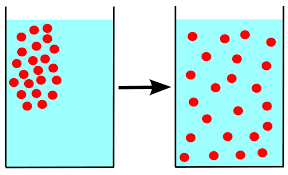
What is diffusion?
a)
when molecules move from a low concentration to a high concentration 
b)
when molecules move from a high concentration to a low concentration.
c)
no movement 
d)
molecules move everywhere
68.
Where is there a high concentration of water?
a)
in the flower
b)
cannot be determined by picture.
c)
in the vase
d)
in the leaves
69.

The picture below is an example of _________________.

a)

osmosis

b)

isotonic

c)

diffusion

d)

active transport

70.
Osmosis is the movement of _____ across a membrane.
a)
food
b)
energy
c)
oxygen
d)
water
71.
_______ regulates what enters and leaves a cell.  
a)
Cell Membrane
b)
Nucleus
c)
Mitochondria
d)
Cytoplasm
72.
What is the definition of Osmosis?
a)
the movement of WATER molecules across the cell membrane.
b)
the state where molecules are equally concentrated (balanced) on both sides of the cell membrane.
c)
the process that brings LARGE particles INTO the cell through the cell membrane
d)
he movement of molecules across the cell membrane that REQUIRES ENERGY output from the cell
73.
An animal cell placed in a hypertonic (salty) solution will
a)
Shrink
b)
Swell
c)
Stay the same
74.
Just like Coke is a type of soda, __________ is a type of ___________.
a)
diffusion, osmosis
b)
concentration, equilibrium
c)
equilibrium, concentration
d)
osmosis, diffusion
75.
A person would never have pure water put into their veins in a hospital because their cells would...
a)
Shrink/Dehydrate
b)
Expand
76.
A person should never drink salty water because their cells would
a)
shrink
b)
expand
77.
True or false, diffusion is passive.
a)
True
b)
False
78.
What is diffusion?
a)
when molecules move 
b)
when molecules move from a high concentration to a low.
c)
no movement 
d)
molecules move everywhere