
 Worksheets
End of 3rd Nine Weeks Test 2017
Total questions: 80
Worksheet time: 1hrs 10mins
Name
Class
Date
1.

A red winged bird of some kind has made a nest in the garage of Cole’s house. This bird is unlike any other that has been seen in this area and is acting very strange when people get near its nest. What type of scientist would be the best help for Cole’s family in identifying the bird?
a)
Ichthiologist
b)
Ornithologist
c)
Astronomer
d)
Botanist
2.

A strange species of fish is being caught off the coast of Georgia. No one who has caught this fish has been able to identify it. Fishermen should take fish to a(n) __________________ to help them identify what type of fish they are catching.
a)
Ornithologist
b)
Ichthyologist
c)
Botanist
d)
Astronomer
3.

Scientist who specialize in studying insects are called _____________.
a)
Botanist
b)
Entomologist
c)
Hematologist
d)
Lepidopterist
4.
After completing an experiment, all chemical wastes should be
a)
taken home
b)
dumped in the sink
c)
disposed of according to your instructor’s directions
d)
left at your lab station for the next class
5.
Approved eye protection devices (such as goggles) are worn in the laboratory
a)
to improve vision
b)
only if you don't wear glasses
c)
ALWAYS! Especially when heat, chemicals or glasswear is involved.
d)
to avoid eye strain
6.

Perform only ______________________
a)
safe experiments
b)
experiments authorized by your teacher
c)
if you are a good actor
d)
experiments that cause FIRE!!!
7.
What is the MOST important part of the lab experiment?
a)
Having Fun
b)
Getting the Correct Answer
c)
Safety
d)
Looking Cool in Your Safety Goggles
8.

The proper technique for smelling chemicals is ______________
a)
Keeping your nose close to the glassware
b)
WAFT it toward your nose
c)
to sniff only a small amount
d)
Trick question; you never are allowed to smell chemicals in class
9.

Name the tool pictured
a)
scalpel
b)
Pipette
c)
Tweezer
d)
Forceps
10.

What is measured with a graduated cylinder?
a)
Passage of time
b)
Distance from one thing to another
c)
Weight of an object
d)
Volume of liquid
11.

The name of the liquid measurement line that is read when finding the volume of a liquid is called?
a)
Center Line
b)
Interval
c)
Meniscus
d)
Mid-Line
12.

The volume of the mysterious liquid in the graduated cylinder is _________.
a)
21 mL
b)
17 mL
c)
19 mL
d)
30 mL
13.
During an experiment in science lab Jesse collected the temperature of a liquid as it changed colors. His temperature measurements are as follows:
56 F, 67 F, 82 F, 94 F, 106 F
What was the range of temperatures the liquid was exposed to?
56 F, 67 F, 82 F, 94 F, 106 F
What was the range of temperatures the liquid was exposed to?
a)
24 F
b)
96 F
c)
64 F
d)
50 F
14.
Convert 7,000 g to ____ kg
a)
70
b)
700
c)
7
d)
0.07
15.
Convert 285 mg = ____ g
a)
285,000
b)
0.285
c)
2,850
d)
28,500
16.
All organisms are made of small building blocks called _________.
a)
Chemicals
b)
Atoms
c)
Cells
d)
Molecules
17.
A unicellular organism is
a)
composed of many cells
b)
composed of one cell
c)
made of many proteins
d)
harmful to only plants
18.
A multicellular organism is
a)
composed of many cells
b)
composed of one cell
c)
composed of water
d)
harmful to only plants
19.

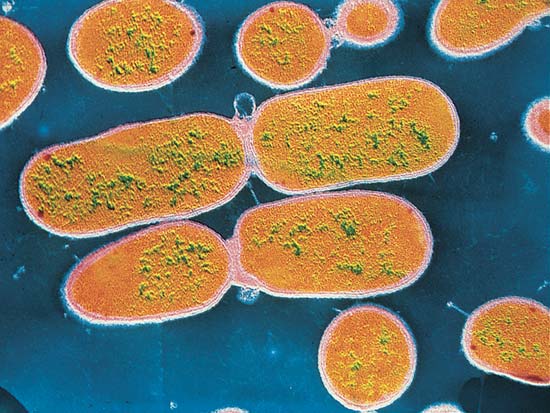
What type of cell is pictured here?
a)
Prokaryoic, because there are few internal structures and no nucleus.
b)
Eukaryotic, because there are many internal structures and a flagellum.
c)
Prokaryotic, because there are many internal structures and a nucleus.
d)
Eukaryotic, because thera er few intarnal structures adn no nucleus.
20.
The offspring from asexually reproduced organisms are?
a)
Different than their parents
b)
Identical to parents
c)
Like a combination from both parents
d)
A different species
21.
If two organisms reproduce sexually, then their offspring will exhibit a genetic makeup that is -
a)
identical to only one parent
b)
identical to all of its siblings
c)
a unique combination of traits
d)
the recessive traits of each parent
22.

An asexual offspring needs:
a)
Fertilization
b)
Some fertilization
c)
Wings to fly
d)
No fertilization
23.

Which of the following scientists contributed to the cell theory?
a)
Redi, Robert Hooke, Anton van Leuwenhoek
b)
Matthais Schleiden, Theodor Schwann, Rudolf Virchow, Robert Hooke, Anton Van Leeuwenhoek
c)
Pasteur, Theodor Schwann, Anton von Leuwenhoek
d)
Einstein, Matthais Schleiden, Robert HookeOption
24.
Anton van Leeuwenhoek made his own version of the microscope and discovered something very odd when he looked a the gunk on his teeth. What did he discover?
a)
Cells
b)
Bacteria
c)
Cavities
d)
Influenza
25.
Matthis Scheliden and Theodore Schwann contributed to Cell Theory by...
a)
looking at cork and coming up with the term "cell".
b)
observing unicellular organisms moving underneath a microscope.
c)
concluding that plants and animals are non-living.
d)
concluding that plants and animals are made up of cells.
26.
Enhanced Compound Microscope
Observed Cork
Coined the term "Cells"
The contributions to cell theory in the box above were discovered by?
Observed Cork
Coined the term "Cells"
The contributions to cell theory in the box above were discovered by?
a)
Anton Van Leuwenhoek
b)
Matthias Scheliedn
c)
Theodore Schwann
d)
Robert Hooke
27.

Which of the following statements is not part of the cell theory?
a)
Cells are the basic unit of structure and function in all living things.
b)
All cells are produced from other cells.
c)
Only animal cells are composed of cells.
d)
All living things are composed of cells.
28.
An accepted scientific idea in the 1700's that stated nonliving things could produce living organisms.
a)
Cell Theory
b)
Spontaneous Generation
c)
Law of Cells
d)
Cellular Respiration
29.

What is one way in which all living things on Earth are alike?
a)
All living things have hair.
b)
All living things are made of cells and come from other cells.
c)
The cells of all living things have chloroplast.
d)
All living things can move.
30.
A cell that has very few internal structures; creates simple organisms; circular DNA; no nucleus.
a)
Prokaryotic Cell
b)
Eukaryotic Cell
31.
A cell that has many internal structures; a membrane bound nucleus; spiral DNA; and creates complex organisms.
a)
Prokaryotic
b)
Eukaryotic
44.
Under a microscope, a student observes a specimen containing a cell wall, nucleus, and chloroplasts. Which of the following could the specimen being observed belong to?
a)
oak tree leaf
b)
human
c)
bacteria
d)
cat hair
33.
Ribosome's are different from other organelles, because they.....
a)
lack protein
b)
are found in more than one place in a cell
c)
lack a nucleus
d)
have an abundance of water
34.
Trion football players are very muscular. Muscles use large amounts of energy (ATP). Which cell organelle will be most important in the "Bulldog Muscle Cells"?
a)
Chromosomes
b)
Ribosomes
c)
Mitochondria
d)
Cytoplasm
35.
In an animal cell, the largest organelle is?
a)
Vacuole
b)
Nucleus
c)
Ribosome
d)
Cytoplasm
36.
Selectively permeable barrier that controls what enters and leaves the cell.
a)
cell membrane
b)
cell wall
c)
cytoskeleton
d)
rough ER
37.
In an animal cell the vacuoles are.....
a)
Smaller, but many are found
b)
Larger than the nucleus
c)
Exactly the same as a plant cell
d)
Smaller, but fewer than a plant cell
38.
Both plant and animal cells are considered to be........
a)
Prokaryotic
b)
Eukaryotic
c)
Simple
d)
Non-membrane bound
39.
When an organism has the ability to maintain stable internal conditions it is considered to be at ___________.
a)
Homeostasis
b)
Full Growth
c)
Full Development
d)
Hungry
40.
Produces energy in the form of ATP for the cell.
a)
chloroplast
b)
mitochondria
c)
ribosome
d)
nucleus
41.
Modifies, collects, & packages proteins.
a)
smooth ER
b)
golgi bodies
c)
ribosome
d)
rough ER
42.
The only organelle in the cell that makes proteins and is floating freely in the cytoplasm and on the rough endoplasmic reticulum.
a)
nucleus
b)
mitochondria
c)
vacuole
d)
ribomsome
43.
Stores materials such as WATER, salts, proteins, & carbohydrates.
a)
ribosome
b)
lysosome
c)
vacuole
d)
endoplasmic reticulum
44.
Under a microscope, a student observes a specimen containing a cell wall, nucleus, and chloroplasts. Which of the following could the specimen being observed belong to?
a)
oak tree leaf
b)
human
c)
bacteria
d)
cat hair
45.
Unlike animal cells, plant cells have __________ and __________ and ____________.
a)
chloroplasts, cell walls, mitochondria
b)
chloroplasts, cell walls, large vacuoles
c)
circular shape, chloroplasts, vacuoles
d)
chloroplasts, cell walls, circular shape
46.
Diffusion is the movement of molecules from an area of higher concentration to an area of lower concentration.
a)
True
b)
False
47.
What is equilibrium?
a)
When concentrations cannot be balanced between two substances
b)
When concentrations are balanced between two substances
c)
Making the energy in the top half of your body equal the the energy in the bottom half
d)
Concentrations do not exist
48.

Analyze the diagram to determine how many Carbon molecules (diamond) need to move to reach equilibrium?
a)
A net of 2 molecules move inside the cell.
b)
A net of 2 molecules move outside the cell.
c)
There is no net movement because the molecules are at equilibrium.
d)
The molecules do not move.
49.

Analyze the diagram to determine which way will the water molecules move during osmosis?
a)
Out of the cell, so the cell shrinks.
b)
Out of the cell, so the cell swells.
c)
Into the cell, so the cell shrinks.
d)
Into the cell, so the cell swells.
50.
Passive and Active Transport are used to help cells _______.
a)
Reproduce
b)
Grow
c)
Die
d)
Communicate
51.

The cell below is in a _____________ solution.
a)
Hypertonic
b)
Hypotonic
c)
Isotonic
52.

This process is known as (leaving the cell)
a)
phagocytosis
b)
endocytosis
c)
exocytosis
d)
osmosis
53.
Controlling what goes into or out of the cell with the help of energy is called
a)
active transport
b)
endocytosis
c)
passive transport
d)
exocytosis
54.
The circulatory system works with the ___________ system to provide our body with oxygen.
a)
respiratory
b)
digestive
c)
muscular
d)
skeletal
55.
The circulatory system works with the __________ system to obtain energy from nutrients that we eat.
a)
respiratory
b)
digestive
c)
skeletal
d)
nervous
56.
The main purpose of the muscular system is to ___________.
a)
To help with movement of the body.
b)
To help with digesting food.
c)
To help with breathing.
d)
To help with removing fluids.
57.

A body system that controls and coordinates all body activities through electric impulses/messages between brain, spinal cord and nerves.
a)
endocrine system
b)
nervous system
c)
nerve
d)
neuron
58.

Choose the order of blood vessels in the body from largest to smallest.
a)
Capillaries
Arteries
Veins
Arteries
Veins
b)
Veins
Capillaries
Arteries
Capillaries
Arteries
c)
Veins
Arteries
Capillaries
Arteries
Capillaries
d)
Arteries
Veins
Capillaries
Veins
Capillaries
59.
Which sequence lists the levels of organization in the human body from simplest to most complex?
a)
organ system → tissue → cell → organ
b)
tissue → cell → organ → organ system
c)
organ → organ system → tissue → cell
d)
cell → tissue → organ → organ system
60.

USE DIGESTIVE SYSTEM DIAGRAM
Looking at the diagram, letter A corresponds to which organ in the Digestive System?
Looking at the diagram, letter A corresponds to which organ in the Digestive System?
a)
Mouth
b)
Gallbladder
c)
Esophagus
d)
Small Intestine
61.

USE DIGESTIVE SYSTEM DIAGRAM
The pancreas is represented by which letter?
The pancreas is represented by which letter?
a)
A
b)
B
c)
C
d)
D
62.

USE DIGESTIVE SYSTEM DIAGRAM
Looking at the diagram above, letter B corresponds to which organ in the Digestive System?
Looking at the diagram above, letter B corresponds to which organ in the Digestive System?
a)
Stomach
b)
Liver
c)
Pancreas
d)
Large Intestine
63.

USE DIGESTIVE SYSTEM DIAGRAM
The Rectum is represented by which letter?
The Rectum is represented by which letter?
a)
A
b)
B
c)
C
d)
D
64.

USE RESPIRATORY SYSTEM DIAGRAM
Which of the following letters corresponds to the trachea?
Which of the following letters corresponds to the trachea?
a)
A
b)
B
c)
C
d)
D
65.

USE RESPIRATORY SYSTEM DIAGRAM
Letter D represents which major organ in the Respiratory System?
Letter D represents which major organ in the Respiratory System?
a)
Lungs
b)
Diaphragm
c)
Bronchi
d)
Pharynx
66.

USE RESPIRATORY SYSTEM DIAGRAM
The lungs correspond to which letter?
The lungs correspond to which letter?
a)
A
b)
B
c)
C
d)
D
67.

USE EXCRETORY SYSTEM DIAGRAM
The diagram includes all of the following except ________.
The diagram includes all of the following except ________.
a)
Bladder
b)
Kidney
c)
Urethra
d)
Appendix
68.

USE EXCRETORY SYSTEM DIAGRAM
Which of the following correctly labels the excretory system diagram?
Which of the following correctly labels the excretory system diagram?
a)
A. Kidney
B. Bladder
C. Ureters
D. Urethra
B. Bladder
C. Ureters
D. Urethra
b)
A. Kidney
B. Urethra
C. Ureters
D. Bladder
B. Urethra
C. Ureters
D. Bladder
c)
A. Kidney
B. Ureters
C. Bladder
D. Urethra
B. Ureters
C. Bladder
D. Urethra
d)
A. Urethra
B. Bladder
C. Brain
D. Rectum
B. Bladder
C. Brain
D. Rectum
69.
Active transport is the movement of ______ molecules across the cell membrane using a _____ _____.
a)
large, transport protein
b)
small, osmosis
c)
large, tunnel
d)
small, diffusion
70.
If you looked at red blood cells under a microscope and saw that several of the blood cells had burst, what would you say happened?
a)
The cells were placed in a hypotonic solution.
b)
The cells were placed in a hypertonic solution.
c)
The cells were placed in an isotonic solution.
71.
In nature you will find that if one factor is changed or removed………………..
a)
The other factors are not affected in any way.
b)
Only the biotic factors are affected.
c)
Only abiotic factors are affected.
d)
All factors in an ecosystem are affected when one thing is increased or decreased.
72.
A herd of rhinos live in an area of the savanna that has a carrying capacity of 25. What could happen if 7 additional rhinos immigrated into the existing herd?
a)
There will be enough food, water, and shelter for all of the rhinos.
b)
There will be no change in the ecosystem from the original 25 rhinos.
c)
The food, water and shelter will be limited and could cause emigration and competition.
d)
The rhinos will have to immigrate and leave the existing savanna.
73.
Eco: _________::logy: ___________
a)
The study of: life
b)
Not/against: life
c)
Home: The study of
d)
Life: Not/Against
74.
A group of the same species living in an ecosystem is referred to as a ____________.
a)
Community
b)
Population
c)
Ecosystem
d)
Organism
75.
All of the different BIOTIC factors in an ecosystem.
a)
Community
b)
Population
c)
Ecosystem
d)
Organism
76.
A particular ecosystem has seen an increase in temperature and rainfall. The population of chipmunks is decreasing in number because of death and emigration. Which of the following would be examples of limiting factors?
a)
Increase in Temerature
b)
Increase in Rainfall
c)
Chipmunks
d)
Both Increase in Temperature and Increase in Rainfall
77.
An environment that contains water, fish, turtles, sand, rocks and oxygen is considered to be a(n).
a)
Organism
b)
Population
c)
Community
d)
Ecosystem
78.
A single black widow spider could be classified at what level of ecological organization?
a)
Population
b)
Organism
c)
Community
d)
Ecosystem
79.
What could possibly be a result of decreasing a population of vultures in a desert ecosystem?
a)
The vultures prey population will increase.
b)
The vulture prey population will decrease.
c)
The vulture prey population will stay the same.
d)
The amount of rainfall in increase in the desert with no vultures.
80.
The parts of an ecosystem that are currently living or that have once lived.
a)
Biotic Factor
b)
Abiotic Factor
c)
Species
d)
Biome
100 %

