
 Worksheets
Mechanisms of Genetics
Total questions: 80
Worksheet time: 3hrs 56mins
A mutation that occurs in the gametes of an organism will most likely be transferred to which of the following?
The siblings of the organism
The offspring of the organism
The other organisms living nearby
The mating partner of the organism

What is the purpose of this process?
To replicate the DNA of an organism before cell division
To assemble nucleotides in an mRNA chain along a DNA template
To synthesize amino acids used to unzip strands of DNA and copy the genetic code
To translate the genetic code into a specific sequence of amino acids

What characteristic is shared by all four cells?
A mechanism for transforming sunlight into energy
Self-locomotion
Membrane-bound organelles that transport substances
Genetic material composed of DNA

Which DNA strand is complementary to the one shown above?


The process represented in the diagram produces a molecule that is complementary to the template strand of DNA. What type of molecules is produced.
New DNA
Polypeptide
Messenger RNA
Carbohydrate

What causes this change in fur color?
The alleles for fur color change as the arctic fox grows older.
Gene expression for fur color is regulated by latitude.
The arctic fox has two traits for fur color that are determined at birth.
Gene expression for fur color is regulated by temperature.

Which process and product are represented in Diagram 2
Process: transcription; product: mRNA
Process: translation; product: protein
Process: replication; product: tRNA
Process: recombination; product: polymerase

The chart shows a dihybrid cross between pea plants. What are the genotypes of the parents in this cross?
RRyy and rrYY
RrYy and RrYy
RRYY and rryy
RrYY and Rryy
In guinea pigs, the allele for a rough coat (R) is dominant over the allele for a smooth coat (r). A guinea pig with a rough coat is mated with a guinea pig with a smooth coat. Of the three offspring, 1 has a smooth coat. What is the probability that their next offspring will have a smooth coat?
0%
25%
50%
75%

The genotypes of four offspring are shown in the table. If one parent’s genotype is xx, what is the genotype of the second parent?
xx
XX
Xx
xX

Which of the following best describes the process that diagram 2 represents?
cell division that occurs in reproductive structures of an organism
process prior to the first stage of cell division
occurs in all cells of the body system
cell division that occurs in the repair process of damaged skin cells

A sequence of a DNA template strand is shown below.
3’ TCC AAT GGC TTA TTT GCA 5’
Which of these is the correct amino acid chain produced from the DNA template strand
Arginine - Leucine - Proline - Asparagine - Lysine - Arginine
Tryptophan - Phenylalanine - Leucine - Glycine - Asparagine - Phenylalanine
Serine - Leucine - Proline - Asparagine - Lysine - Arginine
Tryptophan - Phenylalanine - Leucine - Glycine - Asparagine - Serine

In cattle the allele for cloven hooves (H) is dominant over the allele for mule-foot hooves (h). The phenotype for each trait is shown in this picture. What is the probability of cloven hooves in the offspring of parents that are heterozygous for the trait?
25%
50%
75%
100%
Which part of a DNA molecule is responsible for the direct coding of specific traits in an organism?
The number of hydrogen bonds that hold the strands of DNA together.
The number of carbons in the DNA molecule.
The sequence of nucleotide bases in the DNA molecule.
The sequences of phosphates along each DNA strand.
In a Punnet Square, which letter is used to represent the recessive allele?
Capital letter
Lower-case letter

If the 2 alleles of a trait are the same, the individual is ______.
Homozygous
Heterozygous

If the 2 alleles of a trait are different, the individual is ______.
Homozygous
Heterozygous
In pea plants, tall is dominant over short. If a pea plant's genotype is Tt, what is it's phenotype?
tall
short
medium
tiny

Complete this Punnet Square : Tt x tt (T=tall; t=short). What is the percentage of tall plant offspring?
0%
25%
50%
100%

Complete this Punnet Square: RR x Rr (R=round seeds; r=wrinkled seeds). What is the percentage of wrinkled seed plant offspring?
0%
25%
50%
75%

What is the correct order to make a protein?
Protein, DNA, RNA
RNA, DNA, Protein
DNA, RNA, Protein
Protein, RNA, DNA
RNA has what base that is instead of thymine?
guanine
adenine
thymine
uracil
What is the building block of the biomolecule, Nucleic Acid?


What are the three main parts of a nucleotide?
carbon, hydrogen, and oxygen
phosphate, sugar, and nitrogen base
phosphate, sulfate, and nitrate
adenine, thymine, and uracil

What type of mutation is shown in the diagram?
substitution
insertion
deletion
no change

A model of a DNA molecule is shown below.
The arrow indicates —
the bond between adjacent phosphate and deoxyribose molecules
the junction of introns and exons in the sense strand of DNA
the hydrogen bond between complementary nucleotides
the junction of a codon and a DNA triplet
A mutation that occurs in the gametes of an organism will most likely be transferred to which of the following?
The siblings of the organism
the offspring of the organism
The other organisms living nearby
The mating partner of the organism

Using the codon chart, which of the following polypeptides is coded for by the mRNA sequence 5’ AUG GUU AAA CGA CAA UCC 3'
Val, Lys, Phe, Gly, Ser, Met
Met, Asp, Phe, Ala, Arg, Ser
Met, Val, lys, Arg, Gln, Ser
Ile, Gln, Lys, Asp, Gly, Ser

How is information for a specific protein carried on the DNA molecule?

GAT-TAC-AGA-TTA-CAT?
ATCGTA


The mutated DNA segment is TTCGCAAG. This is an example of ___ mutation.
GAG-CTC-GAC-AGA
Mutant
GAG CTC-CAC-AGA
T-G-A-C-C-A
T-G-A-G-C-A
Mutation: ATC GCAT
What mutation occurred?
Meiosis starts with one cell and ends with...
one
two
three
four

The striped gray shape represents...
sugar
nitrogen base
phosphate
nucleotide
Together a phosphate, sugar, and nitrogen base make a...
chromosome
gene
base pair
nucleotide

Mutations that effect gametes and that will be passed on
to the next generation
Genetic change
Protein synthesis
Apoptosis
Cell membrane
What is the order for Protein Synthesis?
Transcription -> Translation -> Protein
Translation - > Transcription -> Protein
Protein -> Transcription -> Translation
Translation -> Protein -> Transcription


A parent that has a mutation to their skin cells can pass this mutation to their offspring
True
False
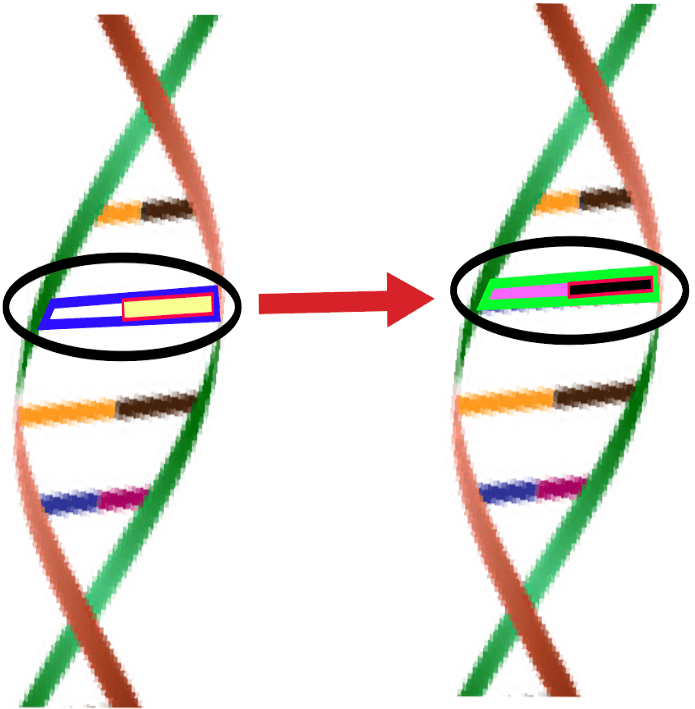
A permanent change in the DNA sequence
which can affect a single gene or group of genes
Homeostasis
Somatic Cell
Chromosomal Mutation
Gene Mutation
What is a type of Mutation?
Deletions
Insertions
Substitutions
All of the Above
How does DNA in cells determine an organism's complex traits?
DNA contains codes for proteins, which are necessary for the growth and fucntions of an organism
DNA separates into long single strands that make up each part of an organism
DNA produces the energy an organism needs in order to grow
DNA fold into the nucleus of each of the cells of an organism

Students are given data from an investigation that identified some of the chemicals present in four different samples as seen in the image. Which sample was most likely DNA?
Sample 1
Sample 2
Sample 3
Sample 4

Four types of cells are shown. Which characteristic is shared by all four cells?
A mechanisms for transforming sunlight into energy
Self-Locomotion
Membrane-bound organelles that transport substances
Genetic Material composed of DNA

A model of DNA is shown. The arrow indicates-
the bond between adjacent phosphate and deoxyribse molecules
the junction of introns and exons
the hydrogen bond between complementary nucleotides
the junction of a codon and a DNA triplet

Which process and product are represented in the diagram below?
Process transcription; product DNA
Process translation; product tRNA
Process transcription; product mRNA
Process translation; product mRNA

Which process and product are represented in the diagram?
process translation; product mRNA
Process transcription; product protein
Process transcription; product mRNA
Process translation; product protein
When gene expression occurs
A gene is mutated with either an insertion or deletion
The gene is removed from the genotype in that cell
The gene is passed on to the daughter cells during mitosis
The gene is activated and used in protein synthesis
Where are proteins made?
muscles
nucleus
outside the nucleus in the cytoplasm
Where is DNA and RNA made?
nucleus
cytoplasm
mitochondria
ER

What is the purpose of this cellular process?

