
 Worksheets
Post test Review 2017
Total questions: 76
Worksheet time: 1hrs 14mins
Name
Class
Date
1.
Which of the following properties is a physical property?
a)
magnetism
b)
reactivity with oxygen
c)
flammability
d)
non-reactive
2.

this is an example of?
a)
physical property
b)
chemical property
3.
Flammability is an example of what property?
a)
Chemical property
b)
Physical property
4.
What kind of properties can only be observed when a substance changes into a different substance?
a)
physical properties
b)
chemical properties
c)
liquid properties
d)
real properties
5.
Diamonds are capable of cutting glass
a)
Chemical Property
b)
Physical Property
6.
Water boils at 100 degrees celcius
a)
Physical Property
b)
Chemical Property
7.

What is the order of succession shown in this figure?
a)
A, B, C, D
b)
B, A, D, C
c)
C, D, A, B
d)
D, A, B, C
8.
A garden was cleared out, but had to be left alone for a month. What would you expect to see?
a)
lichens and mosses
b)
grasses and weeds
c)
a fully blossomed garden
d)
bushes and small trees
9.
What is Ecological Succession?
a)
Competition between plants in a society
b)
A natural disaster such as a flood or fire
c)
The cycle of a tomato plant
d)
The change an ecosystem experiences over time
10.

What is the difference between biotic and abiotic?
a)
Biotic are non-living things
b)
Abiotic are living organisms
c)
Biotic is life,
Abiotic is non-living
Abiotic is non-living
d)
Biotic is non-living, Abiotic is living
11.

How would the biodiversity of this ecosystem be affected if the lantern fish disappeared?
a)
The ocean sunfish population would increase.
b)
The large shark population would die out.
c)
The squid would die out.
d)
There would be no change.
12.
Biodiversity is the variety of ________ in a community.
a)
genes
b)
population
c)
species
d)
community
13.

A place where plants and animals live and grow naturally is called a ______________.
a)
shelter
b)
tree
c)
habitat
d)
organism
14.
After a volcanic eruption, lava covers the land. What is the order that plants grow to repopulate the area?
a)
Lichens → Shrubs → Grasses → Trees
b)
Lichens → tree → shrubs→Grasses
c)
Grasses → Lichens → Shrubs → Trees
d)
Lichens → Grasses → Shrubs → Trees
15.
A population of small fish and a population of small squids eat the same type of krill (a type of plant) in the same ecosystem. Krill is the main source of food for both the fish and squid. If the squid grows faster than the fish population, what will most likely happen to the fish population?
a)
The fish population will stay the same size.
b)
The fish population will start to grow faster.
c)
The fish population will get smaller or even die out.
d)
The fish population will start to eat more krill than the squids.
16.
All of the living AND non-living things in an particular area is called a(n):
a)
ecosystem
b)
house
c)
community
d)
mountain
17.
When 2 or more individuals or populations try to use the same resource such as food, water, shelter or sunlight.
a)
Coexistence
b)
Competition
c)
Cooperation
d)
Carrying Capacity
18.
Inherited variation means...
a)
an animal produces a large number of offspring.
b)
some individuals die from starvation, competition, disease or predation.
c)
individuals have different traits.
d)
individuals best adapted to the environment have many offspring.
19.
Natural selection is best described as...
a)
The ability to generate new adaptations that better suit the species.
b)
The mechanism that leads to perfect species.
c)
Variations of traits causes those better suited to the environment to survive and reproduce.
d)
Causing the death of a significant part of the population.
20.
The ability to survive and reproduce.
a)
Adaptation
b)
Trait
c)
Fitness
d)
Variation
21.
Any variation that can help a species survive in a given environment is called...
a)
an adapatation
b)
a characteristic
c)
a homologous structure
d)
a vestigial structure
22.
Polar bears have compact ears, a small tail, and thick fur to keep themselves warm. Are these examples of physical (structural) or behavioural adaptations?
a)
Physical
b)
Behavioural
23.
Lions often hide in the tall grass while stalking their prey. This is an example of...
a)
camouflage
b)
warning coloration
c)
mimicry
d)
hibernation
24.
How would warmer temperatures affect polar bears?
a)
there would be more ice. so hunting would be easier
b)
there would be less ice, so, hunting would be easier
c)
there would be more ice, so hunting would be harder
d)
there would be less ice, so hunting would be harder
25.
Which organisms are most likely to survive?
a)
the best adapted
b)
the fastest
c)
the strongest
d)
the most domesticated (tamed)
26.
Do organisms "decide" to evolve and change?
a)
Yes, they know they need to change to survive
b)
No, they change because of natural selection
27.

What is the volume of Object X?
a)
10.0 cm3
b)
15.0 cm3
c)
20.0 cm3
d)
25.0 cm3
28.
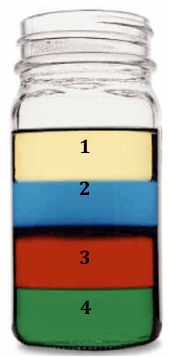
Put the liquids in order from most dense to least dense?
a)
4, 3, 2, 1
b)
1, 2, 3, 4
c)
3, 4, 2, 1,
d)
4, 3, 1, 2
29.
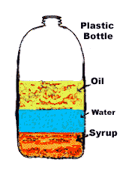
Which liquid is the least dense?
a)
oil
b)
water
c)
syrup
d)
plastic bottle
30.

Which box has a higher density?
a)
Box A
b)
Box B
c)
cannot be determined
d)
they are the same
31.

What is the volume of the fish?
a)
18.0 cm3
b)
6.0 cm3
c)
38.0 cm3
32.
True or False: The density of a specific type of material never changes.
a)
True
b)
False
33.
Which lab tool might you use to measure the volume of a liquid?
a)
electric scale
b)
bunsen burner
c)
test tube
d)
graduated cylinder
34.

Mr. Krabbs is trying a new money making scheme. On Tuesdays he is selling his crabby patties on colored buns. He usually averages 25 customers per day. On Tuesdays he now averages 27 customers.
What was the control variable?
What was the control variable?
a)
The customers
b)
The crabby patty
c)
The colored buns
d)
The number of customers
35.

Mr. Krabbs is trying a new money making scheme. On Tuesdays he is selling his crabby patties on colored buns. He usually averages 25 customers per day. On Tuesdays he now averages 27 customers.
What was the independent variable?
What was the independent variable?
a)
The customers
b)
The crabby patty
c)
The colored buns
d)
The number of customers
36.
How many independent variables can be tested in a controlled experiment?
a)
one
b)
two
c)
three
d)
as many as possible
37.
What is the group in an experiment that receives treatment with the independent variable?
a)
control group
b)
experimental group
c)
constant group
d)
variation group
38.
What is the Scientific Method?
a)
The steps to making an experiment.
b)
The steps to making proving your hypothesis is right.
c)
Don't know.
d)
The six steps to making an experiment.
39.
When writing your hypothesis, what information follows IF?
a)
dependent variable
b)
how you know it will happen
c)
independent variable
d)
anything
40.
This part of the experiment serves as a basis of comparison; the one variable being tested has been omitted (left out).
a)
experimental group
b)
control group
c)
data
d)
variables
41.
The summary at the end of an experiment that explains the results.
a)
conclusion
b)
procedures
c)
materials
d)
responding variable
42.
What step does every scientific experiment begin with?
a)
hypothesis
b)
question/problem
c)
procedures
d)
conclusion
43.
Why do scientist use the scientific method?
a)
To make sure they get credit for their discoveries.
b)
To make sure their results are valid and can be performed by other scientists.
c)
So that other scientist don't get mad at them
44.

Free stickers are being given away at Carmela's school basketball game tonight. Carmela will choose one sticker from the bag without looking. What color of sticker is Carmela most likely to take from the bag?
a)
orange
b)
red
c)
blue
d)
yellow
45.
What can a hypothesis NOT be?
a)
If, Then, Because Statement
b)
An Inference (reasonable prediction)
c)
Statement that has to be true
d)
An educated guess
46.
Which of these are NON-RENEWABLE energy sources?
a)
Wind, solar, oil
b)
Oil, natural gas, geothermal
c)
Oil, coal, nuclear
d)
Nuclear, geothermal, coal
47.
During the past century, average temperatures on Earth have ______________.
a)
Increased
b)
Decreased
c)
Stayed the same
48.
During the past century, carbon dioxide (CO2) in the air has ______________.
a)
Stayed the same
b)
Decreased
c)
Increased
49.
What is the difference between Renewable and Non-renewable energy sources?
a)
Renewable energy is energy that is used only once, and non-renewable energy can be used over and over again
b)
Non-renewable energy is energy that is used only once, and renewable energy can be used over and over again
c)
There is no difference
d)
Non-renewable energy is cheap energy and renewable energy is expensive energy
50.
Which of these are FOSSIL fuels?
a)
Oil, natural gas and solar
b)
Wind, coal and gas
c)
Biomass, wind and geothermal
d)
Oil, natural gas and coal
51.
What is a fuel?
a)
Anything that makes electricity
b)
Anything that makes energy
c)
Anything that burns to make energy
d)
Anything that makes light
52.
The process that keeps Earth warm when gases in Earth’s atmosphere trap heat energy from the sun is called the ______________.
a)
Glasshouse Effect
b)
Greenhouse Effect
c)
Ozone Effect
d)
Methane Effect
53.
What does carbon footprint mean?
a)
how much carbon is in the air
b)
how much carbon is in the ground as fossil fuel
c)
how much carbon is used by a person, town, city, country, etc
54.
Which of the following are the FOUR VITAL SIGNS of Earth's climate health?
a)
CO2, Methane, Sea Level Change, Ice Changes
b)
CO2, Temperature, Sea Level Change, Ice Changes
c)
Sea level, CO2, Temperature , Methane
55.
Which of the following actions can reduce your impact on the climate?
a)
Ride a bike to school or work
b)
Leaving the lights on all the time
c)
Going on an airplane every year
56.
These gases trap and hold energy of the sun in the atmosphere around the Earth and heat it.
a)
Global Warming
b)
Global Climate Change
c)
Greenhouse Gases
d)
Fossil Fuels
57.
How do most animals get the carbon they need to survive?
a)
Photosynthesis
b)
Respiration
c)
Eating Plants
d)
Transpiration
58.
Which of the following options would be the most reasonable change that could result from an increase in the burning of fossil fuels?
a)
More trees will be chopped down
b)
There would be a global rise in temperatures
c)
Ecosystems would become more diverse
d)
Rates of photosynthesis would decrease.
59.

A compound is:
a)
A substance that is composed of two or more elements that are chemically bonded.
b)
A molecule formed by atoms of the same element.
c)
another word for an atom.
d)
any substance that can be spit apart.
60.

An element is made of one type of
a)
atom
b)
compound
c)
mixture
d)
molecule
61.

How many electrons does this element have?
a)
16
b)
32
c)
3p4
d)
8
62.

Where are the protons in an atom?
a)
Orbiting the nucleus
b)
In the nucleus
c)
Atoms don't have protons!
63.

Where are the neutrons in an atom?
a)
Orbiting the nucleus
b)
In the nucleus
c)
Atoms don't have protons!
64.

Where are the electrons in an atom?
a)
Orbiting the nucleus
b)
In the nucleus
c)
What's an electron?
65.

Which of these is a molecule?
a)
H2O
b)
CO2
c)
O2
d)
They all are!
66.

Which of these is an element?
a)
Water
b)
Carblon
c)
Carbon dioxide
d)
Hydrogen
67.
Water is an element
a)
true
b)
false
68.
All matter is made of what?
a)
energy
b)
atoms
c)
electrons
d)
compounds
69.
what is a solid
a)
matter that has no definite size or shape
b)
matter that has a definite size and shape
70.

Which is bigger, an atom or a molecule
a)
atom
b)
molecule
71.
Compounds are made from the atoms of two or more _______.
a)
solutions
b)
carbs
c)
mixtures
d)
elements
72.

The Aztecs and Maya Tribes of Mexico where some of the first humans to slowly change wild corn to the corn we know today. What process did these tribes use?
a)
Natural Selection
b)
Artificial Selection "Selective Breeding"
c)
Mitosis
d)
Cell Membrane
73.

Which option is the best example of environmental pressures that cause natural selection?
a)
Ranchers breeding cows
b)
Farmers creating bigger corn
c)
Climate and Predators
d)
Artificial Selection
74.

A German Shepard would probably not survive in the wild because...
a)
the dog is mixed.
b)
the dog is a product of artificial selection and not adapted for the wild.
c)
the dog is dumb.
d)
the dog is a product of natural selection and can survive in the wild.
75.

This animal is product of
a)
Natural Selection
b)
Selective Breeding
c)
Asexual Reproduction
d)
Bacteria
76.

Scientist have created larger and sweeter strawberries for humans to consume (eat). What process was used?
a)
Natural Selection
b)
Artificial Selection
c)
Cellular Respiration
d)
Environmental Natural Selection
100 %

