wayground logo

Free Printable Worksheets

NEW

Font size

S
M
L
XL
Worksheets

Ecology Test Review

Total questions: 80

Worksheet time: 1hrs 16mins

Name
Class
Date
1.
Examples of a producer
a)
frog
b)
algae
c)
worm
d)
mouse
2.
Example of a decomposer
a)
fungus
b)
mouse
c)
plants
d)
frogs
3.
What is a producer?
a)
an organism that gets energy from eating other organisms
b)
an organisms that uses sunlight to make its own food
c)
an organism that gets energy from eating dead organisms, non-living material or waste
d)
an organism that uses chemical energy to make its own food
4.
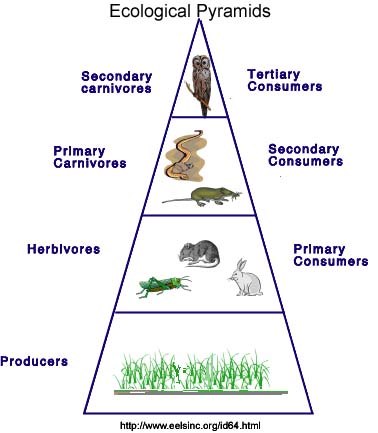
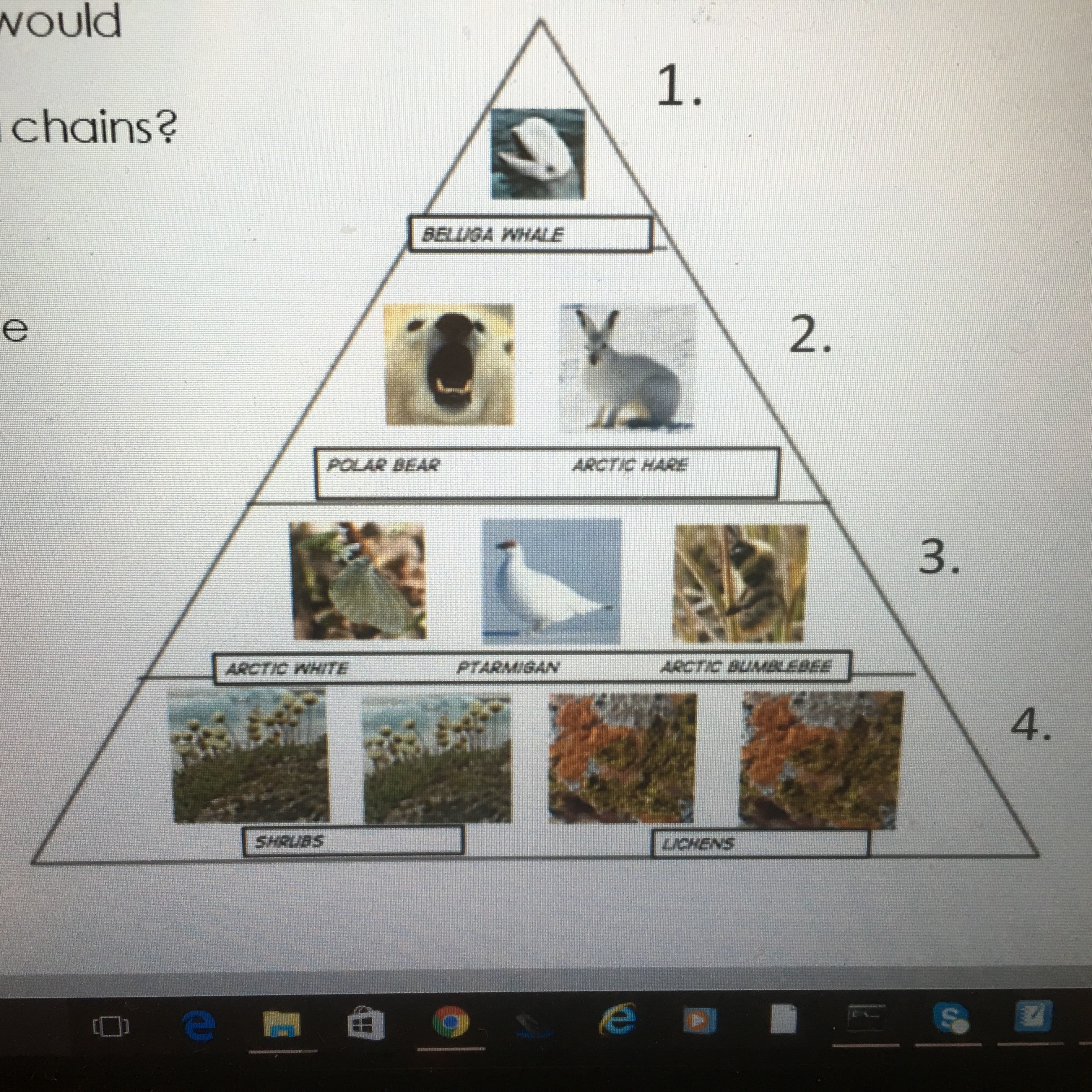
In the energy pyramid here, which organisms have the most energy available?
a)
Producers
b)
Carnivores
c)
Herbivores
d)
Top Predator
5.
In the energy pyramid below, which organism has the least amount of energy available?
a)
Producers
b)
Herbivores
c)
Carnivores
d)
Top Predator
6.
If there is 1000 Kcal available in the producers in trophic level 1, how much energy is available in the herbivores in trophic level 2?
a)
10 Kcal
b)
1 Kcal
c)
100 Kcal
d)
1000 Kcal
7.
If these organisms were arranged in a food pyramid, which organism would have the least amount of total energy available?
a)
coyote
b)
insect
c)
lizard
d)
shrub
8.
Which organism recieves the least amount of energy from the producer?
a)
Owl
b)
Grasshopper
c)
Lilypad
d)
Mouse
9.
The largest group of organisms found in a food web would be:
a)
Primary Consumers
b)
Producers
c)
Decomposers
d)
Tertiary Consumers
10.
A food pyramid represent the relative amount of energy in trophic levels. Which of the following correctly shows a food pyramid?
a)
A
b)
B
c)
C
d)
D
11.
A third-level consumer has to be which type?
a)
Carnivore.
b)
Decomposer.
c)
Producer.
d)
Herbivore.
12.
A secondary consumer 
a)
eats primary consumers
b)
eats producers
c)
eats plants
13.
Level 1 is called the _____________ trophic level. 
a)
Tertiary consumer
b)
Tertiary producer
c)
Primary consumer
d)
Primary producer
14.

How does the energy flow in an energy pyramids?

a)

up the pyramid

b)

down the pyramid

15.
Which is the smallest level of an ecosystem?
a)
organsism
b)
population
c)
community
d)
ecosystem
16.
a system of food chains that shows the transfer of energy  is termed
a)
food web
b)
food chain
c)
prey
d)
predator
17.
Biodiversity is 
a)
the variety of species within an ecosystem
b)
a large number of the same species in an ecosystem
c)
an abundant amount of the same primary consumers 
d)
the ability to have an abundant source from the same species
18.

Photosynthesis is important because...

a)

it makes carbon dioxide

b)

it makes food for the food webs

c)

it makes water

d)

it's not important

19.

What is a niche?

a)

The habitat that an organism lives in

b)

An organism’s “role” in an ecosystem

c)

A type of consumer

d)

The relationship between a producer and consumer

20.

What happens when different species try to occupy the same niche?

a)

The species compete with each other

b)

The species cooperate with each other

c)

The species coexist with each other

d)

All of the above

21.
Different populations living and interacting with each other in the same area
a)
Biome
b)
Ecosystem
c)
Community
d)
Niche
22.
A collection of organisms that make up a community as well as all of the nonliving aspects of the environment.
a)
Population
b)
Community
c)
Habitat
d)
Ecosystem
23.
The nonliving aspects of an ecosystem.
a)
Abiotic factors
b)
Biotic factors
24.
An illustration that uses arrows to show the MANY possible directions in which matter and energy can pass through the organisms in an ecosystem.
a)
Food chain
b)
Food web
c)
Energy Pyramid
d)
Succession Map
25.
Where an organism lives
a)
habitat
b)
niche 
c)
heterotrogh
d)
biosphere
26.
What does a food web represent?
a)
All connections of energy flow throughout all organisms in a habitat.
b)
The specific ways that mutualism is carried out.
c)
A single pathway or energy flow between organisms. 
d)
How carnivores get their food. 
27.
Consumer that eats plants
a)
heterotroph
b)
herbivore
c)
producer
d)
community
28.
An organism that needs to eat other organisms to obtain energy is known as a:
a)
Autotroph
b)
Producer
c)
Consumer
d)
Mutualist
29.
Barnacles grow on whales.  Whales give the barnacles a place to live but the barnacles do not help or harm the whale.  Which type of relationship is this?
a)
commensalism
b)
mutualism
c)
parasitiesm
30.
In which type of relationship do both species benefit?
a)
parasitism
b)
mutualism
c)
commensalism
31.
Which is an example of a parasitic relationship?
a)
a bee pollinates a flower
b)
a tapeworm takes nutrients from a dog
c)
an orchid lives in a tree but does not harm the tree
32.
Which is represented by all of the bullfrogs living around a pond?
a)
community
b)
habitat
c)
population
33.
Which of the following is an organism that eats only meat?
a)
herbivore
b)
carnivore
c)
omnivore
34.
Members of a species in a defined area
a)
Ecosystem
b)
community
c)
biodiversity
d)
population
35.
Consumer that eats plants
a)
heterotroph
b)
herbivore
c)
producer
d)
community
36.
What may happen if the snowshoe hare was removed from the food web pictured?
a)
The insects in the habitat would increase.
b)
The shrew population would decrease due to being only hawk food source.
c)
The willow tree population would decrease.
d)
Foxes would dies due to no food source. 
37.
In the energy pyramid here, how much of the energy in the producers gets passed to the herbivores?
a)
10%
b)
20%
c)
80%
d)
90%
38.

All of the biotic and abiotic factors.

a)

community

b)

ecosystem

c)

population

39.

Predator population lags behind prey population because......

a)

Increase in predators leads to decrease in prey

b)

Increase in predators leads to increase in prey

c)

Increase in predators leads to decrease in producers

d)

Increase in producers leads to increase in prey

40.
What is the term for each step in the transfer of energy and matter within a biological community?
a)
energy path
b)
food web
c)
trophic level
d)
food pyramid
41.
What does every food chain start with? (Even if it's not drawn or written there!)
a)
producers
b)
sun
c)
consumer
d)
decomposers
42.

What type of consumer eats plants?

a)

Herbivore

b)

Omnivore

c)

Carnivore

d)

Both herbivore and omnivore

43.

Organisms that can make their own food do so by the process of:

a)

decomposition

b)

respiration

c)

photosynthesis

d)

scavenging

44.

What statement is TRUE about the graph?

a)

The prey is the green line because there needs to be more prey than predators.

b)

The prey is the red line because there needs to be more predators than prey.

c)

The green line is the producers

d)

The red line is the producers

45.

Cellular Respiration's goal is to

a)

make water

b)

make energy

c)

make glucose

d)

make oxygen

46.
What gas is released into the air during cellular respiration?
a)
oxygen
b)
carbon dioxide
c)
water 
d)
glucose
47.

___ is the process that cells use to take energy from glucose.

a)

cellular respiration

b)

photosynthesis

c)

transpiration

d)

excretion

48.

___ is needed for cellular respiration, it is absorbed from the air.

a)

oxygen

b)

glucose

c)

carbon dioxide

d)

water

49.

What converts nitrogen gas into a usable form for plants and animals?

a)

bacteria

b)

rain

c)

fungi

d)

car exhaust

50.

Organisms that need nitrogen to survive.

a)

only plants

b)

only animals

c)

only bacteria

d)

all living things

51.

How is nitrogen "fixed" into a usable form for plants?

a)

Through action of bacteria only

b)

Through lightning only

c)

Through action of bacteria and lightning

d)

Through photosynthesis

52.

How do animals get the nitrogen they need?

a)

From the air they breathe

b)

From the water they drink

c)

From the food they eat

d)

From the sun

53.
Which of the following removes carbon from the atmosphere?
a)
Combustion
b)
Respiration
c)
Photosynthesis
d)
Death
54.
Which process converts carbon in the form of sugar into carbon dioxide gas?
a)
Bioremediation
b)
Photosynthesis
c)
Respiration
d)
Transpiration
55.
Carbon can be found in...
a)
The atmosphere
b)
Soil
c)
Fossil fuels
d)
All of the above
56.
What process occurs when coal (fossil fuel) is used for energy?
a)
Decomposition
b)
Combustion
c)
Pressurization 
d)
Respiration 
57.

How do animals get carbon?

a)

By eating plants and or other animals.

b)

They absorb it from the atmosphere.

c)

From the ground

d)

They do not get carbon from anywhere.

58.
Snow, sleet, hail, and rain are all examples of  ________________. 
a)
evaporation
b)
condensation
c)
accumulation
d)
precipitation
59.
What is it called when plants give off water vapor as a waste product?
a)
condensation
b)
evaporation
c)
sublimation
d)
transpiration
60.
What is the process during which water changes from a liquid to a gas as it heats up?
a)
Condensation
b)
Runoff
c)
Precipitation
d)
Evaporation
61.
What is the process during which water cools and turns from a gas to a liquid?
a)
Condensation
b)
Runoff
c)
Precipitation
d)
Evaporation
62.

What are factors that affect carrying capacity?

a)

Biotic only

b)

Biotic and abiotic

c)

Depends on the ecosystem

d)

Abiotic only

63.

What is carrying capacity?

a)

A condition that occurs when two or more organisms compete for the same resources within an ecological community

b)

A relationship in which two organisms are mutually dependent on each other for survivial

c)

All the biotic and abiotic factors and the interactions among them in a given area

d)

The maximum number of organisms an ecosystem can support

64.

Which statement best describes the term limiting factors?

a)

All the biotic and abiotic factors and the interactions among them in a given area

b)

A finite resource organisms in an ecosystem require

c)

The biotic and abiotic factors in an ecosystem

d)

The maximum number of organisms an ecosystem can support

65.

What happens if a population grows past its carrying capacity?

a)

The population keeps growing

b)

The population starts to die off

c)

The entire species will go extinct

d)

The carrying capacity just increases

66.

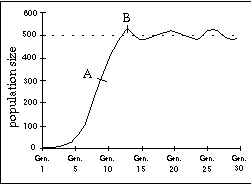
What is the carrying capacity of the graph?

a)

around 500

b)

more than 800

c)

less than 300

d)

around 700

67.

When death rate is equal to birth rate...

a)

population increases

b)

population decreases

c)

population stays the same.

d)

population rapidly increases then becomes stable

68.

Why do the populations of invasive species grow so quickly?

a)

Invasive species are native to an area

b)

Invasive species are prey to many animals

c)

Invasive species have no predators

d)

Invasive species keep the ecosystem in equilibrium

69.

Invasive species alter the ecosystem by ______ in number quickly. This leads to ______ food for the native species.

a)

increasing, less

b)

increasing, more

c)

decreasing, less

d)

decreasing, more

70.

The primary cause of the introduction of invasive species is ---

a)

too much food

b)

humans bringing them over

c)

weather events

d)

asteroids

71.

What is an invasive species?

a)

A native (naturally found) species which are added to an area

b)

A non-native (not naturally found) species added to an area

c)

A keystone species in an environment

d)

none of the above

72.

If 50 crabs were captured and marked and then released and then a few days later 25 were caught and of those 5 were marked. What would the estimate of the population be?

a)

500

b)

250

c)

75

d)

200

73.

Why do scientists use sampling techniques to gather population data?

a)

their lazy

b)

it is not possible to count an entire population

c)

it is possible to count an entire population

d)

they like to make estimations

74.

If I wanted to know how many blades of grass are inside the track, which sampling method could I use?

a)

count every blade of grass

b)

Mark a random number of blades of grass, return two days later and recapture the blades

c)

Divide the grassy area into 1 inch sections, randomly pick several sections to count, average them together and multiply that by the total square inches.

75.

Which of the following accurately describes the difference between mark recapture and quadrat sampling?

a)

Quadrat sampling is used for mobile populations and mark recapture is used for stationary populations

b)

Quadrat sampling is used for stationary populations and mark recapture is used for mobile populations

c)

Quadrat sampling can only be used for small populations

d)

Mark recapture sampling can only be used for small populations

76.

The number of organisms per unit area

a)

Density

b)

Volume

c)

Mass

77.

Factors that have an impact on the population, whether the population is large or small, growing or shrinking.

a)

Density Dependent

b)

Density Independent

78.

Factors in the environment that depends on the number of organisms in a population.

a)

Density Dependent

b)

Density Independent

79.

droughts, floods, hurricanes and fires

a)

Density Dependent

b)

Density Independent

80.

Illnesses passed from other organisms

a)

Density Dependent

b)

Density Independent