
 Worksheets
Genetics Quiz 1 Review
Total questions: 83
Worksheet time: 42mins

What is the likelihood that the offspring will be green (G)?
25%
50%
75%
100%
Dominant alleles are represented by a:
capital letter
lowercase letter

What allele combination should go in the missing box?
AA
Aa
aa
none of these
AA and Aa will both show up as ___________________ traits.
dominant
recessive

Each one of the boxes on the Punnett Square represents what percentage?
25%
1%
10%
0%

What is the likelihood that the offspring will be yellow?
0%
25%
50%
75%
Which characteristic is inherited?
hair color
sleeping late
enjoying hiking
loving to read
Traits are passed on from one living thing to another through
DNA
blood
minerals
calories
What is the likelihood that the offspring will be yellow (g)?
25%
50%
75%
100%
What is the likelihood that the offspring will be green?
0%
25%
50%
75%

What is the likelihood that the offspring will have brown eyes (B)?
0%
100%

What is the probability that the offspring will have blue eyes?
25%
50%
75%
100%

If b stands for blue, what is the percentage that the offspring will have blue eyes?
35%
50%
65%
100%

Which trait is dominant?
pinkish purple
white

A tall plant (TT) is crossed with a short plant (tt). All of the offspring will be ____________.
tall
short

A tall pine tree (Tt) is crossed with a tall pine tree (Tt). What is the likelihood that an offspring could be short?
0%
25%
50%
75%
A tall pine tree (Tt) is crossed with a tall pine tree (Tt). What is the likelihood that an offspring would be tall?
0%
25%
50%
75%

Round seeds are dominant (R). Wrinkled seeds are recessive (r). What is the likelihood that this offspring is round (R)?
0%
25%
50%
75%
Round seeds are dominant (R). Wrinkled seeds are recessive (r). What is the likelihood that this offspring is wrinkled (r)?
0%
25%
50%
75%
Why is DNA important?
it is very small and very complicated
it's in everything that's not alive
it serves as the blueprint for traits of all living things
because we eat it every day for energy
Aa, DD, Bb, yy are all examples of
genotypes
phenotypes
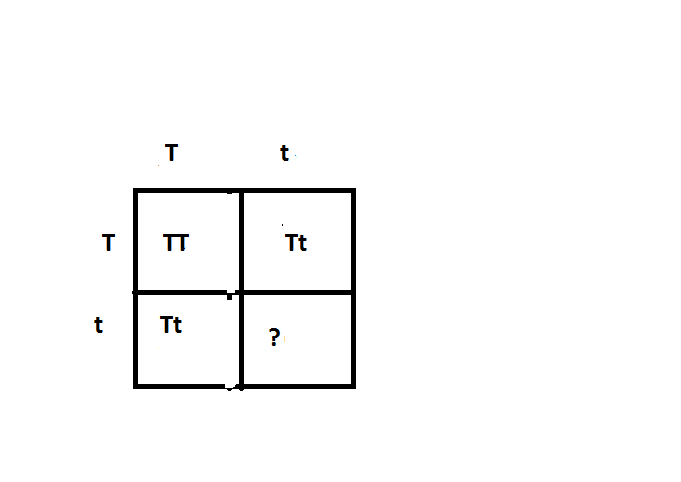
T - tall and t = short
In the punnett square below, what belongs in the missing square
tt
Tt
Bb
TT
Which of the following genotypes is heterozygous?
Bb
BB
bb
B

In a flowering plant species, red flower color (R) is dominant over white flower color (r). What is the genotype of any white-flowering plant resulting from this species?
rr
rR
RR
Rr
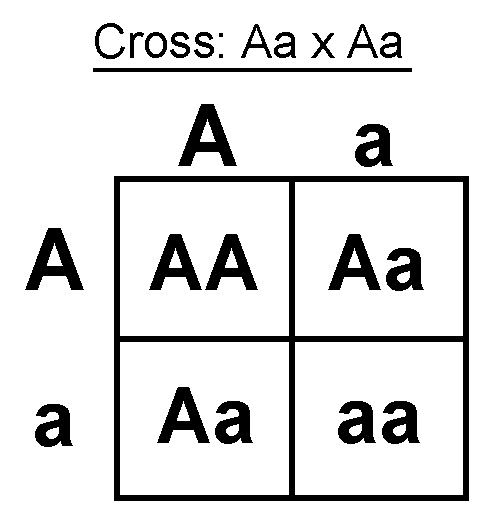
What are the phenotype percentages of the offspring?
(A-Brown fur color; a-white fur color)
50 % Brown fur and 50% White fur
25 % Brown fur and 75% White fur
75 % Brown fur and 25% White fur
0% Brown fur and 100% White fur
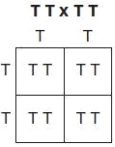
What ratio of the offspring from the cross shown will be homozygous recessive for the trait of tallness?
0 in 4
1 in 4
2 in 4
4 in 4

What are the possible genotypes for this cross?
(Click the picture to see it without the text)
TT = 25% Tt= 50% tt=25%
all tall
TT= 75% tt = 25%
Tt = 100%

B = brown fur b = white fur
In the Punnett square, what is the probability for white fur?
0%
25%
50%
75%

Sam and Madeline are having another baby. Which statement is true?
The baby will inherit the trait.
The baby will be a carrier for the trait.
The baby will not inherit or carry the trait.
None of these are correct.

This pedigree shows how left handedness has been passed. Can Mike and Molly have a left handed child? Left handedness is a recessive trait!
No, their child can't be left handed.
There is not enough information to tell.
Yes, they can have a left handed child.
They can have a left or right handed child.

Which statement about this Punnett square is NOT true?
There is a 50% of offspring with green pods.
The offspring have a 50% chance of inheriting a dominant gene.
The parents are heterozygous.
Each parent carries at least one recessive gene.

Which statement about this Punnett square is true?
All of the offspring will have brown eyes.
1 parent has brown eyes and the other has blue.
Both parents have blue eyes.
They have a 25% chance of offspring with brown eyes.

Which statement about this Punnett square is NOT true?
1 parent is heterozygous, the other is homozygous.
The offspring have a 50% chance of being homozygous.
The offspring have a 50% chance of having blue eyes.
50% of the offspring be homozygous for brown eyes.

How many offspring did Walter and Suzanne have?
4
3
7
5

Which statement about this Punnett square is true?
Both parents have yellow pods.
All of the offspring will inherit at least 1 yellow pod gene.
The parents are both heterozygous.
Yellow pods is a dominant trait.

How many female carriers are in this pedigree?
2
5
3
4
If 1 parent has curly hair (CC) and 1 has straight hair (cc), what type of genotype will their offspring inherit?
CC
cc
Cc
There is not enough information to tell.
If 1 parent has curly hair (CC) and 1 has straight hair (cc), what type of offspring will they have?
Heterozygous
Homozygous
Whatsazygous
Whosazygous

How many children did Noah and Mary have?
3; 2 girls and 1 boy.
3; 2 boys and 1 girl
4; 3 girls and 1 boy
4; 2 girls and 2 boys
Which of the following shows how a trait is passed through multiple generations of a family?
Family Square
Genetic Chart
Punnett Square
Pedigree Chart
What is a tool used to predict which genes an offspring can inherit?
Punnett Square
Pedigree Chart
Genetic Chart
Family Square
What does each box in a Punnett square represent?
A 100% chance of possible genes from the parents.
A 50% chance of possible genes from the parents.
A 25% chance of possible genes from the parents.
A 75% chance of possible genes from the parents.
Gregor Mendel bred pea plants with green pods (GG) with plants that had yellow pods (gg). What is true about the offspring of these plants?
They would all have yellow pods.
They would all have green pods.
They would all be homozygous.
50% would have yellow pods and 50% would have green.
What does a fully colored in circle or square on a pedigree represent?
Someone who carries a gene for the trait.
Someone who has the trait.
Someone who has no genes for the trait.
Someone who has reproduced.
What does a half shaded in circle or square represent on a pedigree?
Someone who carries a gene for the trait.
Someone who has the trait.
Someone who has no genes for the trait.
Someone who has died.

Which statement about this Punnett square is NOT true?
The parents genotypes are both Bb.
Purple is the dominant flower color.
They could have offspring with purple or white flowers.
The offspring have a 50% chance for purple flowers.

What do half colored symbols represent?
The individual is a carrier.
The individual expresses the trait.
The individual has both recessive alleles.
The individual has both dominant alleles.


What does a horizontal line between a square and a circle mean?
They are siblings
They are cousins
They are married ("together")
They are the children
What does a vertical line coming down from a square and circle that are connected by horizontal line indicate?
They are cousins
The children
Aunts and Uncles
DNA is short for
Ribonucleic acid
Deoxyribonucleic acid
Nucleic acid
How many pairs of chromosomes do human cells contain?
23
46
16
32
Where is DNA found in a human cell?
ribosome
nucleus
cell membrane
cytoplasm
What is a short segment of a DNA strand that codes for our characteristics?
chromosome
DNA
RNA
gene
What is a long coiled strand of DNA and proteins?
gene
RNA
chromosome
genome
Most same genes are located in the same place on pairs of chromosomes.
True
False
Cell division is...
the process in which a daughter cell copies itself to generate two identical parent cells.
the process in which a parent cell copies itself to generate multiple identical daughter cells.
the process in which a parent cell copies itself to generate two identical daughter cells.
How many chromosomes do human body cells have?
8
23
46
trillions
Each daughter cell ends up with the ____ number of _______ as the ________.
chromosomes, parent cel, same
parent cell, same, chromosomes
same, daughter cell, chromosomes
same, chromosomes, parent cell
A structure in the nucleus that contains genetic material is called ....
genetic material
code
nucleus
chromosome
Why do cells divide?
All of the above
To repair
To replace
To copy and divide
if the parent cell has 12 chromosomes, how many chromosomes does each daughter cell have after mitosis?
6
12
24
46

In the second generation-how many people are carriers of the trait?
2
3
5
6

Which individual in the first generation is a carrier?
The male
The female
individual 1
None of the above

What is this?
Pedigree
Karyotype
Venn diagram
Punnett Square

How many kids did the mother and father from the first generation have?
2
4
5
6

How are individuals III-2 and II-4 related?
Brother and sister
Dad and daughter
Uncle and niece
Grandfather and granddaughter

What is the mode of inheritance shown here?
Recessive because it "skips" a generation
Dominant because it shows up in every generation

In the second generation of this pedigree, how many people are carriers of the trait? *Remember: a carrier does not have the disorder/disease, but can pass it on to his/her children.
1
2
3
5

Why do all the daughters in Generation II carry the colorblind gene?
Because mom passed on the gene.
Because dad passed on the X chromosome.

The trait this pedigree traces is recessive because it skips a generation and individuals can be carriers. What is the most likely genotype for person III-3?
GG
Gg
gg

Which individual in the first generation is a carrier?
I-1
I-2

If this pedigree shows a recessive disorder, what MUST the genotype of individual II-3 be?
HH
Hh
hh
Which of the following best describes a karyotype?
A visual representation of an individual's chromosomes
A chart showing the inheritance of traits in a family
A diagram of the cell cycle
A model of DNA replication
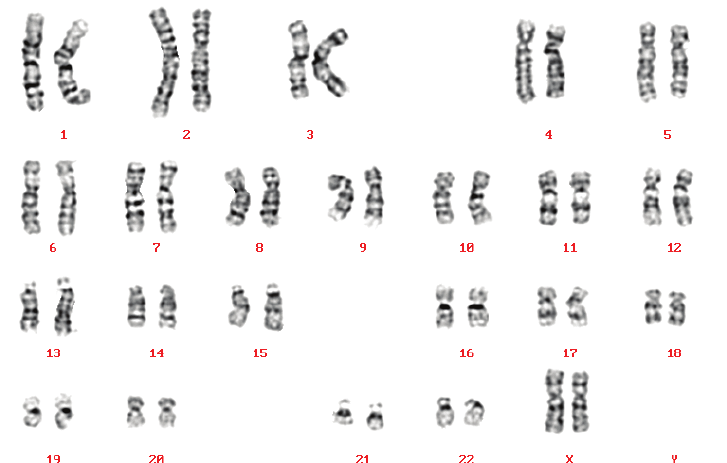
By looking at the chromosomes how can you tell that this person is biologically female?
Because there are two X chromosomes
Because there are more chromosomes than in a male
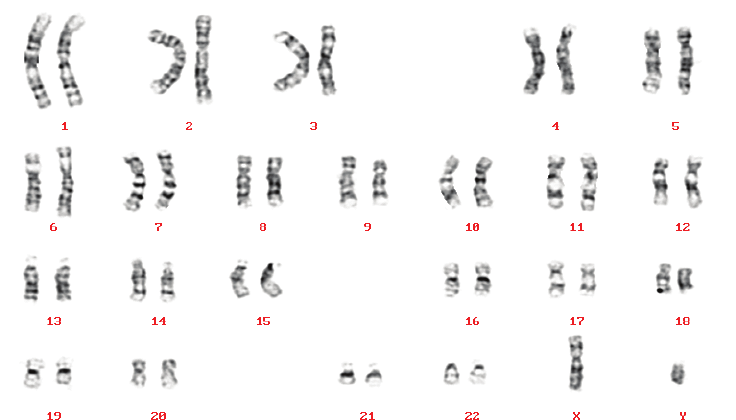
By looking at the chromosomes is this individual biologically male or female? How do you know?
Female, because they have two X chromosomes
Male, because they have one X and one Y chromosome
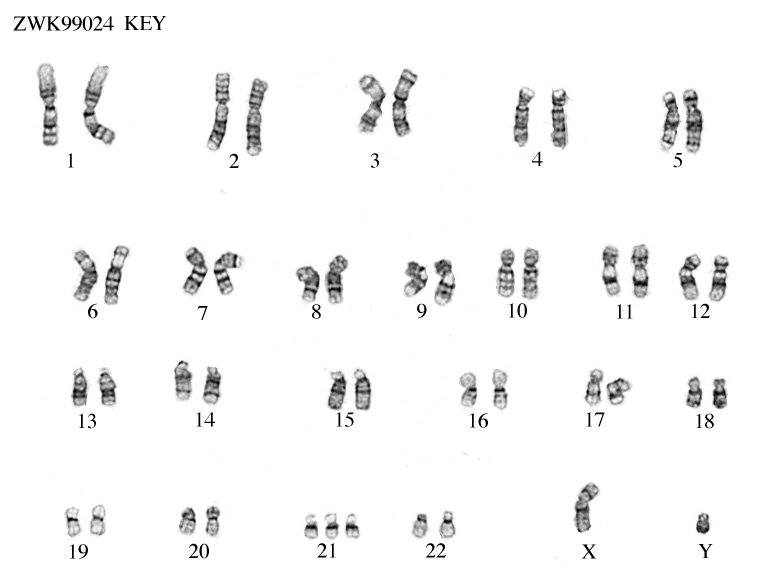
What is the mutation in this persons chromosomes?
There is only one X
7 is shaped like a hockey stick
There's an extra 21
1 is too curved
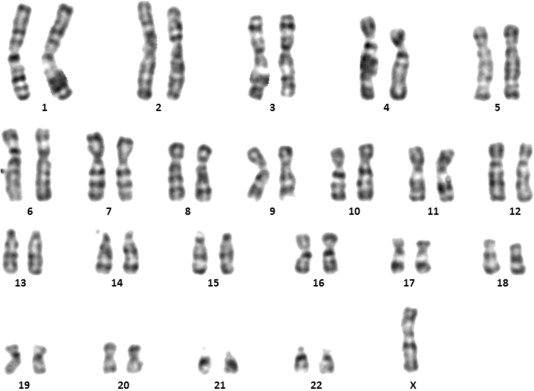
This is called Turners syndrome, can you notice the mutation in the chromosomes?
Both chromosomes 1 are bent
There are too many chromosomes
There are too many of chromosome 3
There is no Y chromosome
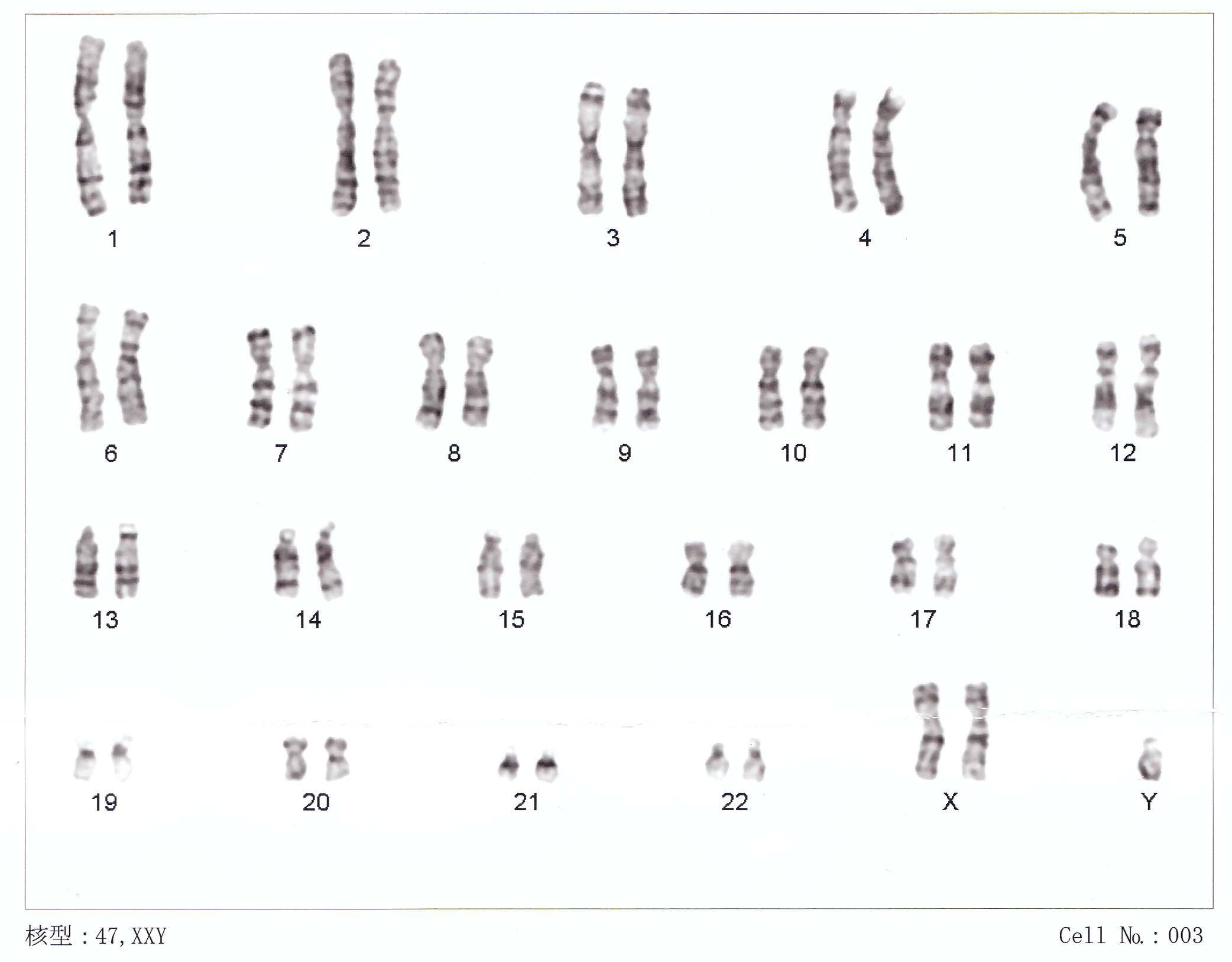
These are the chromosomes of someone with Kleinfelters syndrome. What is different about their chromosomes?
There is only one Y chromosome
One of the 5th chromosomes is too curved
There is an extra X chromosome
There are too few chromosomes
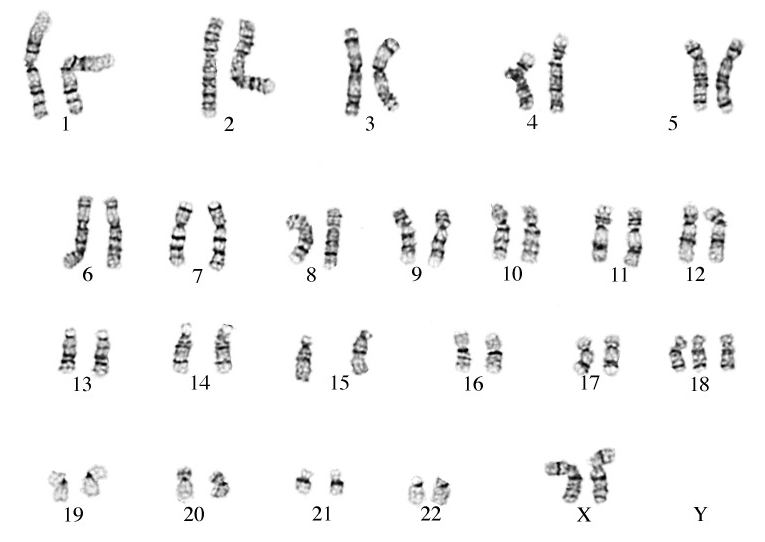
This is known as Edwards Syndrome, can you identify the chromosomal mutation?
Chromosomes 1 and 2 are bent
There is no Y chromosome
This persons chromosomes are normal
There are 3 of chromosomes 18

