
 Worksheets
Wave Interactions and Properties
Total questions: 80
Worksheet time: 1hrs 5mins
When a wave passes into a new medium and changes direction, this is called:
refraction
absorption
diffraction
reflection

What wave behavior is shown in this image?
Polarization
Diffraction or interference
Refraction
Reflection
A mirror is an example of a surface that causes:
Reflection
Absorption
Refraction
Diffraction

This image best depicts which of the following wave behaviors?
Reflection
Refraction
Diffraction
Resonance
Which of the following is NOT a result of wave interaction?
Reflection of light
Creation of matter
Diffraction of sound
Interference of waves

This image is representing what wave interaction?
Refraction
Diffraction
Reflection
Interference

What would you call this?
Reflection
Diffraction
Refraction
Friction
When sound bends around a door and enters another room, it is an example of:
refraction
diffraction
absorption
reflection
A prism creates a rainbow through the process of:
Refraction and dispersion of light
Reflection of light
Absorption of light
Scattering of light

What wave behavior is occurring here?
Constructive Interaction
Diffraction
Refraction
Reflection
A wave traveling from air into water will likely:
slow down and refract towards the normal
reflect off the surface without entering the water
remain unchanged in speed and direction
speed up and refract away from the normal
Which property affects how high or low a pitch is?
Amplitude
Frequency
Wavelength
Direction
If a sound is quiet, it has:
high frequency
strong resonance
sharp clarity
low amplitude
When you hear an echo, sound is being:
reflecting off a surface
dispersing in all directions
traveling in a straight line
absorbing into the surface
The changing pitch of police car's siren as it moves by you is an example of
speed of sound
doppler effect
resonance
intensity
Sound travels as a ____________ wave.
transverse
electromagnetic
longitudinal
gamma
Which term refers to how high or low a sound seems to a person?
intensity
reflection
volume
pitch
A system of detecting objects under water using reflected sound waves is
dissonance
sonar
acoustics
infrasound

The picture shows sound waves from a musical instrument. In which way is the sound wave in picture 1 different from the sound wave in picture 2?
it has a lower pitch
It has a lower volume
It has a greater amplitude
It has a higher frequency

Which wave represents the sound with the lowest pitch?
A
B
C
D

#2 refers to the
wavelength
amplitude
crest
trough

The waves are traveling at the same speed.
Which wave has the greater amplitude?
Wave on the Left
Wave on the Right
Both amplitudes are the same

The waves are traveling at the same speed.
Which wave has the greater frequency?
Graph on the Left
Graph on the Right
Both have the same frequency

Which graph shows the wave with the highest amplitude, greatest frequency and shortest wavelength?
Graph on the Left
Graph on the Right
Both waves have the same

Which statement is true about the two waves?
Both waves have the same amplitude, but the bottom wave has greater energy because of a greater frequency.
The top waves has greater energy because it has greater amplitude.
Both waves have the same frequency, but the top wave has a greater amplitude.
High frequency sounds have _______ pitch
HIgh
Low

High Amplitude =__________________
Louder sounds
Quieter Sounds

Low Amplitude = ______________
Quieter Sounds
Louder sounds

Low frequency = _______ Pitch
Low
High

In General Sound waves travel the fastest in __________
solid
liquid
Gas
plasma

In General Sound waves travel the slowest in __________
solid
liquid
Gas
Plasma

Way in which sound waves are used by animals such as dolphins and bats.
Echolocation
Transverse
Doppler Effect
Longitudinal

Why does a banana look yellow?
it reflects yellow wavelengths of light and absorbs most other wavelengths
it absorbs yellow wavelengths of light and reflects most other wavelengths

what is the correct order of the visible light spectrum?
red, yellow, green, orange, blue, violet and indigo
indigo, blue, violet, orange, yellow, green and red
violet, blue, indigo, green, yellow, orange and red
red, orange, yellow, green, blue, indigo and violet
When no light can pass through an object it is...
opaque
translucent
transparent
What type of rays are used for medical images?
radio waves
visible light
gamma rays
x-rays
When some light can pass through an object it is...
opaque
translucent
transparent
When all light can pass through an object it is...
opaque
translucent
transparent

Which image shows a convex lens?


Which image shows a concave lens?
Light travels fastest through what?
water
glass
a vacuum
air
Light bends as it passes from air to glass because of ___________.
refraction
absorption
transmission
reflection
White light contains which colors of visible light?
Red, orange, yellow, green, blue, indigo, violet
Red, orange, yellow, green, blue
Red, yellow, green, blue

If you are using a green color filter, what color will you only see?
blue
green
white
red
Light travels in straight lines until reflected by another object. Which illustration best shows the light being reflected?


According to the Law of Reflection,
The angle of incidence is always greater than the angle of reflection.
The angle of reflection is always zero degrees.
The angle of incidence equals the angle of reflection.
The angle of incidence and reflection are unrelated.
Waves travel only in straight lines.
True
False

What kind of wave is this
electromagnetic
transverse
longitudinal

When the two waves in the picture (to the left) meet, they will go through
Reflection
Constructive Interference
Destructive nNterference
Refraction

The picture best represents
Refraction
Reflection
Diffraction
Interference

Which form of Interference is occurring in this picture?
Reflection
Refraction
Diffraction
Radiation
This image is representing what wave interaction?
Refraction
Diffraction
Reflection
Interference

What is the reason the pencil appears different under water?
Interference
Refraction
Diffraction
Reflection


When you place things into water they sometimes look bent (see the image below). What is this an example of?
Refraction
Diffraction
Transmission
Absorption
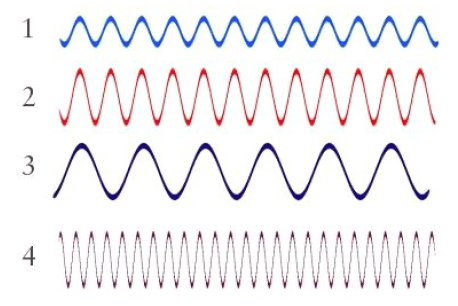
Which wave in the diagram has the longest wavelength?
1
2
3
4

What are the two main types of mechanical waves?
Transverse and longitudinal
Infrared and ultraviolet
Radio and sound
Compressional and electromagnetic
As amplitude increases, loudness
What displays electronic signals and allows sound waves to be seen?
Intensity of sound is measured in
High sounds that we cannot hear are known as
ultrasounds
infrasound


Light is part of the?

Unlike sound light waves do not need a
Light moves in _______ lines
What is the speed of light?


A concave lens has an inward curved shape. It refracts light outward from the lens. They light rays spread apart as they exit the lens. Which represents a concave lens?
A
B
A and B
neither A or B
Frequency is related to?
Pitch
What happens to the speed of light as it enters water from air?
It decreases
It disappears
It increases
It stays the same
Which property of a wave determines its loudness?
Amplitude
Wavelength
Frequency
Speed
Which of the following is NOT a property of waves?
Transparency
Frequency
Amplitude
Wavelength
What happens to the speed of light when it enters water from air?
It increases
It decreases
It stays the same
It disappears
Which type of wave requires a medium to travel through?
X-ray
Sound wave
Light wave
Radio wave
Which of the following is an example of the absorption of sound?
A carpeted room being quieter than a tiled room
An echo in a canyon
Waves passing through a narrow opening
Light bending through a prism
Which property of a wave determines its loudness?
Frequency
Amplitude
Wavelength
Speed
Which of the following best describes what happens when a sound wave hits a smooth, hard surface?
The sound is refracted into the surface
The sound is reflected back
The sound is absorbed completely
The sound is scattered in all directions
What property of a wave determines how loud a sound is perceived?
Wavelength
Speed
Amplitude
Frequency

