wayground logo

Free Printable Worksheets

NEW

Font size

S
M
L
XL
Worksheets

Genetics Terminology and some Punnetts

Total questions: 79

Worksheet time: 3hrs 47mins

Name
Class
Date
1.

Which of the following is homozygous recessive?

a)

Rr

b)

RR

c)

rr

d)

All of them

2.

Brown (B) is dominant over white (b). Which is a homozygous GENOTYPE of BROWN FUR?

a)

BB

b)

Bb

c)

bb

d)

B

3.

Which term describes the different forms of a gene?

a)

Chromosome

b)

Allele

c)

DNA

d)

Punnett Squares

4.

This image shows a

a)

Phenotype

b)

Punnett Square

c)

Homozygous Dominant gentotype

d)

Pedigree

5.

What does a Punnett Square do?

a)

Show the possible genotypes

b)

Determine the possible phenotypes

c)

Predict offspring traits

d)

All of the above

6.

A phenotype is

a)

Physical appearence

b)

Dominance

c)

Recessiveness

d)

Letter combinatons

7.

What is a gene?

a)

They cause disease

b)

What you wear to parties

c)

The basic building blocks of heredity

d)

It is what DNA is made up of

8.

What is an allele?

a)

A gene

b)

A genotype

c)

A phenotype

d)

Different forms of a gene

9.
allele that is masked by the presence of a dominant allele (will not always be visible if present); represented by a lowercase letter
a)
Dominant
b)
Recessive
c)
Virus
d)
Genetic
10.
the expressed gene in a hybrid (will always be visible if present); represented by a capital letter
a)
Controlling
b)
Dominant 
c)
Recessive 
d)
Agressive
11.
What is a phenotype
a)
The genetic make up (code)
b)
The physical trait
12.
The man who studied genetics and came up with genetics is
a)
Watson
b)
Crick
c)
Mendel
d)
Darwin
13.
the passing of genetic traits from parent to offspring.
a)
heredity
b)
trait
c)
gene
d)
allele
14.
having two of the same genes for the trait (sometimes called purebred).
a)
homozygous
b)
hetrozygous
c)
protein
d)
chromosome
15.
having two different genes for a trait (sometimes called hybrid).
a)
protein
b)
homozygous
c)
heterozygous
d)
genotype
16.
What is the definition of genotype?
a)
The physical expression of a trait
b)
The genetic combination of alleles 
c)
the genes on a DNA strand
17.
One form of a gene is called_______________
a)
a DNA
b)
a Phenotype
c)
a trait
d)
an allele
18.
Where, in the eukaryotic cell, is DNA located?
a)
ribosomes
b)
nucleus
c)
E.R.
d)
cytoplasm
19.
An allele whose trait always shows up in the organism when the allele is present.
a)
recessive allele
b)
dominant allele
c)
hidden allele
d)
present allele
20.
An allele whose trait only shows up when no dominant allele is present.
a)
hidden allele
b)
dominant allele
c)
recessive allele
d)
present allele
21.
the chances of something happening
a)
dominant
b)
genotype
c)
phenotype
d)
probability
22.
having two of the same genes for the trait (sometimes called purebred).
a)
homozygous
b)
hetrozygous
c)
protein
d)
chromosome
23.
having two different genes for a trait (sometimes called hybrid).
a)
protein
b)
homozygous
c)
heterozygous
d)
genotype
24.
Hair colour is an example of
a)
genotype
b)
phenotype
25.
Dominant or Recessive?
R
a)
Dominant
b)
Recessive
26.
Dominant or Recessive?
e
a)
Dominant
b)
Recessive
27.
Heredity is the passing of traits from _____________________ to _____________________
a)
predators to prey
b)
water to rain
c)
parents to offspring
d)
fungi to protists
28.
___________________________ is the study of how traits are passed on, or inherited.
a)
dominant traits
b)
ratio
c)
phenotype
d)
genetics
29.

A sperm cell of an alligator has 16 chromosomes. What is the total number of chromosomes that should be present in a stomach cell of the same alligator

a)

8

b)

16

c)

32

d)

48

30.

Compared to the number of chromosomes contained in a body cell, how many chromosomes would normally be contained in a gamete?

a)

the same number

b)

twice as many

c)

one-fourth as many

d)

half as many

31.

Which cells are NOT formed during meiosis?

a)

Somatic Cells

b)

Gametes

c)

Sex Cells

d)

Sperm Cells

32.

Somatic cells in humans contain _________ chromosomes and an example is _______.

a)

30; skin cells

b)

23; heart cells

c)

46; liver cells

d)

46; sperm cells

33.

What diagrams are used to help predict the genotype and phenotype combinations of a genetic cross?

a)

Punnett Square

b)

Venn Diagram

c)

T Table

d)

Bubble Map

34.

What is a fertilized egg called?

a)

Sperm

b)

Egg

c)

Zygote

35.
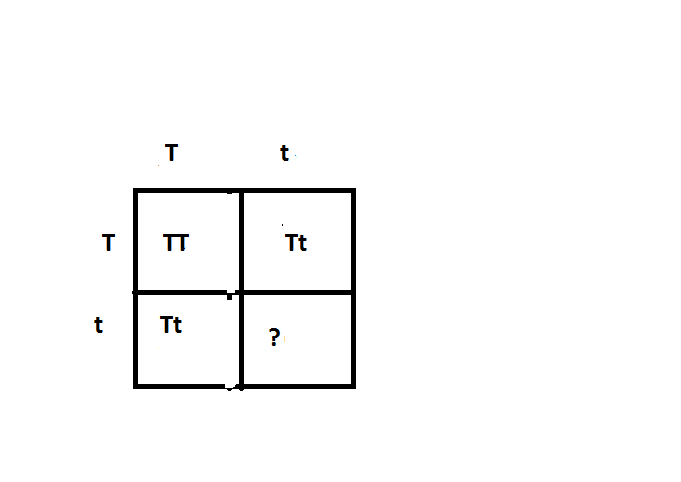
T - tall and t = short
In the punnett square below, what belongs in the missing square
a)
tt
b)
Tt
c)
Bb
d)
TT
36.
B = brown fur  b = white fur
In the punnett square, what is the probability for white fur? 
a)
0%
b)
25%
c)
50%
d)
75%
37.
In the punnett square shown, what must the genotype of the missing parent be?
a)
BB
b)
Bb
c)
bb
d)
Tt
38.
In the punnett square shown, what is the genotypes of the two parents?
a)
RW and RR
b)
RW and WW
c)
RR and WW
d)
RW and RR
39.
This image shows a...
a)
Punnett Square
b)
Phenotype
c)
Genotype
d)
Dominant allele
40.
What genotype is missing from this Punnett Square?
a)
RrYy
b)
RRYY
c)
rryy
d)
RrYY
41.
Which of the following genotypes is heterozygous?
a)
Bb
b)
BB
c)
bb
d)
B
42.
What is called when a organism has  two different alleles for a trait. Tt or Rr
a)
Heterozygous
b)
Homozygous
c)
Domozygous
d)
Thermozygous
43.
An organism’s genetic makeup or allele combination.
a)
Genotype
b)
Phenotype
c)
Beanotype
d)
Notype
44.
Scientists use capital and small letters to show the _____ of an organism. 
a)
genotype
b)
genetic disorder
c)
phenotype
d)
genome
45.
An organism that has one dominant and one recessive allele for height is _____.
a)
unusual
b)
homozygous
c)
mutated
d)
heterozygous
46.
In a certain species of plant, the color purple (P) is dominant to the color white (p).
According to the Punnett Square, what is the probability of an offspring being purple?
a)
25%
b)
0%
c)
100%
d)
50%
47.
In a certain species of plant, the color purple (P) is dominant to the color white (p).
According to the Punnett Square, what is the probability of an offspring being white?
a)
25%
b)
0%
c)
100%
d)
50%
48.
Is it possible for a visible trait to skip a generation? Example: Blue eyes
a)
Yes
b)
No
49.
Each one of the boxes on the Punnett Square represents what probability of an offsprings' genotype?
a)
25%
b)
1%
c)
10%
d)
0%
50.
Aa, DD, bB, yy are all examples of
a)
genotypes
b)
phenotypes
51.
AA and Aa always show up as
a)
dominant
b)
recessive
52.
In a flowering plant species, red flower color (R) is dominant over white flower color (r). What is the genotype of any red-flowering plant resulting from this species?
a)
rr
b)
R
c)
RR
d)
RR or Rr
53.
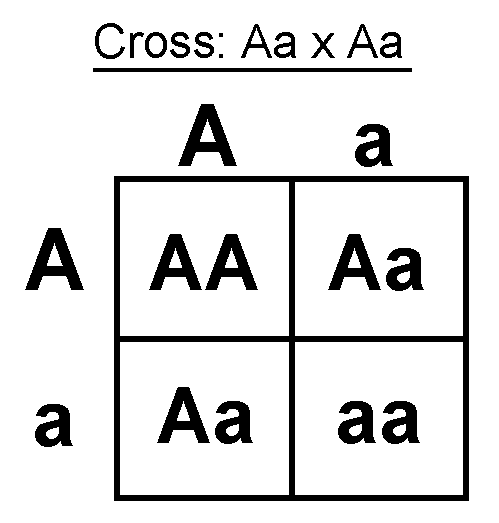
T - tall and t = short
In the punnett square below, what belongs in the missing square
a)
tt
b)
Tt
c)
Bb
d)
TT
54.
What is the phenotype of the offspring? (A-Brown hair; a-blond hair) 
a)
50 % Brown Hair and 50% Blond Hair 
b)
25 % Brown Hair and 75% Blond Hair 
c)
75 % Brown Hair and 25% Blond Hair 
d)
0% Brown Hair and 100% Blond Hair 
55.
A green pea plant (GG) is being crossed with a green pea plant (Gg). What is the phenotype?
a)
100 % rainbow 
b)
50% yellow and 50% green 
c)
100% green
d)
100% yellow 
56.
How many alleles (letters) do each person carry for a trait?
a)
1
b)
2
c)
3
d)
4
57.
AA and Aa always show up as
a)
dominant
b)
recessive
58.
Aa is
a)
homozygous
b)
heterozygous
59.
What ratio of the offspring from the cross shown will be homozygous recessive for the  trait of tallness? 
a)
0 in 4
b)
1 in 4
c)
2 in 4
d)
4 in 4
60.
In a flowering plant species, red flower color (R) is dominant over white flower color (r). What is the genotype of any red-flowering plant resulting from this species?
a)
rr
b)
R
c)
RR
d)
RR or Rr
61.
Which of the characteristics is a lion least likely to pass on to its offspring?
a)
fur color
b)
length of tail
c)
scars on leg
d)
body size
62.
If T=Tall & t=short, what is the genotypic ratio?
a)
1:3
b)
3:1
c)
1:2:1
d)
2:2
63.
B = brown fur  b = white fur
In the Punnett square, what is the probability for white fur
a)
0%
b)
25%
c)
50%
d)
75%
64.
In the Punnett square shown, what must the genotype of the missing parent be?
a)
BB
b)
Bb
c)
bb
d)
Tt
65.
A heterozygous yellow pea plant's genotype would be:
a)
YY
b)
yy
c)
Yy
d)
Yg
66.
B - black, b - brownTwo black mice mate and have some black and some brown mice.  What is the genotype of the parents?
a)
BB x Bb
b)
BB x bb
c)
Bb x Bb
d)
Bb x bb
67.
What ratio of the offspring from the cross shown will be homozygous recessive for the  trait of tallness
a)
0 in 4
b)
1 in 4
c)
2 in 4
d)
4 in 4
68.
What are the possible genotypes for this cross?
(Click the picture to see it without the text)
a)
TT = 25% Tt= 50% tt=25%
b)
all tall
c)
TT= 75% tt = 25%
d)
Tt = 100%
69.
B = brown fur  b = white fur
In the Punnett square, what is the probability for white fur
a)
0%
b)
25%
c)
50%
d)
75%
70.
Purple (P) is dominant to the white (p).
According to the Punnett Square, what is the probability of an offspring being purple?
a)
25%
b)
0%
c)
100%
d)
50%
71.
What is the yellow seed genotype?
a)
aa
b)
Aa
c)
AA
d)
AA or Aa
72.
What is the dominant trait?
a)
yellow pea seeds
b)
green pea seeds
c)
there is no dominant seed
d)
Jolly green giant
73.
What is the genotypic ratio here?
a)
25% blue eye 75 % brown eye 
b)
BB = 25% Bb = 50% bb = 25%
c)
BB= 50 % bb = 50%
d)
All brown eye
74.
What does a Punnett Square do?
a)
tell you exactly what your offspring will look like
b)
increase the chance you pass on recessive traits
c)
predict genotypes and phenotypes in offspring
d)
have no purpose but for Taylor to give us extra assignments
75.
What genotype would go in box 2?
a)
BB
b)
Bb
c)
bb
76.
What genotype would go in box 3?
a)
BB
b)
Bb
c)
bb
77.
What genotype would go in box 1?
a)
BB
b)
Bb
c)
bb
78.
Which of the following is homozygous dominant?
a)
Jj
b)
Rr
c)
MM
d)
ee
79.
Which of the following is homozygous recessive?
a)
Tt
b)
tt
c)
TT
d)
T