
 Worksheets
End of the Year Wrap Up
Total questions: 75
Worksheet time: 1hrs 1mins
A change in an organism that helps it to survive & reproduce is called a(n)
Adaptation
Gene
Trait
Pollination
Which of the following is a biotic factor that influences the growth and development of living things?
The amount of rainfall in an area
The number of hawks in an area
The amount of sunlight in an area
The amount of oxygen in an area

According to the graph, which is the best temperature for a plant to grow?
12
24
30
36
A fruit bat is nocturnal and doesn't have a sense of smell. Which flower would the fruit bat be most likely to pollinate?
the flower that only blooms during the day
the flower that only blooms at night
the flower with brightly colored petals
the flower that smells like rotting meat
What is a gene?
a genetically determined characteristic
the offspring of two plants or animals of different species or varieties
the passing on of physical characteristics genetically from one generation to another
a unit of heredity which is transferred from a parent to offspring and is held to determine some characteristic of the offspring
Analyze: Which of the following is an animal behavior that increases plant reproduction
A goat eating grass and weeds on a farm
A beaver cutting down a tree to build a dam
A bee carrying pollen from one plant to another in search of nectar
A robin using a fig trees branches to build a nest
Where does all energy in an ecosystem come from?
The moon
The sun
Nitrogen
Phosphorus
Why is photosynthesis important to the cycling of matter and the flow of energy? *Choose all that apply*
It changes the sun’s energy into a form that can be used by living things
It changes nitrogen into a form that can be used by living things
It changes phosphorus into a form that can be used by living things
It changes carbon into a form that can be used by living things
Which macromolecule is used to store energy?
Carbohydrates
Nuclei acids
Lipids
Proteins
How does matter move through an ecosystem?
It flows to the sun
It flows from the sun
It moves in a straight line
It cycles
What is the role of bacteria in the nitrogen cycle?
They change carbon from the atmosphere into a form that can be used by living things
They change nitrogen from the atmosphere into a form that can be used by living things
They fix nitrogen from the air onto the roots of plants
They change phosphorus into a form that can be used by living things
Which macromolecules contain carbon? *Choose all that apply*
Carbohydrates
Lipids
Proteins
Nucleic Acids
During photosynthesis, which molecule is produced that living things use for energy?
Glucose
Sucrose
Fructose
Cellulose
What happens during cellular respiration?
Carbon dioxide is released back into the environment
Sugar is produced for energy
Carbon dioxide is taken out of the environment
Oxygen is produced
What happens during photosynthesis?
Sugar and oxygen chemically combine to form carbon dioxide and water
Water and carbon dioxide chemically combine to form sugar and oxygen
Bacteria convert nitrogen into a usable form
Phosphorus is released from rocks into the environment
Which body system is responsible for processing sensory information?
Respiratory system
Circulatory system
Nervous system
Digestive system
When a person participates in physical activity, they need to take in more oxygen so that their cells create more energy through the process of ___________
Photosynthesis
Osmosis
Active transport
Cellular respiration

What does the digestive system do?
Breaks down food and absorbs nutrients
Pumps blood throughout the body
Helps you breathe
Helps your arms and legs move
An organism needs to
Breathe oxygen
Display the 6 characteristics of life
Perform photosynthesis
Talk

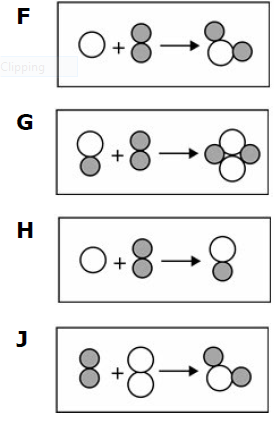
Which of the following are considered pure substances?
Mixtures
Elements
Compounds

Classify the picture with the correct label.
Element
Compound
Mixture
Which are signs that a chemical change has taken place? *choose all that apply*
A gas is produced
An odor is produced
An energy change
A change to the state of matter
Which of the following is NOT a physical change?
Burning paper
Cutting paper
Freezing paper
Writing on paper

At which temperature would the particles of water be moving the slowest?
20 ⁰C
30 ⁰C
40 ⁰C
50 ⁰C

Matter that have volume, but no shape
Solid
Gas
Liquid
Atom

When a gas (vapor, steam) cools and changes into a liquid
sublimation
melting
vaporization
condensation
Matter can change states from solid to liquid when
heat is removed
heat is added
water is added
mass is added
Solid particles are...
tightly packed with strong attractive forces
loosely bonded and flowing
free to fly in all directions
so hot that the electrons are removed from the nucleus
Which type of vaporization happens at the surface of a liquid?
Condensation
Boiling
Evaporation
Sublimation
What can cause a change in the state of matter of an object?
Adding thermal energy
Removing thermal energy
Either adding or removing thermal energy
A chemical reaction
The energy of motion is
Chemical energy
Potential energy
Mechanical energy
Kinetic energy
When thermal energy is removed, what happens to the particles of a substance?
They slow down
They speed up
They stay the same
They move further apart
What always happens during a chemical reaction?
A color change occurs
A new substance forms with new chemical and physical properties
A new substance is formed with a combination of properties from the reactants
A gas is released
In the equation 2 NaHCO3 + CaCl2 --> CaCO3 + CO2 + 2 NaCl + H2O, which substance(s) are the reactants?
CaCO3 + CO2
2 NaHCO3 + CaCl2
2 NaCl + H2O
CaCO3 + CO2 + 2 NaCl + H2O
In a chemical equation, is it true that -
the reactant side and product side can have different numbers of atoms for each element
there can be different elements on the reactant side and the product side
the elements need to be in the same order on the reactants and products side of the equation
the number of atoms of each element need to be the same on both the reactants and products side of an equation
Which of these is NOT a sign that a chemical change has occurred?
A change in the state of matter
An unexpected color change
A temperature change
The formation of a precipitate
The Law of Conservation of Mass states
that matter exists in all states and reacts the same
that matter can only be changed into new substances by introducing a catalyst
that matter exists in the same state throughout any chemical change
that matter cannot be created or destroyed and that the mass of the products must equal the mass of the reactants
When baking soda and vinegar reacts in a open beaker, why does it appear as though mass has been "lost"?
All material is trapped in the beaker
Some mass has been destroyed
A gas is released into the environment
After a chemical reaction, 17 grams of glucose and 60 grams of oxygen are formed. What is the amount of the reactants?
77 grams
43 grams
more than 77 grams
less than 43 grams
What process occurs when clouds form?
evaporation
condensation
precipitation
sublimation
When you hold an ice cube, you are transferring heat to it by:
raditation
convection
conduction
Local winds that occur during the day and blow from the sea towards the land are called:
sea breezes
land breezes
Prevailing westerlies
trade winds
The main way heat is transferred throughout the air in the atmosphere is:
raditation
conduction
convection
Coriolis
The sun's energy causes water on the surface to go through which phase change and become water vapor?
precipitation
evaporation
condensation
convection
Unequal heating between the equator and poles leads to
global winds
local winds
sea breezes
the Coriolis effect
Which global wind belt impacts the weather in North America?
Polar easterlies
Trade winds
Prevailing Westerlies
Doldrums
The sun heats the Earth through the process of
radiation
conduction
convection
the Greenhouse effect
Land breezes form because:
land cools off faster than water
water cools off faster than land
land heats up faster than water
water heats up faster than land
The way Earth's rotation makes winds curve is called the:
Coriolis effect
Greenhouse effect
Convection effect
Global effect
When air is heated, the particles
move faster and it becomes more dense
move slower and it becomes more dense
move faster and it becomes less dense
move slower and become less dense
A collision between two pieces of continental crust at a convergent boundary produces a
Mid-ocean ridge
Deep-ocean trench
Mountain range
Rift valley
Why do earthquakes mostly occur along plate boundaries?
They are the areas with the most movement
They are the areas where mountains form
They are the areas where magma forms
Epicenters are found there
The geological theory that states that pieces of the Earth's lithosphere are in slow, constant motion is the theory of
Subduction
Plate tectonics
Sea-floor spreading
Mass conservation
What is Pangaea?
A German scientist
The supercontinent that existed millions of years ago
Another name for continental drift
An ancient dinosaur
Most geologists rejected Alfred Wegener's idea of continental drift because
Wegener could not identify the force that moved the continents
Wegener used several different types of evidence to support his hypothesis
Scientists were afraid of new ideas
There wasn't a picture of the Earth from millions of years ago
Which of the following is evidence used by Alfred Wegener to explain his theory of continental drift? *Choose all that apply*
The continents fit together like puzzle pieces
The same fossils are found on different continents
The same types of geological formations are found on different continents
Glacial deposits are found on continents that are too far away from the poles
What causes the movement of the plates?
Compression stress
Mid-ocean ridges
Convection currents in the mantle
Rift valleys
The boundary between two plates colliding is called a
Convergent boundary
Divergent boundary
Transform boundary

At point B, extreme heat and pressure changes existing rock into what new type of rock?
Sedimentary rock
Metamorphic rock
Igneous rock
The soft, plastic-like layer of the mantle is called the
Lithosphere
Asthenosphere
Lower mantle
The results of plate movement can be seen at
Abysmal plains
Ocean margins
Epicenters
Plate boundaries
In which organelle does photosynthesis take place?
Cell wall
Cell membrane
Chloroplast
Nucleus
What is the relationship between photosynthesis and cellular respiration?
Photosynthesis produces water and carbon dioxide which is used during cellular respiration to produce glucose and oxygen
Photosynthesis produces glucose and carbon dioxide which is used during cellular respiration to produce water and oxygen
Photosynthesis produces glucose and oxygen which is used during cellular respiration to produce water and carbon dioxide
Photosynthesis produces nitrogen which is used during cellular respiration to produce water and carbon dioxide
In which organelle does cellular respiration take place?
Cell wall
Cell membrane
Chloroplast
Mitochondria
True or False: Matter can neither be created nor destroyed
True
False
When you move higher in a food chain, what happens to the amount of energy available?
It increases
It decreases
It stays the same
It depends on the organisms in the food chain

