wayground logo

Free Printable Worksheets

Font size

S
M
L
XL
Worksheets

THE WOUFF-HONG: Properties of Matter Quiz

Total questions: 78

Worksheet time: 54mins

Name
Class
Date
1.

Anything that has mass and takes up space

a)

Matter

b)

weight

c)

volume

d)

mass

2.

True or false. Your mass would change if you went to another planet.

a)

True

b)

False

3.
The blue ball has ________ mass than the red one.
a)
less
b)
more
4.
Mass, relative density, solubility, color, texture, state of matter, conductivity, etc.
a)
Physical state
b)
Insulators
c)
Physical Properties 
d)
Inferences
5.
Which tool helps us to measure mass?
a)
scale
b)
triple beam
c)
ruler
d)
magnifying glass
6.
__________ is the amount of space something takes up. 
a)
matter
b)
volume
c)
weight
d)
density
7.
Which of the following is not a unit of temperature?
a)
Celsius
b)
Milliliters 
c)
Fahrenheit 
8.
This tool could be used to determine the _______ of an object. 
a)
mass
b)
temperature
c)
magnetism 
d)
density
9.
________ is a measure of how packed the molecules of a substance are.
a)
volume
b)
density
c)
weight
10.
The physical properties of an object include how it ________. 
a)
tastes
b)
looks 
c)
smells
d)
all of the above
11.
The beach ball is _____ dense than the water.
a)
more
b)
less
12.
Weight is the measure of the pull of ________ on the mass of an object. 
a)
magnetism
b)
the Earth
c)
volume
d)
gravity
13.

Mass is _________________

a)

The amount of matter in something; measured in grams.

b)

How dense something is compared with a reference material. Sink or Float

c)

How much space something takes up.

d)

Material that allows heat or electrical energy to easily flow through it.

14.

Physical Properties are _____________

a)

Measurement of the ability of a solid to dissolve in a liquid.

b)

Energy that can be measured by a thermometer.

c)

Measurable characteristics that describe the physical state of something, including mass, magnetism, temperature, density, shape, volume, and conductivity.

d)

The classification of matter as a solid, liquid, or gas.

15.

Solubility is __________

a)

How dense something is compared with a reference material. Sink or Float

b)

Anything that has mass and takes up space.

c)

How much space something takes up.

d)

Measurement of the ability of a solid to dissolve in a liquid.

16.

Volume is __________

a)

How dense something is compared with a reference material. Sink or Float

b)

Anything that has mass and takes up space.

c)

How much space something takes up.

d)

Measurement of the ability of a solid to dissolve in a liquid.

17.

Water displacement is __________________

a)

How dense something is compared with a reference material. Sink or Float

b)

Anything that has mass and takes up space.

c)

How much fluid is pushed away when an object is placed in it. We can then know the volume of the object.

d)

Measurement of the ability of a solid to dissolve in a liquid.

18.

A material that is less dense will -

a)

float

b)

sink

19.

A material that is more dense will -

a)

float

b)

sink

20.

All metals are -

a)

conductors

b)

magnetic

c)

insulators

d)

soluble

21.

Materials that are magnetic are made from -

a)

Iron

b)

Nickel

c)

Steel

d)

Iron, Nickel, and Steel

22.

Insoluble means a material -

a)

Can NOT dissolve

b)

Can dissolve

23.

Thermal Energy is -

a)

charged electrons

b)

heat energy

c)

vibrations

d)

light

24.

Something that allows energy to flow through it easily

a)

state of matter

b)

conductor

c)

insulator

d)

property

25.

Something that does not allow energy to flow through it easily

a)

insulator

b)

conductor

c)

solubility

d)

relative density

26.

A characteristic that can be observed or measured

a)

mass

b)

volume

c)

state of matter

d)

property

27.

When two or more substances are put together.

a)

Volume

b)

Density

c)

Mixture

d)

Mass

28.

Sometimes when mixing two substances something new will be created because of a ____________________.

a)

Volume

b)

Chemical Reaction

c)

Physical Reaction

d)

Mass

29.

The unit of measurement used for weight in physics.

a)

Newton

b)

Kilograms

30.
Which tools are used to measure volume?
a)
beaker, graduated cylinder, and ruler
b)
triple beam balance, pan balance
c)
thermometer
d)
stopwatch and timer
31.
The identity of a substance will change when observing a ...
a)
Universal property
b)
Biological property
c)
Chemical property
d)
Physical property
32.
Which property is the same for gasoline, paper, and wood?
a)
boiling point
b)
magnetism
c)
flammability
d)
luster
33.
Fool's gold will react with acid to turn a green color.  Gold will remain yellow in color.  Which type of property is being described?
a)
Universal property
b)
Biological property
c)
Chemical property
d)
Physical property
34.
Which is true about the density and magnetism of iron and aluminum?
a)
Iron is more dense; Only iron was magnetic
b)
Iron is more dense; both were magnetic
c)
Aluminum is more dense; Only aluminum was magnetic
d)
Aluminum is more dense; both were magnetic
35.
What is at the center of every atom?
a)
An electron
b)
A compound
c)
A molecule
d)
A nucleus
36.
Which two particles make up the nucleus of an atom?
a)
Protons and Electrons
b)
Protons and Neutrons
c)
Molecules and Compounds
d)
Neutrons and Electrons
37.
The particles with no charge in an atom are the _______.
a)
electrons
b)
neutrons
c)
protons
d)
protons and neutrons
38.
In an atom, what is the number of protons equal to?
a)
The number of electrons.
b)
The number of neutrons.
c)
The number of molecules.
d)
The number of nuclei.
39.
The positively charged particles of an atom are the ________.
a)
electrons
b)
protons
c)
neutrons
d)
protons & neutrons
40.
The negatively charged particles of an atom are the ______.
a)
electrons
b)
protons
c)
neutrons
d)
protons & neutrons
41.
An electron has this charge
a)
positive
b)
negative
c)
neutral
42.
A proton has this charge
a)
negative
b)
positive
c)
neutral
43.
A particle that moves around the nucleus is a(n)...
a)
Proton
b)
Neutron
c)
Electron
d)
Quark
44.
A neutron has this charge
a)
negative
b)
positive
c)
neutral
45.
What does the nucleus of an atom contain?
a)
Electrons and neutrons
b)
Protons and neutrons
c)
Neutrinos and positrons
d)
DNA and RN
46.
What number indicates an electron?
a)
1
b)
2
c)
3
d)
4
47.
What number indicates the nucleus?
a)
1
b)
2
c)
3
d)
4
48.
What is the mass number?
a)
the number of protons
b)
the sum of the number of protons and the number of neutrons in the nucleus of an atom 
c)
the number of electrons
d)
the number of neutrons
49.
Which element has 31 protons ?
a)
Gallium 
b)
Germanium
c)
Gadolinium
d)
Polonium
50.
What is the atomic number?
a)
number of protons
b)
number of neutrons
51.
Oxygen’s atomic number is 8. This means that an oxygen atom must have
a)
8 electrons
b)
8 protons
c)
8 neutrons
d)
a mass number of 8
52.
 What is the mass number of this element?
a)
5
b)
27
c)
32
d)
59
53.

When the Moon is directly between the Sun and the Earth, what phase would the Moon be in?

a)

Full Moon

b)

New Moon

c)

Half Moon

d)

Waxing Crescent

54.

What term is associated with the moons that are increasing in size (more light on them) each day?

a)

Waxing moons

b)

Waning moons

c)

Crescent moons

d)

Gibbous moons

55.

What phase of the moon is this?

a)

Waxing Gibbous

b)

Waning Gibbous

c)

Waxing crescent

d)

Waning crescent

56.
The different phases of the Moon are caused by:
a)
The days of the months
b)
The angle at which we see the lit Moon as it revolves around the Earth
c)
The position of the Earth in its orbit around the Sun
d)
The tides of the ocean
57.

About how long does it take the Moon to complete it's cycle?

a)

around 1 week

b)

around 1 month

c)

around 1 year

d)

around 1 day

58.

What phase of the moon is shown?

a)

waning gibbous

b)

1st quarter

c)

waxing crescent

d)

Waxing gibbous

59.
Name the phase of the moon that comes BEFORE this moon phase.
a)
waxing gibbous
b)
waning gibbous
c)
waning crescent
d)
waxing crescent
60.

How much of the Moon is always reflecting light from the Sun?

a)

The entire moon is always illuminated

b)

Half of the Moon is always illuminated; it's just not always facing Earth

c)

Half of the Moon is illuminated only during the new moon

d)

Half of the Moon is illuminated only during the full moon
61.

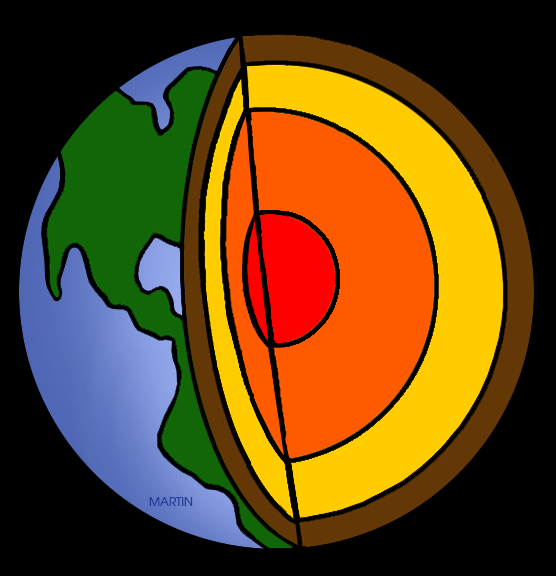
Which layer is shown in red?

a)

crust

b)

mantle

c)

outer core

d)

inner core

62.

Sally is researching the differences that exist in each layer of the Earth. Which of the following best describes Earth's crust?

a)

Solid, rocky

b)

Liquid, metallic

c)

Semisolid, convecting

d)

Dense, extremely hot

63.
The layer that lies beneath the mantle and surrounds the inner core. 
a)
mantle
b)
outer core
c)
inner core
d)
crust
64.
This is the outermost, rigid layer of the Earth, made up of two parts, is divided into pieces call tectonic plates.
a)
Inner Core
b)
Asthensophere
c)
Lithosphere
d)
Outer Core
65.

Which layer of the Earth is the THINNEST?

a)

crust

b)

mantle

c)

outer core

d)

inner core

66.

Which layer of the Earth is the THICKEST?

a)

crust

b)

mantle

c)

outer core

d)

inner core

67.

Which layer is the hottest?

a)

crust

b)

mantle

c)

outer core

d)

inner core

68.
What is the correct order (starting from the surface) of Earth's layers?
a)
crust, outer core, inner core, mantle
b)
mantle, outer core, inner core, crust
c)
crust, mantle, outer core, inner core
d)
outer core, inner core, crust, mantle
69.

How many zodiac signs are there?

a)

10

b)

11

c)

12

d)

13

70.

Which sign of the zodiac is nicknamed 'The Twins'?

a)

Pisces

b)

Taurus

c)

Gemini

d)

Aquarius

71.

Which sign of the zodiac is nicknamed 'The Water Bearer'?

a)

Virgo

b)

Cancer

c)

Capricorn

d)

Aquarius

72.

Where is Dunder Mifflin located?

a)

Utica, New York

b)

Scranton, Pennsylvania

c)

Nashua, New Hamshire

d)

Akron, Ohio

73.

What is the smallest part of a gold ring that is still gold?

a)

an atom

b)

an electron

c)

a molecule

d)

a compound

74.

What is the smallest part of an element that still has the same properties of that element?

a)

an electron

b)

an atom

c)

a proton

d)

a molecule

75.

A substance made of two or more elements that cannot be separated by physical means is called a:

a)

compound.

b)

homogeneous mixture.

c)

heterogeneous mixture.

d)

multi-element.

76.

The name for a mixture in which all samples are made up of the same proportions of matter is:

a)

pure substance

b)

homogeneous

c)

heterogeneous

d)

homologous

77.

A compound:

a)

is made of more than one kind of element.

b)

cannot be separated by physical means.

c)

is classified as a substance.

d)

All of the above

78.

All of the following are examples of heterogeneous mixtures EXCEPT:

a)

blood

b)

air

c)

gold

d)

sugar