wayground logo

Free Printable Worksheets

Font size

S
M
L
XL
Worksheets

Fresh & Ocean Water Test Review

Total questions: 75

Worksheet time: 3615secs

Name
Class
Date
1.

Water the infiltrates the soil and is stored in the spaces between the sediment particles is referred to as

a)

groundwater

b)

water that is evaporated

c)

condensed water

d)

water as runoff

2.

What is the source for most of the water vapor that enters the atmosphere through evaporation?

a)

plants

b)

oceans

c)

land

d)

mountains

3.

Which part of the ocean would have the lowest salinity?

a)

in areas near the equator

b)

In areas where there is little rainfall

c)

in areas near melting glaciers

d)

in areas with the highest temperatures

4.

Where is most of the Earth’s freshwater located?

a)

in rivers and streams

b)

in aquifers

c)

in the oceans

d)

in icecaps and glaciers

5.

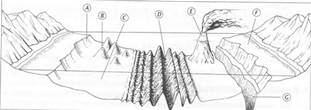
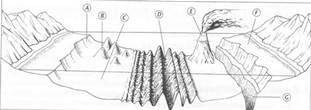
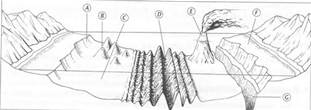
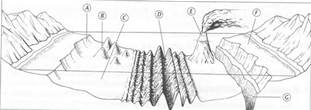
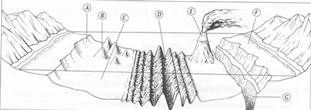
A seamount is an underwater mountain that peaks at least 1000 meters above the ocean floor and does not reach the ocean’s surface. Which letter on the diagram most likely labels a seamount?

a)

E

b)

D

c)

G

d)

C

6.

Which is most likely represented by B?

a)

continental slope

b)

oceanic trench

c)

volcanic island

d)

abyssal plain

7.

Ocean currents moving toward the poles are ____currents, while those moving toward the equator are ____ currents.

a)

cold, warm

b)

warm, cold

8.

Every year, the Moon’s distance from the Earth increases by about 3.8 cm. When the Moon comes to be a much greater distance from Earth, Earth’s oceans will experience

a)

less extreme tides than they do today

b)

tides that are similar as those found today

c)

more extreme tides than they do today

d)

tides that are not even noticeable

9.
What part of the water cycle does this picture show?
a)
condensation
b)
precipitation
c)
evaporation
10.
97% of Earth's water is __________ water.
a)
Fresh
b)
Salt
11.
The energy for the water cycle originally comes from the
a)
sun
b)
clouds
c)
salinity
d)
ice
12.
In the water cycle, water moves between land, living things, bodies of water on Earth's surface, and the _____________________.
a)
School
b)
Animals
c)
Ocean
d)
Atmosphere
13.
Fresh water makes up what percent of the Earth's water?
a)
5%
b)
10%
c)
4%
d)
3%
14.
Most of the Fresh water on Earth is
a)
in the ocean
b)
underground
c)
frozen
d)
in rivers
15.
Which ocean is our largest ocean?
a)
Artic
b)
Indian
c)
Atlantic
d)
Pacific
16.

About 30% of freshwater is located:

a)

Frozen

b)

Ground

c)

Lakes

d)

Rivers

17.
The _____ drives the water cycle
a)
moon
b)
tides
c)
sun
d)
core
18.

Which of the following is a process that occurs in the water cycle?

a)

condensation

b)

evaporation

c)

precipitation

d)

all of the above

19.

Sources of salt water on Earth include ice, rivers, lakes, and groundwater.

a)

True

b)

False

20.

What is one way the oceans gets lower in salinity?

a)

High Precipitation

b)

High Freezing

c)

High Temperature

21.

How can you increase salinity?

a)

Increase rain

b)

Melt glaciers

c)

Evaporation

22.
Which factor does not affect the salinity of ocean water?
a)
precipitation
b)
dissolved gasses
c)
temperature
d)
evaporation
23.
What is the primary cause of ocean waves?
a)
upwellings
b)
wind
c)
density differences in ocean water
d)
temperature differences in ocean water
24.
Which of the following statements is true about ocean water temperature and depth?
a)
As depth increases, temperature increases.
b)
As depth increases, temperature decreases.
c)
As depth increases, temperature decreases, then increases.
d)
  Temperature and depth are not related in ocean water.
25.
As you travel deeper in the ocean...
a)
Temperature increases
b)
Light increases
c)
Pressure decreases
d)
Temperature decreases
26.
What term describes an underwater river?
a)
Tide
b)
Current
c)
Wave
d)
The Coriolis Effect
27.
Why do waves only move on the surface?
a)
Wind cannot reach low depths
b)
Too much pressure
c)
Not enough sunlight
d)
The temperature is too low
28.
What term is the measure of dissolved salts in water?
a)
Thermocline
b)
Salinity
c)
Saltiness
d)
Tides
29.
Why is the Dead Sea so salty?
a)
Water evaporates quickly in the hot, arid climate
b)
Fresh water is being added often
c)
Lots of fish have died in there
d)
People visit and pour salt into it
30.
Which of the following would have the lowest salinity?
a)
Middle of the Ocean
b)
Mouth of a river
c)
Dead Sea
d)
Bottom of a trench
31.
Which of the following would NOT change the density of water
a)
Temperature
b)
Salinity
c)
Color
d)
All of these change density
32.
Cold and warm ocean water is carried around the world by
a)
spring tides
b)
currents
c)
neap tides
d)
tsunamis
33.
As you go deeper in the ocean, which of the following does not decrease?
a)
temperature
b)
light
c)
the number of algae
d)
pressure
34.
Both surface currents and waves are caused mainly by
a)
differences in the density of water
b)
the Coriolis effect
c)
winds
d)
the moon's gravity
35.
Exploring the bottom of the ocean is difficult because of its
a)
darkness
b)
high water pressure
c)
cold temperature 
d)
all of the above
36.
The density of sea water depends on its temperature and __________
a)
salinity
b)
turbidity
c)
pressure
d)
humidity
37.
Deep Ocean currents are a result of
a)
Global Wind Patterns
b)
Earth's Rotation
c)
Density
d)
All of the above
38.
Cold water is _______ dense than warm water
a)
More
b)
Less
c)
equally
39.

The area between the high tide and the low tide mark

a)

benthic zone

b)

intertidal zone

c)

pelagic zone

d)

abyssal zone

40.

Organisms/lifestyle where they live on or in the bottom

a)

benthos

b)

neuston

c)

littoral

d)

heterotrophs

41.

The gently sloping shallow sea bed surrounding a continent

a)

abyssal

b)

bathyal

c)

littoral

d)

continental shelf

42.

Organisms that are able to swim against the ocean’s currents-- they do not just freely float and move where the currents take them.

a)

neuston

b)

plankton

c)

nekton

d)

naphron

43.

The bottom portion of the ocean/ocean floor.

a)

pelagic zone

b)

bathyal zone

c)

neustonic zone

d)

benthic zone

44.

Organisms that drift in the ocean-- they are unable to swim against the currents

a)

benthos

b)

plankton

c)

nekton

d)

epifauna

45.
Most of Earths fresh water (~70%) is used for _____?
a)
Agriculture (farming)
b)
Industry (making products)
c)
Domestic (at home)
46.
A lack of water in an area is called ____.
a)
water scarcity
b)
water footprint
47.

Water on the top of Earth's surface can form lakes or rivers, these are termed ____.

a)

fresh water

b)

infiltration

c)

surface water

d)

groundwater

48.
What is the driving force of the water cycle?
a)
evaporation from the ocean
b)
heat from the sun
c)
precipitation from rainfall
d)
runoff from mountains
49.
The amount of water on average used by individuals, based on domestic is and agricultural or industrial consumption is termed ____.
a)
transpiration
b)
fresh water
c)
water scarcity
d)
water footprint
50.
Which correctly describes the flow of the water cycle.
a)
It follows a set pattern or route
b)
It follows no set pattern or route
51.
When water falls from the sky as rain, hail, sleet or snow.
a)
Condensation
b)
Precipitation
c)
Evaporation
d)
Transpiration
52.
The average water footprint in the United States is ____?
a)
1,500 gallons per day
b)
2,200 gallons per day
c)
3,500 gallons per day
d)
4,200 gallons per day
53.
1 out of 5 of children ____________ die worldwide due to water related diseases.
a)
ages 2 and under
b)
ages 5 and under
c)
ages 11 and under
d)
ages 13 and under
54.
How does investing in water quality impact a countries economy?
a)
They economy losses money in additional costs
b)
The economy is boosted by healthier citizens
55.
Water on earth can be found in the form of _____. 
a)
Water Vapor 
b)
Liquid Water 
c)
Ice 
d)
All of the Above
56.

Is the water that was on the earth millions of years ago still on earth today?

a)

YES!

b)

No Way!

57.

Why is it important to conserve water?

a)

It isn't important. We live in a water abundant country.

b)

It's only important for physically scarce or economically scarce areas.

c)

It just is.

d)

Water is a limited resource and can/will run out.

58.

Identify the common sectors that use water.

a)

Industrial

b)

Coastal

c)

Agricultural

d)

Political

e)

Domestic

59.

High income countries, like the United States or Canada, use a higher proportion of water on ___ than developing countries.

a)

agriculture

b)

domestic

c)

industry

60.

Areas of economic water scarcity tend to be located in areas

a)

of high economic development.

b)

with low levels of precipitation.

c)

of low economic development.

d)

with high temperatures.

61.

Identify the region that experiences physical water scarcity.

a)

Northern Europe

b)

Southwest United States

c)

Southeast Asia

d)

Indonesia

62.

Which option would be the most appropriate solution for a high income country?

a)

Spill over ponds

b)

Desalination plants

c)

Terracing

d)

Sediment trapping

63.

Which option would be the most appropriate solution for a low income country?

a)

Reservoir and dam

b)

Improving infrastructure such as pipes and treatment

c)

Water conservation and storage

d)

Desalination plants

64.

The Mariana __________ is the deepest known place on Earth

a)

Volcanoe

b)

Seamount

c)

Ridge

d)

Trench

65.
Which best represents the order of seafloor features as you move from the shoreline to the deep ocean?
a)
 Continental slope – continental shelf- continental rise – mid-ocean ridge
b)
 Continental rise – continental shelf – mid-ocean ridge -  continental slope
c)
 Continental shelf – continental slope – continental rise – mid-ocean ridge
d)
   Mid-ocean ridge – continental rise – continental shelf- continental slope
66.
What is letter D?
a)
Cont. Shelf
b)
Mid-Ocean Ridge
c)
Volcanic Island
d)
Seamount
67.
What is letter E?
a)
Volcanic Island
b)
Seamount
c)
Mid-Ocean Ridge
d)
Abyssal Plain
68.
What is letter G?
a)
Mid-Ocean Ridge
b)
Rift
c)
Trench
d)
Cont. Shelf
69.

The gradually sloping part of a continent that extends under the ocean is the _____.

a)

continental slope

b)

continental shelf

c)

abyssal plain

d)

trench

70.

The continental slope is located at the end of the

a)

shoreline

b)

continental shelf

c)

mid ocean ridge

d)

abyssal plain

71.

The place where new ocean floor forms is called the

a)

mid-ocean ridge

b)

abyssal plain

c)

trench

d)

continental shelf

72.
What is the difference between a volcanic island & a seamount?
a)
A volcanic island rises above the water & a seamount does not
b)
A seamount rises above the water & a volcanic island does not
c)
Both the seamount & volcanic island are underwater
d)
Both the seamount & the volcanic island rise above the water
73.

What is letter A?

a)

Continental Shelf

b)

Continental Slope

c)

Seamount

d)

Abyssal Plain

74.

What is letter C?

a)

Mid-Ocean Ridge

b)

Continental Shelf

c)

Continental Slope

d)

Abyssal Plain

75.

Modern scientists use ______ to determine the oceans depth.

a)

Submarines

b)

SONAR

c)

SCUBA

d)

Weighted lines