wayground logo

Free Printable Worksheets

Font size

S
M
L
XL
Worksheets

8th grade Science MAAP Review

Total questions: 70

Worksheet time: 45mins

Name
Class
Date
1.
Which is an example of erosion?
a)
water sitting in a well
b)
magma rising in a volcano
c)
wind blowing sand on a beach
d)
heat melting rock underground
2.
A girl collects rocks while at the beach.  She notices that the rocks are milky white and contain fossils.  What type of rock has she found?
a)
Sedimentary, because it contains fossils
b)
Sedimentary, because it is milky white
c)
Metamorphic, because it contains fossils
d)
Metamorphic, because it is milky white
3.
A girl collects rocks while at the beach.  She notices that the rocks are milky white and contain fossils.  What type of rock has she found?
a)
Sedimentary, because it contains fossils
b)
Sedimentary, because it is milky white
c)
Metamorphic, because it contains fossils
d)
Metamorphic, because it is milky white
4.
Where are earthquakes most likely to occur?
a)
In the middle of plates
b)
In the oceans
c)
Along plate boundaries
d)
Anywhere on the Earth
5.
Suppose you find fossils of dinosaurs on an island but no fossils of bird or mammal fossils found on the continent it broke off from  This information provides evidence of _________________.
a)
global warming
b)
seafloor spreading
c)
mountain building
d)
continental drift
6.
In order to be an index fossil the fossil must
a)
exist for a short period of time over a large area.
b)
exist for a long period of time over a small area.
c)
exist in spotty areas around the world.
d)
exist, die out,  and come back into existence.
7.

True or false?

When white light strikes an object, we only see the colors that are absorbed.

a)

true

b)

false

8.

The color of objects that we see is the color of the wavelength that is _______ from its surface.

a)

opaque

b)

absorbed

c)

reflected

d)

shined

9.

A compression of a wave can be described as...

a)

the part of a sound wave where the particles are close together

b)

the part of a sound wave where the particles are spread apart

c)

The resting point of the wave

10.

Which of the following statements about sound waves is true?

a)

Sound is a transverse wave that can only travel in water.

b)

Sound waves cannot typically be easily decoded by animals

c)

A sound wave is a longitudinal wave that needs a medium in order to be transmitted.

11.

Is this picture showing a balanced or unbalanced force?

a)

balanced

b)

unbalanced

c)

neither

12.

Is the picture showing a balanced or unbalanced force?

a)

balanced

b)

unbalanced

c)

neither

13.

What is the net force acting on this box?

a)

18 N

b)

80 N

c)

2 N

d)

108 N

14.

What is the net force acting on this box?

a)

30 N

b)

6030 N

c)

60 N

d)

90 N

15.
Which law states that acceleration depends on an objects mass and the force acting on it.
a)
Newton's 1st
b)
Newton's 2nd
c)
Newton's 3rd
16.
Which law states that an object in motion will stay in motion or at rest unless acted upon by a nonzero force
a)
Newton's 1st
b)
Newton's 2nd
c)
Newton's 3rd
17.
Which law states that an object that exerts a force on another object will receive an equal and opposite force from the second object
a)
Newton's 1st
b)
Newton's 2nd
c)
Newton's 3rd
18.
The resistance to change in motion.
a)
Inert
b)
Inertia
c)
Inerf
d)
iPad
19.
To increase acceleration of an object you reduce its ______ and/or increase the applied force
a)
mass
b)
volume
c)
length
d)
density
20.
If you sit on a chair, the chair pushes up with a ________ force
a)
stronger
b)
weaker
c)
equal 
21.
Acceleration depends on mass and the _______ acting on it.
a)
mass
b)
volume
c)
force
d)
speed
22.
What is the SI unit for acceleration?
a)
m/s^2
b)
m/s^3
c)
m/s
d)
mi/hr
23.
"For every action, there is an equal and opposite reaction."
a)
Newton's 1st Law
b)
Newton's 2nd Law
c)
Newton's 3rd Law
d)
Newton's 4th Law
24.
Force = Mass x Acceleration
a)
Newton's 1st Law
b)
Newton's 2nd Law
c)
Newton's 3rd Law
d)
Newton's 4th Law
25.
The tendency of an object to resist changes in its motion is...
a)
inertia
b)
force
c)
acceleration
d)
velocity
26.
The differences among a species, like different bird beaks, are called
a)
genes.
b)
variations.
c)
traits.
d)
theories.
27.
Behavioral changes of individuals of a species that allow for better survival. (Acquired traits)
a)
Variation
b)
Adaptation
c)
Behavior
d)
Environment
28.
Where the better adapted organisms survive to pass traits along to offspring.
a)
Evolution
b)
Natural Selection
c)
Extinction
d)
Artifical Selection
29.
What is the advantage of having different shaped beaks?
a)
To look different from other species.
b)
To be able to eat the food readily available in the environment.
c)
To protect itself against predators.
d)
To protect itself against prey.
30.
Why are advantageous traits more likely to be passed onto offspring?
a)
Because they are more likely to survive and reproduce.
b)
Because they come from dominant alleles.
c)
Because they come from recessive alleles.
d)
Because the trait is an acquired phenotype.
31.
When every organism of a species has died.
a)
Evolution
b)
Natural Selection
c)
Extinction
d)
Artificial Selection
32.
Mutations are a change in what?
a)
DNA
b)
tRNA
c)
genotype
d)
phenotype
33.
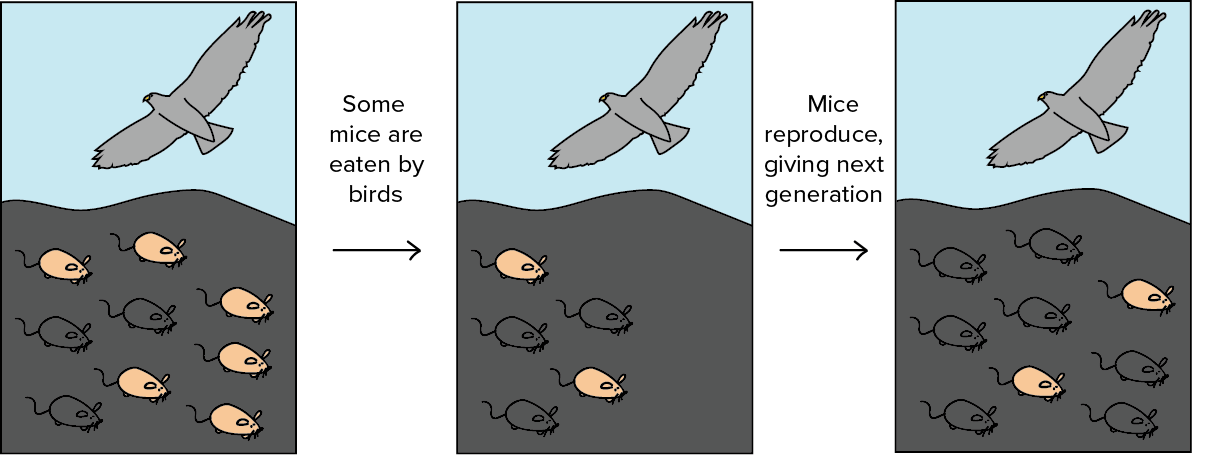
Why is the mouse population changing over time?
a)
The light mice can reproduce more successfully than the dark mice
b)
The hawks eat more dark mice than light mice because the dark mice taste better
c)
The hawks eat more light mice than dark mice because they can see the light mice more easily
d)
The hawks eat more dark mice than light mice because they can see the dark mice more easily
34.

Based on the organism skulls, which organisms share the most recent common ancestor?

​Select the two correct answers.

a)
b)
c)
d)
e)
35.

​Based on the fossil layers shown, what can you infer about the past environment at this location?

a)

The environment at this location has never changed

b)

The organisms at this environment became simpler over time

c)

The environment began as a dry land environment, then evolved into an ocean or water environment.

d)

The environment began as an ocean or water environment, then evolved into a dry land environment.

36.

Selective breeding is...

a)

a process to create an organism with desired traits from parents with those desired traits

b)

natural method of producing offspring with desired traits

c)

creating a new species

d)

making organisms reproduce during times of stress

37.

An example of selective breeding is

a)

a dog breeder mating 2 dogs to make more dogs

b)

a farmer grows bees to pollinate the plants on his farm

c)

a person pollinates 2 white rose plants to only create white roses

38.

One problem with selective breeding is

a)

creating a new species

b)

gene variety is lost

c)

extinction of a species

39.

Which of these is the first step in selective breeding flowers.

a)

Repeat the process only with the offspring with the desired traits

b)

watch the seeds grow

c)

Choose plants that have the desired trait to pollinate

d)

chose which trait is desirable

40.

A segment of DNA that codes for a trait

a)

gene

b)

centromere

c)

chromosome

d)

chromatid

41.

an observable characteristic

a)

trait

b)

personality

c)

cell

d)

DNA

42.

A version or variation of a gene

a)

trait

b)

gene

c)

allele

d)

DNA

43.

The alleles that an organism has/inherits are its

a)

genotype

b)

phenotype

c)

chromosome

d)

recessive

44.

The observable expression of a trait is its

a)

phenotype

b)

genotype

c)

chromosome

d)

allele

45.

Long strands of DNA are wrapped into

a)

DNA

b)

Chromosome

c)

Alleles

d)

Phenotype

46.
Chromosomes are made of
a)
DNA
b)
RNT
c)
WWE
d)
DMA
47.

The physical expression of a trait.

a)

phenotype

b)

genotype

c)

chromosome

d)

allele

48.

Hair color and eye color are examples of a person's....

a)

recessive traits

b)

dominant alleles

c)

genotype

d)

phenotype

49.

The passing of traits from parents to offspring is known as....

a)

hierarchy

b)

heredity

c)

traits

d)

genetics

50.
Genes always appear in pairs. Your parents donate ________ allele for every trait.
a)
1
b)
2
c)
23
d)
46
51.

What phase is this?

a)

Metaphase I

b)

Prophase II

c)

Telophase I

d)

Anaphase II

52.

What phase is this?

a)

Telophase I

b)

Prophase II

c)

Metaphase I

d)

Anaphase II

53.

What phase is this?

a)

Metaphase II

b)

Prophase II

c)

Telophase I

d)

Anaphase I

54.

What phase is this?

a)

Metaphase II

b)

Prophase I

c)

Telophase I

d)

Anaphase II

55.

What phase is this?

a)

Metaphase II

b)

Prophase I

c)

Telophase I

d)

Anaphase I

56.

What phase is this?

a)

Telophase II

b)

Anaphase II

c)

Telophase I

d)

Anaphase I

57.

What phase is this?

a)

Metaphase II

b)

Prophase I

c)

Telophase II

d)

Anaphase I

58.

What phase is this?

a)

Anaphase II

b)

Telophase I

c)

Telophase II

d)

Anaphase I

59.
The structure shown in the diagram is a _____________?
a)
chromatid
b)
chromosome
c)
centromere
d)
DNA
60.
Which stage of mitosis is shown in the diagram?
a)
Anaphase
b)
Cytonkinesis
c)
Interphase
d)
Prophase
61.
Which stage of mitosis is shown in the diagram?
a)
Cytokinesis
b)
Interphase
c)
Anaphase
d)
Metaphase
62.
How many chromosomes do humans have?
a)
46
b)
21
c)
10
63.

Examine the diagram of a volcano.

Which letter indicates magma?

a)

W

b)

X

c)

Y

d)

Z

64.

A student prepared a list of changes that can occur to landforms through volcanic eruptions.

Which changes in the student’s list are correct?

a)

1 and 2

b)

1 and 3

c)

2 and 3

d)

3 and 4

65.

How do volcanoes act as constructive forces?

a)

Volcanoes emit ash and other particles into the air, which prevent the formation of clouds. 

b)

Volcanoes release heat from Earth’s mantle, which prevents the crust from sinking.

c)

The lava from underwater volcanoes can create new islands.

d)

The lava from surface volcanoes can burn surrounding forests.

66.

Which statement correctly describes the impact of water flowing in a river?

a)

Water in a river is always a destructive force.

b)

Water in a river is always a constructive force.

c)

Water in a river can be both a constructive and a destructive force.

d)

Water in a river can be neither a constructive nor a destructive force.

67.

What are the two types of waves?

a)

longitudinal and transverse

b)

sound and light

68.

What is the number of complete waves passing a fixed point in a given amount of time?

a)

Amplitude

b)

Intensity

c)

Wavelength

d)

Frequency

69.

What is frequency measured in?

a)

Milliseconds

b)

Miles

c)

Hertz

d)

Kilograms

70.

What is the distance between the calm sea and the highest wave called?

a)

Wave

b)

Frequency

c)

Amplitude

d)

Magnitude