
 Worksheets
Grade 9 - The Nervous system
Total questions: 66
Worksheet time: 1hrs 18mins
Which parts make up the peripheral nervous system?
Brain
Sensory neuron
Motor neuron
Spinal cord
Which parts make up the central nervous system?
Brain
Sensory neuron
Motor neuron
Spinal cord
Which is the correct order/sequence of the parts of a neuron in a neural impulse?
afferent/sensory neurons
efferent/motor neurons

.
Label the Neuron-What does the letter "H" represent?
Schwan celln
Axon terminal
Axon
Dendrite

What is the name of the blue structure
axon terminal
dendrite
schwann cell
axon

Myelin would be which color of structure?
the red one
the blue one
the green one
the purple one
The basic unit of structure and function in the nervous system is a nerve cell. Nerve cells are also called...
Spinal Cord
Neurons
Dendrites
Brain
Which part of the brain is in charge of balance?
Cerebellum
Cerebrum
Brain Stem
Frontal Lobe

What part of the Nervous System is "B"?
Spinal Cord
Nerves
Brain
Ribs
The Nervous System is divided into 2 parts called
The Corollary Nervous system and Peripheral Nervous system
The Central Nervous system and Peripheral Nervous system
The Central Nervous system and Paradigm Nervous system
The Corollary Nervous system and Paradigm Nervous system

The letter "B" represents which part of the brain?
Brain stem
Cerebellum
Cerebrum
Hypothalamus
An electrical impulse within a single neuron is called a
synapse
membrane potential
action potential
cell body

What type of neuron is A?
Sensory
Inter
Motor
What type of neuron is C?
Sensory
Inter
Motor
Which statement best describes a reflex?
Slow response that you have to think about
Rapid response to protect body from harm

Which number represents the stimulus?
1
2
3
4
This part of the eye has color and opens and closes. What is it?
Iris
Retina
Optic Nerve
Cornea
Light enters this part of the eye. What is it?
Lens
Pupil
Retina
Optic Nerve
This part of the eye focuses on what we see and makes it clearer. What is it?
Retina
Lens
Cornea
Iris
This sends the image of what the eye sees to the brain. What is it?
Optic Nerve
Retina
Lens
Iris

Scatter

How do light rays travel?
In a straight line
In a curved line
Cornea
The clear, outer covering of the eyeball.
The white part of the eye.
What cells help to detect colors?
cornea
cone cells
retina

# 5 refers to the layer of receptor cells at the back of the eye in which the image is focused
Retina
Lens
Optic Nerve
Lens
carries messages from the eye to the brain
lens
vitreous humor
retina
optic nerve


Sound is caused by ....
instruments
vibrations
force
volume
The correct unit for wavelength is:
Hz
S
m
cm
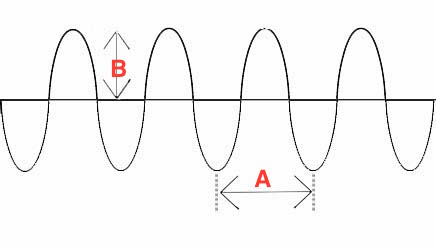
The distance between two troughs in a wave is:
frequency
wavelength
equilibrium
period
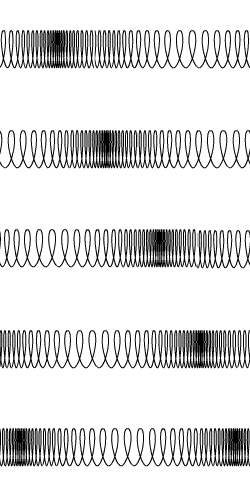
The area of a longitudinal wave where the particles are crowded together.
compression
crest
transverse
medium
The highest point on a wave.
frequency
compression
trough
crest


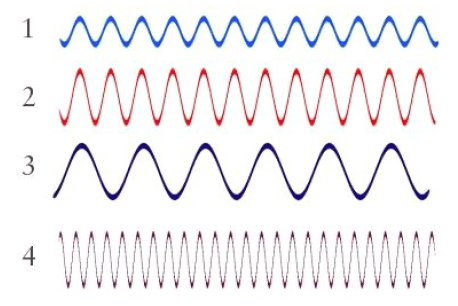
What is frequency measured in?
Milliseconds
Miles
Hertz
Kilograms
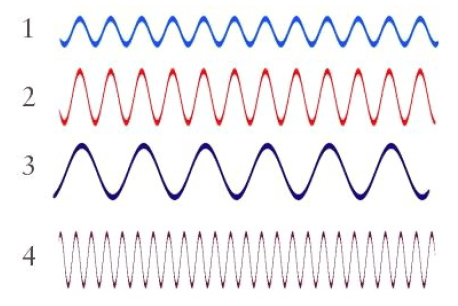

The distance between two consecutive crests.
Wavelength
Medium
Frequency
LIne of Origin

Which wave has the largest amplitude?
Green
Blue
Red

What is amplitude as it refers to sound waves?
The distance between the same two points on a wave
The number of waves per second
The measure of the height of the wave
The frequency of the wave

Which of these waves would have a higher pitch?
Low Frequency
High Frequency
Frequency does not determine pitch
Farsightedness
Myopia
Hyperopia
both
Nearsightedness
Myopia
Hyperopia
both
May result from eyeball being too short
Myopia
Hyperopia
Both
May result from eyeball being too long
Myopia
Hyperopia
Both
Focal point is behind the eyeball
Myopia
Hyperopia
Both
Focal point is in front of retina
Myopia
Hyperopia
Both

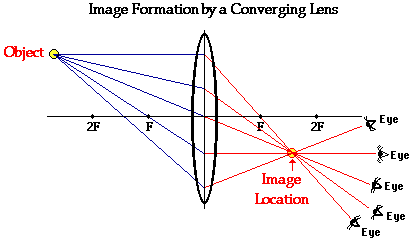
Which lens represents the path light takes through a diverging lens?


The above lens is a type of ___.
diverging lens
converging lens
are the two openings of the nose.
nostrils
nasal cavity
olfactory bulb
The space inside the nose is called .
nostril
nasal cavity
olfactory bulb
It interprets this smell.
nasal cavity
olfactory bulb
nostril

You taste food on your__________.
lips
taste buds
nose
skin

