wayground logo

Free Printable Worksheets

Font size

S
M
L
XL
Worksheets

Evolution Unit Study Guide

Total questions: 76

Worksheet time: 2hrs 0mins

Name
Class
Date
1.
The law of superposition states
a)
the oldest rock layer is on the top, the younger rock layer is on the bottom
b)
rock layers are always in sequence from oldest to youngest
c)
the youngest rock layer is on the bottom and the oldest is on the top
d)
the oldest layer is on the bottom and the youngest is on the top when it is undisturbed
2.
What can help a scientist know the approximate age of bones?
a)
the soil it is found in
b)
the index fossils in the area
c)
the type of rock it is formed in
d)
absolute dating
3.
Scientist find dinosaur fossils in the bottom of a cliff and mammals fossils in the middle layer, what can be inferred?
a)
dinosaurs ate plants
b)
dinosaurs were eaten by the mammals
c)
they lived at the same time
d)
dinosaurs lived before the mammals
4.
Ostrich wings are examples of
a)
homologous structures
b)
vestigial structures
c)
adaptations
d)
traits
5.
Dolphins have the same arm structure as wolfs, what type of evidence for evolution does this represent?
a)
DNA
b)
vestigial structures
c)
homologous structures
d)
embryology
6.
What would indicate that a series of fossils represent evolution?
a)
the fossils were identical
b)
the fossils were found in the same layers of rock
c)
the fossils show similarities
d)
the fossils were completely different
7.
Change over time is
a)
evolution
b)
generation
c)
growth
d)
biogenesis
8.
What animal is Darwin known for studying?
a)
dinosaurs
b)
tunicates
c)
finches
d)
horses
9.
Natural selection is
a)
survival of the fittest
b)
humans change
c)
two species are the same
d)
more animals survive
10.
This makes an organism more suited to its enviornment
a)
species
b)
lifespan
c)
adaptation
d)
mutation
11.
Surviving and reproducing show that an organism
a)
is adapting
b)
is not adapting
c)
is forming fossils
d)
is not reproducing
12.
What is one reason that strawberries are surviving in the winter season?
a)
they have larger leaves
b)
they have genetic variations allowing them to be resistant to cold
c)
they reproduce more
d)
the color is dark
13.
Who was Charles Darwin?
a)
A naturalist who came up with the theory of evolution
b)
A scientist who studied plants
c)
A geologist who looked at rocks and fossils
d)
A paleontologist who studied dinosaurs
14.
Relative dating
a)
gives the exact age of rocks and fossils
b)
is when you date your cousin
c)
gives the approximate age of rocks
d)
tells us who to trust
15.
Darwin wrote that organisms with traits that are best suited to the environment will ________________
a)
increase in number
b)
become extinct
16.
Which of the following is NOT an example of natural selection? 
a)
People selectively breeding hamsters.
b)
Insect populations developing resistance to certain pesticides.
c)
Bacteria becoming resistant to antibiotics.
d)
Male birds of certain species developing colorful feathers to attract female mates.
17.
What characteristic did Darwin observe about the finches on the Galapagos Islands?
a)
Their feathers 
b)
Genotypes 
c)
Their beaks
d)
Their body sizes
18.
Which term refers to the process by which individuals that are better suited to the environment survive and reproduce therefore passing down their genes to their offspring? 
a)
Evolution 
b)
Variation 
c)
Adaptation
d)
Natural Selection 
19.
Which species’ DNA is most similar to the DNA of the toothed whale? 
a)
Hippopotamus 
b)
Baleen Whale
c)
Grazing Mammals
d)
Camels
20.
When an organism completely dies out, it is called.....
a)
Adaption
b)
Extinction
c)
Fossilization
d)
Mutation
21.
The separation of a group of individuals from the rest of the population is referred to as 
a)
genetic drift
b)
natural selection
c)
geographic isolation
d)
survival of the fittest
22.
What is the advantage of having different shaped beaks?
a)
To look different from other species.
b)
To be able to eat the food readily available in the environment.
c)
To protect itself against predators.
d)
To protect itself against prey.
23.
Why are advantageous traits more likely to be passed onto offspring?
a)
Because they are more likely to survive and reproduce.
b)
Because they come from dominant alleles.
c)
Because they come from recessive alleles.
d)
Because the trait is an acquired phenotype.
24.
Mutations are a change in what?
a)
DNA
b)
tRNA
c)
genotype
d)
phenotype
25.
Where humans have bred organisms together based on traits we like.
a)
Evolution
b)
Natural Selection
c)
Extinction 
d)
Artificial Selection
26.
Genetic differences between organisms of the same species
a)
Variation
b)
Adaptation
c)
Behavior
d)
Environment
27.
Structures with the same parts have different functions; suggests that organisms share a common ancestry
a)
vestigial structures
b)
homologous structures
c)
adaptive radiation
d)
fossil
28.
Some organisms that share a common ancestor have features that have different functions, but similar structures.  These are known as
a)
vestigial structures
b)
analogous structures
c)
homologous structures
d)
fossil structures
29.

Scientists have collected millions of fossils of different organisms, and have developed a timeline of life on Earth. What do we call this?

a)

Mutation

b)

Natural Selection

c)

The theory of evolution

d)

Fossil Record

30.

What most likely caused the finches on the Galapagos Islands to have beaks that were different from the finches on the mainland?

a)

There were different types of predators on the island.

b)

There were different types of food available on the island.

c)

The finches had no water to drink.

d)

The finches on the mainland could not fly high enough.

31.
Darwin's expedition was called the Voyage of the _________.
a)
Titanic
b)
Beagle
32.
Remains of ancient organisms are called
a)
Extinctions
b)
Fossils
c)
Mutations
d)
Variations
33.
Which of the following is NOT a factor that affects the process of natural selection?
a)
Overpopulation
b)
Fossils
c)
Competition
d)
Variations
34.
A well-tested concept that explains a wide range of observations is called a(an):
a)
hypothesis
b)
experiment
c)
cause and effect
d)
scientific theory
35.
A group of similar organisms that can mate with each other and produce fertile offspring is called a species.  
a)
True  
b)
False
36.

What do we call structures that no longer perform their original function?

a)

Natural Selection

b)

Analogous Structure

c)

Vestigial Structure

d)

Homologous Structure

37.

Hibernation is an example of which type of adaptation?

a)

Behavioral Adaptation

b)

Physical Adaptation

38.

Select ALL the parts of Natural Selection.

a)

overproduction

b)

evolution

c)

variation

d)

selection

e)

competition

39.

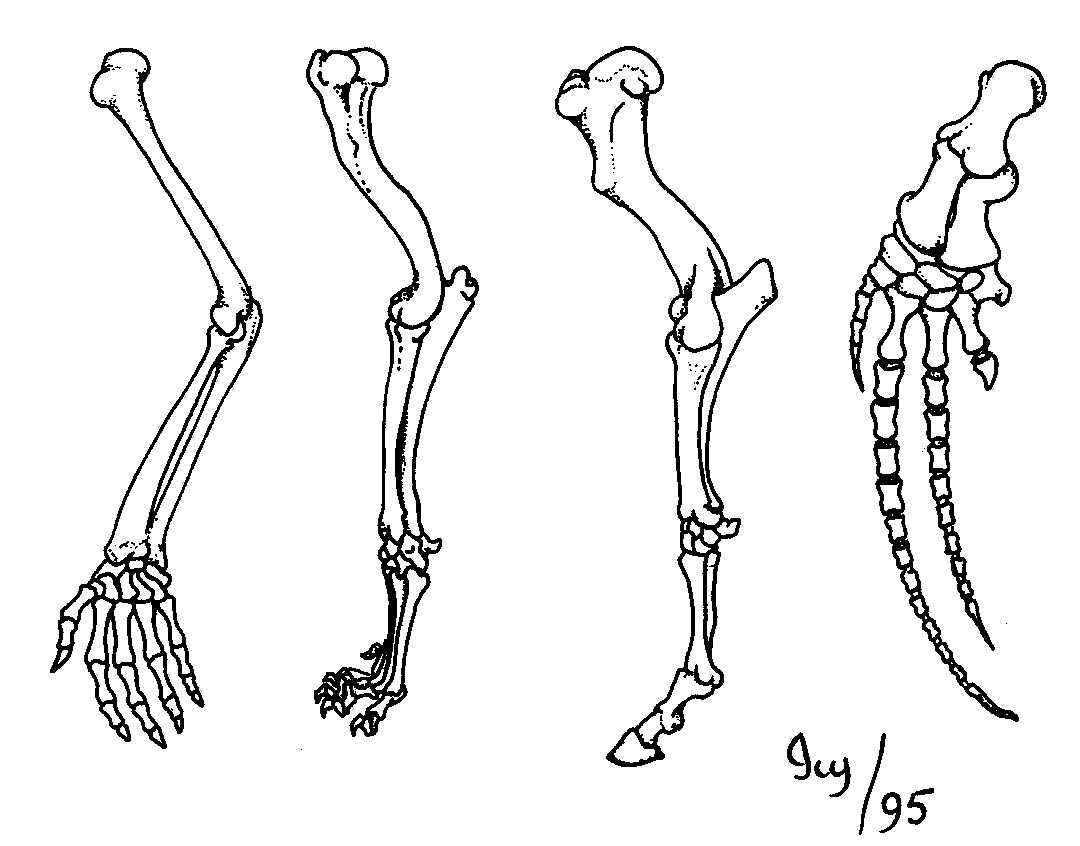
What type of evidence is shown in the image above?

a)

Fossils

b)

Vestigial structures

c)

Homologous Structures

d)

DNA

40.

Adaptations are:

a)

physical or behavioral tendencies.

b)

physical or behavioral characteristics that help an organisms survive and reproduce.

c)

physical or behavioral characteristics that do not help the organism in any way.

d)

genetic mutations that have gone wrong.

41.
The diagram shows fossils in different rock layers. Which of these statements about the age of these fossils is most likely correct?
a)
Fossil A and C are the same age
b)
Fossil B is older than fossil C
c)
Fossils A is older than fossil B
d)
Fossil D is older than fossil C
42.

The process by which two populations of the same species become so different that they can no longer interbreed.

a)

natural selection

b)

artificial selection

c)

speciation

d)

fossilization

43.

What are the 3 steps of speciation?

a)

Overproduction

b)

Separation

c)

Struggle for survival

d)

Adaptation

e)

Division

44.

Which of the following is true about the picture above?

a)

Camels are highly adapted to cold climates.

b)

There are no benefits to using a camel vs. a horse in the desert.

c)

Camels have directly evolved from whales.

d)

A camels long large intestine, long eyelashes and wide feet allow it to be very adapted to the desert.

45.
This is a group of organisms of the same species that live in a specific geographical area.
a)
Environment
b)
Evolution
c)
Biological diversity
d)
Populations
46.
This is the variation of living organisms.
a)
Biological diversity
b)
Evolution
c)
Environment
d)
Natural selection
47.
This is an ecological relationship in which two or more organisms depend on the same limited resource.
a)
Adaptation
b)
Competition
c)
Evolution
d)
Natural selection
48.
The death of every member of a species.
a)
Competition
b)
Population
c)
Extinction
d)
Evidence
49.
What does this picture model?
a)
DNA structure of the horse
b)
Evolution of the horse
c)
Extinction of the horse
d)
Singular traite of the horse
50.
Which would NOT be considered a fossil?
a)
bones buried deep in the earth
b)
footprints harened in  mud or rocks
c)
imprints left in rocks
d)
stories passed down from generation to generation
51.

Which of these are true about Extinct Species? (multiple answers)

a)

All members of the species are dead.

b)

The species had no successful traits for the environment.

c)

They won't be found in the fossil record after their extinction.

d)

Only some of the members are still alive.

52.

The fossil record help scientists

a)

better understand the kinds of organisms that lived in the past

b)

better understand how the environment has changed over time

c)

better understand how organisms have evolved over time

d)

all of the above

53.

The earliest organisms were ___________; the more recent organisms are ____________.

a)

simple; more complex

b)

complex; more simple

54.
A theory has significant evidence to support it.  True or False
a)
True
b)
False
55.
What is the most helpful thing when looking at a fossil record?
a)
size of the fossil
b)
color of the fossil
c)
surface area of the rocks found around the fossil
d)
depths in which the fossils are found
56.
If scientist were to find 4 fossil that appear to be of the same ancestor, what can be concluded?
a)
number of each fossil are similiar
b)
members of the group living today live together
c)
fossils were found in the same rock layer
d)
fossils have similar chacteristics
57.
When lions prey on a herd of antelope some antelopes are killed and same escape. Which part of Darwin's concept of natural selection might be used to describe this situation?
a)
acquired characteristics
b)
reproductive isolation
c)
survival of the fittest
d)
descent with modification
58.
What does Darwin's theory of evolution suggest?
a)
species change over time
b)
extinct species are not related to living species
c)
different species can interbreed
d)
animals that look alike are most closely related
59.

Natural selection is the process that passes down ____________________ traits.

a)

Same

b)

Old

c)

Useless

d)

Favorable

60.

A mistake or change that occurs in the DNA sequence is called a ______________________.

a)

Extinction

b)

Speciation

c)

Mutation

d)

Genetic Variation

61.
differences in physical traits of an individual from the group to which it belongs
a)
Adaptation
b)
Variation
c)
Fittness
d)
Natural Selection
62.

A body, organ, or bone that is still present but no longer useful to the organism is ______________________.

a)

Homologous Structure

b)

Vestigial Structure

63.

A similar bone or organ within many different species of life is a ____________________.

a)

homologous structure

b)

vestigial structure

64.

When species evolve into another species; ______________________ occurs.

a)

Speciation

b)

Extinction

c)

Mutation

d)

Natural Selection

65.

What is the scientific name for modern day humans?

a)

Homo Habilis

b)

Homo Sapiens

c)

Homo Erectus

d)

Neanderthal

66.

selective pressure exerted by humans on populations in order to improve or modify particular desirable traits

a)

natural selection

b)

artificial selection

67.

body parts found in living organisms that no longer serve a purpose (not necessary for the organisms survival)

a)

analagous structures

b)

homologous structures

c)

vestigal structures

68.

On a farm, Marcia observes that individuals of a certain goat species have slightly different sizes and colors. What characteristic of populations is Marcia observing?

a)

adaption

b)

evolution

c)

selection

d)

variation

69.

Did Darwin or Lamarck think Giraffe's could stretch their necks and control it's height?

a)

Lamarck

b)

Darwin

70.

Did Darwin or Lamarck think that a body builders muscles could be passed down to their baby?

a)

Lamarck

b)

Darwin

71.

Do flashy colors developed in butterflies over time support Darwin or Lamarck's theories?

a)

Lamarck

b)

Darwin

72.

Which scientist thought that if you had tatoos you could pass them on to your children?

a)

Lamarck

b)

Darwin

73.

It the Artic wolf's color changing fur based on its season an evolutionary trait or an acquaired trait? Which scientists theory does it support?

a)

Lamarck

b)

Darwin

74.

Are the finches different types of beaks that were developed over time an example of Darwin or Lamarck's theories?

a)

Lamarck

b)

Darwin

75.

Which scientist supported the theory of Use and Disuse?

a)

Darwin

b)

Lamarck

76.

Which scientist thought that species changed over time?

a)

Darwin

b)

Lamarck