
 Worksheets
5th Grade Electricity and Magnetism GMAS Review
Total questions: 71
Worksheet time: 42mins
Name
Class
Date
1.

The smallest unit of an element is
a)
An electron
b)
A proton
c)
A neutron
d)
An atom
2.

The picture shows a hydrogen atom, what is it's atomic number
a)
0
b)
1
c)
2
d)
3
3.
If an object has the same number of positive and negative charges, its electrical charge is...
a)
positive
b)
negative
c)
neutral or no charge
d)
opposite
4.
What charge does a proton have?
a)
negative (-)
b)
positive (+)
c)
neutral or no charge (0)
5.
What charge does an electron have?
a)
negative (-)
b)
positive (+)
c)
neutral or no charge (0)
6.
Static electricity is
a)
The balance of electrical charge on an object
b)
The imbalance of electrical charge on an object
c)
The discharge of electrical charge
d)
The build up of protons in the nucleus of an atom
7.
True or False
Like charges repel
Like charges repel
a)
True
b)
False
8.
True or False
A positively charged object has lost electrons
A positively charged object has lost electrons
a)
True
b)
False
9.
If an atom gain's a proton then
a)
it is positively charged
b)
it is negatively charged
c)
it changes into a new element
d)
it explodes due to nuclear fussion
10.
Materials that tightly hold on to their electrons are considered
a)
Good conductors
b)
Good insulators
c)
Good anti-static agents
d)
Useful for storing charge
11.
Which one of these objects is a good insulator
a)
Copper wire
b)
Glass
c)
Aluminum
d)
Gold
12.
Materials that easily loose or accept electrons are considered
a)
Good conductors
b)
Good insulators
c)
Good anti-static agents
d)
Good for storing charge
13.
What is the major difference between static electricity and current electricity?
a)
Current electricity involves a continuous flow of neutrons; static electricity is a sudden transfer of protons
b)
Current electricity can be deadly; static electricity is almost always safe
c)
In current electricity, there's a single transfer of electrons; in static electricity, there's a steady flow of electrons
d)
Current electricity involves a flow of electrons; static electricity involves a single transfer of electrons
14.
Charge separation in clouds is one way
a)
that freezing rain occurs
b)
that lightning occurs
c)
that low pressure system occurs
d)
that a tornado occurs
15.
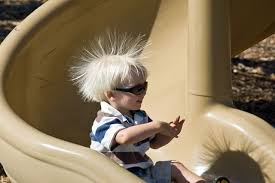
What method of static charging is shown in this picture
a)
Polarization
b)
Friction
c)
Induction
d)
Conduction
16.
Which technology uses static electrical charge to work
a)
Tesla Coil
b)
Turbine
c)
AC/DC Generator
d)
Photocopy Machine
17.
A flow of electrons through a conductor is called:
a)
A river
b)
A spark
c)
An electron flow
d)
A current
18.
A material in which electrons are able to move easily
a)
Circuit
b)
Insulator
c)
Resistance
d)
Conductor
19.
An example of a parallel circuit is
a)
the wiring in a house
b)
a flashlight
c)
a single circular path
20.
What does the switch do in a circuit?
a)
It supplies the power.
b)
It carries electricity.
c)
It opens and closes the circuit.
d)
It is an insulator.
21.
This allows only one path for the electrons to flow:
a)
conductor
b)
insulator
c)
parallel circuit
d)
series circuit
22.
Electricity is the flow of ______.
a)
electrons
b)
protons
c)
neutrons
d)
atoms
23.
When socks get stuck to towels in your dryer, this is an example of________________
a)
current electricity
b)
static electricity
24.
What types of charges attract?
a)
Positive and Positive
b)
Positive and Neutral
c)
Negative and Neutral
d)
Positive and Negative
25.
If a substance has a higher number of electrons than protons on its surface, what type of charge does it have?
a)
A positive charge.
b)
A negative charge.
c)
A neutral charge
d)
No charge at all
26.
What is the major difference between static electricity and current electricity?
a)
Current electricity involves a continuous flow of neutrons; static electricity is a sudden transfer of protons
b)
Current electricity can be deadly; static electricity is almost always safe
c)
In current electricity, there's a single transfer of electrons; in static electricity, there's a steady flow of electrons
d)
Current electricity involves a flow of electrons; static electricity involves a single transfer of electrons
27.
Wanda's dad wired new lights for her playground. When he thought everything was connected, he turned on the switch and nothing happened. What could be the problem?
a)
He put too many lights and switches in the circuit.
b)
He needed to connect more batteries to the circuit
c)
He made a mistake that caused an open circuit.
d)
He should have wired the circuit in parallel.
28.
When several light bulbs are connected in a series circuit, what will happen if one bulb burns out?
a)
All of the light bulbs will go out.
b)
The other bulbs will continue to burn.
c)
The other bulbs will burn together.
d)
There will be a short circuit.
29.
Marta has a radio in her room. It requires electricity in order to play. Which of the following is necessary in order for electricity to move from the source to the radio?
a)
a circuit
b)
a magnet
c)
a light bulb
d)
an insulator
30.
When electricity moves through a metal wire, the wire is
a)
a generator
b)
an insulator
c)
a generator
d)
a conductor
31.
Which material conducts electricity?
a)
piece of glass
b)
cotton t-shirt
c)
rubber ball
d)
copper coin
32.
To have an electric current when using batteries, there MUST be a
a)
switch
b)
lightbulb
c)
complete circuit
d)
motor
33.
Which term refers to the flow of electrical charges?
a)
conductance
b)
resistance
c)
current
d)
energy
34.
Which of these is a conductor?
a)
a short length of string
b)
a plastic drinking straw
c)
a piece of aluminum foil
d)
a piece of chalk
35.
Why does plugging in and turning on a hair dryer make it operate?
a)
light energy can be converted into heat and wind
b)
electrons have a complete circuit to travel
c)
heat energy can be transferred from a power station
d)
the flow of electricity is now stopped and can be contained
36.
Which components could complete an electric circuit?
a)
wire, bulb, switch
b)
battery, bulb, switch
c)
battery, wire, switch
d)
battery, wire, bulb
37.
Two students design a circuit that includes a switch, battery, and light bulb all directly connected by wires. Before flipping the switch, what could the students do to BEST ensure that it will work?
a)
clean the wire
b)
check the brightness of the bulb
c)
reverse the direction of the wires
d)
make sure there is a complete path
38.
Larry connects a wire from a battery to each of the listed items. Which item would allow a current from the battery to pass through if connected to another wire on an opposite end?
a)
wooden door
b)
rubber ball
c)
brass door knob
d)
cotton shirt
39.
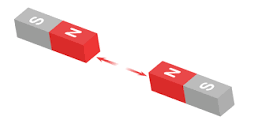
What will happen when these magnets are brought close together?
a)
They will attract each other.
b)
They will repel each other.
c)
Both magnets will turn to the left
d)
Both magnets will turn to the right
40.
Where is the force of attraction the strongest on a magnet?
a)
at the poles
b)
in the middle
c)
above the magnet
d)
below the magnet
41.

Why does a compass needle point north?
a)
The compass is a bar magnet
b)
Because north is up
c)
Because it's magic
d)
It lines up with the Earth's magnetic field
42.
What is the metal center of an electromagnet called?
a)
The current
b)
the wire
c)
the coil
d)
the core
43.

How are electromagnets different from magnets?
a)
magnets can be turned on/off
b)
you can turn an electromagnet on/off
c)
magnets are more powerful
d)
magnets have a North and South pole
44.
What is magnetism?
a)
invisible objects coming together
b)
a force that either attracts or repels certain materials
c)
full of electricity
d)
metals
45.
What is true about electricity and magnetic fields?
a)
Electricity is needed to create any magnet.
b)
Electricity always creates a magnetic field.
c)
Electricity is stronger than a magnetic field.
d)
Electricity prevents magnetic fields from occurring.
46.
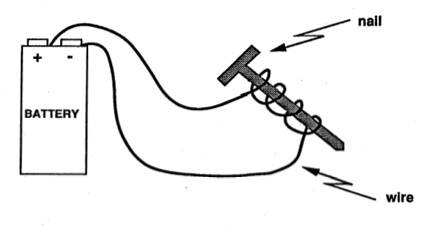
This is a picture of a simple electromagnet. How can the electromagnet be made stronger?
a)
Add more coils of wire to the nail.
b)
Use a smaller battery.
c)
Reverse the poles of the magnet.
d)
Remove all the coils and the nail.
47.
What is true about electricity and magnetic fields?
a)
Electricity is needed to create any magnet.
b)
Electricity always creates a magnetic field.
c)
Electricity is stronger than a magnetic field.
d)
Electricity prevents magnetic fields from occurring.
48.

What is a circuit?
a)
A constant flow of electricity
b)
A path that a current can flow along
49.

An outlet in a wall and a battery are examples of __________.
a)
Power source
b)
Load
c)
Energy pathway
d)
ALL of them
50.

The light bulb in the circuit is an example of _______.
a)
Load
b)
Battery source
c)
Energy pathway
d)
All of them
51.

Electrons need a GOOD PATH made of a ______ for them to flow.
a)
Conductor
b)
Insulator
52.

___________ wires keep electrons on course & protect us from the dangerous flow of electricity.
a)
Insulated
b)
Conducted
53.

From this picture which is the conductor and which is the insulator?
a)
Conductor: yellow wire, Insulator: black wire
b)
Insulator: yellow wire, Conductor: black wire
54.

A _______ controls whether an electric device is ON or OFF.
a)
electrical switch
b)
electric circuit
55.

If the electric circuit is CLOSED, the switch is _______.
a)
ON
b)
OFF
56.

If the electric circuit is OPEN, the switch is ____.
a)
ON
b)
OFF
57.

We need a _____ circuit for the light bulb to BE ON.
a)
closed
b)
open
58.
Bar magnets have two poles. What are they?
a)
north and south
b)
west and east
c)
positive and negative
d)
right and wrong
59.
Like/same poles __________ each other while unlike/opposite poles ___________ each other.
a)
repel, attract
b)
attract, repel
c)
love, hate
d)
oppose, connect
60.

A balloon has a negative charge. A glass rod has a positive charge. What will happen when the glass rod is brought close to the balloon?
a)
The balloon will be attracted to the rod.
b)
The balloon will be repelled by the rod.
c)
The balloon will remain in place.
d)
The balloon will spin in circles.
61.

These are iron filings and bar magnets on a sheet of paper. Where is the magnetic field the strongest?
a)
1
b)
2
c)
3
d)
4
62.

Where is earth's magnetic field the strongest?
a)
1 - near Africa
b)
2 - by the equator
c)
3 - near Europe
d)
4 - at the poles
63.

Which of the following can work as an energy source?
a)
Battery
b)
Light bulb
c)
Wire
d)
All of them
64.

What are the two types of electric circuits?
a)
Parallel circuits & Series circuits
b)
Parallel circuits & Electric circuits
c)
Electric circuits & Series circuits
d)
All of them
65.

Look at the drawing. Which best describes the switch?
a)
Closed
b)
Open
c)
Parallel
d)
Series
66.

Does this diagram represent a series or parallel circuit?
a)
series circuit (1 loop)
b)
parallel circuit (more than 1 loop)
67.
This circuit has more than one loop. When one light goes out, the others stay on.
a)
closed circuit
b)
series circuit
c)
parallel circuit
d)
open circuit
68.
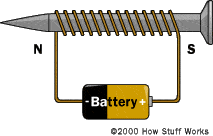
What kind of magnet can be turned on and off?
a)
refrigerator magnet
b)
electromagnet
c)
magnetite
d)
iron
69.
This is a picture of a simple electromagnet. How can the electromagnet be made stronger?
a)
Add more coils of wire to the nail.
b)
Use a smaller battery.
c)
Switch the wires on the battery.
d)
Remove all the coils and the nail.
70.

How are electromagnets different from regular magnets?
a)
A. They can be turned on and off
b)
B. Their poles can be reversed
c)
C. Their strength can be changed
d)
D. All of the above
71.
What device uses an electromagnet?
a)
speakers in headphones
b)
a light bulb
c)
scissors
d)
a phone charger
100 %

