
 Worksheets
Review
Total questions: 67
Worksheet time: 50mins


When one substance dissolves in another creating the same composition throughout.
Mixture
Solution
Matter that has its own shape and a definite volume.
solid
liquid
gas
Matter that always takes the shape of its container, such as air.
solid
liquid
gas
toxicity
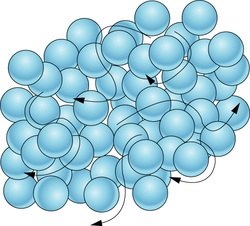
What state of matter does this picture show?
Solid
Liquid
Gas
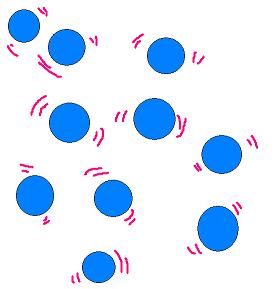
Which state of matter does this picture show?
Solid
Liquid
Gas

On a hot, humid summer day drops of water form on a can of cold soda. What process caused this to happen?
condensation
freezing
vaporization
deposition
An uncovered pot of soup is simmering on Mr. Wright's stove, and there are water droplets on the wall behind it. What sequence can you infer has occurred?
evaporation, then condensation
freezing, then melting
condensation, then evaporation
None of the above
Condensation occurs when _____________ water vapour comes into contact with a cooler surface, loses heat and condenses into water droplets.
Room temperatured
warmer
None of the above
colder
The Particles of which of the following have the greatest energy?
a gas
a liquid
a solid
an amorphous solid
A student mixes 125 grams of sugar, 250 grams of water and 5 grams of flavoring. The solution weighs...
250 grams
380 grams
375 grams
400 grams
A student makes a garden salad by stirring lettuce, tomatoes, carrots, and peppers together in a bowl. Why is the garden salad a mixture?
the student cut the vegetables into equally sized pieces
the vegetables are combined but maintain their physical properties
the peppers cannot be taken out of the salad
the salad grew from a garden
True or False: A mixture must have at least two different materials.
True
False

Physical Properties are _____________
Measurement of the ability of a solid to dissolve in a liquid.
Energy that can be measured by a thermometer.
Measurable characteristics that describe the physical state of something, including mass, magnetism, temperature, density, shape, volume, and conductivity.
The classification of matter as a solid, liquid, or gas.
Which is a chemical property?
Reactivity
boiling point
density
conductivity
What is not a pure substance?
hot chocolate and water
water
sugar
salt
Boiling point is a
Physical property
Chemical property
Real property
Fake property
Flammability is a
Chemical property
Physical property
Real property
Fake property


What subatomic particle has a negative charge and is found outside of the nucleus?
Electron
Proton
Nucleus
Neutron
Which subatomic particle has a positive charge and is found inside the nucleus?
Electron
Proton
Neutron
Nucleus
Which subatomic particle has a neutral charge and is found inside the nucleus?
Electrons
Protons
Neutrons
Nucleus
True or False: Electrons are found in the nucleus.
True
False

This picture represents which of the following:
element
compound

This picture represents which of the following?
element
compound

This picture represents which of the following?
element
compound

This picture represents which of the following?
element
compound

This picture represents which of the following?
element
compound

This picture represents which of the following?
element
compound

This picture represents which of the following?
element
compound

This picture represents which of the following?
element
compound
The smallest particle of matter that makes up an element and a compound?
Element
Chemical
Atom
Substance
Which statement best describes an element?
pure, made of more than one type of atom
when combined, a chemical reaction forms
pure, made of only one type of atom
can be broken down easily
When two or more different elements chemically combine, a __________________________ is formed.
element
compound
mixture
solution

Examples are water (H2O) and carbon dioxide (CO2).
elements
compounds
Compounds are different than elements because compounds are ---
combinations of two or more elements.
not able to be broken down into parts.
made from the same type of atoms.
a pure substance; elements are not.
Both elements and compounds are pure substances.
Agree
Disagree
Cannot be broken down into a simpler substance
Elements
Compounds
Both
Compounds have properties different from the elements that make it up.
Agree
Disagree
Reactivity, flammability and rusting
Physical Properties
Chemical Properties

