

wayground logo

Free Printable Worksheets

NEW

Font size

S
M
L
XL
Worksheets

Ecosystems

Total questions: 62

Worksheet time: 2hrs 49mins

Name
Class
Date
1.
What do consumers do in the food chain?
a)
They obtain energy from other organisms. 
b)
They break down dead plant and animal material. 
c)
They use sunlight to make food. 
d)
They are parasites of plants. 
2.
Which of the following food chains shows the correct energy flow left to right? 
a)
rabbit-coyote-grass
b)
grass-rabbit-coyote
c)
coyote-rabbit-grass
d)
grass-coyote-rabbit
3.
Which of the following adaptations would be most useful for a desert reptile? 
a)
long hair to keep it warm at night.
b)
white coloring to hide it from predators.
c)
webbed feet for quicker movement. 
d)
thick outer body covering to reduce moisture loss. 
4.
Which of the following directly use the Sun's energy to produce their own food? 
a)
decomposers
b)
carnivores
c)
consumers
d)
producers
5.
Which organism do the owl and the weasel compete for in the food web?
a)
Hawk
b)
Spider
c)
Grasshopper
d)
Shrew
6.
Which of the following is a herbivore?
a)
cricket
b)
frog
c)
hawk
d)
shrew
7.
A consumer that hunts is called:
a)
a producer.
b)
an omnivore.
c)
a predator.
d)
a herbivore.
8.
A frog eats a fly. The frog and fly are demonstrating ________.
a)
mutualism
b)
competition
c)
predator/prey
d)
parasitism
9.
All of the living AND non-living things in an particular area is called a(n):
a)
ecosystem
b)
house
c)
community
d)
mountain
10.
A connection of food chains with many food energy paths in an ecosystem is a ____________.
a)
ecosystem
b)
food web
c)
environment
d)
population
11.
The diagram is intended to show relationships in an ecosystem. What do the arrows represent?
a)
The direction of population migration
b)
Differences in dietary habits
c)
Progressively smaller organisms
d)
The direction of the energy flow
12.
Grass is considered a ...
a)
consumer
b)
producer
c)
decomposer
d)
composers
13.
Which of the following activities has a positive effect on the environment?
a)
recycling
b)
deforestation
c)
pollution
14.
Temperature, light, air, water, and soil are all  _____  parts of the environment
a)
alive
b)
biotic 
c)
abiotic
d)
living
15.
What is an example of a biotic factor?
a)
skunk
b)
rocks
c)
soil
d)
water
16.
What is a example of a abiotic factor?
a)
Panda
b)
Turtle
c)
Butterfly
d)
weather
17.
Which term best describes two predators living in the same habitat who feed on the same prey?
a)
coexistence
b)
competition
c)
mutualism
18.
A pride of lions stalks, tackles, and kills an antelope. Which is best being demonstrated?
a)
predation
b)
mutualism
c)
cooperation
19.
Which best represents the niche of phytoplankton and algae in a marine ecosystem?
a)
producers
b)
consumers
c)
scavengers
d)
decomposers
20.
_______ are consumers that eat only meat.
a)
Herbivore
b)
Omnivore
c)
Carnivore
21.
________ are consumers that eat plants and meat.
a)
Herbivore
b)
Omnivore
c)
Carnivore
22.
Which group do fungi, bacteria, and termites belong to?
a)
decomposers
b)
producers
c)
herbivores
d)
omnivores
23.
Which organism make their own food through the process of photosynthesis? 
a)
decomposer
b)
consumer
c)
herbivore
d)
producer 
24.
Field mice eat corn. Which would most likely happen if the field mouse population grew?
a)
There would be more corn to feed the field mice.
b)
There would be less corn due to the mice eating it.
c)
The habitat would get overpopulated because the mice woudl eat too much.
25.
Which describes a decomposer?
a)
an organism that eats only plants
b)
an organism that makes its own food
c)
an organism that breaks down dead matter
d)
an organism that recieves energy from the sun
26.
If the population of prey increases, the population of predators will ________because of the availability of food.
a)
decrease
b)
stay the same
c)
increase
27.
What are interconnected food chains called?
a)
consumers
b)
predators
c)
food web
28.
All food chains_____________________
a)
have more consumers than producers
b)
produce and use same amount of energy
c)
begin with a producer
d)
are unhealthy 
29.
How do consumers get their energy? 
a)
laying in the sun
b)
eating other organisms 
c)
providing food for other organisms
d)
surviving in an ecosystem 
30.
Which of the following is a herbivore?
a)
cricket
b)
frog
c)
hawk
d)
shrew
31.
Which organism do the owl and the weasel compete for in the food web?
a)
Hawk
b)
Spider
c)
Grasshopper
d)
Shrew
32.
Which of the following directly use the Sun's energy to produce their own food? 
a)
decomposers
b)
carnivores
c)
consumers
d)
producers
33.
Which of the following would have a negative impact on an ecosystem
a)
constructing highways
b)
planting trees
c)
recycling paper
34.
Temperature, light, air, water, and soil are all  _____  parts of the environment
a)
alive
b)
biotic 
c)
abiotic
d)
living
35.
In the energy pyramid here, which organisms have the most energy available?
a)
Producers
b)
Carnivores
c)
Herbivores
d)
Top Predator
36.
In the energy pyramid below, which organism has the least amount of energy available?
a)
Producers
b)
Herbivores
c)
Carnivores
d)
Top Predator
37.

These organisms cannot make their own food; they must eat something for energy

a)

decomposer

b)

consumer

c)

producer

38.

NON-living things found in an ecosystem

a)

biotic

b)

abiotic

c)

habitat

39.

LIVING things in an ecosystem

a)

biotic

b)

abiotic

c)

ecosystem

40.

Choose the producer.

a)

rock

b)

tree

c)

cow

d)

bird

41.

Choose the decomposer.

a)

grass

b)

elephant

c)

bacteria

d)

bird

42.

Choose the abiotic factor.

a)

sunflower

b)

dog

c)

cat

d)

rock

43.

Choose the consumer.

a)

mushroom

b)

horse

c)

tree

d)

grass

44.

Where does the food chain START?

a)

with consumers that eat grass

b)

with the sun giving energy to producers

c)

with the sun giving energy to consumers

d)

with consumers eating other consumers

45.

What is scarcity and how could it affect an ecosystem?

a)

Too many animals or plants in an area can cause the ecosystem to fail.

b)

Too many animals or plants in an area can cause the animals to be too fat.

c)

Too few animals or plants in an area can cause other animals to go hungry or die.

d)

Too few animals or plants in an area can cause pollution.
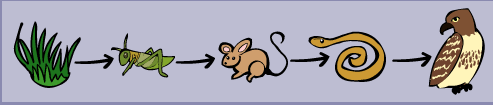
46.

Explain the flow of energy in this food chain (who passes energy to who).

a)

The hawk gives energy to the snake. The snake gives energy to the mouse. The mouse gives energy to the grasshopper who gives energy to the grass.

b)

The mouse gives energy to the hawk. The snake gives energy to the grasshopper. The grass gives energy to the snake.

c)

The grass gives energy to the grasshopper. The grasshopper gives energy to the mouse. The mouse gives energy to the snake who gives energy to the hawk.

47.
On a safari at night, a lion hunts and feeds on an antelope. In this relationship, the lion is the ____________________ and the antelope is the _________________.
a)
Parasite/host
b)
Predator/prey
c)
Prey/Predator
48.
How do producers obtain energy?
a)
They conduct photosynthesis.
b)
They consume plants.
c)
They consume primary consumers.
d)
They consume secondary consumers.
49.
A fox is an example of...
a)
Biotic Factor
b)
Abiotic Factor
50.
True or False. In this Food Web Pyramid the consumers on each level only get about 10 percent of energy that the plants have stored.
a)
True
b)
False
51.

Which organisms in figure 1 could be classified as carnivores?

a)

deer, mice, and grasshoppers

b)

grasshoppers, lizards, and shrews

c)

coyotes, shrews, and lizards

d)

mountain lion, deer, and shrews

52.
If these organisms were arranged in a food pyramid, which organism would have the least amount of total energy available?
a)
coyote
b)
insect
c)
lizard
d)
shrub
53.
The rabbit in this food web would be considered a:
a)
Decomposer
b)
Producer
c)
Secondary Consumer
d)
Primary Consumer
54.
Where do crickets get their energy?
a)
Cattails
b)
Marsh Grass
c)
Grasshoppers
d)
Shrews
55.
What may happen if the snowshoe hare was removed from the food web pictured?
a)
The insects in the habitat would increase.
b)
The shrew population would decrease due to being only hawk food source.
c)
The willow tree population would decrease.
d)
Foxes would dies due to no food source. 
56.
Organisms that break down dead plants & animals and release nitrogen back into atmosphere...
a)
bacteria
b)
plants
c)
animals
d)
producers
57.
Photosynthesis
a)
absorbs CO2
b)
releases CO2
58.
In what process is Carbon turned transformed into chemical energy?
a)
Photosynthesis
b)
Respiration
c)
Primary Production
d)
Secondary Production
59.
When a millipede breaks down dead and decaying material, it is acting as what?
a)
a decomposer
b)
an apex predator
c)
a producer
d)
prey
60.
Where does the energy start in this food chain?
a)
Plant
b)
Sun
c)
Deer
d)
Wolf
61.

Observe the food chain above. Which organism’s population would increase if finches were removed from the ecosystem?

a)

Grass

b)

Grasshopper

c)

Hawk

62.

The diagram shows an incomplete food chain. Which of the following would best complete this food chain?

a)

Producer

b)

Consumer

c)

Decomposer
