wayground logo

Free Printable Worksheets

NEW

Font size

S
M
L
XL
Worksheets

1st Semester Review 2019-2020

Total questions: 80

Worksheet time: 1hrs 7mins

Name
Class
Date
1.
An experiment is performed on plants to see how different liquids affect plant growth. Each plant in the experiment is given a different liquid; water, apple juice, or milk. Each plant has the same amount of soil, sunlight, and listens to the same music. In this investigation, the independent variable is ...
a)
The type of plant
b)
The amount of sunlight
c)
The type of music
d)
The type of liquid
2.

This variable in an experiment is the one being deliberately changed by the scientist.

a)

dependent/outcome variable

b)

independent/test variable

c)

data

d)

control group

3.
Mr. S. sets up an experiment to see how the mass of a ball affects the distance it rolls off a ramp.  Identify the independent variable.
a)
distance traveled by the ball
b)
height of the ramp
c)
mass of the ball
d)
weight of the ball
4.
Mr. S. sets up an experiment to see how the mass of a ball affects the distance it rolls off a ramp.  Identify the dependent variable.
a)
height of the ramp
b)
 distance traveled by the ball
c)
mass of the ball
d)
weight of the ball
5.
A student is planning an experiment to find out how the height from which he drops a ball affects how high the ball bounces. The dependent variable is the _____.
a)
Diameter of the ball
b)
Force acting on the ball
c)
Height that the ball bounces
d)
Height from which the ball is dropped
6.
When experimenting with the growth of a plant, a scientist uses three (of the same type of) plants, two different fertilizers, equal light, and equal water. What type of variable is the fertilizer?
a)
Dependent
b)
Independent
c)
Control
d)
Compound
7.
An experiment is performed on plants to see how different liquids affect plant growth. Each plant in the experiment is given a different liquid; water, apple juice, or milk. Each plant has the same amount of soil, sunlight, and listens to the same music. In this investigation, what is the dependent variable?
a)
Type of plant
b)
Water, apple juice, milk
c)
Plant growth
d)
Color of the plant's leaves
8.

What is a theory?

a)

A possible explanation of something that happens in nature.

b)

A guess as to what will happen in an experiment?

c)

The variable that is tested.

d)

A description of something that happens in nature.

9.
Which of the following is NOT a way to improve an experiment?
a)
Increase Sample size
b)
Remove sources of human error by using more accurate measurement tools.
c)
Adding a second independent variable.
10.

When a scientist sets up their experiment with multiple trials this is called

a)

repetition

b)

replication

c)

restitution

d)

constant variable

11.

What is the IF....THEN....statement?

a)

Hypothesis

b)

Conclusion

c)

Experiment

d)

Data

12.

A scientific law will

a)

explain what happens in nature.

b)

describe what happens under a specific set of circumstances.

c)

give the most logical possibilities to a scenario.

d)

give a statement that will suggest a way of experimentation.

13.
Eduardo is a conservation biologist. He needs to develop a plan to preserve wetlands. He begins his project by studying the data in the following chart. How is Eduardo using scientific methods in developing a plan?
a)
He is analyzing data about causes and effects.
b)
He is analyzing a hypothesis about causes and effects.
c)
He is proposing an experiment about causes and effects.
d)
He is using intuition to determine causes and effects.
14.
Mr. McNeice wanted to know if different types of music affected people's heart rates, so he played different music and checked their pulses.  What is the dependent variable?
a)
type of music
b)
heart rate
c)
how long they listend to music
d)
Mr. McNeice
15.

Marcia did an experiment to find out whether tulips grow faster under fluorescent lighting or incandescent lighting. Under flourescent lighting, Marcia's plants grew 1.5 cm taller in two months. She gave her notes to Alex, who did the same experiments with similar results. Which term describes Alex's experiment?

a)

plagiarism

b)

replication

c)

pseudo science

d)

repetition

16.

What is the outcome (DEPENDENT) variable?

a)

plant height

b)

time in days

c)

sunflower

d)

daisy

17.

A prevailing theory about heredity is challenged by newly discovered information from a few experiments. As a result, what might happen to the scientific knowledge about heredity?

a)

A new theory will immediately be established.

b)

All that is known about heredity will be erased

c)

Nothing because scientific knowledge cannot change once it is established.

d)

Scientific knowledge may change and grow over time.

18.
How many variables should be changed in a simple experiment?
a)
5
b)
3
c)
1
d)
6
19.
A valid scientific investigation must be able to be 
a)
graphed.
b)
predicted.
c)
replicated (which means repeated)
d)
observed.
20.

What does it mean to replicate

a)

Copy another person's answers down

b)

Complete repeated trials of an experiment to test the authentication of data

c)

performing another scientist's study; following the same procedures

d)

Collect data and put it in a chart

21.

Which of these does sound travel fastest through?

a)

Steel

b)

Water

c)

Air

d)

Rock

22.
A wave that requires a medium through which to travel
a)
mechanical wave
b)
chemical wave
c)
electromagnetic wave
d)
pitch
23.
What medium does sound travel through slowest?
a)
gas
b)
solid
c)
liquid
d)
trees
24.

As the frequency of an electromagnetic wave increases, its speed in a vacuum

a)

decreases

b)

increases

c)

remains the same

25.
Which has the LONGEST wavelength and, therefore, the lowest frequency/energy
a)
Gamma Rays
b)
Radio Waves
c)
Visible Light
d)
Infrared rays
26.
How are electromagnetic waves different from other waves? 
a)
They have very short wavelengths 
b)
They transmit energy instead of matter 
c)
They can travel through a vacuum 
d)
They can change direction by reflection 
27.
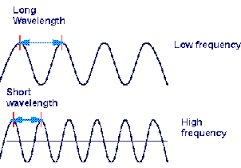
Wavelength and Frequency are related in that...
a)
they are always the same
b)
when one increases, the other decreases (inversely proportional)
c)
no correlation
d)
they are both confusing
28.
These are the only wavelengths the human eye can see:
a)
X-rays
b)
Radio Waves
c)
Visible Light
d)
Gamma Waves
29.

High frequency equals

a)

high energy

b)

low energy

c)

no change in energy

d)

none of the above

30.
Infrared rays have a shorter wavelength than _____________.
a)
ultraviolet rays
b)
x-rays
c)
radio waves
d)
gamma rays
31.
Put the visible light colors in order from longest wavelength to shortest wavelength
a)
Violet, Indigo, Blue, Green, Orange, Yellow, Red
b)
Red, Yellow, Green, Orange, Violet, Blue, Indigo
c)
Red, Orange, Yellow, Green, Blue, Indigo, Violet
32.
Which is the correct order of the electromagnetic spectrum from highest frequency to lowest frequency?
a)
Gamma, X-ray, Ultraviolet, Visible, Infrared, Microwave, Radio
b)
Gamma, Ultraviolet, Visible, Infrared, X-ray, Microwave, Radio
c)
Ultraviolet, Microwave, Radio, Visible, X-ray, Gamma, Infrared
d)
Radio, Microwave, Infrared, Gamma, X-ray, Ultraviolet, Visible
33.

Materials that allow light to pass through them allowing you to see "clearly" to the other side are called

a)

opaque

b)

translucent

c)

transparent

34.

An object with a smooth, shiny surface would be able to ________________ light.

a)

reflect

b)

refract

c)

absorb

35.
Which of these objects is "translucent"?
a)
A Brick Wall
b)
Sunglasses
c)
Mirror
36.
When the frequency of a wave increases, what happens to the wavelength?
a)
The wavelength is not directly affected by the frequency of a wave.
b)
The wavelength increases.
c)
The wavelength decreases.
d)
More specific information is needed to form a conclusion about the wavelength.
37.
A mechanical wave cannot travel through...
a)
a vacuum(empty space).
b)
water.
c)
air. 
d)
glass.
38.
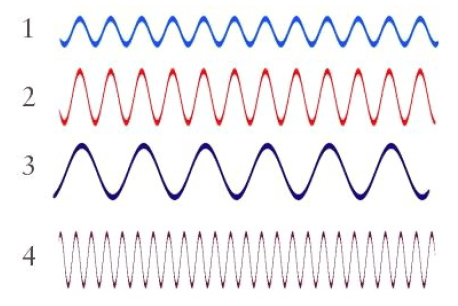
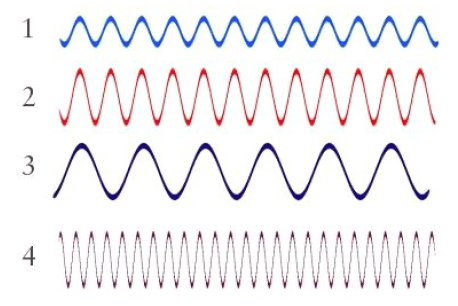
Which wave in the diagram has the greatest frequency?
a)
1
b)
2
c)
3
d)
4
39.
Which wave in the diagram has the greatest wavelength?
a)
1
b)
2
c)
3
d)
4
40.
Which of the following can sound travel through?
a)
solid
b)
liquid
c)
gas
d)
all of the above
41.
which material does sound travel the fastest?
a)
solid 
b)
liquid 
c)
gases
42.
When a wave bends as it passes through at an angle from one medium to another.(example: pencil in a glass of water-)
a)
medium
b)
refraction
c)
reflection
d)
interference
43.
You can't hear sounds in outer space because there is no
a)
matter
b)
light
c)
energy
d)
heat
44.
Of the following, ________ have the greatest frequency of the electromagnetic spectrum.
a)
ultraviolet rays
b)
gamma rays
c)
radio
d)
visible waves
45.
When a wave travels from air to water, ________.
a)
the wave changes direction
b)
a new wave forms
c)
some of the wave's energy can be transferred to the matter
46.
This color in the visible part of the spectrum has the smallest wavelength.
a)
Blue
b)
Red
c)
Violet
d)
Yellow
47.
High energy waves have a ____. 
a)
high frequency
b)
low frequency
c)
small amplitude
d)
big wavelength
48.
How much of the electromagnetic spectrum is visible?
a)
All of it
b)
None of it
c)
Most of it
d)
Only a small part
49.
Different wavelengths of light are seen as 
a)
atoms
b)
colors
c)
speeds
d)
sounds
50.

The youngest material of the ocean floor is found at mid-ocean _________.

a)

ridges

b)

trenches

c)

basins

d)

rifts

51.
What process is used to form sedimentary rocks?
a)
Lava cools and hardens to form a rock.
b)
Weathering, Erosion, Deposition, Compaction, Cementation
c)
Extreme heat and pressure from inside the Earth turn rocks into new rocks.
d)
Magma trapped under the Earth's surface cools and solidifies.
52.
What is deposition?
a)
Dropping off sediment
b)
Movement of sediment
c)
Breaking down of sediment 
53.
The process when rocks break into smaller pieces due to exposure to natural elements is called
a)
erosion
b)
weathering
c)
sediments
d)
deposition
54.

The tectonic plates are broken pieces of

a)

lithosphere

b)

lower mantle

c)

outer core

d)

asthenosphere

55.

The layer of the Earth with the highest temperature is the

a)

crust

b)

inner core

c)

mantle

d)

outer core

56.

The thickest layer of the Earth is the

a)

continental crust

b)

inner core

c)

mantle

d)

outer core

57.

If you traveled from the surface of the Earth to the center, the pressure would...

a)

increase

b)

decrease

c)

stay the same

d)

unsure

58.
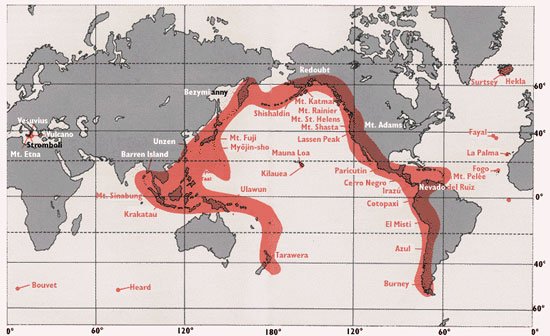
This is the name for the chain of volcanos around the edge of the Pacific Plate.
a)
Circle of Fire
b)
Ring of Lava
c)
Ring of Fire
d)
Circle of Magma
59.

Earth has multiple layers due to differences in

a)

temperature and depth differences.

b)

weight and pressure.

c)

density and chemical composition.

d)

gravity and position.

60.

Which layer of Earth is the only liquid layer?

a)

oceanic crust

b)

mantle

c)

outer core

d)

inner core

61.

What needs to happen for igneous rock to be transformed into sedimentary rock?

a)

Weathering and erosion need to wear away the igneous rock, forming particles that will eventually cement into sedimentary rock.

b)

Low temperatures at the poles need to freeze the igneous rock, cooling and hardening it into extremely dense sedimentary rock.

c)

Tectonic plates must collide near the igneous rock, driving it under the surface, where it melts into sedimentary rock.

d)

High pressure needs to compact the igneous rock, eventually melting it and forming sedimentary rock as it cools.

62.

Which explanation describes how metamorphic rocks are formed?

a)

Metamorphic rock is formed when sedimentary and igneous rocks change over time under heat and pressure.

b)

Metamorphic rock is formed when earthquakes shake up the rocks so they are broken into small pieces.

c)

Metamorphic rock is formed when sedimentary rocks are broken down over time by wind and rain.

d)

Metamorphic rock is formed when lava that erupts from a volcano cools in the atmosphere.
63.
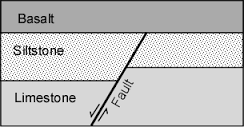
How does the law of crosscutting explain the age of a fault?
a)
The fault is younger than the rocks above it.
b)
The fault is younger than the rocks it cuts through.
c)
The fault is older than the rocks above it.
d)
The fault is older than the rocks it cuts through.
64.

What are the relative ages of the features in order from youngest to oldest?

a)

Limestone, Basalt, Fault, Siltstone

b)

Siltstone, Fault, Basalt, Limestone

c)

Limestone, Fault, Basalt, Siltstone

d)

Basalt, Fault, Siltstone, Limestone

65.
Stretching rock so it becomes thinner in the middle is what kind of stress?
a)
tension
b)
compression
c)
shearing
66.

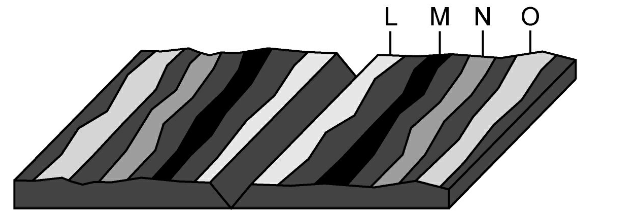
Where would the youngest rock be found?

a)

L

b)

M

c)

N

d)

O

67.

Where do most volcanoes form?

a)

in the Atlantic Ocean at diverging plates

b)

in the middle of plates

c)

along the edges of converging plates in the Pacific

68.
This is the name for the chain of volcanos around the edge of the Pacific Plate.
a)
Circle of Fire
b)
Ring of Lava
c)
Ring of Fire
d)
Circle of Magma
69.
The San Andreas Fault in California is an example of a ________.
a)
divergent boundary
b)
convergent boundary
c)
transform fault
d)
subduction zone
70.

Example of divergent boundary between two continental plates.

a)

Mid-Atlantic Ridge (Atlantic Ocean)

b)

Andes Mountains (S. America)

c)

East Africa Rift Valley

d)

None of the above

71.

New crust is formed at what type of boundary?

a)

convergent

b)

divergent

c)

transform

d)

shearing

72.
The heating and cooling - rising and sinking of magma beneath the earth's crust is an example of which type of heat transfer?
a)
Conduction
b)
Convection
c)
Radiation
73.
the transfer of energy by electro-magnetic waves is called
a)
conduction
b)
convection
c)
radiation
74.
Which state of matter has the fastest molecules?
a)
solid
b)
liquid
c)
gas
d)
water
75.
On a roller coaster, where is the least potential energy?
a)
at the top of the big hill
b)
at the bottom of the big hill
c)
going down the big hill
d)
at the hot dog cart
76.
A form of potential energy that is stored in chemical bonds between atoms.
a)
chemical energy
b)
electrical energy
c)
electromagnetic energy
d)
nuclear energy
77.

What energy transformation occurs when a television speaker produces sound?

a)

electrical to sound

b)

elastic to sound

c)

thermal to sound

d)

sound to electrical

78.
Gravitational potential energy depends on the ________ and ________ of the object. 
a)
Height and mass
b)
Friction and movement
c)
Mass and Movement
d)
Height and Friction 
79.

A teacher rubbed a match against a piece of sandpaper. The match started to burn. Which statement best describes the energy changes that occurred?

a)

The chemical energy stored in the match changed to thermal energy and light energy.

b)

The thermal energy stored in the match changed to light energy and chemical energy.

c)

The light energy and thermal energy stored in the match changed to mechanical energy.

d)

The light energy and thermal energy stored in the match changed to chemical energy.

80.

When an egg is boiled in a pot of water on the stove, there is more than one kind of heat transfer. Heat is transferred from the stove to the pot directly since they are physically touching. Heat is also transferred from the pot to the egg, carried through the water. What two kinds of heat transfer are represented?

a)

Stove → Pot = radiation, Pot → Egg = conduction

b)

Stove → Pot = conduction, Pot → Egg = radiation

c)

Stove → Pot = convection, Pot → Egg = conduction

d)

Stove → Pot = conduction, Pot → Egg = convection