wayground logo

Free Printable Worksheets

Font size

S
M
L
XL
Worksheets

Semester One Review Biology

Total questions: 80

Worksheet time: 58mins

Name
Class
Date
1.
What word describes when water is attracted to other substances?
a)
cohesion
b)
adhesion
c)
capillary action
d)
surface tension
2.
Attractions between the negative Oxygen atom of one water molecule and the positive Hydrogen atom of another water molecule are called
a)
Covalent bonds
b)
Ionic bonds
c)
Polar bonds
d)
Hydrogen bonds
3.
Water droplets take a spherical shape (as pictured) because of ____________
a)
adhesion
b)
cohesion
c)
capillary action
d)
solubility
4.
Which end of the water molecule has a slightly positive charge?
a)
the oxygen end
b)
the hydrogen end
c)
both ends are slightly positive
d)
neither end is positive
5.

The movement of molecules from an area of HIGHer Concentration TO an area of LOWer Concentration

a)

Diffusion

b)

Osmosis

c)

High Low

d)

Active Transport

6.
You put a cell into a solution, the cell grows. Is the solution hypotonic or hypertonic to the cell? 
a)
hypertonic
b)
hypotonic
c)
isotonic
d)
not enough information
7.
The cell below is in a _________ solution.
a)
Hypotonic
b)
Hypertonic
c)
Isotonic
8.
The cell below is in a _____________ solution.
a)
Hypertonic
b)
Hypotonic
c)
Isotonic
9.
An ISOTONIC solution has a(n) ______________ concentration of solute (dissolved stuff) than inside the cell.
a)
lower
b)
equal
c)
higher
10.

Virus latches onto cell membrane

a)

Attachment

b)

Entry

c)

Synthesis

d)

Self-Assembly

e)

Release

11.

Host enzymes (proteins) make copies of the viral genome to stuff inside future viruses and host ribosomes make viral proteins

a)

Attachement

b)

Entry

c)

Synthesis

d)

Self-Assembly

e)

Release

12.

Viruses "explode" out of the host cell----killing the host cell---they move on to attach to other host cells.

a)

Attachment

b)

Entry

c)

Synethesis

d)

Self-Assembly

e)

Release

13.
Has membrane bound organelles
a)
Prokaryote
b)
Eukaryote
c)
both
14.
One example of a prokaryote is a...
a)
fungus
b)
bacteria
c)
animal
d)
plant
15.
Which type of cell?
a)
Prokaryote
b)
Eukaryote
16.
Which type of cell?
a)
Prokaryote
b)
Eukaryote
17.

What forms the channels and pumps in the phospholipid bilayer?

a)

carbohydrates

b)

proteins

c)

hydrophilic heads

d)

lipids

18.
Which of the following is NOT part of the cell membrane?
a)
Lipids
b)
Carbohydrates
c)
Proteins
d)
Nucleic Acids
19.
Which of the following is responsible for getting large or charged (polar) molecules across the cell membrane?
a)
E
b)
B
c)
C
d)
D
20.
Hydrophilic portion of cell membrane?
a)
A
b)
C
c)
D
d)
21.
Hydrophobic region of the cell membrane?
a)
E
b)
B
c)
C
d)
22.

Active transport is different from passive transport in that active transport involves:

a)

the movement of molecules from high concentration to low concentration

b)

an expenditure of energy

c)

the use of ribosomes

d)

a process which occurs only in the cells of simple plants and animals

23.

Which of the following are examples of passive transport? (Select all that apply)

a)

osmosis

b)

diffusion

c)

endocytosis

d)

exocytosis

24.

Which of the following are examples of active transport? (Select all that apply)

a)

osmosis

b)

diffusion

c)

endocytosis

d)

exocytosis

25.
a)
Passive Transport
b)
Active Transport
26.
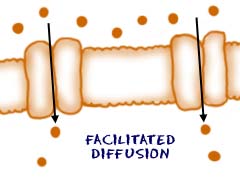
Solutes move with the concentration gradient
a)
Passive Transport
b)
Active Transport
27.
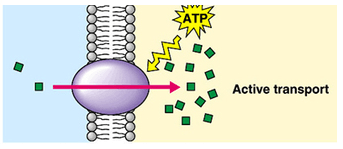
Solutes move against the concentration gradient
a)
Passive Transport
b)
Active Transport
28.
a)
Passive Transport
b)
Active Transport
29.

What functional group(s) is/are present on the molecule? (check all that apply)

a)

Hydroxyl

b)

Carboxyl

c)

Methyl

d)

Carbonyl

30.

What is the monomer of a carbohydrate?

a)

fatty acid

b)

amino acid

c)

monosaccharide

d)

nucleotide

31.

What functional group is highlighted here?

a)

hydroxyl

b)

carbonyl

c)

amine

d)

sulfhydryl

32.

What is the name(s) of the functional group?

a)

ketone, hydroxyl

b)

carboxyl

c)

carbonyl

d)

amine

33.

A molecule is composed of the elements carbon, hydrogen, and oxygen (only those three). Which of the following could it be?

a)

carbohydrate

b)

lipid

c)

protein

d)

nucleic acid

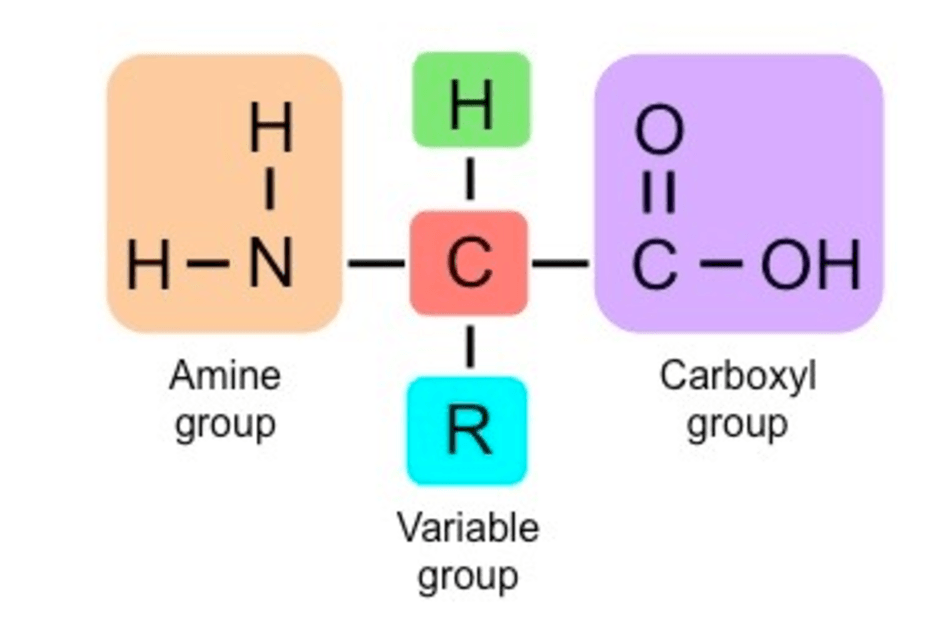
34.
What is the monomer of a protein?
a)
amino acid
b)
monosaccharide
c)
fatty acid
d)
nucleic acid
35.

Which of the following describes the secondary structure of proteins?

a)

The sequence of amino acids

b)

The α-helix and β-pleated sheet folding

c)

The folding of the polypeptide chain due to the 'R' groups

d)

The joining of different protein molecules to make one big molecule
36.
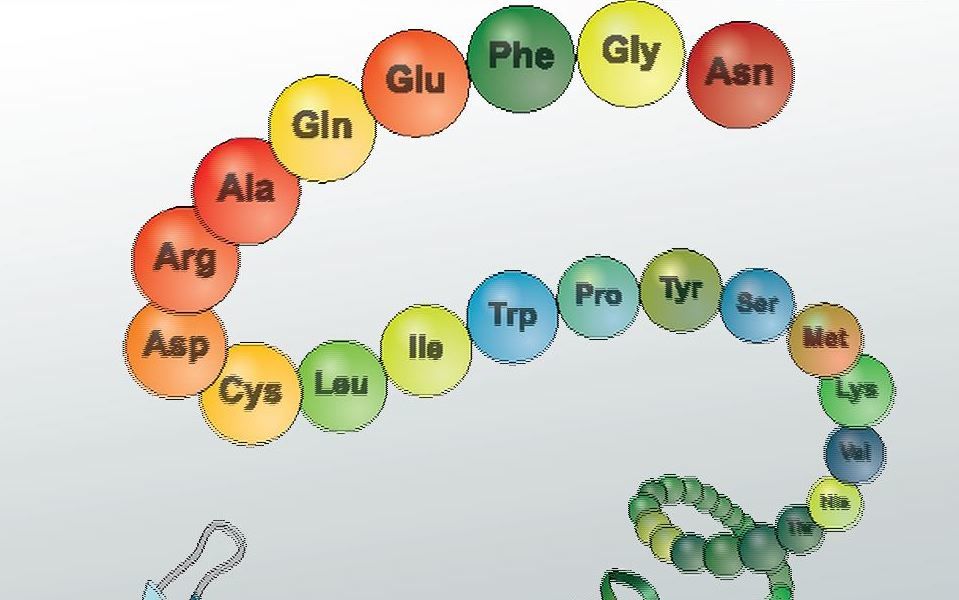
The name of the initial chain of monomers in a protein is called.....
a)
polypeptide
b)
polysaccharide
c)
polyester
d)
polynucleotide
37.
The two strands of a DNA molecule are held together by ________ bonds between their base pairs.
a)
covalent
b)
hydrogen
c)
ionic
d)
peptide
38.
Which of the following is not a base found in DNA?
a)
adenine
b)
thymine
c)
cytosine
d)
uracil
39.
If one strand of DNA has the sequence TTACCG, the sequence of the other strand of the same molecule will be
a)
AATGGC
b)
TTACCG
c)
AACGGC
d)
AATGGG
40.
Once replication in a DNA molecule is complete, each new DNA molecule contains 
a)
two new strands.
b)
3 exact copies of strands.
c)
one new strand and one old.
d)
two old strands.
41.

In what process is mRNA synthesized?

a)

Transcription

b)

Translation

c)

DNA Replication

d)

Mitosis

42.

How many nucleotides equal 1 amino acid?

a)

1

b)

2

c)

3

d)

4

43.

A polypeptide is a sequence of ____________________ held together by a ______________ bond.

a)

amino acids; peptide

b)

fatty acids; ionic

c)

proteins; hydrogen

d)

fatty acids; covalent

44.

TRANSCRIBE this DNA sequence: TACGTTACT

a)

AUGCAAUGA

b)

ATGCAATGA

c)

AUGGATUGA

d)

TACGTTACT

45.

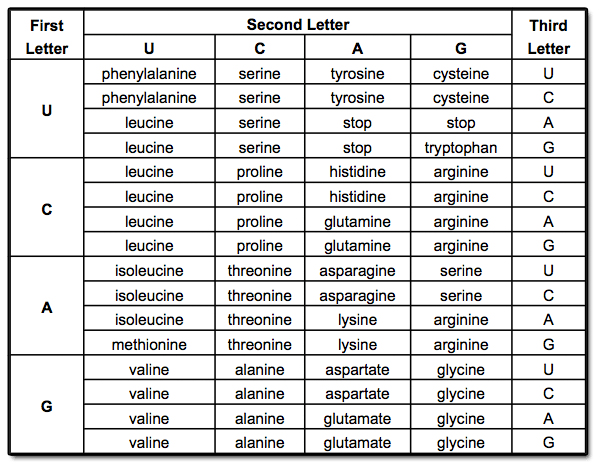
TRANSLATE this RNA sequence: AUGCAAUGA

a)

Met-Glu-Stop

b)

Met-His-Stop

c)

Thr-Glu-Stop

d)

Thr-Pro-Stop

46.
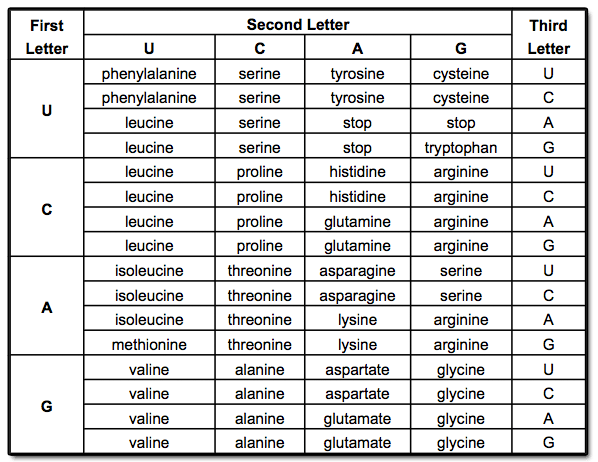
What amino acid is represented by the codon UUA?
a)
Phenylalanine
b)
Tyrosine
c)
Leucine
d)
Stop codon
47.
What is the correct amino acid sequence for the mRNA code AUGCCAGUAUGA
a)
Met-Pro-Ala-Val
b)
Met-Pro-Val
c)
Tyr-Gly-His
d)
Tyr-Gly-Arg-His
48.
The enzyme that unwinds the DNA to prepare for replication
a)
helicase
b)
replicase
c)
polymerase
d)
synthase
49.
In what phase of the cell cycle does DNA replication take place?
a)
G1
b)
S
c)
G2
d)
M
50.
Which enzyme is responsible for adding nucleotides?
a)
Topoisomerase
b)
DNA Polymerase
c)
Ligase
d)
Primase
51.
Which of the following does DNA polymerase NOT do?
a)
connects nucleotides (in the new strand) through covalent bonds
b)
Matches the template nucleotides with free nucleotides
c)
proofreads
d)
It does all of these functions
52.
Fruit fly body cells have 8 chromosomes. After mitosis, you would expect a resulting fruit fly daughter cell to have ...
a)
16 chromosomes.
b)
46 chromosomes.
c)
8 chromosomes.
d)
4 chromosomes.
53.
Structure B is pointing to the _____. 
a)
chromosome
b)
centromere
c)
DNA
d)
chromatid
54.

How many chromosomes are normally found in human body cells?

a)

46

b)

23

c)

26

d)

44

55.
Identify the phase of mitosis.
a)
prophase
b)
metaphase
c)
anaphase
d)
telophase
56.
Which phase comes NEXT?
a)
prophase
b)
metaphase
c)
anaphase
d)
telophase
57.
a)
Cytokinesis
b)
Interphase
c)
Anaphase
d)
Metaphase
58.

In which cell below would a student likely observe a cell plate during mitosis?

a)

rat muscle cell

b)

alligator stomach cell

c)

onion root cell

d)

human lung cell

59.
What causes genetic variation in meiosis?
a)
chromosomes lining up
b)
crossing over of chromosomes
c)
separation of chromosomes
d)
chromosomes pulling apart
60.
What kind of cells are made in MEIOSIS?
a)
Haploid cells
b)
Diploid Cells
c)
Skin Cells
d)
Liver Cells
61.
Diploid Cells are represented by
a)
2n
b)
n
c)
4n
d)
1/2 n
62.
If the Diploid number of Carrots is 18, the haploid number is
a)
18
b)
9
c)
27
d)
36
63.
The chromosomes that pair up during meiosis, are called __________ chromosomes.  
a)
homozygous 
b)
asexual
c)
homologous
d)
genes
64.
When homologous chromosomes match up, they form a structure call a ___________.
a)
tetrad (pair of chromosomes, one from mom and one from dad)
b)
triad
c)
diploid
d)
quad (group of 4 replicated chromosomes, 2 from mom and 2 from dad)
65.
What phase is represented?
a)
metaphase 1
b)
metaphase 2
c)
anaphase 1
d)
anaphase 2
66.
In pea plants, the trait for tall stems is dominant over the trait for short stems. If two heterozygous tall plants are crossed, what percentage of the offspring would be expected to have the same phenotype as the parents?
a)
100%
b)
75%
c)
50%
d)
25%
67.
One of the parents of a child has phenylketonuria (PKU), which is caused by recessive alleles. The other parent does not have the PKU alleles. What is the chance that the couple will have a child with phenylketonuria?
a)
0%
b)
50%
c)
75%
d)
100%
68.
The observable traits of an organism are known as its
a)
allele
b)
dominance
c)
phenotype
d)
genotype
69.
In dragons, large scales (S) are dominant and small scales (s) are recessive. A dragon that is heterozygous for the trait is crossed with a dragon that has small scales. What should be the ratio of large-scaled dragons to small-scaled dragons among the offspring?
a)
1:2
b)
1:1
c)
2:1
d)
3:1
70.
The gene makeup of an organism for a particular trait is known as its
a)
dominance
b)
phenotype
c)
allele
d)
genotype
71.

A calico cat shows both the traits for orange fur and black fur. What kind of inheritance pattern is this?

a)

Incomplete Dominance

b)

Co Dominance

c)

Sex-Linked

d)

Polygenic

72.

This type of inheritance pattern is a Blend of both traits.

a)

incomplete dominance

b)

co-dominance

c)

complete dominance

d)

recessive pattern

73.
Which of the following genotypes belongs in the red box in the Punnett square?
a)
XBXB
b)
XbXb
c)
XbY
d)
XBY
74.
Hemophilia is a recessive x-linked disorder. According to the Punnett square, what percentage of offspring will have the disorder?
a)
0%
b)
25%
c)
50%
d)
100%
75.
What type of inheritance is determined by multiple genes located at different loci on different chromosomes and there can be a range of traits?
a)
Codominance
b)
Incomplete dominance
c)
Polygenic traits
76.
Duchenne muscular dystrophy is a recessive x-linked disorder.
According to the Punnett square, what percentage of male offspring will have the disorder?
a)
0%
b)
25%
c)
50%
d)
100%
77.
Having two different alleles for a particular gene
a)
Fertilization
b)
Heterozygous
c)
Segregation
d)
Homozygous
78.
This pattern of inheritance is when one gene or mutation can have multiple phenotypic effects
a)
Multiple alleles
b)
Polygenic inheritance
c)
Pleiotropy
d)
Codominance
79.
What is the cell called that results from fertilization?
a)
egg
b)
sperm
c)
zygote
d)
diploid
80.
How many times does a reproductive cell divide during meiosis?
a)
1
b)
2
c)
3
d)
4