wayground logo

Free Printable Worksheets

Font size

S
M
L
XL
Worksheets

5/17 or 5/18 PHSYICS--SPRING FINAL REVEIW

Total questions: 90

Worksheet time: 2hrs 56mins

Name
Class
Date
1.
Waves are a transfer of what?
a)
Heat
b)
Light
c)
Energy
d)
Food
2.
What is vibration?
a)
how loud a sound is
b)
the back and forth movement of matter
c)
how high or low a sound is
d)
the loudness or softness of a sound
3.
The type of waves that require medium to pass:
a)
Mechanical Waves
b)
Electromagnetic Waves
4.
Which of the following represents the wavelength?
a)
G
b)
H
c)
F
d)
J
5.
The motion of a metronome is an example of simple ____________________ motion.
a)
waveform
b)
lyric
c)
harmonic
d)
geometric
6.
How are frequency and period related in simple harmonic motion?
a)
They are directly related.
b)
They are inversely related.
c)
Their sum is constant.
d)
Both measure the number of cycles per unit of time.
7.
For a system in simple harmonic motion, which of the following is the time required to complete a cycle of motion?
a)
amplitude
b)
period
c)
frequency
d)
revolution
8.

Identify - A

a)

crest

b)

trough

c)

wavelength

d)

amplitude

9.

Identify - C

a)

crest

b)

trough

c)

wavelength

d)

amplitude

10.

Identify - C

a)

crest

b)

trough

c)

wavelength

d)

amplitude

11.

Identify - D

a)

crest

b)

trough

c)

wavelength

d)

amplitude

12.
The wave depicted is a _______.
a)
Surface wave
b)
Transverse wave
c)
Longitudinal wave
d)
electromagnetic wave
13.

The wave depicted is a _______(the general type of wave that makes up light waves).

a)

Surface wave

b)

Transverse wave

c)

Longitudinal wave

d)

electromagnetic wave

14.
The wave depicted is a _______.
a)
Surface wave
b)
Transverse wave
c)
Longitudinal wave
d)
electromagnetic wave
15.
The picture depicts which specific wave behavior?
Bending of a wave as it enters a new medium at an angle.
a)
diffraction
b)
refraction
c)
reflection
d)
interference
16.
The picture depicts which specific wave behavior?

Bending of a wave as it enters a new medium at an angle
.
a)
diffraction
b)
refraction
c)
reflection
d)
interference
17.
The picture depicts which specific wave behavior?

A wave bounces off a surface that it cannot pass through.
a)
diffraction
b)
refraction
c)
reflection
d)
interference
18.
The picture depicts which specific wave behavior?

A wave bends as they approach a coastline.  Part of the wave slows in the shallow areas; deeper areas continue with the orginal speed.
a)
diffraction
b)
refraction
c)
reflection
d)
interference
19.
The picture depicts which specific wave behavior?

Bending of a wave as it enters a new medium at an angle
.
a)
diffraction
b)
refraction
c)
reflection
d)
interference
20.
The image depicts which type of interference?
a)
Constructive
b)
Destructive
21.
The image depicts which type of interference?
a)
Constructive
b)
Destructive
22.
Sound travels fastest in which type of medium?
a)
solid
b)
liquid
c)
air
d)
plasma
23.
Sound travels slowest in which type of medium?
a)
solid
b)
liquid
c)
air
d)
plasma
24.
During a Doppler effect -
There is a ____ frequency as the source approaches and there is a ____ frequency as the sound source moves away.
a)
ultrasonic pitch; infrasonic pitch
b)
Infrasonic pitch; ultrasonic pitch
c)
higher pitch; lower pitch
d)
Lower pitch; higher pitch
25.
The number of wavelengths that pass a point each per second is:
a)
frequency
b)
period
c)
longitudinal 
d)
transverse wave 
26.
The type of waves that require medium to pass:
a)
Mechanical Waves
b)
Electromagnetic Waves
27.
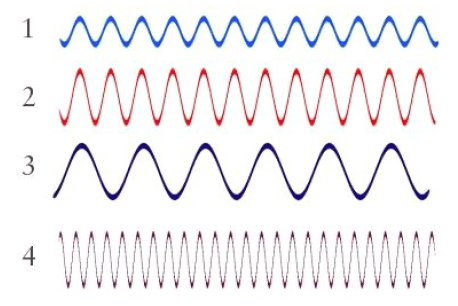
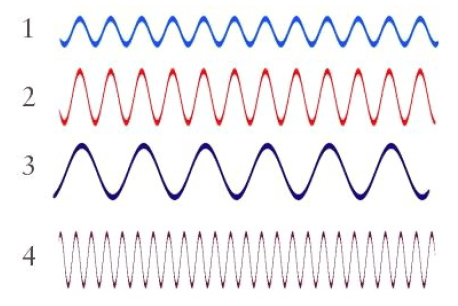
Which wave in the diagram has the greatest frequency?
a)
1
b)
2
c)
3
d)
4
28.
Which wave in the diagram has the greatest wavelength?
a)
1
b)
2
c)
3
d)
4
29.
Sound is caused by? 
a)
force
b)
vibrations
c)
instruments
d)
medium
30.
The units for frequency are measured in _____________.
a)
hertz
b)
seconds
c)
m/s
d)
m
31.
Amplitude reflects the amount of ____________________ in a wave.
a)
energy
b)
compression
c)
rarefaction
d)
speed
32.
What is the wavelength of the sound wave that has a frequency of 340 hertz as it travels through the air at 680 m/s?
a)
0.01 m
b)
0.5 m
c)
2.0 m
d)
200 m
33.
What is the speed of a sound wave that has a frequency of 250 hertz and a wavelength of 8 meters? 
a)
31 m/s
b)
250 m/s
c)
2000 m/s
d)
5280 m/s
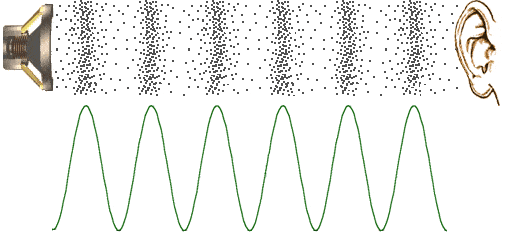
34.
What are the spaced out sections of this wave called?
a)
Reflections
b)
Rarefactions
c)
Compressions
d)
Wavelengths
35.

The SI unit for λ is ________.

a)

m

b)

m/s

c)

hertz

d)

s

36.

The SI unit for wave velocity is ________.

a)

m

b)

m/s

c)

hertz

d)

s

37.

What are the compressed sections of this wave called?

a)

Reflections

b)

Rarefactions

c)

Compressions

d)

Wavelengths

38.
All electromagnetic waves have the same...
a)
frequency
b)
speed
c)
wavelength
d)
energy
39.

Electromagnetic waves with the longest wavelengths are

a)

gamma rays

b)

x-rays

c)

infrared waves

d)

radio waves

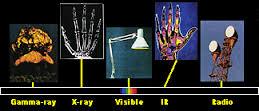
40.

Which of the following does NOT belong in the electromagnetic spectrum:

a)

X-ray

b)

sound wave

c)

ultra violet rays

d)

microwaves

41.
Which waves are the type that can give us suntans and sunburns?
a)
Infrared radiation
b)
Ultraviolet radiation
c)
Radio waves
d)
X-rays
42.
In visible light, which color has the longest wavelength?
a)
Red
b)
Violet
c)
Yellow
d)
Green
43.
Which rays can be felt as heat?
a)
X-Rays
b)
Infrared Radiation
c)
Ultraviolet Radiation
d)
Microwaves
44.
________________ are waves used by cops to test the speed of your car with RADAR.
a)
Ultraviolet
b)
Infrared
c)
Radio
d)
Microwaves
45.
Cancer can be treated with_______________waves.
a)
Penicillin
b)
Radio
c)
Infrared
d)
Gamma
46.
Electromagnetic waves________________travel through space.
a)
Never
b)
Cannot
c)
Can
d)
Wish they could
47.
The blue section of the wave is measuring _________________.
a)
wavelength
b)
crest
c)
trough
d)
amplitude 
48.
The acronym (letters) used to remember visible light is____________
a)
KTPERRY
b)
ROYGBIV
c)
DOGPOUND
d)
ROMERO
49.
_____________________light is the only type of EM wave detected by the human eye.
a)
Red
b)
Gamma
c)
Microwave
d)
Visible
50.
The orange line is measuring the _________________________.
a)
wavelength
b)
amplitude
c)
crest
d)
trough
51.
_______ carry the greatest amount of energy. 
a)
x-rays
b)
gamma rays
c)
infrared rays
d)
visible light
52.
This type of Electromagnetic wave shows a break in bones.
a)
gamma ray
b)
x-ray
c)
brokenometer
d)
radio wave
53.
Put the visible light colors in order from longest wavelength to shortest wavelength
a)
Violet, Indigo, Blue, Green, Orange, Yellow, Red
b)
Red, Yellow, Green, Orange, Violet, Blue, Indigo
c)
Red, Orange, Yellow, Green, Blue, Indigo, Violet
54.

What makes electromagnetic waves different from mechanical waves?

a)

no medium required

b)

medium needed

c)

light -catalyzed

d)

space exclusive

55.

Helpful in military night vision goggles

a)

radio wave

b)

microwave

c)

infrared

d)

light

56.
Electromagnetic waves can transfer energy without a ______________.
a)
Compression
b)
Rarefaction
c)
Medium
d)
Amplitude
57.
What of the following describes the speed of light through a vacuum?
a)
3 x 10⁻⁸
b)
3 x 10⁸
c)
3 x 10⁹
d)
3 x 10⁻⁹
58.
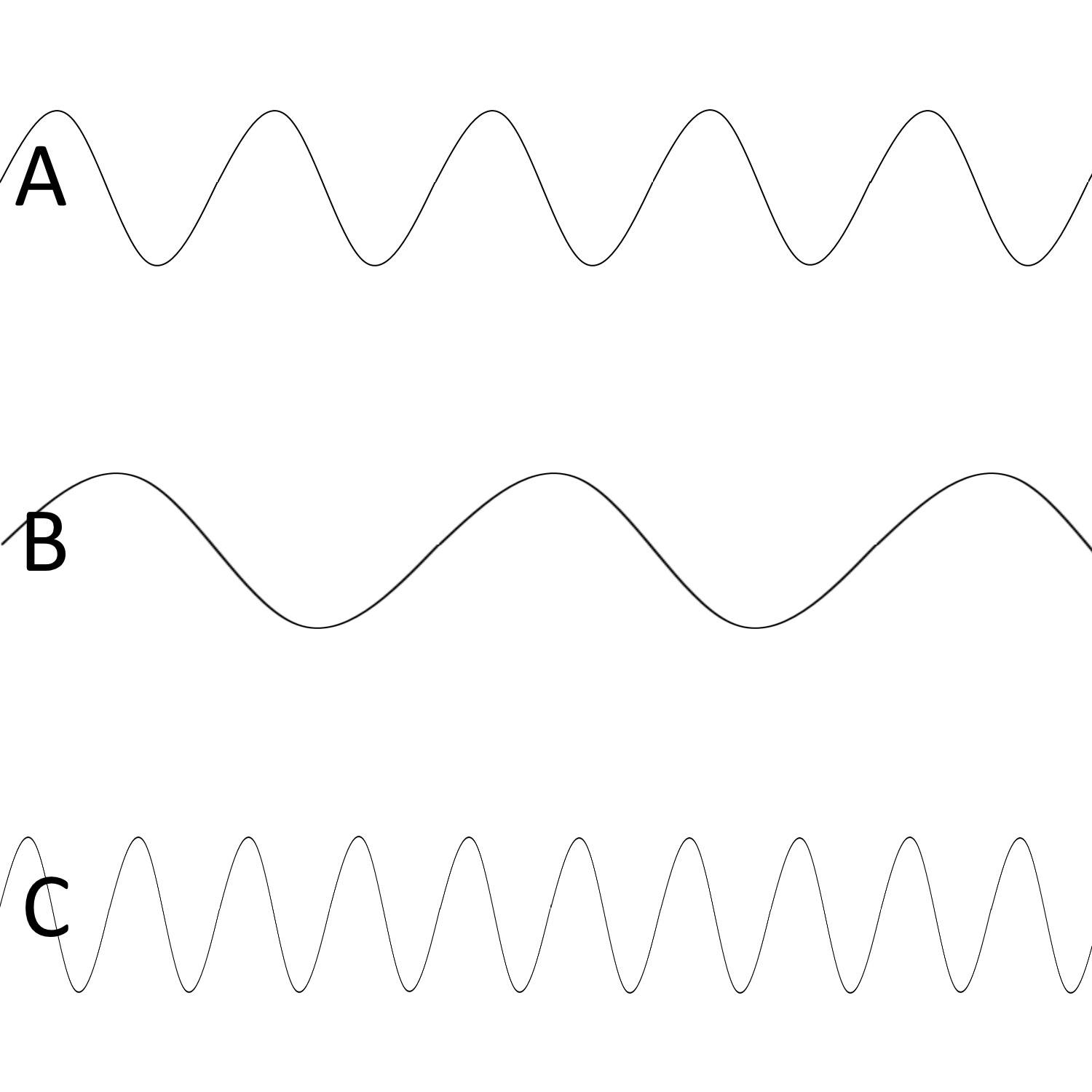
Which wave has the largest wavelength?
a)
A
b)
B
c)
C
d)
None (same wavelength)
59.
Which wave has the largest frequency?
a)
A
b)
B
c)
C
d)
None (same frequency)
60.
Which type of light has the highest energy of this group?
a)
red
b)
yellow
c)
green
d)
blue
61.
Which type of light has the smallest frequency of this group?
a)
red
b)
yellow
c)
green
d)
blue
62.
If the mass on Mars is 6.4 kg x 1023 kg and the mass on Earth is 6.0 kg x 1024 kg, which one would you weigh more on?
a)
Earth
b)
Mars
63.
Complete the following statement: The farther away two planets are the _______ the gravitational force between them.
a)
more
b)
same
c)
dosen't matter
d)
less
64.
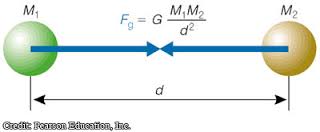
What is the Universal law of gravitation equation? 
a)
G=F ⋅ m⋅m2/r2
b)
F=G ⋅ m⋅m2/(r)2
c)
F=G ⋅ r2/m⋅m2
d)
G=F ⋅ r2/m⋅m2
65.
If a person has a mass of 70 kg on Earth, what will be ther mass if they go to the moon?
a)
35 kg
b)
1.25 kg
c)
70 kg
d)
there is no mass on the moon
66.
The number 6.67 x 10 -11 N* m^2 / kg^2 is called the _______________.
a)
universal speed constant
b)
the speed force
c)
universal gravitational constant
d)
Earth's gravitational constant
67.
Compute the distance separating two asteroids having masses of 3.0 x 10¹⁰ kg and  2.1 x 10¹² kg. It has been determined that they attract each other with a force of  2.50 x 10¹⁵ N.
a)
5.8 x 10^5 m
b)
.04 m
c)
40 m
d)
5.8  x 10 ^-11 m
68.
The gravitational force between two objects that are   2.1x10‐1 m apart is   3.2x10‐6 N.  If the mass of one object is 55 kg, what is the mass of the other object?         
a)
50.1 kg
b)
55.5 kg
c)
38.4 kg
d)
Asteroid 2 has no mass
69.
Two objects are 20 meters apart. What effect does increasing the distance between the objects to 60 meters have upon the gravitational attractive force between them?
a)
1/3 the amount of force will exist
b)
3 times the amount of force will exist
c)
1/9 the amount of force will exist
d)
9 times the amount of force will exist
70.
What is the unit of electric charge?
a)
Volts
b)
Amps
c)
Coulombs
d)
Ohms
71.
How is the electric force between two charges affected when both of the charges are doubled?
a)
four times as much
b)
two times as much
c)
half as much
d)
one quarter as much
72.
What are the two types of charges that objects may possess?
a)
+ and +
b)
+ and -
c)
+ and neutral 
d)
- and neutral 
73.
What is it called when an object gains a charge when touched by a charged object?
a)
Induction
b)
ESD
c)
Conduction
d)
Conducting path
74.
What is it called when an object gains a charge without touching a charged object but by being held near the charged object?
a)
Induction
b)
ESD
c)
Conduction
d)
Conducting path
75.
A cloth has a positive charge and can attract some paper scraps when held near them, what kind of charge can the paper scraps NOT have?
a)
Positive
b)
Negative
c)
Neutral 
76.
What equation is this:
F= k (q(a) x q(b)) / r^2 
a)
Coulombs law
b)
Ohms law
c)
Newtons law
77.
A balloon is rubbed against a student’s hair and then touched to a wall.
The balloon “sticks” to the wall due to 
a)
electrostatic forces between the particles of the balloon 
b)
magnetic forces between the particles of the wall 
c)
electrostatic forces between the particles of the balloon and the particles of the wall
d)
magnetic forces between the particles of the balloon and the particles of the wall 
78.
What is static electricity?
a)
electricity produced by like electric charges attracting
b)
electricity used for powering radios and televisions
c)
a buildup of balanced electric charges
d)
a buildup of excess electric charge
79.
What exerts the force that causes other electric charges to move?
a)
electrical poles
b)
the electric field
c)
insulators
d)
conductors
80.
The law of conservation of charge states that _____.
a)
the mass before a chemical change equals the mass after
b)
charge can be created and destroyed but not transferred
c)
electric charge is not created or destroyed
d)
charge is not created or destroyed or transferred to objects
81.
The negatively charged particles in an atom are called _____.
a)
electrons
b)
neutrons
c)
negatrons
d)
protons
82.
Two like charges
a)
 neutralize each other.
b)
repel each other. 
c)
must be neutrons. 
d)
attract each other.
83.

Coulomb's law says that the force between any two charges depends

a)

directly on the size of the charges

b)

inversely on the square of the distance between the charges

c)

both are correct

84.
The SI unit of charge is
a)
the ampere
b)
the newton
c)
the coulomb
d)
the joule
85.
What is the name of this device that is used to detect charges?
a)
beaker
b)
electroscope
c)
van de graff generator
d)
chargometer
86.
The Law of Conservation of Charge states that:
a)
all atoms have more protons than electrons.
b)
only protons can be rubbed off of an atom.
c)
charge cannot be created or destroyed.
d)
charge cannot be transferred.
87.
The electrostatic force between two charges located 2 meters apart is 0.10 N.  What will the force be between these charges when they are located 1 meter apart?
a)
0.40 N
b)
0.20 N
c)
0.10 N
d)
0.05 N
88.
The reason a charged balloon will stick to a wall is that
a)
the charge is slightly sticky and acts like glue
b)
electrons transfer back and forth between the wall and the balloon
c)
induced opposite charges in the wall are closer than other wall charges
d)
balloon material simply sticks to walls
89.

A 1C and a 4C charge attract each other with 8 N of force. How much will a 2C and the same 4C charge attract each other if the distance is unchanged?

a)

2N

b)

32N

c)

8N

d)

16N

90.

Two point charges, initially 2 m apart, are moved to a distance of 10 m apart. By what factor does the resulting electric force between them change?

a)

25

b)

5

c)

1/5

d)

1/25