
 Worksheets
G11.PHY202
Total questions: 90
Worksheet time: 2hrs 30mins
The relation between linear velocity and angular velocity
r = v⍵
⍵ = vr
v = r⍵
a = v⍵
The unit of angular velocity is
m/s
m/s²
rad/s
rad/s²
1 rev/min is equal to
2Π/60 rad/s
4Π/60 rad/s
360 rad/s
2Π rad/s
The number of complete revolutions per second is:
frequency
period
torque
rotational inertia
The time required for one complete revolution is:
torque
frequency
period
rotational kinetic energy
A ball on a string is spun around in a circle. Which of the following quantities is not constant?
mass
force
velocity
acceleration
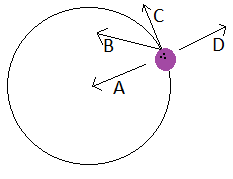
The unit of angular velocity is
m/s
m/s²
rad/s
rad/s²



A block is attached to a free end of an ideal horizontal spring. The system rests on a horizontal frictionless surface. When the block is pulled to the right, stretching the spring from its equilibrium, and released, the system starts oscillations. The horizontal position of the block as a function of time is shown above.
When does the spring exert its maximum force on the block?
0.0 s
2.0 s
4.0 s
8.0 s

When the mass reaches point x = +A its instantaneous velocity is?
Maximum and positive
Maximum and negative
Zero
Less than maximum and positive

When the mass reaches point x = +A or -A, its acceleration is?
Manimum
Maximum
Zero
Slightly less than maximum and positive

You observe that a pendulum completes 45 complete cycles in ninety seconds. What is the frequency of this pendulum?
100 m
1 Hz
0.5 Hz
1m/s

Which of the following is the expression for the above graph?
x = 2 sin (2πt)
x = 2 cos (2πt)
x = 2 sin (0.5πt)
x = 10 sin (2πt)
Given an expression of x = 10 sin (0.25πt) where x in cm, t in second. Which of these answers are true?
the frequency is 0.125 Hz
the amplitude is 10 m
the angular frequency is 0.125 rad s-1
at t = 0, x = 10 cm

The graph shows the variation in displacement with time for an object moving with simple harmonic motion.
What is the maximum acceleration of the object?
0.025 m⋅s−2
0.99 m⋅s−2
2.5 m⋅s−2
9.8 m⋅s−2
Which one of the following gives the phase difference between the particle velocity and the particle displacement in simple harmonic motion?
4π
2π
43π
2π
The highest point of the transverse wave.
a. amplitude
b. crest
c. trough
d. wavelength
These are waves that travel through a medium like air, water and solids.
a. electromagnetic waves
b. mechanical waves
c. surface waves
d. none of these
It is the maximum displacement of a particle from its rest position
a. crest
b. trough
c. amplitude
d. wavelength
It is the distance between two consecutive crests or troughs
a. amplitude
b. frequency
c. wavelength
d. speed
What kind of wave is an electromagnetic wave?
a. a transverse wave
b. a combination of longitudinal and transverse wave
c. a longitudinal wave
d. a shock wave
Which of the following is fundamentally different from the others?
a. X-rays
b. Sound waves
c. Light waves
d. Radio waves
Which statement is FALSE
Longitudinal waves are waves that travel parallel to the direction of the vibration
Shorter wavelengths will have lower frequency and less energy
The higher the frequency, the closer the waves are together and the greater the energy carried by the wave will be.
Speed is a measure of the distance a wave travels in an amount of time.

The diagram represents what type of wave
Transverse wave
Compressed wave
Longitudinal wave
Mechanical wave
Shorter wavelengths will have
lower frequency and less energy
equal frequency and equal energy
higher frequency and greater energy
higher frequency and less energy
A disturbance which travels through a medium from one location to another
electric current
wave
heat
light


flint glass n=1.70
barium glass n=1.60
crown glass n=1.523
water n=1.33
diamond n=2.45

1.5
1.4
1.45
1.55
What is total internal reflection
Where a wave is refracted at the boundary between a dense medium and a less dense medium when the angle of incidence is greater than the critical angle.
Where a wave is refracted at the boundary between a dense medium and a less dense medium when the angle of incidence is smaller than the critical angle.
Where a wave is reflected at the boundary between a dense medium and a less dense medium when the angle of incidence is greater than the critical angle.
Where a wave is reflected at the boundary between a dense medium and a less dense medium when the angle of incidence is smaller than the critical angle.
When the angle of refraction is 90 ° the angle of incidence is called the...
Angle of incidence
Critical angle
Angle of total internal reflection
Angle of refraction
For total internal reflection to occur, light must
travel from a more dense to a less dense medium
travel from a less dense to a more dense medium

What is the refractive index of a fibre optic pipe if the critical angle is 30 degree?
Outside is air.
2.0
1.7
2.4


You stand on the sidewalk next to the street. A fire truck is moving towards you. The frequency of the siren on the fire truck is 600 Hz.
What should you hear?
Frequency higher than 600 Hz
Frequency lower than 600 Hz
Exactly 600 Hz
No sound, silence.
You stand on the sidewalk next to the street. A fire truck is away from you. The frequency of the siren on the fire truck is 600 Hz.
What should you hear?
Frequency higher than 600 Hz
Frequency lower than 600 Hz
Exactly 600 Hz
No sound, silence.
You stand on the sidewalk next to the street. A fire truck is away from you. The frequency of the siren on the fire truck is 600 Hz.
What should the firemen on the truck hear?
Frequency higher than 600 Hz
Frequency lower than 600 Hz
Exactly 600 Hz
No sound, silence.
Which situation will result in the highest observed frequency?
Observer moves at 20 m/s towards sound source.
Sound source is motionless.
Observer moves at 20 m/s towards sound source.
Sound source moves at 20 m/s towards the observer.
Observer is motionless.
Sound source moves at 20 m/s towards the observer.
Observer is motionless.
Sound source moves 20 m/s away from the observer.
Which situation will result in the lowest observed frequency?
Observer moves at 20 m/s towards sound source.
Sound source is motionless.
Observer moves at 20 m/s towards sound source.
Sound source moves at 20 m/s towards the observer.
Observer is motionless.
Sound source moves at 20 m/s towards the observer.
Observer is motionless.
Sound source moves 20 m/s away from the observer.

A car moves at 20 m/s towards a whistle. The whistle is stationary. The whistle makes a sound with a frequency of 500 Hz. The speed of sound in air is 330 m/s.
What is the frequency observed by the driver of the car?
530 Hz
470 Hz
520 Hz
480 Hz

A car moves at 20 m/s away from a whistle. The whistle is stationary. The whistle makes a sound with a frequency of 500 Hz. The speed of sound in air is 330 m/s.
What is the frequency observed by the driver of the car?
530 Hz
470 Hz
520 Hz
480 Hz
You look at a star through a telescope. You use a special camera to measure the light being emitted from the star. The star should be a blue color, but it appears to be slightly purple.
What is the star doing?
Moving away from the Earth.
Moving towards the Earth.
Motionless in space.
Shrinking in size.
You look at a star through a telescope. You use a special camera to measure the light being emitted from the star. The star should be a yellow color, but it appears to be slightly orange.
What is the star doing?
Moving away from the Earth.
Moving towards the Earth.
Motionless in space.
Shrinking in size.
What is the term for the distance a wave travels in one complete cycle?
Period
Frequency
Amplitude
Wavelength
Which of the following describes the change in frequency of a wave in relation to an observer moving towards the source?
Refraction
Doppler Effect
Redshift
Diffraction
In a wave, the point of maximum displacement from the rest position is known as:
Wavelength
Amplitude
Trough
Crest
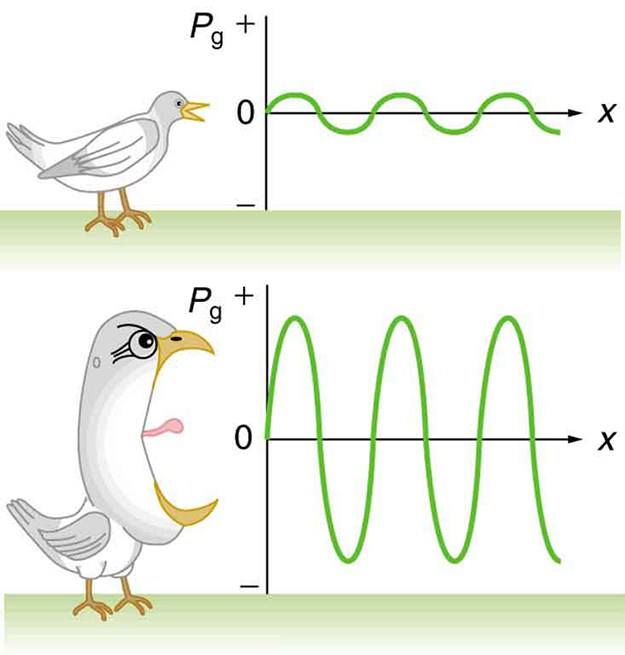

Sound waves travel the fastest through ---
Liquids
Gases
Solids

Sonar and echolocation use ----- to detect objects under water.
Refraction
Reflection
Sound waves that are beyond the range of human ear are known as ----
Infrasonic waves
Ultrasonic waves

A police car siren emits two different sounds P and Q. These are produced alternately. The diagram represents the sound emitted.
A
B
C
D

The diagram represents two sound waves.
A
B
C
D

The diagrams show the wave shapes of two different sounds. The scales are the same in each diagram.
How does sound 2 compare with sound 1?
Sound 2 is louder than sound 1
Sound 2 is quieter than sound 1
Sound 2 has a higher pitch than sound 1
Sound 2 has a lower pitch than sound 1

Two sounds X and Y are produced by loudspeakers.
The amplitude and frequency of each sound wave is given in the table.
How does sound Y compare with sound X?
Y is louder and has a higher pitch
Y is louder and has a lower pitch
Y is quieter and has a higher pitch
Y is quieter and has a lower pitch
A ship sends a pulse of sound vertically downwards to the sea bed. An echo is heard 0.4 seconds later.
If the speed of sound in the water is 1200 m/s , how deep is the water below the ship?
240 m
480 m
1500 m
3000 m
A student claps once when standing 100 m away from a large wall.
The speed of sound in air is 330 m/s.
How long after clapping does the student hear an echo?
0.30 s
0.61 s
1.7 s
3.3 s
A tennis player hits a ball hard and 0.40 s later hears the echo from a wall.
The speed of sound in air is 330 m/s.
How far away is the player from the wall?
66 m
132 m
264 m
825 m
A loudspeaker on the boat produces a pulse of sound in the sea. The echo of the pulse is received back at the boat after 3.0 s. The depth of the sea under the boat is 2250 m.
From this information, what is the speed of sound in the sea water?
330 m/s
750 m/s
1500 m/s
6750 m/s
The spreading of light as it enters the opening of a barrier.
reflection
refraction
interference
diffraction
What does the law of reflection say?
The angle of incidence equals the angle of reflection.
All waves incident on a mirror are reflected.
Waves incident on a mirror are partially reflected.
The angle a ray is reflected from a mirror is random.
What happens to the speed of light when a pencil placed in a glass of water appears broken at the surface of the water?
it stops
it is decreasing
it is increasing
t does not change
What is the angle of refraction if i=C?
60°
40°
90°
80°
What is the correct definition of critical angle?
The angle at which angle of refraction=90°
The angle at which angle of reflection =90°
The angle at which partial reflection and refraction = 90°
The angle at which no refraction takes place
Which of these are the correct factors necessary for total internal reflection to take place? Choose all that apply.
i > C
i < C
light has to travel from denser to rarer medium
light has to travel from rarer to denser medium

What is the angle of incidence at surface KM?
30°
90°
60°
42°

_____ cables transmit beams of light without allowing any of the light to escape until it gets to the end of the cable.
Ethernet
Fiber optic
Armored
Coaxial
Choose the correct statement that describes what happens to the ray of light if the critical angle is 48o and the angle of incidence is 48o
refract
totally internally reflect
travel along the boundary

see image
A
B
C
D


