
 Worksheets
Wave and Wave Behavior Unit Assessment 2021
Total questions: 89
Worksheet time: 2hrs 34mins
What is the definition reflection?
The bending of waves as they enter a new medium
Bouncing back of waves from a surface that it can’t pass through
The bending of waves as they pass through openings or around corners
When two interfering waves have a displacement in the same direction, two crests and two troughs overlap. Increased amplitude.
What is the definition of Refraction?
The bending of waves as they enter a new medium
When two interfering waves have a displacement in the opposite direction, crest and trough overlap. Zero amplitude.
When two interfering waves have a displacement in the same direction, two crests and two troughs overlap. Increased amplitude.
Rainbows are made by...
water
rain
Water droplets act as prisms to separate white light into the ROYGBIV spectrum


Light waves and sound waves are similar in that...
They are both longitudinal waves
They are both transverse waves
They both transmit energy
They both can travel through space.
As light travels through a lens it causes an object to appear larger, this is due to which behavior?
Transmission
Reflection
Absorption
Refraction


What is the definition of Diffraction?
The bending of waves as they enter a new medium
Bouncing back of waves from a surface that it can’t pass through
When two interfering waves have a displacement in the opposite direction, crest and trough overlap. Zero amplitude.
The bending of waves as they pass through openings or around corners
· Why can we hear around a corner but not see?
Increased amplitude of the light wave means brighter light
the smaller the opening the more diffraction, light waves are so small you will have little diffraction.
Decreased amplitude of the light wave means dimmer light
Give an example of Diffraction.
Water droplets act as prisms to separate white light into the ROYGBIV spectrum
Decreased amplitude of the sound wave means softer sound
the smaller the opening the more diffraction, light waves are so small you will have little diffraction.
hearing the bass of the music through the openings in a car (longer wavelengths)

The type of wave in which the medium moves parallel to the wave motion is
transverse
longitudinal
light
electromagnetic
A wave that needs a medium to travel is called a(n)
electromagnetic wave
mechanical wave
ocean wave
any way can do this
A wave that can travel with or without a medium is called a(n)
electromagnetic wave
mechanical wave
surface wave
all waves can travel in any way
Longitudinal waves have:
crests and troughs
crests and compressions
compressions and rarefactions
troughs and rarefactions
Transverse waves have:
crests and troughs
troughs and rarefactions
compressions and contractions
rarefactions and crests
How often a wave occurs is the wave's
frequency
amplitude
wavelength
velocity

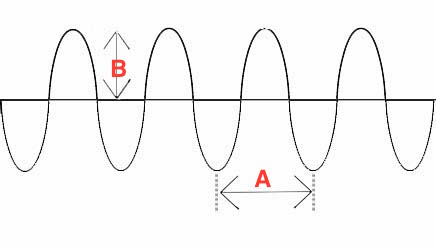
What is the amplitude of this wave?
3
-3
6
4

What is the wavelength of this wave?
3
10
4
8
What would happen to the wavelength if the frequency was doubled?
the wavelength would be halved
the wavelength would be doubled
the wavelength would stay the same
frequency does not affect wavelength
What would happen to the frequency is the wavelength was tripled?
the frequency would be a third of what it was
the frequency would be 3 times larger
the frequency would stay the same
the wavelength does not affect the frequency of a wave

This picture is an example of which type of wave?
transverse wave
compression wave
ocean wave

The image depicts which of the following wave behaviors?
Resonance
Doppler Effect
Polarization
Diffraction
Definition: When one object vibrating at the same natural frequency of a second object forces that second object into vibrational motion.
Reflection
Refraction
Diffraction
Resonance

The image depicts which of the following wave behaviors?
Resonance
Doppler Effect
Interference
Polarization

The image of the two waves depicts
Constructive interference
Destructive interference
Two waves that undergo constructive interference must be...
In phase
Out of phase
Two waves that undergo destructive interference must be...
In phase
Out of phase
The two categories of waves are
Mechanical
Physical
Electromagnetic
Love
The two forms that waves can take are...
Transverse
Circular
Diamond
Longitudinal

Which of the pictured is responsible for our sky being blue?
Transmission
Reflection
Refraction
Scattering
Absorption
Which of the pictured is responsible for black pavement being hot?
Transmission
Reflection
Refraction
Scattering
Absorption

Light from the Sun transfers solar energy to the Earth system. Sunlight travels to Earth as _______ waves.
electromagnetic
seismic
sound
water
Which property of the wave would change if you changed the amount of energy the wave had?
amplitude
frequency
wavelength
wave speed


Which shows the EM spectrum in order from longest to shortest wavelength?
Gamma, X-Ray, UV, Visible, IR, Microwaves, Radio
Radio, Microwaves, IR, Visible, UV, X-Ray, Gamma
Visible, UV, X-Ray, Gamma, Radio, Microwaves, IR
Visible, Radio, Microwaves, IR, UV, X-Ray, Gamma
A wave has wavelength of 10 m and a speed of 340 m/s. What is the frequency of the wave?
34 m/s
34 hz
3400 m/s
3400 Hz
A wave has frequency of 5 Hz and a speed of 25 m/s. What is the wavelength of the wave?
5 m
5 Hz
125 m
125 Hz
A wave has a frequency of 14 Hz and a wavelength of 3 m. At what speed will this wave travel?
42 m/s
42 m
4.67 m/s
4.67 Hz
A wave has a frequency of 540 Hz and is traveling at 340 m/s. What is its wavelength?
1.59 m
0.63 m
183600 m
91800 m
Six waves go past a fixed point in two seconds. What is the frequency of the wave?
3
6 Hz
3 Hz
2
20 waves go past a fixed point in 10 seconds. What is the frequency of the wave?
20 seconds
20 Hz
2 Hz
2
A wave has a frequency of 6 Hz. What is the period of the wave?
0.167 s
6 m
0.167
6 Hz
A wave has a frequency of 50 Hz. What is the period of the wave?
2 m
0.02
25 m
0.02 s
Compared to a low pitch wave, a high pitch wave will have a
higher frequency and shorter wavelength
higher frequency and longer wavelength
larger amplitude and shorter wavelength
smaller amplitude and shorter wavelength
Volume is the human perception if a wave's amplitude. Higher decibels relates to
shorter wavelength
longer wavelength
larger amplitude
smaller amplitude
What is the name of the human perception of frequency?
pitch
sound
volume
decibel
A higher frequency results in
higher volume
lower pitch
lower volume
higher pitch
What do we call the human perception of amplitude?
sound
volume
Hertz
pitch
wavelength
This is a transverse wave
Light
Sound
Both
This is a longitudinal wave
Light
Sound
Both
This wave requires a medium.
Light
Sound
Both
This wave transfers energy from one place to another.
Light
Sound
Both
This wave transfers particles from one place to another
Light
Sound
Both
Neither
This wave is caused by the vibration of particles
Light
Sound
Both
This wave can travel through empty space
Light
Sound
Both
If lightning strikes you see it before you hear the thunder because...
Sound travels faster than light
Light travels faster than sound
a small, fast movement that goes back and forth
vibration
reflect
sound


