
 Worksheets
Final Exam Review Spring
Total questions: 82
Worksheet time: 1hrs 22mins
Name
Class
Date
1.
Two like charges
a)
neutralize each other.
b)
repel each other.
c)
must be neutrons.
d)
attract each other.
2.
The charge of an electron is
a)
positive.
b)
negative.
c)
Electrons have no charge
3.
An atom loses an electron. What type of charge does it have now?
a)
positive
b)
negative
4.
An atom gains an electron. What type of charge does it have now?
a)
positive
b)
negative
c)
No charge
5.
What direction are the electric field lines around an electron?
a)
towards the charge
b)
away from the charge
6.
What does it mean when the electric field lines are close together?
a)
the field is positive
b)
the field is negative
c)
The field is strong
d)
the field is weak
7.
What do you call the process of charging a conductor by bringing it near another charged object?
a)
induction
b)
polarization
c)
neutralization
d)
conduction
8.
What direction are the electric field lines around a proton?
a)
towards the charge
b)
away from the charge
9.
assume a rubber rod is rubbed against a rabbit fur and gains 5 electrons. which of the following is true?
a)
The fur lost 5 electrons
b)
the fur gained 5 electrons
c)
the fur gained 5 protons
d)
The fur lost 2 electrons
10.
A series circuit has ____ path(s) that the electric current can take.
a)
One
b)
Two
c)
Three
d)
Four
11.
Electricity is the flow of _________.
a)
Protons
b)
Neutrons
c)
Electrons
12.

What is the unit of Current?
a)
Amps
b)
Watts
c)
Volts
d)
Joules
13.

What is the unit of voltage?
a)
Amps
b)
Watts
c)
Volts
d)
Joules
14.

What is the unit of energy?
a)
Amps
b)
Watts
c)
Volts
d)
Joules
15.

If the voltage across the battery was 10V in this diagram. What would the voltage across each bulb be?
a)
10V
b)
5V
c)
20V
d)
0V
16.
If you decreases the resistance of a circuit, what happens?
a)
Current decreases
b)
Current increases
c)
Electrons disappear
d)
Bulbs get brighter
17.
If you increase the voltage of a circuit, what happens?
a)
Current decreases
b)
Current increases
c)
Electrons disappear
d)
Bulbs get dimmer
18.

In alternating current, the motion of the charges:
a)
continuously changes in the forward and reverse directions.
b)
is equal to the speed of light.
c)
is greater than the speed of light.
d)
is in the same direction of the electric field.
19.

The current flowing in an electric circuit can be increased by:
a)
increasing voltage or decreasing resistance.
b)
decreasing voltage or increasing resistance.
c)
increasing voltage and increasing resistance.
d)
decreasing voltage and decreasing resistance.
20.

Current from a battery is:
a)
AC
b)
DC
21.

Identify the following as characteristics of either a series circuit or a parallel circuit:
When one light bulb burns out, they all go out.
When one light bulb burns out, they all go out.
a)
Series circuit
b)
Parallel circuit
22.

Identify the following as characteristics of either a series circuit or a parallel circuit:
Voltage throughout the circuit remains the same.
Voltage throughout the circuit remains the same.
a)
Series circuit
b)
Parallel circuit
23.

This is an example of a _______ circuit
a)
open
b)
series
c)
parallel
d)
square
24.

This is an example of a ______ circuit
a)
Series
b)
Parallel
c)
Open
d)
Dihexihedral
25.
When the distance between two charges is halved, the electrical force between the charges
a)
quadruples
b)
reduces to one fourth
c)
halves
d)
doubles
26.
If each of the charges doubles, what happens to the force between them?
a)
Quadruples
b)
Doubles
c)
Stays the same
d)
Reduced by half
27.
If the distance between two charges doubles, what happens to the force?
a)
Reduced by half
b)
Reduced by 1/4
c)
Stays the same
d)
Quadruples
28.
If the distance between two charges is tripled, what happens to the force?
a)
Quadruples
b)
1/9 as much
c)
Triples
d)
nine times greater
29.

A class prepared some electrical circuits using battery, connecting wires, and three light bulbs. Which of these circuits can make the three bulbs light?
a)
A
b)
B
c)
C
d)
D
30.
Where is the strongest attraction force of the magnet?
a)
at the poles
b)
in the middle
c)
above the magnet
d)
below the magnet
31.
Surrounding every moving electron is
a)
(a) a magnetic field
b)
(b) an electric field
c)
(c) both of these
d)
(d) none of these
32.
When there is a change in the magnetic field in a closed loop of wire
a)
(a) a voltage is induced in the wire
b)
(b) current is made to flow in the loop of wire
c)
(c) electromagnetic induction occurs
d)
(d) all of these
33.
If a magnet is pushed into a coil, voltage is induced across the coil. If the same magnet is pushed
into a coil with twice the number of loops,
into a coil with twice the number of loops,
a)
a. one-half as much voltage is induced.
b)
b. the same voltage is induced.
c)
c. twice as much voltage is induced.
d)
d. four times as much voltage is induced.
34.
What condition is necessary for an electric charge to have a magnetic field around it?
a)
a. it must be in a copper wire
b)
b. it must be isolated from the opposite charge
c)
c. it must be moving
d)
d. it must be motionless
35.
What does a moving charged particle experience if it moves through a static magnetic field?
a)
a. nothing
b)
b. an acceleration in the current direction
c)
c. a deflection that is parallel to the magnetic field
d)
e. a deflection that is perpendicular to both the magnetic field and the current
36.
Electromagnetic induction occurs in a coil when there is a change in
a)
a. electric field intensity in the coil.
b)
b. magnetic field intensity in the coil.
c)
c. voltage in the coil.
d)
d. the coil's polarity.
37.

An electric motor converts electric energy into what type of energy?
a)
potential
b)
thermal
c)
magnetic
d)
mechanical
38.

Which of the following is a device that converts electrical energy into mechanical energy?
a)
generator
b)
transformer
c)
magnet
d)
motor
39.

In a generator, mechanical energy is converted to:
a)
electrical energy
b)
potential energy
c)
chemical energy
d)
radiant energy
40.
What letter represents the magnetic field?
a)
M
b)
V
c)
B
d)
i
41.
For Right Hand Rule #1 the thumb represents the direction of the.......?
a)
Force (F)
b)
Current (i)
c)
Velocity (v)
42.

A
a)
Rarefaction
b)
Compression
c)
Crest
d)
Wavelength
43.
B
a)
Rarefaction
b)
Compression
c)
Crest
d)
Wavelength
44.

#3
a)
Trough
b)
Crest
c)
Amplitude
d)
Wavelength
45.
When two waves grow larger in amplitude as they overlap (e.g. crest and crest).
a)
Constructive Interference
b)
Destructive Interference
c)
Passing Interference
46.
When two waves decrease in amplitude as they overlap (e.g. crest and trough).
a)
Constructive Interference
b)
Destructive Interference
c)
Passing Interference
47.
Wavelength and frequency have what relationship?
a)
Direct - when one increases, so does the other
b)
Inverse - when one increases, the other decreases
c)
Unrelated - sometimes they both change in the same way, and sometimes they don't
48.
Pitch and frequency have what relationship?
a)
Direct - when one increases, so does the other
b)
Inverse - when one increases, the other decreases
c)
Unrelated - sometimes they both change in the same way, and sometimes they don't
49.
A wave that has a frequency of 10 Hz, a wavelength of 3m, and an amplitude of 2m, would have which speed?
a)
6 m/s
b)
20 m/s
c)
30 m/s
d)
60 m/s
50.
Crest to crest or trough to trough measures....
a)
Amplitude
b)
Wavelength
c)
Compressions
d)
Rarefactions
51.
The medium (or tension) through which a wave travels affects its...
a)
Wavelength
b)
Speed
c)
Amplitude
52.
Echoes are which type of wave interaction
a)
Reflection
b)
Rarefaction
c)
Refraction
d)
Diffraction
53.
When sound or light travels through a doorway, then spreads out into the whole room...
a)
Refraction
b)
Diffraction
c)
Reflection
d)
Resonance
54.
When one object vibrates and causes another object to vibrate...
a)
Refraction
b)
Diffraction
c)
Reflection
d)
Resonance
55.
Which diagram best represents the shape and direction of a series of wave fronts after they have passed through a small opening in a barrier?
a)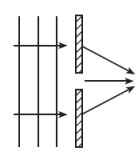
b)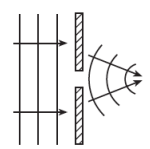
c)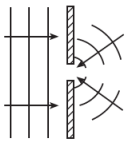
d)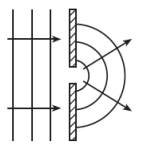
56.

a)
Reflection
b)
Refraction
c)
Diffraction
d)
Interference
e)
Absorption
57.
What is a medium?
a)
something between a small and a large?
b)
the substance through which a wave can travel
c)
a pattern of vibration that simulates when a wave is standing still
d)
the distance from any point on a wave to an identical point on the next wave
58.
You can see this text, your desk, and the person in front of you because light is being _______.
a)
absorbed
b)
refracted
c)
diffracted
d)
reflected
59.
________________ particles vibrate up and down, while the wave as a whole moves left to right.
a)
Transverse Wave
b)
Longitudinal Wave
c)
Sound Wave
d)
Wavy hair
60.

_____________ wave particles move left to right.
a)
Transverse
b)
Electromagnetic
c)
Longitudinal
d)
Ocean
61.
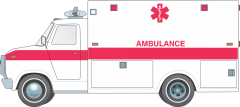
When an ambulance move TOWARD you it sounds ________ pitched.
a)
high
b)
low
c)
medium
62.

The Doppler effect is seen when a wave-making source moves toward an observer.
a)
True
b)
False
63.

What can you tell about this object's motion?
a)
Moving to the North (up).
b)
Moving to the South (down).
c)
Moving to the West (left).
d)
Moving to the East (right).
64.

_____ is a lens that is thicker in the middle and makes an object appear bigger.
a)
prism
b)
convex lens
c)
concave lens
d)
mirror
65.

______ is a lens that is thicker on its edges and makes an object appear smaller?
a)
mirror
b)
convex lens
c)
concave lens
d)
prism
66.
Material that allows light to pass through allowing you to see "clearly" to the other side
a)
opaque
b)
translucent
c)
transparent
67.
Which is true of a green grape?
a)
It absorbs green light.
b)
It absorbs white light.
c)
It reflects green light.
d)
It reflects white light.
68.
When the frequency of a wave increases, what happens to the wavelength?
a)
The wavelength is not directly affected by the frequency of a wave.
b)
The wavelength increases.
c)
The wavelength decreases.
d)
More specific information is needed to form a conclusion about the wavelength.
69.

Glass has a _____________ index of refraction than air.
a)
Equal
b)
Greater
c)
Less
d)
Impossible to say
70.
The measure of how much light refracts is called...
a)
Refraction
b)
Law of reflection
c)
reflected ray
d)
Index of refraction
71.
Light has the highest velocity in which medium?
flint glass n=1.70
barium glass n=1.60
crown glass n=1.523
water n=1.33
diamond n=2.45
flint glass n=1.70
barium glass n=1.60
crown glass n=1.523
water n=1.33
diamond n=2.45
a)
diamond
b)
water
c)
flint glass
d)
barium glass
72.
According to Willebord Snell, light passing from air to glass will cause the light to
a)
maintain its original speed
b)
accelerate while it is in glass
c)
increase its speed
d)
reduce its speed
73.

How does light behave as it enters these mediums?
a)
continue its path as straight line.
b)
bends toward the normal
c)
bends away from the normal
d)
reflects
74.
What does the word "converging" mean?
a)
to separate
b)
to come together
c)
parallel
d)
perpendicular
75.
When an object is placed between the focal point and the convex lens, the image produced is ___.
a)
real, reduced, and inverted
b)
real, enlarged, and inverted
c)
virtual, enlarged, and upright
d)
virtual, reduced, and upright
76.
Images produced by a diverging lens are always _____.
a)
real, reduced, and inverted
b)
virtual, reduced, and upright
c)
real, enlarged, and inverted
d)
virtual, enlarged, and upright
77.
What does the word "diverging" mean?
a)
to spread apart
b)
to come together
c)
parallel
d)
perpendicular
78.

The point where the rays meet is known as....
a)
Fire
b)
the focal point
c)
refraction
d)
Plane of the lens
79.
What type of image is formed when rays of light actually intersect?
a)
real
b)
virtual
c)
projected
d)
curved
80.
A converging lens is also known as a ____ lens.
a)
convex
b)
concave
c)
double
d)
refracted
81.
A diverging lens is also known as a ____lens.
a)
refracted
b)
diffracted
c)
convex
d)
concave
82.

What kind of lens is shown?
a)
Concave
b)
Convex
Convex
Convex
c)
Specular
Concord
Concord
d)
Diffuse
Plane
Plane
100 %

