wayground logo

Free Printable Worksheets

NEW

Font size

S
M
L
XL
Worksheets

Electricity Test Review 2022

Total questions: 79

Worksheet time: 2hrs 40mins

Name
Class
Date
1.
The flow of electricity in a circuit-
a)
current
b)
flow
c)
circuit
2.
Electricity that flows in a closed path is called a
a)
path
b)
current
c)
circuit
3.
Two batteries in a circuit make the lights in the circuit brighter than one battery.
a)
true
b)
false
4.
If the lights are on, the circuit is
a)
closed
b)
open
5.
If the lights are off, the circuit is
a)
closed
b)
open
6.
In a parallel circuit the current
a)
makes one circle
b)
stays in one path
c)
splits and goes through two components
7.
When socks get stuck to towels in your dryer, this is an example of________________
a)
current electricity
b)
static electricity
8.
What is the major difference between static electricity and current electricity?
a)
Current electricity involves a continuous flow of neutrons; static electricity is a sudden transfer of protons
b)
Current electricity can be deadly; static electricity is almost always safe
c)
In current electricity, there's a single transfer of electrons; in static electricity, there's a steady flow of electrons
d)
Current electricity involves a flow of electrons; static electricity involves a single transfer of electrons
9.
True or False, Lighting is a form of static electricity.
a)
True
b)
False
10.

Static means ____________.

a)

moving

b)

not moving

11.
Two objects with LIKE static charges will
a)
attract each other
b)
even out in the end
c)
repel each other
d)
cause a spark
12.
Which is an example of static dischage?
a)
a motor
b)
lightning
c)
thunder
d)
insulators
13.
Static charges build up when
a)
protons move within an object
b)
electrons move within an object
c)
neutrons move within an object
d)
the nucleus moves within an object
14.
Is it possible to CREATE electrons?
a)
Yes, that's what static electricity is.
b)
No, you can move them, but they are never created or distroyed.
c)
Sometimes, it depends on the voltage.
d)
Sometimes, it depends on the element.
15.
If two objects with static charge are attracted, what do you know about them?
a)
They are both positively charged.
b)
They are both negatively charged.
c)
One is positively charged and one is negatively charged, but you won't be able to tell which is which.
d)
One is positively charged and one is negatively charged, and you can tell which is which by looking at them.
16.
Rubbing a balloon on hair is an example of static charge build up created by....
a)
conduction
b)
friction
c)
induction
d)
hairduction
17.

As two oppositely charged particles approach each other, what happens to the electrical force between them?

a)

The attractive force increases

b)

The magnitude of the electric force decreases

c)

The repulsive force increases

d)

The magnitude of their charges increases

18.

What happens to the electric force between two charges when the distance is tripled?

a)

3 times less electric force

b)

3 time more electric force

c)

9 times less electric force

d)

9 times more electric force

19.

The figure shows a neutral glass rod and a positively charged metal sphere.


Which of the following best describes the movement of charges as this glass rod touches the sphere?

a)

Protons move from the sphere to the glass rod.

b)

Electrons move from the sphere to the glass rod.

c)

Electrons move from the glass rod to the sphere.

d)

Protons move from the glass rod to the sphere.

20.

What is the SI unit for charge?

a)

Joules

b)

Coulombs

c)

Newtons

d)

Meters

21.
Electrostatic force F is directly proportional to:
a)
r^2 (distance squared)
b)
q1
c)
q2
d)
both q1 and q2
22.
When distance increases, electrostatic force ____________; we call this relationship ____________ proportional
a)
decreases;directly
b)
decreases;inversely
c)
increases;inversely
d)
increases;directly
23.
The Electric Force is strongest when charges are...
a)
close together
b)
far apart
c)
the electric force is constant everywhere
24.

Approximately how much force would be generated by two charged objects held 2 m apart, if q1 has a charge of 3.0 C and q2 has a charge of 4.0 C?

a)

0.5 N

b)

1.5 N

c)

3 N

d)

6 N

25.

Which is the value of the constant in Coulomb's equation?

a)

k = 9·10-9

b)

k = 9.8

c)

k = 6.67·10-11

d)

k = 9 ·109

26.

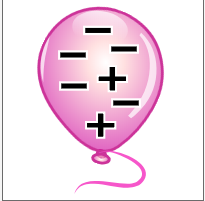
This model of the balloon shows ______ positive charges than negative charges. So this balloon is _____ charged.

a)

fewer/positively

b)

more/positively

c)

fewer/negatively

d)

more/negatively

27.

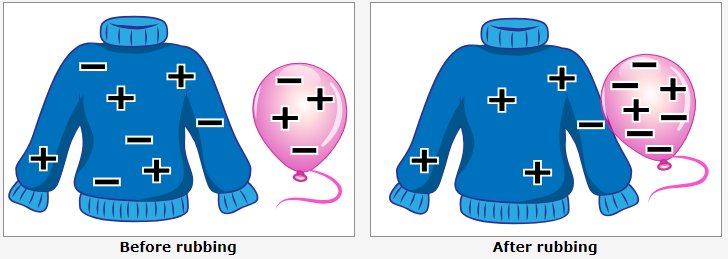
Before the balloons and sweaters are rubbed together, both objects are __________ charged. After they are rubbed together the sweater is __________ charged and the balloon is ___________ charged

a)

negative/positive/negative

b)

neutral/positive/negative

c)

positive/negative/neutral

d)

neutral/negative/positive

28.
What is voltage?
a)
The amount of electric potential energy per one coulomb of charge
b)
The amount of 1 coulomb of charge per unit of potential energy
c)
The number of volts per coulomb
d)
The amount of electric potential energy per volt
29.

How to you calculate the total resistance in a series circuit?

a)

R1 + R2+ R3

b)

R1 - R2 - R3

c)

1/R1 + 1/R2 + 1/R3

d)

R1 = R2 = R3

30.

What is the equivalent or total resistance (Re) across this circuit?

a)

3 kΩ

b)

10 kΩ

c)

13 kΩ

d)

18 kΩ

31.
Which resistor will prevent the most current flow?
a)
1 ohm
b)
100 ohms
c)
1000 ohms
d)
0.5k ohms
32.

the formula to find current when the values of V and R are known is

a)

I = V2R

b)

I = V/R

c)

I = R/V

d)

I=VR

33.
What size resistor would produce a 3 Amp current flow with a 12 Volt battery
a)
1 Ohm
b)
3 Ohms
c)
4 Ohms
d)
12 Ohms
34.
The equivalent resistance in this circuit is 
a)
100 ohms
b)
450 ohms
c)
400 ohms
d)
30 ohms
35.

According to Coulomb's Law, The greater the separation distance between two charges the greater the magnitude of the electric force. True or False?

a)

True

b)

False

36.

Coulomb's Law states that the electric force is directly proportional to the product of the two charges and inversely proportional to the distance between them. True or False?

a)

True

b)

False

c)

not enough information

37.
If the voltage is increased and the resistance stays the same, current will ____.
a)
Increase
b)
Decrease
c)
Stay the same
d)
Not enough info
38.
If the voltage stays the same and resistance is increased, current will ________. 
a)
Increase
b)
Decrease
c)
Stay the same
d)
Not enough info
39.
Find total resistance
total current
and the voltage through resistor 3.
a)
60 Ohms, 0.4 A,  8 V
b)
60 Ohms, 2.5 A,  4 V
c)
90 Ohms, 2.5 A, 24 V
d)
60 Ohms, 0.4 A, 24 V
40.
A light circuit is operating at 75 Volts. What is the circuit's current if the resistance is 5 Ohms?
a)
375 Amps
b)
50 Amps
c)
15 Amps
d)
0.07 Amps
41.
Two resistors are connected to a source of voltage as shown in the diagram below. At which position should an ammeter be placed to measure the current passing only through resistor R1?
a)
1
b)
2
c)
3
d)
4
42.
A 2.0-ohm resistor and a 4.0-ohm resistor are connected in series with a 12-volt battery. If the current through the 2.0-ohm resistor is 2.0 amperes, the current through the 4.0-ohm resistor is
a)
1.0 A
b)
2.0 A
c)
3.0 A
d)
4.0 A
43.
A 30.-ohm resistor and a 60.-ohm resistor are connected in an electric circuit as shown below. Compared to the electric current through the 30.-ohm resistor, the electric current through the 60.- ohm resistor is
a)
smaller
b)
larger
c)
cannot be determined
d)
the same 
44.
What is the current measured by ammeter A?
a)
0.5 Amps
b)
2 Amps
c)
72 Amps
d)
6 Amps
45.
What is the voltage drop across the 36 ohm resistor?
a)
12V
b)
3V
c)
0.33V
d)
24V
46.
A circuit is shown below. Which of the following is true of this circuit?
a)
It is series and therefore both resistors have the same voltage
b)
It is series and therefore both resistors have the same current
c)
It is parallel and therefore both resistors have the same voltage
d)
It is parallel and therefore both resistors have the same current
47.
Two identical lamps, L1 & L2, are connected to a constant voltage power supply. The voltage drop across L1 is 36V. What is the voltage of the power supply?
a)
18V
b)
36V
c)
6V
d)
72V
48.

An atom of oxygen has 8 protons and 10 electrons, this means the atom is ____________

a)

positively charged because it has excess electrons

b)

negatively charged because it has excess electrons

c)

positively charged because it has a deficiency of electrons

d)

negatively charged because it has a deficiency of electrons

49.

Which statement is true of a positively charged object?

a)

Positively charged objects do not contain any electrons.

b)

Positively charged objects do not contain neutrons or electrons.

c)

There is a lack of electrons on a positively charged object.

d)

The protons and the electrons are both positively charged on such objects.

50.

Which statement is true of a positively charged object?

a)

Positively charged objects do not contain any electrons.

b)

Positively charged objects do not contain neutrons or electrons.

c)

There is a lack of electrons on a positively charged object.

d)

The protons and the electrons are both positively charged on such objects.
51.
An atom becomes _________ when it gains electrons.
a)
Positive
b)
Negative
c)
Neutral
d)
Invinsible
52.

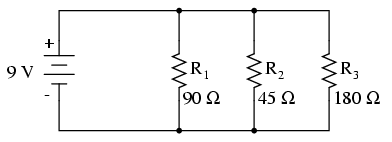
The current going through the 90 ohm resistor is

a)

10 amps

b)

0.1 amps

c)

0.2 amps

53.
The current going through the 180 ohm resistor is 
a)
0.05 amps
b)
0.2 amps
c)
0.1 amps
d)
20 amps
54.
The voltage drop across the 180 ohm resistor is 
a)
9 V
b)
6 V
c)
2 V
d)
12 V
55.
The current going through the 90 ohm resistor is 
a)
10 amps
b)
0.1 amps
c)
0.2 amps
56.
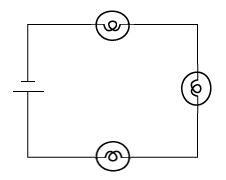
The picture shows an electrical circuit. This circuit is a series circuit because: 
a)
It has 3 light bulbs.
b)
The same current flows through all three light bulbs.
c)
It uses a single battery.
d)
The electrical current has more than one path to flow through
57.
In a Series circuit the more lightbulbs you add the brighter they get 
a)
False 
b)
True 
58.

Which two particles are attracted to each other?

a)

Two neutrons

b)

A proton and an electron

c)

Two protons

d)

An electron and a neutron

59.

A repulsive force exists between which two particles?

a)

Two neutrons

b)

An electron and a neutron

c)

An electron and a proton

d)

Two protons

60.

As two oppositely charged particles approach each other, what happens to the electrical force between them?

a)

The attractive force increases

b)

The magnitude of the electric force decreases

c)

The repulsive force increases

d)

The magnitude of their charges increases

61.

A balloon is rubbed on a student's head. What occurs because of this?

a)

Charged particles on the balloon are destroyed

b)

Positively charged particles move from head to balloon

c)

Charged particles from the balloon are released into the air

d)

Negatively charged particles move from head to balloon

62.
The Electric Force is strongest when charges are...
a)
close together
b)
far apart
c)
the electric force is constant everywhere
63.
What variable is a Coulomb the unit for?
a)
Charge
b)
Force
c)
Distance
d)
Mass
64.

What happens to the force between two charged objects when you halve the distance between them?

a)

2X

b)

1/2X

c)

4X

d)

1/4X

65.

If one of the charges doubles, what happens to the force?

a)

it doubles

b)

it gets cut in half

c)

it quadruples

d)

it is cut by 1/4

66.
If the distance doubles, what happens to the force?
a)
Reduced by half
b)
Reduced by 1/4
c)
Stays the same
d)
Quadruples
67.
When distance increases, electrostatic force ____________; we call this relationship ____________ proportional
a)
decreases;directly
b)
decreases;inversely
c)
increases;inversely
d)
increases;directly
68.
What variable do "Newtons" represent?
a)
Electrostatic Charge
b)
Force
c)
Distance
d)
Mass
69.
If each of the charges doubles, what happens to the force?
a)
Quadruples
b)
Doubles
c)
Stays the same
d)
Reduced by half
70.
If the distance doubles, what happens to the force?
a)
Reduced by half
b)
Reduced by 1/4
c)
Stays the same
d)
Quadruples
71.
How do electrons differ from protons?
a)
They are the same thing
b)
Electrons hold a negative charge and protons hold a positive charge.
c)
Electrons are positively charged and protons are negatively charged.
d)
Protons are neutral 
72.
The Electric Force is strongest when charges are...
a)
close together
b)
far apart
c)
the electric force is constant everywhere
73.

An atom of oxygen has 8 protons and 10 electrons, this means the atom is ____________

a)

positively charged because it has excess electrons

b)

negatively charged because it has excess electrons

c)

positively charged because it has a deficiency of electrons

d)

negatively charged because it has a deficiency of electrons

74.

Coulomb's law says that the force between any two charges depends

a)

directly on the size of the charges

b)

inversely on the square of the distance between the charges

c)

both are correct

75.
Find the magnitude of the force between two charges of 1.0 C each which are 1.0 meter apart?
a)
9E-9 N
b)
9E9 N
c)
1.1E10 N
d)
1.1E-10 N
76.

Which is the value of the constant in Coulomb's equation?

a)

k = 9·10-9

b)

k = 9.8

c)

k = 6.67·10-11

d)

k = 9 ·109

77.
What variable is a Coulomb the unit for?
a)
Charge
b)
Force
c)
Distance
d)
Mass
78.

What does the "k" represent in Coulomb's Law?

a)

charge

b)

Coulomb's Constant

c)

kilometers

d)

distance between charges

79.

Which setup of charged particles shown below has the two exert the most force on one another?

a)
b)
c)
d)