wayground logo

Free Printable Worksheets

Font size

S
M
L
XL
Worksheets

Forces and Motion - review

Total questions: 80

Worksheet time: 2hrs 36mins

Name
Class
Date
1.

A contact force is from

a)

objects physically touching

b)

far apart objects

c)

not touching object

d)

always a pull

2.

The three examples pictured are of

a)

Non-contact Forces

b)

Contact Forces

3.

The force between the phone and the mount is a

a)

contact force

b)

non-contact force

4.

Which is an example of a non-contact force?

a)

elastic force

b)

normal force

c)

applied force

d)

electric force

5.

Air Resistance Force

a)

Contact Force

b)

Non-Contact Force

6.
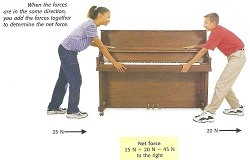
What is the net force?
a)
5 N
b)
45 N to the left
c)
5 N to the right
d)
45 N to the right
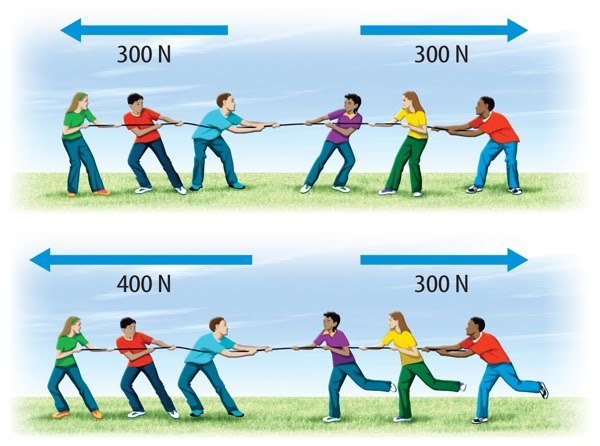
7.
Which one is balanced?
a)
top
b)
bottom
c)
both
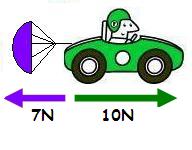
8.
Is it BALANCED? 
a)
Yes
b)
No
9.
What is the unit for FORCE? 
a)
N (Newtons)
b)
lbs (pounds)
c)
g (grams)
d)
m/s (meters per second)
10.
If there are two forces going in the SAME direction, you would ...?
a)
(-) Subtract the forces
b)
(+) Add the forces
c)
Neither
d)
(x) Multiply
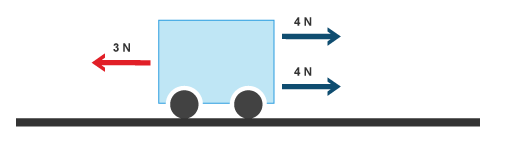
11.
What is the net force?
a)
17 N Right
b)
3 N Right
c)
3 N Left
d)
17 N Left
12.

Do directions matter with forces?

(a)  

13.

When forces are acting in the same direction they should be added together.

a)

True

b)

False

14.

Forces that are acting in opposite directions should be subtracted from each other.

a)

True

b)

False

15.

What are balanced forces?

a)

Forces of the same size, in opposite directions

b)

Forces of the same size, in the same direction

16.

Two forces on an object are in opposite directions. How do we calculate the resultant force?

a)

Divide one by the other

b)

Multiply them

c)

Take one away from the other

d)

Add them together

17.
Two features of a vector?
a)
Size and direction
b)
Speed and distance
c)
Quantity and units
d)
Amount and magnitude
18.

How will this object move?

a)

It won't move.

b)

It will move to the right.

c)

It will move to the left.

19.

How will this object move?

a)

It won't move.

b)

It will move to the right.

c)

It will move to the left.

d)

It will move up.

20.

What is the resultant force?

a)

40 N left

b)

0 N Balalnced

c)

400 N right

d)

40 N right

21.

What is the resultant/ net force?

a)

30 N left

b)

25 N right

c)

5 N left

d)

55 N right

22.

What is the resultant/ net force?

a)

400 N Up

b)

400 N Down

c)

- 400 N Down

d)

800 N Down

23.

Force cannot change the shape of things

a)

True

b)

False

24.
Hooke's Law describes the behaviour of which kind of material under tension?
a)
plastic
b)
metals only
c)
elastic
d)
non-metals only
25.
If F is force, k is spring constant and x is extension, Hooke's Law tells us that:
a)
F=k/x
b)
x=Fk
c)
k=Fx
d)
F=kx
26.
Hooke's Law fails when a material reaches its:
a)
breakdown
b)
elastic limit
c)
end of tether
d)
fracture stress
27.

What is the best description of the relationship shown in this graph?

a)

In this graph, the relationship between force and extension is linear.

b)

In this graph, the relationship between force and extension is non-linear.

c)

In this graph, the relationship between force and extension is directly proportional.

d)

In this graph, there is no relationship between force and extension.

28.

The graph shows the relationship between force and extension as a spring is extended. What is another name for point A?

a)

Point A is the elastic limit

b)

Point A is the elastic summet

c)

Point A is the plastic limit

d)

Point A is the extension limit

29.

In which side of the graph does the spring obey Hooke's law?

a)

To the left of point A

b)

To the right of point A

30.

An unstretched spring becomes longer when a force is applied to it. Which word describes the additional length of the spring gains?

a)

Expansion

b)

Extension

c)

Stretched

31.
A stiff material has a:
a)
high spring constant
b)
low spring constant
c)
spring constant of any value
d)
spring constant which is difficult to predict
32.
A spring has a spring constant of 5N/cm.  What is its extension when loaded with 15N?
a)
4cm
b)
5cm
c)
3m
d)
3cm
33.
Which of the following springs is the stiffest?
a)
A spring that requires a froce of 2000 N to compress it by 6.8 m.
b)
A spring that requires a force of 4000 N to stretch it by 9.0 m. 
c)
A spring that requires a force of 8000 N to compress it by 45 m.  
d)
A spring that requires a force of 4800 N to stretch it by 14 m.
34.
The momentum of an object depends upon the object's ___________&_____________.  
a)
size and shape
b)
mass and speed
c)
mass and veloctiy
d)
mass and energy
35.
The equation to calculate momentum is
a)
p=mv
b)
p=1/2mv2
c)
p=mgh
d)
p=mg
36.
Which has more momentum: a car stopped at a red light or a bike moving at 15 mph?
a)
car
b)
bike
c)
they are equal
d)
cannot determine using the info provided
37.
Momentum is a ____________________ quantity
a)
science
b)
scalar
c)
vector
d)
energy
38.
A boy kicks a football with a force of 20 N, the time the force acts for is 0.3 s.
Calculate the impulse on the ball.
a)
1 N*s
b)
6 N*s
c)
33.3 N*s 
d)
None of these
39.
The impulse is ______ the change in momentum
a)
Greater than
b)
Equal to
c)
less than
d)
always double
40.
In any collision (crash) the ______ is ALWAYS constant
a)
Total Momentum
b)
total speed
c)
total Velocity
d)
Energy
41.
When two objects collide, the Pbefore is ____________ the Pafter.
a)
more than 
b)
less than 
c)
equal to
d)
unrelated to
42.
What is the unit for momentum?
a)
m/sec
b)
kg/sec
c)
kg/m
d)
kg m/sec
43.
What is the unit for velocity?
a)
m/sec
b)
kg/sec
c)
kg/m
d)
kg m/sec
44.
What is the unit for mass?
a)
m/sec
b)
kg/sec
c)
kg
d)
kg m/sec
45.

What is the speed of segment A?

a)

0.5 m/s

b)

2 m/s

c)

3 m/s

d)

0 m/s

46.

What is the speed of segment D?

a)

0.5 m/s

b)

2 m/s

c)

3 m/s

d)

0 m/s

47.

What is the total time traveled?

a)

20 s

b)

30 s

c)

40 s

d)

50 s

48.

Which of these graphs do not show the object staying still?

a)
b)
c)
d)
49.

Which graph shows the object changing directions?

a)
b)
c)
d)
50.

__________________ are used to safely decrease the momentum of a CAR (*not only the person).

a)

Airbags

b)

Crumple zone

c)

Seatbelts

d)

Headrest

e)

Breaks

51.

Some safety features are designed to increase the time of a collision because this reduces the maximum force.

a)

True

b)

False

52.
What will cause an object to move?
a)
Applied forces
b)
Balanced forces
c)
Unbalanced forces
53.

What is unit for Moments

a)

nm

b)

NM

c)

Nm

d)

Nm2

54.

What is Moments?

a)

Turning effects of force

b)

Force x perpendicular distance

c)

Clockwise moments

d)

Force x displacement

55.

Find moment at A

a)

24 kNm

b)

240000 Nm

c)

16 kNm

d)

29000 Nm

56.
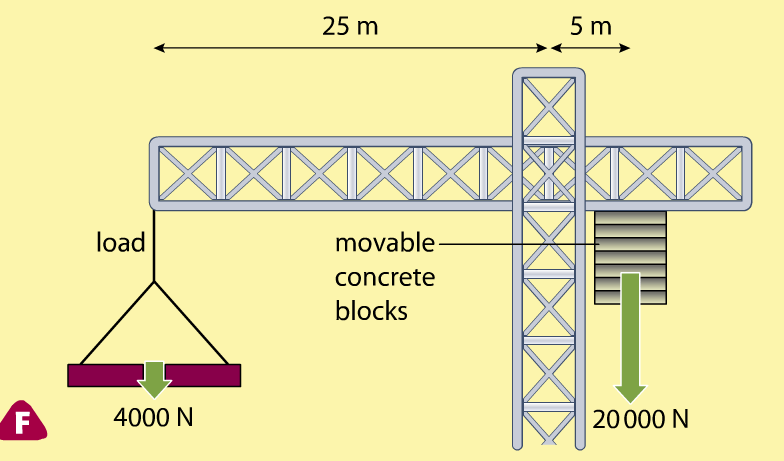
What is the anticlockwise moment acting on this crane?
a)
80,000Nm
b)
100,000Nm
c)
120,000Nm
d)
140,000Nm
57.
The amount of force pushing on an area is the definition of....
a)
Fluid
b)
Viscosity
c)
Barometer
d)
Pressure
58.
Where is pressure the greatest on the dam?
a)
D
b)
C
c)
B
d)
A
59.
Pressure is measured in what units
a)
Newtons
b)
m/s
c)
Pascals
d)
Moles
60.
___________is the result of the weight of a column of air pushing on an area.
a)
air pressure
b)
density
c)
volume
d)
none of the above
61.
As you climb up a mountain what happens to the air pressure?
a)
decreases
b)
increases
c)
stays the same
62.

Pressure in gases is a measure of:

a)

the number of collisions per second of the particles with the side of the container.

b)

the force of the collisions of the particles with the side of the container.

c)

the amount of space taken up by the particles in the container.

d)

None of the above

63.

The pressure inside the syringe will decrease if we move the plunger in:

a)

Direction A

b)

Direction B

c)

We don't have to move the plunger as the pressure will change on its own.

d)

None of the above answers.

64.

We can increase the pressure of a gas by:

a)

Adding more gas.

b)

Reduce the volume of the container.

c)

Increase the temperature of the gas.

d)

None of the above answers.

65.

The reason gases can be compressed is because:

a)

The particles are very close together.

b)

The particles are merely vibrating.

c)

The particles are unable to move.

d)

The particles are very far apart.

66.

what is the product of force and displacement?

a)

work

b)

power

c)

energy

67.

what is the unit of work?

a)

Newton

b)

Joule

c)

Watt

d)

meter

68.

what is the formula needed to solve for work?

a)

w=f/d

b)

w= fd

c)

w=f+d

69.

Two people shove on a wall with 100 N. The wall doesn’t move. How much work is done?

a)

100J

b)

100N

c)

0J

d)

0N

70.
9000 mg = _____ grams
a)
9
b)
90
c)
10
d)
1000
71.
The force of gravity acting on an object is the object's ______.
a)
mass
b)
matter
c)
weight 
d)
friction 
72.
The amount of matter in an object is 
a)
pressure
b)
weight
c)
mass
d)
force
73.
When a car goes around a corner at 20 mph, why do we say it  accelerates?
a)
The car is accelerating because of the velocity is constant
b)
The car accelerates because it's going 20 mph
c)
Cars always accelerate when they are in motion
d)
The car is accelerating because it's changing direction
74.
Acceleration is defined as the CHANGE in 
a)
time it takes for one place to move to another place. 
b)
velocity of an object.
c)
distance divided by the time interval 
d)
velocity divided by the time interval 
75.
Acceleration only takes place when things speed up. 
a)
True
b)
False
76.
Acceleration can be classified as _______________
a)
Speeding up
b)
Slowing Down
c)
Changing directions
d)
All of the above
77.

An object in equilibrium can still have forces acting on it.

a)

True

b)

False

78.

This is a velocity time graph of a skydiver falling. Which point on the graph shows the point where the forces acting on him are equal?

a)

A

b)

B

c)

C

79.

An object travelling at terminal velocity moves in a constant direction.

a)

True

b)

False

80.

Which diagram shows the forces acting on Peter when he is falling at Terminal Velocity?

a)

1

b)

2

c)

3