wayground logo

Free Printable Worksheets

Font size

S
M
L
XL
Worksheets

Year 9 SOUND

Total questions: 84

Worksheet time: 2hrs 27mins

Name
Class
Date
1.

how is sound created?

a)

when something vibrates or moves back and forth quickly

b)

when particles zoom around

c)

ups and downs in volume

2.

vibrating particles transmit sound

a)

true

b)

false

3.

sound can be transmitted through the following mediums... (select all that apply)

a)

solid

b)

liquid

c)

gas

d)

potato

4.

a soundwave has two parts...

a)

compressions and rarefactions

b)

ups and downs

c)

left and right

d)

potato

5.

what is this?

a)

spring

b)

soundwave

c)

left to right

d)

potato

6.

sound waves move in towards the object that is producing sound

a)

true

b)

false

7.

Transverse wave is when the vibration is at right angles to the direction of the wave

a)

true

b)

false

8.

what type of wave is this?

a)

longitudinal

b)

transverse

c)

sound

d)

spring

9.

longitudinal wave is when the vibration happens in the same direction as the wave is travelling.

a)

true

b)

false

10.

what determines the speed of sound?

a)

how closely packed the particles are

b)

how far away the sound is

c)

how hot the weather is

d)

potato

11.

in dense substances, sound travels slower

a)

true

b)

false

12.

will a bird chirp or a big burp be a higher pitch sound?

a)

chirp

b)

burp

c)

potato

13.

something that has a high frequency has a higher number or waves passing every second.

a)

true

b)

false

14.

wavelength of a sound is the distance between successive peaks. which has the shortest wavelength?

a)

top

b)

bottom

c)

neither

d)

potato

15.

which instrument has the highest frequency?

a)

piano

b)

violin

c)

sinewave

16.

Sound travels fastest in...

a)

solids

b)

liquids

c)

gases

d)

air

17.
Sound is a form of? 
a)
energy
b)
pitch
c)
volume
18.
An object that does not vibrate cannot produce
a)
sound
b)
light
c)
heat
d)
electricity
19.

A place where no sound exists is...

a)

in the air

b)

under water

c)

space

d)

all of the above

20.
Sound waves travel the SLOWEST through _____________.
a)
gases
b)
solids
c)
liquids
21.
The volume of a sound is measured in units called ________
a)
decibels
b)
liters
c)
sound waves
d)
inches per minute
22.
Why is sound able to travel faster through a solid than a gas?
a)
Gas molecules are packed tightly.
b)
Sound does not travel faster through a solid than a gas.
c)
Solid molecules are packed tightly.
d)
Gas molecules move slowly.
23.
Sound does not travel in space because
a)
Space is too far away.
b)
There is no matter in space.
c)
Space is the final frontier
d)
Space has planets.
24.
You stand outside a room that has the doors and windows closed. Why can you still hear sounds made inside the room?
a)
Vibrations are absorbed in the doors and windows
b)
Vibrations are reflected inside the room
c)
Vibrations travel through the door and the window
d)
Vibrations echo in the room
25.

When people speak their ________ vibrate.

a)

ear drums

b)

vocal chords

c)

ears

d)

tongue

26.

Will a homemade telephone made of two cans and a string work better with a tightly-woven string or a loosely-woven string?

a)

a tightly woven string because it will not come apart as easily

b)

a loosely woven string because the sound waves have more room to move

c)

a tightly woven string because sound waves travel best through dense materials

d)

a loosely woven string because sound waves travel best through less dense materials

27.
An ________ is a reflected sound.
a)
Vibration
b)
Echo
c)
Pitch
d)
Volume
28.
If a sound has a high amplitude then it also has a ____________!!!
a)
fast echo
b)
slow pitch
c)
high volume
d)
low volume
29.
______________ is the amount of energy in a sound wave.
a)
Amplitude
b)
Echo
c)
Volume
d)
Vibration
30.
What part of the wave is shown at letter A?
a)
crest
b)
trough
c)
wavelength
d)
frequency
31.
Which part of the wave is shown at letter B?
a)
crest
b)
trough
c)
wavelength resting point
32.
Which part of the wave is shown at letter C?
a)
crest
b)
wavelength
c)
resting point
d)
amplitude
33.
Which part of the wave is shown at letter D?
a)
trough
b)
resting point
c)
wavelength
d)
frequency
34.
Which part of the wave is shown at letter E?
a)
trough
b)
crest
c)
resting point
d)
amplitude
35.
What does a wave carry?
a)
boats
b)
matter
c)
energy
d)
water
36.
When wavelength increases, what happens to the frequency?
a)
it increases
b)
it decreases
c)
it stays the same
37.

What is the speed of a wave that has a wavelength of 2m and a frequency of 2.5 Hz?

a)

2.5 m/s

b)

5 m/s

c)

4.5 m/s

d)

6 m/s

38.
Which wave has a longer wavelength?
a)
wave C
b)
wave D
39.
Which wave has a greater frequency?
a)
wave B
b)
wave C
40.
Which wave has the most energy?
a)
top wave
b)
bottom wave
41.
The highest point on a wave is:
a)
the crest
b)
the trough
c)
the top
d)
the coast 
42.
The lowest point on a wave is the:
a)
Amplitude
b)
Crest
c)
Trough
d)
Wavelength
43.
What types of waves carry energy at a right angle or perpendicular to the direction of the energy flow?
a)
Longitudinal waves
b)
Transverse waves
c)
Sound waves
d)
P-waves
44.
What do waves carry from place to place?
a)
Energy, but not matter or particles
b)
Energy and matter or particles
c)
Matter or particles but not energy
d)
Neither energy nor matter or particles
45.
The most dense part of a longitudinal wave.
a)
Density
b)
Compression
c)
Rarefaction
d)
Amplitude
46.
Which wave is pictured?
a)
Transverse
b)
Longitudinal
c)
Both
d)
Neither
47.
Sound needs a medium to travel through.  What is a medium?
a)
solid, liquid, gas
b)
open space
c)
waves
d)
nothing
48.

Which are properties of a mechanical wave?

a)

can be longitudinal or transverse

b)

can move through space

c)

must have matter to move

d)

carries energy

49.

The wave equation used for sound calculations is:

a)
b)
c)
50.

What happens in the eardrum?

a)

Sound waves vibrate the skin and delivers vibrations

b)

Sound waves make the tiny hairs in your ear move

c)

Carries the message to the brain

51.

What does the fluid inside your ears (cochlea) do?

a)

Vibrates the skin in your ear

b)

Sends sound waves to the brain

c)

Vibrates the cilia (tiny hairs).

52.

What does the Auditory nerve do?

a)

Carries the message to the brain

b)

Carries the message to the Semi-Circular canal

c)

Send the message to the Eustachian tube

53.

Name the 3 bones in your ear

a)

Hammer, Stirrup, Anvil

b)

Hammer, Anvil, Stirrup

c)

Rods, Cones, Anvil

54.

Where is the Eardrum located?

a)

The Outer ear

b)

The Inner Ear

c)

The Middle Ear

55.

Where is the Cochlea located

a)

The Inner Ear

b)

The Middle Ear

c)

The Outer Ear

56.

Where is the Eustachian Tube connected to?

a)

The back of the head

b)

The back of the nose

c)

The back of the Ear

57.

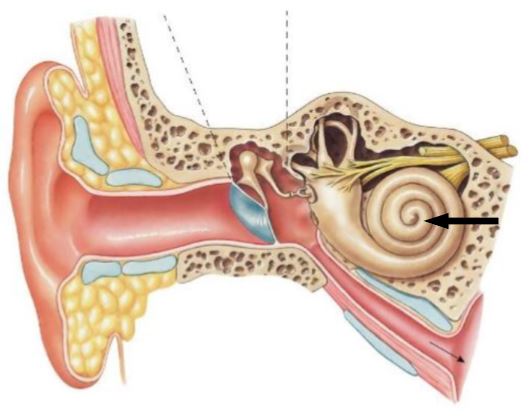
What is this?

a)

Ear Drum

b)

Ear Canal

c)

Pinna

d)

Cochlea

e)

Hearing Nerve

58.

What is this?

a)

Pinna

b)

Hearing Nerve

c)

Cochlea

d)

Ear Drum

e)

Anvil

59.

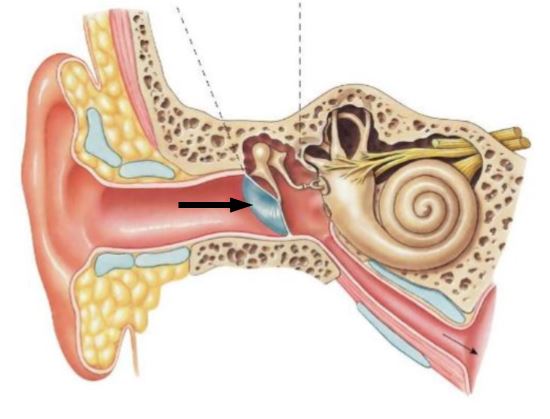
What is this?

a)

Ear Drum

b)

Ear Canal

c)

Pinna

d)

Hammer

e)

Cochlea

60.

What is this?

a)

Anvil

b)

Hammer

c)

Stirrup

d)

Ear Canal

e)

Ear drum

61.

Name the part(s) of the ear found in the inner ear.

a)

ear canal

b)

cochlea

c)

anvil

d)

auditory nerve

e)

hammer

62.
When sound waves cause the eardrum to vibrate, these vibrations are immediately passed on to the_________.
a)
outer ear and ear canal
b)
inner ear
c)
tiny hairs
d)
three small bones in the middle ear
63.
How does increasing the amplitude of a sound wave affect the sound?
a)
it makes the sound louder
b)
it makes the sound travel faster
c)
it increases the wavelength of the sound
d)
it increases the frequency of the sound
64.
Where is a place a person would hear no sound?
a)
in a cave
b)
in a forest
c)
in space
d)
in water
65.
Identify the order in which sound travels through the ear 
a)
hammer, stirrup, anvil, eardrum, ear canal
b)
ear canal, eardrum, hammer, stirrup, anvil 
c)
ear canal, eardrum, hammer, anvil, stirrup
d)
eardrum, ear canal, hammer, anvil, stirrup
66.

What is the main cause of damage to your hearing from loud noises?

a)

Cause the hairs (cilia) inside the cochlea to become damaged and die.

b)

Ruptures the eardrum.

c)

Damages the auditory nerve so impulses can't travel to your brain.

d)

Shrinks the Pinna of the ear.

67.

The Eustachian tube allows pressure in the middle ear to be equalised with the pressure of the outer ear.

a)

True

b)

False

68.

What can occur if the pressure outside the ear is greater than the pressure within the middle ear, and it is not equalised via the Eustachian tube?

a)

The fluid in the cochlea can expand causing pain.

b)

The person will go permanently deaf.

c)

The Eardrum can rupture as it is a thin membrane that cannot withstand very high pressure.

69.

A drum is producing sound at a frequency of 25Hz and a speed of 5m/s. What is the wavelength of the sound waves produced?

a)

1m

b)

0.8m

c)

0.2m

d)

1.2m

70.

A guitar is producing a sound wave at a speed of 15m/s. The sound wave has a wavelength of 3m. What is the frequency of the wave?

a)

5 m

b)

2.5 Hz

c)

2.5 m/s

d)

5 Hz

71.

An Echo is produced by a sound wave that reflects off a distant hard surface and returns in more than:

a)

0.2 seconds

b)

1 second

c)

0.1 seconds

d)

0.8 seconds

72.

A Reverberation is produced by a sound wave that reflects off a close hard surface and returns in less than:

a)

0.1 seconds

b)

2 seconds

c)

0.7 seconds

d)

0.5 seconds

73.

Fill in the missing word - "A reverberation occurs when a sound wave reflects off a __________ hard surface."

a)

close

b)

distant

c)

shiny

d)

rough

74.

Fill in the missing word - "An Echo occurs when a sound wave reflects off a __________ hard surface."

a)

Soft

b)

Rough

c)

Distant

d)

Close

75.
When the car moves AWAY from you, its horn seems...
a)
Low pitched
b)
High pitched
c)
Normal
76.
When an ambulance move TOWARD you it sounds ________ pitched. 
a)
high
b)
low
c)
medium
77.
The Doppler effect is seen when a wave-making source moves toward an observer. 
a)
True
b)
False
78.
What can you tell about this object's motion?
a)
Moving to the North (up).
b)
Moving to the South (down). 
c)
Moving to the West (left). 
d)
Moving to the East (right). 
79.
What can you tell about the motion of this object?
a)
Moving left.
b)
Moving right quickly.
c)
Standing still. 
d)
Moving up slowly. 
80.
What best describes the doppler effect?
a)
An apparent change in frequency of a wave due to the relative motion between a wave source and an observer
b)
When sound changes pitch
c)
When light changes color
d)
An apparent change in the amplitude of a wave due to the relative motion between a wave source and an observer.
81.

Look at the Jet plan. What is occurring as it breaks the speed of sound?

a)

Jet plans cannot go faster than speed of sound.

b)

The plane is releasing all its fuel to go faster.

c)

A sonic boom is occurring.

d)

The air particles are sticking to the plane.

82.

What range of frequencies can humans hear?

a)

100 - 10 000 Hz

b)

20 - 20 000 Hz

c)

1 - 10 000 Hz

d)

5 - 30 000 Hz

83.

Which of the above waves will have a higher pitch sound?

a)

The BLUE wave because it has a lower frequency.

b)

The RED wave because it has a lower frequency.

c)

The BLUE wave because it has a higher frequency.

d)

The RED wave because it has a higher frequency.

84.

If the wavelength of a sound wave is increased, what would happen to the sound made by this wave?

a)

It would have a lower pitch

b)

It would get softer

c)

It would get louder

d)

It would have a higher pitch