
 Worksheets
Q3- Post Test Review Honors
Total questions: 80
Worksheet time: 3hrs 31mins
Name
Class
Date
1.
Si + S8 --> Si2S4
a)
Synthesis (combination)
b)
Decomposition
c)
Single replacement
d)
Double replacement
2.
Ca + AlCl3 --> CaCl2 + Al
a)
Synthesis (combination)
b)
Decomposition
c)
Single replacement
d)
Double replacement
3.
KOH + H3PO4 --> K3PO4 + H2O
a)
Synthesis (combination)
b)
Decomposition
c)
Single replacement
d)
Double replacement
4.
Pb(NO3)2 --> PbO + NO2 + O2
a)
Synthesis (combination)
b)
Decomposition
c)
Single replacement
d)
Combustion
5.
Mg + N2 --> Mg3N2
a)
Synthesis (combination)
b)
Decomposition
c)
Single replacement
d)
Combustion
6.
NO2 --> N2 + O2
a)
Synthesis (combination)
b)
Decomposition
c)
Single replacement
d)
Combustion
7.
On the right side of a chemical reaction are the ....
a)
Reactants
b)
Products
8.
Which chemical reaction breaks down into 2 substances?
a)
Double Replacement
b)
Single Replacement
c)
Synthesis
d)
Decomposition
9.
How many TOTAL atoms are in 2CaO2
a)
2
b)
3
c)
5
d)
6
10.
C3H8 + O2 --> H2O + CO2
a)
Synthesis (combination)
b)
Decomposition
c)
Single replacement
d)
Combustion
11.
What is the formula for magnesium chloride?
a)
MgCl
b)
Mg2Cl
c)
MgCl2
d)
Mg(ClO3)2
12.
The rate of a reaction increases as temperature__________________.
a)
Decreases
b)
Increases
c)
Stays the Same
13.
Products will form faster if____________
a)
the particle size of the reactants are larger.
b)
temperature is decreased.
c)
concentration of the reactants are increased.
d)
the reaction is not stirred.
14.
A ______________ is a substance that increases the rate of a reaction without being used up during the reaction.
a)
catalyst
b)
product
c)
reactant
d)
solute
15.
Smaller particle size allows for a _________ surface area to be exposed for the reaction.
a)
larger
b)
smaller
16.
The ___________ the surface area of the reactants, the faster the reaction rate.
a)
larger
b)
smaller
17.
Increasing the temperature will increase the kinetic energy of particles, therefore increasing the collisions between particles.
a)
false
b)
true
18.
Usually lowering the temperature will slow down a reaction.
a)
false
b)
true
19.
Exothermic reactions release heat to the surroundings.
a)
true
b)
false
20.
A catalyst increases the efficiency of collisions between reactants.
a)
true
b)
false
21.
Rate of chemical reaction means
a)
amount of product formed
b)
speed of reaction
c)
concentration of reacting particles
d)
combining reactants with products
22.
Activation energy is required to start a chemical reaction. What is activation energy?
a)
The maximum amount of energy used
b)
The minimum amount of energy required to cross the reaction barrier
c)
The energy of the reactants
d)
The energy possessed by the products
23.
Reactions that give out heat to the surrounding are classified as one of the following:
a)
Spontaneous
b)
Sluggish
c)
Exothermic
d)
Endothermic
24.
To slow down a chemical reaction you will do one of the following:
a)
Place the reactants in hot water
b)
Place the products in ice bath
c)
Place the reactants in a ice bath
d)
Keep stirring the reactants with a stirring rod
25.

In an endothermic reaction the products have
a)
more energy than the reactants
b)
less energy than the reactants
c)
the same energy as the reactants
d)
no energy
26.

In an exothermic reaction the products have
a)
more energy than the reactants
b)
the same energy as the reactants
c)
less energy than the reactants
d)
no energy
27.

B represents
a)
energy absorbed
b)
energy released
c)
activation energy
28.

C represents
a)
energy absorbed
b)
energy released
c)
activation energy
29.

What is the correct formula for this molecule?
a)
NH
b)
N3H
c)
NH3
d)
NH4
30.
tetra
a)
Earth
b)
Four
c)
Five
d)
Multiple
31.
A covalent bond is
a)
a bond that shares electrons metallicaly
b)
A bond that shares electrons with non metals
c)
Metalloids bonding
d)
metals and nonmetals bonding
32.
SO2 is called:
a)
Sulfur dioxide
b)
Sulfur monoxide
c)
Monosulfur dioxide
d)
Disulfur
33.
How many electrons should Oxygen have around its Lewis dot model?
a)
5
b)
6
c)
7
d)
8
34.

What is the correct formula for this molecule?
a)
Si4F
b)
SiF4
c)
SiF
d)
Si4F4
35.

Which of the following is the correct Lewis dot structure for the molecule fluorine (F2)?
a)
A
b)
B
c)
C
d)
D
36.

Which of the following is the correct Lewis structure for the compound PBr3?
a)
structure A
b)
structure B
c)
structure C
d)
structure D
37.
How many electrons should Carbon have around its Lewis dot model?
a)
1
b)
3
c)
4
d)
5
38.
An element will always have the same number of
a)
neutrons
b)
protons
c)
isotopes
d)
atoms
39.
An element with five valence electrons is
a)
phosphorus
b)
oxygen
c)
beryllium
d)
rubidium
40.
Rows on the periodic table are called _____ while columns are called _____.
a)
groups, families
b)
groups, periods
c)
periods, groups
d)
families, groups
41.

How many electrons are in the outer (valence) shell of Chlorine (Cl)?
a)
1
b)
3
c)
6
d)
7
42.
What is the name of the group that never reacts--ever ever they are stable with a full outermost ring!!!
a)
noble gases
b)
transition
c)
halogens
d)
borons
43.

Is this equation balanced?
a)
yes
b)
no
c)
Not enough information
44.
Is this equation balanced?
_Mg + _Cl2 --> _MgCl2
a)
not balanced
b)
already balanced
c)
maybe
45.
What does the Law of Conservation of Mass state?
a)
Matter cannot be gained or lost in a chemical reaction.
b)
Matter can only be lost in a chemical reaction.
c)
Matter can only be gained in a chemical reaction.
d)
Matter can be gained and lost in a chemical reaction.
46.
When balancing equations a ____ can be placed to the left of a formula of a substance to make the equations balanced
a)
charge
b)
subscript
c)
random number
d)
coefficient
47.
Which of the following will have a higher electronegativity than arsenic (As)?
a)
Carbon (C)
b)
Neon (Ne)
c)
Antimony (Sb)
d)
Germanium (Ge)
48.
Which of the following will have a lower ionization energy than Scandium (Sc)?
a)
Helium (He)
b)
Titanium (Ti)
c)
Calcium (Ca)
d)
Magnesium (Mg)
49.
As atoms of elements in group 16 are considered in order from top to bottom, the electronegativity of each successive element....
a)
decreases
b)
increases
c)
remains the same
d)
none of the above
50.
Which atom has the largest atomic radius?
a)
potassium
b)
rubidium
c)
francium
d)
cesium
51.
As you move down the periodic table atoms get bigger. This is because ____________.
a)
The atoms have more mass.
b)
The atoms have more protons.
c)
The atoms have more energy levels
d)
The atoms have more nuetrons
52.
As you move across the periodic table atoms tend to get smaller because, ______________.
a)
the atoms have more mass.
b)
the atoms have less mass
c)
the atoms have more protons.
d)
the atoms have less electrons.
53.
Atoms that have a high electronegativity, _______________.
a)
give up their electrons more easily.
b)
hold on to their electrons more tightly.
c)
have more electron shells.
54.
Electronegativity is...
a)
how good an atom is at attracting electrons
b)
the ability of an atom to lose electrons
c)
the energy required to remove an electron from a specific atom
d)
how easy it is to make friends.
55.
Ionization energy is...
a)
the energy required to add an electron to a specific atom
b)
how much energy it takes to remove an electron from an atom
c)
the energy required to shield the outer electrons from the nucleus
d)
a measure of the ability of an atom to attract electrons
56.
The atom with the largest atomic radius in Group 18 is -
a)
Ar
b)
He
c)
Kr
d)
Rn
57.
The element with the largest electronegativity in the halogens is -
a)
At
b)
F
c)
Cl
d)
Br
58.

What scientist is best known for his "Plum Pudding" model of the atom?
a)
J.J. Tomson
b)
Ernest Rutherford
c)
John Dalton
d)
Democritus
59.

What contribution did John Dalton make to atomic theory?
a)
He discovered that every atom was positively charged.
b)
He discovered that every element consisted of one type of atom.
c)
He discovered that atoms had nuclei.
d)
He discovered that atoms could be divided into smaller parts.
60.

Place the following scientists in order, from earliest to latest:
A) Ernest Rutherford
B) J.J. Thomson
C) John Dalton
A) Ernest Rutherford
B) J.J. Thomson
C) John Dalton
a)
B,C,A
b)
C,A,B
c)
A,C,B
d)
C,B,A
61.

J.J. Thomson provided evidence that an atom...
a)
is the smallest particle of matter
b)
contains negatively charged particles
c)
has an overall negative charge
d)
has an overall positive charge
62.
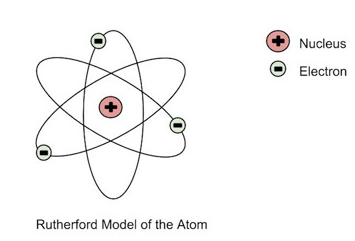
Rutherford's gold foil experiment provided evidence that...
a)
negative and positive charges are spread evenly throughout the atom.
b)
alpha particles have a positive charge.
c)
gold is not a dense as previously thought.
d)
there is a dense positively charged nucleus at the center of an atom.
63.

Who came up with this model of an atom?
a)
J.J. Thompson
b)
Ernest Rutherford
c)
Neils Bohr
d)
James Chadwick
64.
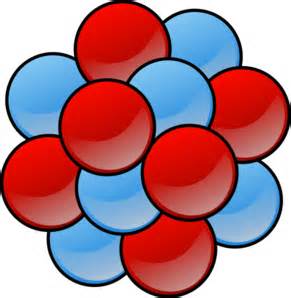
What does the nucleus of an atom contain?
a)
Electrons and neutrons
b)
Protons and neutrons
c)
Neutrinos and positrons
d)
DNA and RN
65.
Neon has an atomic number of 10 and an atomic mass of 20.180. How many protons, electrons, and neutrons will it have?
a)
P=10 E=10 N=11
b)
P=5 E=5 N=10
c)
P=10 E=10 N=10
d)
P=10 E=5 N=5
66.
Which particle is responsible for the chemical properties of an atom?
a)
Neutron
b)
Protons
c)
Valence Electrons
d)
Nucleus
67.

Ernst Rutherford discovered which part of the atom through the use of gold foil?
a)
Proton
b)
Neutron
c)
Electron
d)
Orbitals
68.

Which is the correct sequence of the scientists who made major changes in the model of the atom?
1-JJ Thomson
2-Erwin Schrodinger
3-John Dalton
4-Niels Bohr
5-Ernest Rutherford
1-JJ Thomson
2-Erwin Schrodinger
3-John Dalton
4-Niels Bohr
5-Ernest Rutherford
a)
2, 1, 4, 3, 5
b)
3, 1, 5, 4, 2
c)
5, 3, 2, 1, 4
d)
4, 3, 2, 1, 5
69.

Which of the following is proposed by Erwin Schrodinger?
a)
Solar system model of the atom
b)
Plum pudding model of the atom
c)
Billiard ball model of the atom
d)
Electron cloud model of the atom
70.

J.J. Thomson provided evidence that an atom...
a)
is the smallest particle of matter
b)
contains negatively charged particles
c)
has an overall negative charge
d)
has an overall positive charge
71.

How many bonds can the following element form?
a)
1
b)
2
c)
3
d)
4
72.
Which atomic model describes the structure of an atom to be much like the solar system
a)
Dalton
b)
Thomson
c)
Rutherford
d)
Bohr
73.

calcium oxide
a)
Ca2O2
b)
Ca2O
c)
CaO
d)
CaO2
74.

Lithium fluoride
a)
LiF
b)
LiF2
c)
Li2F
d)
Li2F3
75.

carbon monoxide
a)
CO
b)
CO2
c)
C2O
d)
COH
76.

P2O5
a)
phosphorus oxide
b)
phosphorus (II) oxide
c)
diphosphorus pentoxide
d)
phosphorus pentoxide
77.
What is the correct name for the compound PH3?
a)
Monophosphorus trihydride
b)
Phosphorus hydride
c)
Trihydrogen monophosphide
d)
Phosphorus trihydride
78.
What is the correct name for the compound Al2S3?
a)
Aluminum sulfide
b)
Dialuminum trisulfide
c)
Trisulfur dialuminide
d)
Aluminum sulfur
79.
What is the correct name for the compound N2O?
a)
Dinitrogen monoxide
b)
Dinitrogen oxide
c)
Nitrogen oxide
d)
Nitrogen dioxide
80.
What is the correct name for the compound CBr4?
a)
Monocarbon tetrabromide
b)
Carbon tetrabromide
c)
Carbon bromide
d)
Tetrabromine monocarbon
100 %

