
 Worksheets
Module 5 Review
Total questions: 87
Worksheet time: 2hrs 37mins
A projectile is fired horizontally at 10 m.s-1 from the top of a cliff, 55 m high.
What is the magnitude of the projectile’s velocity as it impacts the water?
32.8 m.s-1
1078 m.s-1
1175.8 m.s-1
34.3 m.s-1
An astronaut is standing on Mars. The astronaut throws an object of mass 0.30 kg vertically upward at an initial speed of 9.0 m.s-1. It reaches a maximum height of 11 metres.
What is the magnitude of the acceleration of the object?
1.4 ms-2
3.7 ms-2
9.0 ms-2
9.8 ms-2

A device launches two identical balls (x and y) simultaneously in a horizontal direction from the same height, with different horizontal velocities. The results are shown.
x hits the ground before y as it is closer to the launch site
y hits the ground before x as it has a higher launch velocity
x and y hit the ground simultaneously with the same velocity
x and y hit the ground simultaneously with different velocities.
A ball is launched horizontally from a cliff with an initial velocity of u m.s-1. After two seconds, the ball’s velocity is in the direction 45o from the horizontal.
What is the magnitude of the velocity in m.s-1 at two seconds?
u
1.5 u
19.6
27.7
A projectile was launched from the ground. It had a range of 70 metres and was in the air for 3.5 seconds.
At what angle to the horizontal was it launched?
30 degrees
40 degrees
50 degrees
60 degrees
An aeroplane is flying horizontally over level ground. It has an altitude of 490 m and a velocity of 100 ms-1. As the aeroplane passes directly above a cross marked on the ground, an object is released from the aeroplane.
How far away from the cross will this object land?
490 m
1000 m
10 000 m
49 000 m


At what point is vy= 0 m/s?
A
B
C
D
None of these points
At what point is vx= 0 m/s?
A
B
C
D
None of these points

This Graph shows the vertical velocity of an object that has been thrown in the air. Its starting velocity is 40 m/s. What height does the object reach at its peak?
0 m
20 m
40 m
80 m
160 m
If a ball thrown straight up into the air takes 4 seconds to reach the top (peak), how long will it take to travel from the peak back to the original position?
0s
1s
3s
4s


Planets A, B and C are identical. A and C have a giant moon orbiting them, while B has a lightweight artificial satellite orbiting it, as shown in the diagram. Which planet has the strongest gravitational interaction with its satellite?
Planet A, because its moon is heavy and close to it.
Planet B, because only a lightweight object can orbit without falling down.
Planet C, because it can interact with a heavy object that is far away.
All have the same gravitational attraction, because the planets are all the same mass.

According to Kepler's Second Law, the areas of triangle A and B are equal and took an equal amount of time to create. What must be true as a result?
The planet must travel at a constant speed throughout it's orbit
The planet traveled faster through triangle A than triangle B
The planet traveled faster through triangle B than triangle A
The planet moves faster when it's further away from the sun

The period is the length of time to complete one full cycle. What is the period of a planet around the sun?
The amount of times a planet orbits the sun in an Earth year
The number of times the planet rotates in an Earth year
The amount of distance a planet travels in an Earth year
The time it takes for the planet to complete its orbit

Each planet below has the same mass (M) and an identical rocket orbiting at a distance (D). The darker the planet, the denser the material. Which rocket experiences a stronger force of gravity?
A, higher density means stronger gravity when distance to center of the planet is the same.
B, smaller distance to the surface of the planet means stronger gravity when mass of the planet is the same.
Both the same, each planet has the same mass and the rocket is at the same distance from the center of the planet.

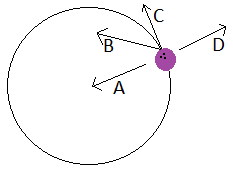
An object is moving in uniform circular motion as shown in the picture. Which arrow best represents the direction of the Net Force acting on the object?
A
B
C
D

How does the gravitational force the Earth exerts on the Sun compare to the gravitational force the Sun exerts on the Earth?
The gravitational force of the Sun on the Earth is larger
The gravitational force of the Earth on the Sun is larger
The gravitational forces are equal
There's not enough information to answer the question

A
B
C
D

A
B
C
D

A
B
C
D

A
B
C
D

A
B
C
D

A
B
C
D

A
B
C
D

A
B
C
D
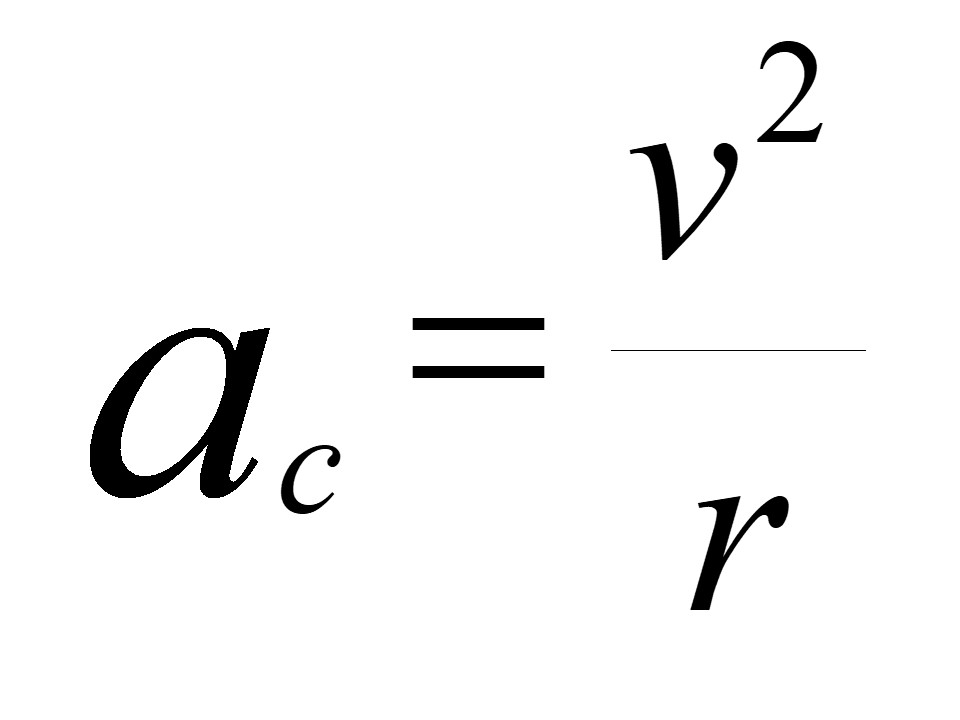
What's the centripetal acceleration of an object traveling 2.3 m/s around a circle of diameter 0.6 m?
5 m/s2
17.63 m/s2
10 m/s2
8.81 m/s2
A toy car is following a circular path with a constant speed of v=3 m/s . If the radius of the circular path is 1 m, find The centripetal acceleration of the car
30 m/s2
3 m/s2
9 m/s2
6 m/s2
You put a ball on the end of a string. You swing the ball with a rotation speed of 5.6 m/s. The mass of the ball is 2.0 kg. The length of the string is 1.60 m.
Calculate the centripetal acceleration.
19.6 m/s2
8.96 m/s2
3.50 m/s2
7.00 m/s2
A 22.0 kg child is riding a playground merry-go-round that is rotating at 40.0 rev/min. What centripetal force must she exert to stay on if she is 1.25 m from its center?
120 N
240 N
480 N
960 N
A car is making a turn at speed v. The radius of the turn is r and the centripetal force on the car is F.
If the car rounds the same curve at speed 2v, what is the required centripetal force?
0.5 F
F
2F
4F
The combined mass of a race car and its driver is 600 kg. Travelling at constant speed, the car completes one lap around a circular track of radius 160 m in total time of 36 s. What is the magnitude of the centripetal acceleration of the car?
0.17 m s-2
4.9 m s-2
78 m s-2
100 m s-2
A rock attached to a string swings in a vertical circle. At the highest point,
no forces act on the rock.
only one force acts on the rock.
two forces act on the rock and their resultant is zero.
two forces act on the rock and their resultant is not zero.
An aeroplane is circling in the sky at a speed of 150 m s−1. The aeroplane describes a circle of radius 20 km.
For a passenger of mass 80 kg inside this aeroplane, calculate her centripetal acceleration.
0.0075 m s−2
1.13 m s−2
7.5 m s−2
15 m s−2
An aeroplane is circling in the sky at a speed of 150 m s−1. The aeroplane describes a circle of radius 20 km.
For a passenger of mass 80 kg inside this aeroplane, calculate the centripetal force acting on her.
0.60 N
90 N
600 N
1200 N

The diagram shows a stone tied to the end of a length of string and is whirled round in a horizontal circle . What provides the centripetal force on the stone?
The weight of the string.
The friction in the string.
The tension in the string.
The air resistance from the surroundings.
which are the following is Newton’s Law of gravitation ?
W=rGMm
F =r2GMm
V =rGM
g=− rGM
A satelite is orbiting about the earth at the height of 45 km from the earth surface. the satelite's velocity is 7.88 ×10³ ms−1 . what is the mass of earth?
6.0×1026 kg
6.4 ×10⁶ kg
5.56 ×1026kg
6.0 ×1024 kg

F = Gm1m2/d2.
G=6.67x10⁻¹¹ NM2/KG2
Calculate the force between two objects that have masses of 70 kilograms and 100 kilograms separated by a distance of 1 meter. Use “G” for the Gravitational constant.
What this means is that if a satellite moves away from what it is orbiting,

If a planet's orbital radius is doubled, what happens to the length of a year on that planet?

A
B
C
D

A
B
C
D

A
B
C
D

A
B
C
D

A
B
C
D

A
B
C
D

A
B
C
D

A
B
C
D

A
B
C
D

A
B
C
D

A
B
C
D

A
B
C
D

A
B
C
D

A
B
C
D

A
B
C
D

A
B
C
D

A
B
C
D

A
B
C
D

A
B
C
D

A
B
C
D

A
B
C
D

A
B
C
D

