
 Worksheets
Electrostatics Revision
Total questions: 85
Worksheet time: 1hrs 25mins

Which statement best describes the charge of the spheres after this procedure is completed?
When two objects are rubbed together, there is a transfer of electrons. How do you determine which object acquires the transferred electrons?
Always transfer from the bigger to the smaller object, to make it even
Transfer is based on the initial charge of the two objects
Transfer is based on how much electron affinity that each object has
Always transfer from the more negative to the more positive object
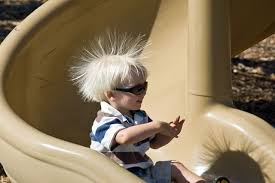
What method of static charging is shown in this picture
Contact
Friction
Grounding
Electron Shifting
When a charged object contacts another object (one is usually a conductor), there is a transfer of electrons. How do you determine which object acquires the transferred electrons?
Always transfer from the bigger to the smaller object, to make it even
Transfer is based on the initial charge of the two objects
Transfer is based on how much electron affinity that each object has
Always transfer from the more negative to the more positive object
What is the end result of charging by friction?
Both object have the same charge, so they will attract one another
Both object have the same charge, so they will repel one another
Both object have the opposite charge, so they will attract one another
Both object have the opposite charge, so they will repel one another
After grounding, how will objects interact?
Both will have the same charge, so they attract one another
Both will be neutral, so they will attract one another
Botn will be neutral, so they will repel one another
Both will be neutral, so they will not attract nor repel
Insulators are best for demonstrating electrostatics because they
are easier to melt
don't easily lose a charge when touched
are readily available
are made of gold
Arrows on electric field lines pointing inward represent a charge of
neutral
negative
positive
zero

What is the triboelectric series?
Like the World Series: objects compete for electrons
A series of events that create a static charge
A list of materials arranged by strength of electron-holding
A number to show how well an object conducts electrons

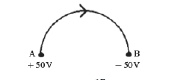
What is the electrostatic potential at equatorial point of a dipole?
twice of the axial point
half of the axial point
zero
not defined
Why must electrostatic field at the surface of a charged conductor be normal to the surface at every point?
As electric field inside conductor is always zero
If not normal than it will have component parallel to the surface and perpendicular to the surface
parallel component of the field will generate current along the surface, which is not possible
work done in moving the charge along the surface ha to be zero
Two charges – q and + q are located at points A (0, 0, -a) and B (0, 0, +a) respectively. How much work is done in moving a test charge 2 µC from point P (7, 0, 0) to Q (-3, 0, 0)?
100Kq2
16Kq2
10Kq2
zero
Relation between the electric field and the electrostatic force due to a source charge Q at a point 'r' distance away from the charge on test charge q0 is
F=Eq0
F=E/Q
F=E/q0
F=EQ
Charge Q is distributed uniformly throughout a spherical insulating shell. The net electric flux through the inner surface of the shell is:
0
Q/e0
2Q/e0
Q/4*Pi*e0
The net force on an electric dipole in an uniform electric field is
0
>0
<0
varies from negative to positive value from negative to positive charge.
The expression for Torque on an electric dipole in an uniform electric field is __________
τ =E ×p
τ =Ep
τ=p.E
Electric field of a thin spherical shell of charge density σ and radius R at a point r>R, r=R and r<R respectively are
ϵ0σ, 0, ϵ0σr2R2
ϵ0σ, ϵ0σr2R2, 0
ϵ0σ, 0, 2ϵ0σ
Dimensional formula of the permittivity of free space ϵ0 is
[M1L3T−4A−2]
[M−1L−3T2A2]
[M−1L−3T4A2]
[M−1L−2T4A2]
The electric field inside a charged conducting sphere of radius R is
4πϵ01 R2q
4πϵ01 r2q
4πϵ01 Rq
0
The force of attraction between two charges is given by
4πϵ01 r2q1q2
4πϵ01 r2q
4πϵ01 rq1q2
4πϵ01 r3q1q2 r
The potential inside a uniformly charged spherical shell of radius R and surface charge density σ is
ϵ0zR2σ
ϵ0Rσ
0
4πϵ01 Rσ
Electric field due to an infinite plane sheet having surface charge density σ is
ϵ0σ
ϵ02σ
ϵ0zσ
2ϵ0σ
Which charge configuration Produces a uniform electric field?
Point charge
Uniformly charged infinite line
Uniformly charged infinite plane
Uniformly charged spherical shell
Which charge configuration Produces a uniform electric field?
Point charge
Uniformly charged infinite line
Uniformly charged infinite plane
Uniformly charged spherical shell

D<C<B<A
D>C>B>A
A<B=C<D
C<A=B<D

A
B
C
D
An electric field E= 10xi exist in certain region of space. Then the potential difference V = Vo-Va where Vo is the potential at orgin and Va is the potential at x= 2 m is
10 V
-10 V
20 V
-20 V

Newton's Universal Law of Gravitation and Coulomb's Law share a very similar equation. What else do the Laws have in common (check all that apply)?
Both forces can cause either attraction or repulsion
Both forces are equal in strength
Both forces are non-contact forces
Both forces become weaker with distance

Based on your knowledge of electric fields, what must be true about the picture shown above?
Both A and B are negative
A is negative and B is positive
A is positive and B is negative
Both A and B are positive

Based on your knowledge of electric fields, what must be true about the picture shown above?
Both X and Y are negative
X is negative and Y is positive
X is positive and Y is negative
Both X and Y are positive

Assuming the proton was held at 1.0 m away from the fixed charge and then moved 2.0 m away upon being released, we would say that the electric potential energy was:
Positive because we would have to force it to move that way
Negative because the charge is moving farther away
Positive because both charges are positive
Negative because the charges do the work of moving apart naturally
What are the units of electric potential?
volts (V) or joules/coulomb (J/C)
joules (J)
newtons (N)
meters (m)

Where is the electric field stronger?
A
B
which is the field for opposite charges


Which of the following quantities are vectors ?
Electrostatics Force
Electric field
Electric Potential
Electric Potential Energy
Equipotential Surface
The work done by a test charge to move from a point to other point on the same equipotential surface is ....
zero
1 Joule
infinity


The capacity of a parallel plate capacitor is 10 μF when the distance between its plates is 8 cm. If the distance between the plates is reduced to 4 cm , the capacity will be
10 μF
5 μF
20 μF
40μF
A hollow spherical conductor carries negative charge. A positive charge is placed at the center of the sphere. Then this positive charge will
Oscillate between the opposite points of the conductor
Stick to the conductor
move in the circle
Stay at the center
When the three capacitors of 3 ,4 , 5 units are connected in series , the equivalent capacity is
12
60
1.28
0.78
Eight drops of the mercury of equal radii and possessing equal charge combine to form a big drop. The capacitance of the bigger drop as compared to the each similar drop is
2 times
8 times
4 times
16 times
Small rain drops of the same size are charged to the potential V volts each. if such n drops coalesce to form a single drop, then the potential of the bigger drop will be
n1/3 V
n2/3 V
nV
n3/2V
The distance between the charges 5×10⁻¹¹C and –2.7×10⁻¹¹C is 0.2 m. The distance at which the third charge should be placed in order that it will not experience any force along the line joining the two charges is
0.44 m
0.65 m
0.566m
0.350m
A small sphere is charged due to a potential of 50 V and the big hollow sphere is charged to a potential of 100V. Electricity will flow from the smaller sphere to the bigger sphere one when
The smaller one is placed inside the bigger one and connected by the wire
The bigger one is placed inside the smaller one and connected by the wire
The bigger one is placed near the smaller one and connected by the wire
none of these
A charged oil drop is to be held stationary between the two plates separated by a distance of 25 mm .If the mass of the drop is 5 × 10-15 kg and the charge on it is 10-18 C , the potential to be applied between the plates is ( g = 10m/s2)
125 V
1250 V
2500 V
450 V
The mean electric energy density between the plates of the charged capacitor is ( 'q 'is the charge and 'A' is the area of the plates )
2є0A2q2
2є0A2q
2є0Aq2
None
A 0.2 μF capacitor is charged to 600 V. After removing it from the battery it is connected to another uncharged capacitor 1 μF in parallel. The voltage on the capacitor will become
300 V
600 V
100 V
120 V
When the electric dipole P is placed in the electric field E then at what angle between the P & E , the torque will maximum
90°
0°
180°
45°
Two conducting charged spheres having unequal charges are connected by the wire. What remains conserved?
Total Energy of the spheres
Charge
Energy and the charge
Neither Energy and the charge
Two metallic spheres of the radii 1 cm and 2 cm are given charges 10-2 C and 5×10⁻² C respectively. If they are connected by a conducting wire , the final charge on the smaller sphere will be
1×10⁻² C
2×10⁻² C
3×10⁻² C
4×10⁻² C
Charge Q is divided in to two parts which are then kept some distance apart . The force between them will be maximum if the two parts are
2Q each
4Q and 43Q
3Q and 32Q
e and (Q−e)
In the region of the space , The electric field is in the x –direction and proportional to x , E = E0 x î . Consider an imaginary cubical volume of the edge a with the edges parallel to the axes of the coordinates . The charge inside this volume is
Zero
ϵ0E0a3
ϵ0E0a3
6ϵ0E0a3

