
 Worksheets
Chapter 4: Fingerprints Review
Total questions: 130
Worksheet time: 1hrs 27mins
Fingerprints are considered individual evidence because:
They are the same for everyone.
They can be easily altered.
They are unique to each individual.
They change frequently over time.
Why might there be no fingerprint evidence at a crime scene?
The surface was not conducive to retaining fingerprints.
The perpetrator wore gloves.
The fingerprints were wiped away.
All of the above.
How have computers made personal identification easier?
By increasing the speed of data processing
By reducing the need for physical documents
By enhancing the accuracy of identification
All of the above
Define the three basic properties that allow individual identification by fingerprints.
Uniqueness, permanence, and pattern complexity
Color, size, and shape
Texture, temperature, and flexibility
Age, gender, and ethnicity
How can you obtain an inked, readable fingerprint for each finger?
By using a digital scanner
By pressing each finger on an ink pad and then on paper
By using a fingerprint app on a smartphone
By taking a photograph of each finger
What are the general ridge patterns in fingerprints?
Loops, whorls, and arches
Circles, lines, and spirals
Squares, triangles, and hexagons
Dots, dashes, and curves
Identify friction ridge characteristics and compare two fingerprints with at least ten points of identification.
It is possible to identify and compare fingerprints with less than ten points of identification.
At least ten points of identification are required to compare two fingerprints.
Friction ridge characteristics are not used in fingerprint comparison.
Fingerprint comparison does not require any points of identification.
What are the differences among latent, plastic, and visible fingerprints?
Latent fingerprints are visible to the naked eye, plastic fingerprints are impressions left on soft surfaces, and visible fingerprints are made by fingers coated with a substance.
Latent fingerprints are invisible and require special techniques to be seen, plastic fingerprints are impressions left on soft surfaces, and visible fingerprints are made by fingers coated with a substance.
Latent fingerprints are made by fingers coated with a substance, plastic fingerprints are invisible and require special techniques to be seen, and visible fingerprints are impressions left on soft surfaces.
Latent fingerprints are impressions left on soft surfaces, plastic fingerprints are made by fingers coated with a substance, and visible fingerprints are invisible and require special techniques to be seen.
How can you develop latent prints using physical and chemical methods?
By using fingerprint powders and cyanoacrylate fuming
By using ink and paper
By using water and soap
By using heat and pressure
What are the methods used for recording and classifying fingerprints?
Ink and paper method
Digital scanning
Biometric sensors
All of the above
Which of the following is not a characteristic of fingerprint loops, whorls, and arches?
A) Ridge characteristics
B) Primary identification number
C) Color of the print
Which of the following chemicals are used in lifting fingerprints?
Ninhydrin and Cyanoacrylate
Acetone and Benzene
Ethanol and Methanol
Sulfuric acid and Hydrochloric acid
Which of the following is a type of print other than fingerprints?
Palm
Lip
Teeth
All of the above
The primary identification number is used for what purpose in fingerprint classification?
To identify the type of fingerprint pattern
To determine the age of the fingerprint
To match fingerprints with criminal records
To measure the size of the fingerprint
Which of the following is a fundamental principle of fingerprints?
A) A fingerprint is a universal characteristic.
B) A fingerprint changes frequently during an individual's lifetime.
C) A fingerprint is an individual characteristic.
D) Fingerprints cannot be classified.
True or False: A fingerprint remains unchanged during an individual's lifetime.
True
False
Fingerprints have general characteristic ridge patterns that permit them to be systematically classified. True or False?
True
False
What is the term for the characteristic of ridge patterns known as 'Ridge ending'?
Ridge ending
Ridge bifurcation
Ridge crossover
Ridge island
What is the term for the characteristic of ridge patterns known as 'Island or short ridge'?
Island or short ridge
Bifurcation
Ridge ending
Delta
What is the term for the characteristic of ridge patterns known as 'Bridge'?
Bridge
Loop
Whorl
Arch
What is the term for the characteristic of ridge patterns known as 'Eye or enclosure'?
Eye or enclosure
Loop
Whorl
Arch
What is the term for the characteristic of ridge patterns known as 'Delta'?
Delta
Core
Loop
Whorl

What is the term for the characteristic of ridge patterns known as 'Bifurcation or fork'?
Bifurcation
Loop
Whorl
Arch

What is the term for the characteristic of ridge patterns known as 'Dot'?
Dot
Loop
Whorl
Arch

What is the term for the characteristic of ridge patterns known as 'Spur'?
Spur
Loop
Whorl
Arch

What is the term for the characteristic of ridge patterns known as 'Double bifurcation'?
Double bifurcation
Loop
Whorl
Arch

What is the term for the characteristic of ridge patterns known as 'Trifurcation'?
Trifurcation
Bifurcation
Quadrifurcation
Pentafurcation

What is the central part of a fingerprint called?
Core
Loop
Whorl
Arch
Which fingerprint minutiae is represented by a small isolated ridge?
Dot
Bifurcation
Ending Ridge
Enclosure
What is the term for a single ridge that splits into two?
Bifurcation
Confluence
Divergence
Convergence
Which minutiae is characterized by a ridge that ends abruptly?
Ridge ending
Bifurcation
Island
Dot
What is the name of the fingerprint feature that looks like a small dot?
Dot
Whorl
Loop
Arch
Which fingerprint feature is a ridge that connects two other ridges?
Bridge
Whorl
Loop
Arch
What is the term for a ridge that splits into two and then splits again?
Bifurcation
Trifurcation
Quadrifurcation
Multifurcation
Which fingerprint minutiae is a ridge that forms a triangular shape?
Delta
Bifurcation
Ridge Ending
Dot
What is the term for a ridge that has a noticeable break or gap?
Col
Peak
Valley
Plateau
Which fingerprint feature is a ridge that curves back on itself?
Loop
Whorl
Arch
Delta
Fill in the blank: An arch fingerprint does not have type lines, deltas, or ______.
ridges
whorls
loops
arches

A loop must have one or more ridges entering and exiting from the same side. Loops must have one delta. Types: Radial—opens toward the thumb, Ulnar—opens toward the “pinky” (little finger). Which type of loop is this, if it is on the right hand? Left hand?
Radial on the right hand, Ulnar on the left hand
Ulnar on the right hand, Radial on the left hand
Radial on both hands
Ulnar on both hands

What is a characteristic of a plain or central pocket whorl?
It has no ridges.
It makes a complete circuit.
It has three deltas.
It is covered by other categories.

How many deltas does a whorl have?
One
Two
Three
Four
Fill in the blank: A double loop is made of ________ loops.
two
three
four
five
Fill in the blank: An accidental is a pattern not covered by other ________.
categories
shapes
colors
sizes

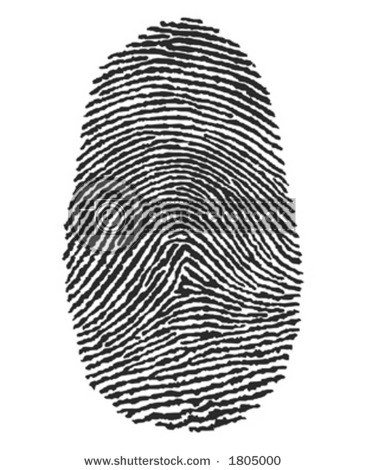
What type of fingerprint is shown in the first image?
A) Loop
B) Whorl
C) Arch

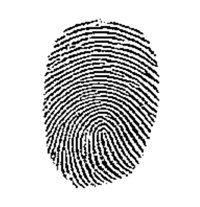
What type of fingerprint is shown in the second image?
A) Loop
B) Whorl
C) Arch

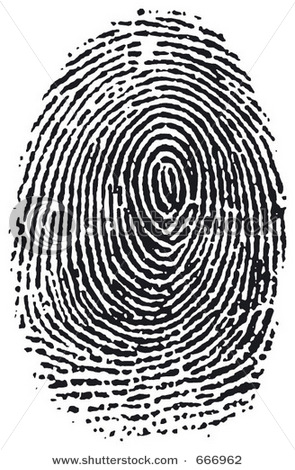
What type of fingerprint is shown in the third image?
A) Loop
B) Whorl
C) Arch

What is the Henry-FBI Classification System used for?
Classifying fingerprints by point value
Measuring hand size
Identifying palm lines
Determining finger length
Assign the number of points for each finger that has a whorl and substitute into the equation: right index, right ring, left thumb, left middle, left little + 1 / right thumb, right middle, right little, left index, left ring + 1 = ________. That number is your primary classification number.
0
1
2
3
What is the general number of points of similarity accepted by criminal courts in the United States for fingerprint matching?
5 to 7 points
8 to 12 points
13 to 15 points
16 to 20 points
What are latent fingerprints?
Fingerprints that are not visible to the naked eye and require special techniques to be detected
Fingerprints that are visible and can be easily seen without any special techniques
Fingerprints that are only found on electronic devices
Fingerprints that are used in digital security systems

Which gland secretes largely water with both inorganic and organic compounds?
A) Apocrine
B) Sebaceous
C) Eccrine

Which gland secretes fatty or greasy substances?
Eccrine
Sebaceous
Apocrine
What is the purpose of using substances that interact with secretions in developing latent prints?
To enhance the visibility of latent prints
To remove latent prints
To change the color of the surface
To destroy the evidence
Which of the following substances adheres to both water and fatty deposits?
Iodine
Powders
Water
Oils
Iodine fumes react with oils and fats to produce a temporary _______ color.
yellow-brown
blue
green
red
What does Ninhydrin react with to produce a purple color?
Chloride
Amino acids
Water
Silver chloride
Silver nitrate reacts with chloride to form ________, a material that turns gray when exposed to light.
Silver chloride
Sodium chloride
Potassium chloride
Calcium chloride
Cyanoacrylate fumes react with water and other fingerprint constituents to form a hard, ________ deposit.
Whitish
Transparent
Black
Yellow

What is the method shown in the image for detecting fingerprints?
A) Dusting
B) Iodine Fuming
C) Cyanoacrylate Fuming
D) Ninhydrin

What is the topic of Chapter 4 in the image?
DNA Analysis
Fingerprints
Blood Spatter
Toxicology

What are Cyanoacrylate Fingerprints?
A type of fingerprint developed using superglue fuming
A method of fingerprinting using ink
A digital fingerprinting technique
A type of fingerprint found on paper

What is the process of developing Cyanoacrylate Fingerprints?
Heating cyanoacrylate to produce fumes that react with fingerprint residues
Using a brush to apply cyanoacrylate directly on the fingerprint
Mixing cyanoacrylate with a dye to color the fingerprint
Dipping the object in a cyanoacrylate solution
Place the following in the order of fingerprint identification:
collect print
analyze loop, whorl, and arch patterns
analyze ridge characteristics
compare to prints on file
What is the main purpose of using the AFIS (Automated Fingerprint Identification System) in forensic investigations?
To analyze DNA samples
To compare bullet casings
To match unidentified fingerprints against a database
To reconstruct crime scenes digitally
During a crime scene investigation, Harper, Aria, and Rohan are tasked with processing a piece of evidence. They need to examine its shape, size, number of lines, and minutiae. What type of evidence are they likely processing?
Blood sample
Hair Sample
DNA sample
Fingerprint Sample
Identical twins have identical fingerprints
True
False
One of more ridges entering from one side of the print and recurving and exiting from the same side are known as:
Arches
Loops
Whorls
Central Pocket Whorls
Which best describes fingerprint identification and their origin?
it is a new science
It was developed in 1910
It has been around for a few deconds
It has been around for centuries
_______ is the study of fingerprint identification. So a _______ is the appropriate name for a fingerprint.
Endoscopy;POS
Pterodactyl; compression
Dactyloscopy; dactylogram
Ridge count; anagram
Bifurcation; fingerprint
What is the main purpose of fingerprinting in forensic science?
To determine a person's age
To identify individuals
To find out a person's occupation
To establish a person's health status
What is the purpose of lifting a fingerprint?
To clean the surface
To make it visible for analysis
To erase it from the crime scene
To transfer it to another location
Why is it important to wear gloves when collecting fingerprints?
To keep your hands clean
To prevent contaminating the evidence
To avoid getting fingerprints on your clothes
To make the process faster
Label the different ridge characteristics:
Bifurcation
Crossover
Ending Ridge
Eye
Bridge
Short Ridge
Hook/Spur
Label the finger prints correctly
Arch
Loop
Whorl
Match the following minutiae.

ridge ending

bifurcation

eye

island

bridge
A (a) fingerprint is a concealed fingerprint that has to be made visible using powders or other forensic techniques.
A (a) fingerprint is a three-dimensional fingerprint made in soft material such as clay, soap, or putty.
A (a) fingerprint is a visible fingerprint made when fingers coated in blood, ink, or some other substance touch a surface and leave behind a print.

What fingerprint pattern is this?
radial loop
plain whorl
tented arch
accidental whorl
Match the following prints with the correct names

arch

whorl

loop
Identify the core and the delta in this fingerprint.
core
delta

arch

whorl

loop

tented arch
A fingerprint is an impression left on a surface that consists of patterns made by (a) on a finger.
A (a) fingerprint is a concealed fingerprint that has to be made visible using powders or other forensic techniques.
latent
patent
plastic

Identify the fingerprint pattern shown.
loop
arch
whorl


Identify the core and the delta in this fingerprint.
core
delta

What type of fingerprint is shown in the third image?
A) Loop
B) Whorl
C) Arch
Which of the following is a type of print other than fingerprints?
Palm
Lip
Teeth
All of the above
A loop must have one or more ridges entering and exiting from the same side. Loops must have one delta. Types: Radial—opens toward the thumb, Ulnar—opens toward the “pinky” (little finger). Which type of loop is this, if it is on the right hand? Left hand?
Radial on the right hand, Ulnar on the left hand
Ulnar on the right hand, Radial on the left hand
Radial on both hands
Ulnar on both hands
What is the purpose of lifting a fingerprint?
To clean the surface
To make it visible for analysis
To erase it from the crime scene
To transfer it to another location

Do these fingerprints match?
YES
NO

Do These Fingerprints Match
YES
NO

Do these fingerprints match?
YES
NO

Do these fingerprints match?
YES
NO

Do these fingerprints match?
YES
NO

Do these fingerprints match?
YES
NO
Fingerprints remain (a) during an individual's lifetime.
(a) prints are ridge impressions left on a soft material like putty, wax, or soap.
(a) prints are invisible prints left behind by clean oils on fingertips.

What is the name of this minutiae?
Bifurcation
Splitting Ridge
Delta
Y

What is the name of this minutiae?
Enclosure/Eye
Island
Dot
Bifurcation

What is the name of this minutiae?
Ending Ridge
Spur
Half-Ridge
Partial Ridge

What is the name of this minutiae?
Bridge
Junction
Connector
Zigzag

What is the name of this minutiae?
Spur
Hanging Ridge
Overhang
Mini-fork
What is the most common type of fingerprint? (65%)
Arch
Loop
Whorl

What are the red triangles?
deltas
useless
forks
loops
Which type of fingerprint cannot be seen with the naked eye?
patent fingerprint
latent fingerprint
visible fingerprint
plastic fingerprint
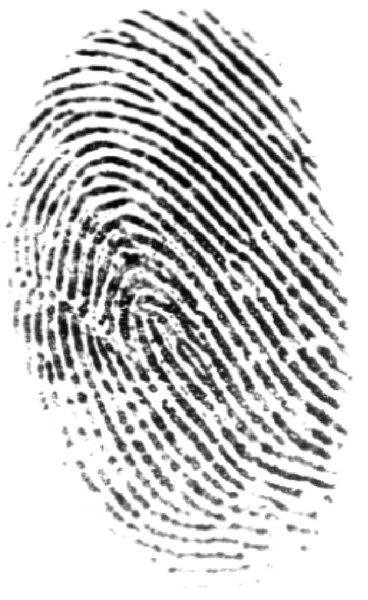

The number of deltas found in an arch pattern is ______.
zero
one
two
three
The number of deltas found in a loop pattern is ______.
zero
one
two
three
The most common ridge characteristic on fingerprints is _____.
bifurcation (fork).
island.
short ridge.
crossover.
Prints are called __________ prints when the ridges made contact with a colored substance, such as blood, paint or oil prior to being impressed on a surface.
latent
plastic
visible

