wayground logo

Free Printable Worksheets

Font size

S
M
L
XL
Worksheets

Semester REVIEW (Part 2)

Total questions: 84

Worksheet time: 1hrs 17mins

Name
Class
Date
1.

Which of the following is true about moment of force?

a)

Force × Distance

b)

Mass × Gravitational force

c)

Distance ÷ Time

d)

Force ÷ Area

2.

The diagram shows a uniform beam. It has a pivot at point P.


What is the magnitude of W to prevent the beam from turning?

a)

4 N

b)

8 N

c)

10 N

d)

20 N

3.

What is the unit for moment of force?

a)

N/m

b)

Pa

c)

Nm

d)

N/kg

4.

A beam is pivoted at position X. Two loads are attached on one side of the pivot as shown.


What is the magnitude of L in order for the beam to stay equilibrium?

a)

32 N

b)

62 N

c)

82 N

d)

102 N

5.

Which solid block remains at rest under the action of the forces shown?

a)

A

b)

B

c)

C

d)

D

6.

A student uses a stand and clamp to hold a flask of liquid.


Which diagram shows the most stable arrangement?

a)

A

b)

B

c)

C

d)

D

7.

The moment of a force causes an object to

a)

move forward

b)

move backward

c)

stop moving

d)

turn about a fixed point

8.

The turning effect of a force on a door is greater when it is applied at

a)

A point near the hinges and perpendicular to the door

b)

A point near the hinges and parallel to the door

c)

A point far away from the hinges and perpendicular to the door

d)

A point far away from the hinges and parallel to the door

9.

A nut can be loosen more easily with

a)

A short spanner because a large turning effect can be produced

b)

A short spanner because a larger force can be produced.

c)

A heavy spanner because a larger force can be produced.

d)

long spanner because a large turning effect can be produced.
10.

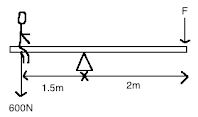
A boy of weight 600N sits on the see-saw as shown at a distance of 1.5m from the pivot. What is the force F required at the other end to balance the see-saw?

a)

450 N

b)

350 N

c)

4.5 N

d)

200 N

11.
When an object is in circular motion it is constantly changing its velocity.
a)
True
b)
False
12.
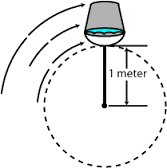
You swing a bucket of water attached to a string in a circle above your head. What keeps the water in the bucket?
a)
Friction
b)
Centripetal Force
c)
Gravity
d)
Inertia
13.
A horse gallops around a circular arena.  The centripetal force on the horse is ___.
a)
directed outward
b)
tension
c)
directed toward the center of the arena
d)
9.8 N
14.
A car traveling at 15 m/s on a flat surface turns in a circle with a radius of 25 m.  What is the centripetal acceleration of the car?
a)
2.4 x 10⁻² m/s2
b)
0.60 m/s2
c)
9.0 m/s2
d)
zero
15.
Which of the following terms means "center seeking"?
a)
centrifugal
b)
centrifuge
c)
centripetal
d)
centenarian
16.
Which of the following is the unit for centripetal force?
a)
J
b)
m/s2
c)
kg⋅m/s
d)
N
17.
What happens to the centripetal force exerted on an object if you triple the velocity?
a)
it increases to 3X
b)
it decreases to 6X
c)
it increases to 6X
d)
it increases to 9X
18.
Which of the following is a fictional force that pushes outward as something moves in a circle?
a)
Centripetal Force
b)
Gravitational Force
c)
Centrifugal Force
d)
Normal Force
19.
a push or a pull acting upon an object
a)
force
b)
motion
c)
energy
d)
friction
20.
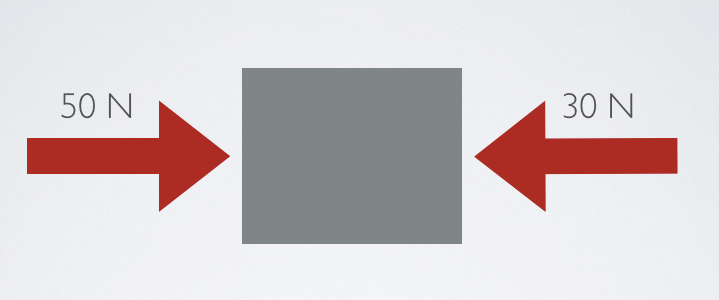
What is the net force?
a)
40 N left
b)
0 N Balalnced
c)
400 N right
d)
40 N right
21.
How will this object move? 
a)
It won't move. 
b)
It will move to the right. 
c)
It will move to the left. 
d)
It will move in both directions. 
22.
How will this object move? 
a)
It won't move. 
b)
It will move to the right. 
c)
It will move to the left. 
d)
It will move up. 
23.
What has to happen when a force is exerted on an object for work to be done?
a)
the object moves
b)
the object stays still
c)
the object is heavy
d)
none of these
24.
What is power?
a)
work per unit time
b)
force per unit distance
c)
total energy used
d)
force over a time interval
25.
What is kinetic energy?
a)
stored energy
b)
energy of motion
c)
energy of friction
d)
energy stored in chemical bonds
26.
How do we express the total amount of energy a moving object has?
a)
KE x PE
b)
KE + PE
c)
KE - PE
d)
KE / PE
27.
When a roller coaster cart falls towards the ground, what happens to its potential energy?
a)
Increases
b)
Decreases
c)
Stays the same
d)
Nothing
28.
When a rollercoaster cart moves towards the ground, what happens to the PE that it has?
a)
It transforms into KE
b)
It leaves the system
c)
Nothing
d)
It stays PE
29.
What is the kinetic energy of a ball sitting on top of a hill?
a)
0 J
b)
less than 0 J
c)
more than 0 J
30.
The Law of Conservation of Energy states that total amount of energy in a closed system will always
a)
stay the same
b)
increase
c)
decrease
d)
cannot be determined
31.
What is being transferred as you do work?
a)
Energy
b)
Heat
c)
Power
d)
Gravitational Potential Energy
32.

How do you calculate power?

a)

P = W/t

b)

P = E/t

c)

P = wt

d)

P = bbq/chicken

33.

How do we calculate work?

a)

W = Fd

b)

w = fD

c)

W = FD

d)

w = fd

34.
The SI unit of work is?
a)
Joules
b)
Watts
c)
Newtons
d)
meters
35.
The SI unit for power is...?
a)
Watts
b)
Joules
c)
Newtons
d)
Meters
36.

What is the formula for Gravitational Potential Energy?

a)

PE = mgh

b)

KE = 1/2mv2

c)

W = Fd

d)

P = W/t

37.

What is the formula for Kinetic Energy?

a)

PE = mgh

b)

KE = 1/2mv2

c)

W = Fd

d)

P = W/t

38.
A 5000N block is lifted 10 m. How much work was done?
a)
50000 J
b)
5000 J
c)
500 J
d)
50 J
39.
Bro A bench presses 145-lbs five times in 20 seconds.
Bro B bench presses 145-lbs five times in 10 seconds.
a)
Bro A did more work.
b)
Bro B did more work.
c)
Both Bros did the same amount of work.
d)
Bro
40.
You drop a 5 kg ball from a height of 2 m. Just before it reaches the ground, what type of energy does it have?
a)
Potential Energy
b)
Kinetic Energy
c)
Nuclear Energy
d)
Chemical Energy
41.
what happens when you have a change in temperature?
a)
when temperature increases, pressure decreases 
b)
when temperature increases, pressure increases 
42.

Which is a quality that only gasses display

a)

Spread out to fill all available space

b)

Take the shape of their container

c)

Can't be compressed

d)

All of these

43.
Which of the following would increase the pressure on a system?
a)
Increase the Temperature
b)
Pump in more gas
c)
Decrease the volume
d)
All of these
44.

What is pressure?

a)

The amount of force exerted on a surface

b)

The surface area of an object

c)

The weight of an object

45.

Why won't you sink in mud if you wear boots?

a)

Because the surface area is larger creating less pressure.

b)

Has air in it to keep you floating.

c)

Because the mud won't want you.

46.
What is the unit of measurement for pressure?
a)
pascal
b)
grams
c)
milliters
d)
meters
47.
Which of the statements is true?
a)
The bottom of the boot exerts more pressure than the high-heeled shoe as a result of an increase in surface area.
b)
The bottom of the high-heeled shoe exerts more pressure than the boot as a result of an decrease in surface area.
c)
The bottom of the high-heeled shoe exerts the same pressure as the bottom of the boot.
48.
Look at the pressure triangle. How do we calculate the area?
a)
f ÷ a
b)
f x p
c)
p x f
d)
f ÷ p
49.
Look at the pressure triangle. How do we calculate the force?
a)
f ÷ a
b)
f x p
c)
p x a
d)
f ÷ p
50.

Pressure can be measured in Pascals (Pa) or Newtons per square metre.

1 Pa = 1N/m2

a)

True

b)

False

51.
What does pressure measure?
a)
Strength
b)
Force exerted on a given area of surface
52.
At higher temperatures
a)
particles in an object have less energy
b)
particles in an object move faster
c)
a gas contracts
53.
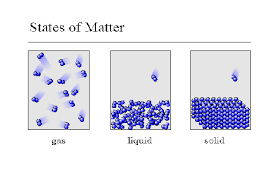
Which state of matter has a definite shape?
a)
solid
b)
liquid
c)
gas
54.
What is happening when my ice cream changes from a solid to a liquid?
a)
freezing
b)
melting
c)
burning
d)
evaporation
55.
Define a liquid.
a)
Indefinite shape, indefinite volume
b)
Definite shape, definite volume
c)
Found in stars
d)
Definite volume, indefinite shape
56.
The state of matter that has no definite size or shape is
a)
Solid
b)
Liquid
c)
Gas
57.
Particles (molecules) in a ______________________ have more energy than the other states of matter.
a)
gas
b)
solid
c)
liquid
58.
Particles of a liquid
a)
are tightly packed together and stay in a fixed position.
b)
have no viscosity.
c)
decrease in volume with increasing temperature.
d)
are free to move around one another but still touch.
59.
What term describes a solid changing to a gas?
a)
Deposition
b)
Sublimation
c)
Evaporation
d)
Freezing
60.
What is condensation?
a)
gas to solid
b)
gas to liquid
c)
liquid to solid 
d)
solid to liquid 
61.
Thermal energy is...
a)
heat energy.
b)
the energy of motion
c)
energy of nuclear processes.
d)
an indication of physical change.
62.
Which of the following statements is NOT true of all different types of matter?
a)
They are made of atoms and molecules
b)
The particles are always in motion
c)
The particles always move at the same speed
d)
They are made of particles that are too small to see
63.
What happens when my glass of water is sitting in the sun and disappears into a gas?
a)
evaporation
b)
burning
c)
melting
d)
freezing
64.
A bimetallic strip is made up of _____________________ welded together.
a)
two metals of the same kind 
b)
two different metals that expand and contract unequally
c)
two different metals that expand and contract equally
65.

What is Thermal Contraction

a)

The movement of particles.

b)

A decrease in a materials volume when its temperature decreases

c)

The movement of fluids in a cycle because of convection

d)

A material through which thermal energy does not flow easily.
66.
Which is NOT an insulator.
a)
Wool
b)
Plastic
c)
Copper
d)
Glass
67.
Conductors are materials that...
a)
Allow heat to pass through
b)
Stop heat from passing through
c)
Allow cold to pass through
d)
Stop cold from passing through
68.
The kind of heat transfer that travels through space in electromagnetic waves is ______________________.
a)
insulation.
b)
Radiation
c)
Conduction
d)
Convection
69.
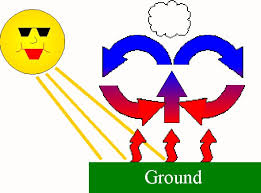
Warm air rises and the cool air sinks demonstrates this type of heat transfer. 
a)
conduction
b)
convection
c)
radiation
d)
Insolation 
70.
Heat transfers from an area of ____temperature to an area of ___ temperature.
a)
high to low
b)
low to high
c)
high to high
d)
It can travel high to low and low to high. 
71.
The Gulf Stream is a current that brings warm ocean water from the south to the north. What type of heat transfer is this?
a)
conduction
b)
convection
c)
radiation
d)
Insolation 
72.
Water has a specific heat of 4184 J/KgºC.  Wood has a specific heat of 1760 J/KgºC.  What material needs more energy to raise the temperature 1ºC
a)
Wood
b)
Water
c)
Both are the same
73.
Copper, Stainless Steel, Carbon Steel, and Zinc were all heated using the same thermal energy.  What material would be the coolest after being heated?
a)
Copper
b)
Carbon Steel
c)
Zinc
d)
Stainless Steel
74.

What is Specific Heat?

a)

The amount of thermal energy required to increase the temperature of 1kg of a material by 1°C.

b)

The amount of radiant energy required to increase the temperature of 1kgof a material by 1°C

c)

The amount of energy required to increase the temperature of 2 kg of a material by 1°C.

d)

The amount of friction required to increase the temperature of 1 kg of a material by 1°C.

75.
A high specific heat means...
a)
It heats up quickly with energy added
b)
It requires more energy to change temperature
76.
Objects gain heat and _________. 
a)
expand
b)
contract
77.
When materials warm up, they ___________, and when they cool down _____________.
a)
expand, and contract
b)
contract and expand
c)
liquidifye, and solidify
d)
Solidify and liquidify
78.
This is a 
a)
heating curve
b)
cooling curve
79.
Transfer of thermal energy by the movement of particles from one part of a material to another.
a)
Radiation
b)
Convection
c)
Conduction
d)
Convection Current
80.
An object that doesn't conduct heat well is known as:
a)
a conductor
b)
an insulator
c)
conduction
d)
insulation
81.
Heat transfer always goes from-
a)
Cold to Hot
b)
Hot to Cold
c)
Heat doesn't transfer
d)
Freezing to Cold
82.

What is the formula to calculate heat energy required to raise the temperature of any substance?

a)

E=mc∆T

b)

E=mc

c)

E= ½mv2

d)

m=EC

83.
How much energy is required to heat up 12kg of copper from 10 °C to 120 °C. The specific heat capacity is 390 J/kg °C.
a)
46800 J
b)
561600 J
c)
514800 J
84.
11088 J of heat energy are required to raise the temperature of 1.6 kg of copper from 7°C to 25°C. Calculate the specific heat capacity of copper.
a)
385 J/kg °C
b)
124740 J/kg °C
c)
0.002 J/kg °C