
 Worksheets
P4 - Electricity and Magnetism - REVISION
Total questions: 80
Worksheet time: 2hrs 2mins

Graph represents two conductors with different value of resistance. Resistance of A is _________________ than B.
Higher
Lower

What is the resistance in this circuit?
0.05Ω
1.8Ω
20Ω
What is the resistance of an object that draws 0.24 A when connected to a 120 V circuit?
0.024 Ω
28.8 Ω
124 Ω
500 Ω
What is the current drawn by a 10 Ω resistor when it is connected to a 12 V car battery?
22 amperes
1.2 amperes
0.83 amperes
120 amperes

Two balloons, X and Y, are suspended by insulating threads. They are each held near a negatively charged balloon. The balloons hang as shown.
A
B
C
D
What is the unit of electromotive force?
amperes
newtons
ohms
volts
What is the unit of electrical power?
amperes
joules
volts
watts

Which of the above diagrams shows the magnetic field lines around the north pole of a magnet?
A
B
C
D

When magnets and metal bars are close together they experience forces.
Which row gives the correct description of the effect between these materials?
A
B
C
D
Some magnets are easily magnetised when placed in a magnetic field, and then quickly lose their magnetism once the field is removed. These materials are used in electromagnets, and are called...
soft magnetic materials
hard magnetic materials
temporary magnets
partial magnets
What is the correct equation linking charge current and time
Q = It
I = Qt
t = QI
What is the correct equation for electrical power
P = I x V
P = V / I
P = I / V
What is the name of the Law that relates current, voltage and resistance in an electrical circuit?
Ohm's Law
Lenz's Law
Faraday's Law
Hooke's Law

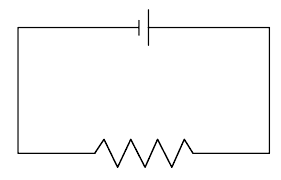
This circuit has a 24 volts battery and the resistor is 8 ohms. How many amps are running through the circuit?
3 Amps
192 Amps
2 Amps
4 Amps
What unit is used to measure voltage?
Ohms
Omega
Volts
Amps
Which is the right form of Ohm's Law linking voltage, current and resistance?
V=I/R
V=R/I
I=V/R
I=R/V
What is the correct name for the unit for measuring resistance?
amps (A)
volts (V)
coulombs (C)
ohms (Ω)
A computer circuit board contains a 4 kΩ resistor and has a p.d. of 8 V across it.
What does p.d. stand for?
potential difference
potential divider
power difference
power divider
A computer circuit board contains a 4 kΩ resistor and has a p.d. of 8 V across it.
What is the current through the resistor?
2 mA
2 A
16 mA
16 A
To get a large current to flow in a wire, you can either
increase the wire resistance or increase the supply voltage
increase the wire resistance or decrease the supply voltage
decrease the wire resistance or increase the supply voltage
decrease the wire resistance or decrease the supply voltage
Which of the following is the correct unit for charge?
coulombs (C)
Amps (A)
current (I)
charge (Q)
A 6 V light bulb is switched on for a short time. A 6 V battery transfers 2 C of charge to the bulb in this time. What energy has been transferred?
0.33 J
3 J
6 J
12 J
Which list contains an example of a non-magnetic material, a magnetic material and a magnetised material?
copper, iron, a compass needle
copper, iron, polythene
iron, steel, a compass needle
iron, steel, polythene
Which properties make materials suitable for use as a core in an electromagnet?
difficult to magnetise and easy to demagnetise
difficult to magnetise and retains magnetic strength
easy to magnetise and retains magnetic strength
easy to magnetise and easy to demagnetise

Which row describes the ease with which iron or steel can be magnetised and demagnetised?
A
B
C
D
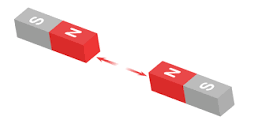
The AREA around a magnet where a magnet experiences a force.
Gravitational field
Magnetic Field
Electric field
Magnetism
What unit of electricity measures the amount of current ?
Volts (V)
Coulombs (C)
Amperes (A)
Ohms (Ω)
Which of the following materials is an electrical conductor?
Plastic spoon
Silver-colored plastic spoon
copper spoon
wooden spoon
Particles with the _________ charge are attracted to each other.
Like (same)
Unlike (opposite)
Which of the following is a good insulator?
copper
aluminum
glass
silver

A
B
C
D
Equation for voltage
current x resistance
current / resistance
resistance / current
Resistance x amps
Unit of electrical charge is
C (Coulombs)
J (Joules)
A (amps)
V (volts)
Equation for electrical power
voltage x current
voltage / current
current / voltage
voltage + current
Electrical power is measured in
Joules
Watts
Amps
Volts
170 W
170 Ω
1.7 Ω
1.7 W

Remember: V=IR and P=VI
80 W
200 W
2.5 A
22.5 kJ
What will be the current drawn by an electric bulb of 1000 W when it is connected to a source of 220 V?
4.55 A
28800 J or 28.8 KJ
80 W
200 A
100 W
100 V
6.3 W
6.3 V
Electricity in a metals wire is the flow of _________.
protons
neutrons
electrons
10C of charge flows in a wire every 2 seconds. Calculate the current in the wire.
5 Ohms
5 Amps
0.2 Volts
0.2 Amps
Longer wires have _______ resistance than shorter wires.
more
less
the same
If a cell provides 12 V to a circuit and 4 C of charge flows. How much energy is being provided by the cell?
3 J
0.25 J
48 J
16 J
What is a material called that easily carries a current?
insulator
electric potential
semiconductor
conductor
I am rubbing a glass rod with silk. If the rod ends up being positively charged, what is the charge of the silk?
negative
positive
neutral
Which of the following type of copper wire would you expect to have the least electric resistance?
a thick long wire
a thick short wire
a thin long sire
a thin short wire
If two charges repel each other, the two charges could be
Positive and neutral
Positive and negative
positive and neutral
negative and negative
What is a formula to calculate Charge
Q=It
Q=tI
Q=VE
Q=IR
How are resistance, voltage and current related?
V = IR
R=VI
V=RI
R=IV
How do you calculate electrical power?
Power = current x voltage
Power=votlagecurrent
Power = energy x time
Power = resistance x time
How do you calculate the energy transferred in a component?
E=IVt
E=IVt
E=IV
E=Q/t
A current of 12 A flows for 20 minutes into an electric cooker.
How much charge has the cooker used?
14400 C
280 C
100 C
0.6 C
The current in a motor is 2.1 A and the potential difference across it is 12V. The motor takes 1.5 seconds to lift a mass. What is the energy transferred to the motor as it lifts the mass?
85 J
3.8 J
38 J
8.5 J
An electric bulb is connected to a 220V generator. The current is 0.50 A. What is the power of the bulb?
440 W
110 W
55 W
0.0023 W
A
B
C
D
A computer circuit board contains a 4 kΩ resistor and has a p.d. of 8 V across it.
What does p.d. stand for?
potential difference
potential divider
power difference
power divider
A computer circuit board contains a 4 kΩ resistor and has a p.d. of 10 V across it.
What is the current through the resistor?
2.5 mA
2.5 A
40 mA
40 A
To get a large current to flow in a wire, you can either
increase the wire resistance or increase the supply voltage
increase the wire resistance or decrease the supply voltage
decrease the wire resistance or increase the supply voltage
decrease the wire resistance or decrease the supply voltage
A 240 volt, 3 amp heater is left running for 5 minutes.
Which of these gives the total energy output?
3.6 kJ
216 kJ
72 kJ
0.9 kJ

The diagrams show four current-voltage graphs. Which two graphs show the characteristics of an ohmic resistor and of a filament lamp?
A
B
C
D

A resistor of resistance R is connected to a battery of e.m.f. V. There is a current I in the resistor. Power P is dissipated by the resistor, and in time t the energy transferred is E. Which expression is correct?
A
B
C
D

In the circuit shown, the ammeter reads 2.0A and the voltmeter reads 12V. How much energy is transferred by the resistor in 10 seconds?
A
B
C
D

Two similar balloons hang side by side, on insulating threads, a short distance apart. They are both rubbed with the same dry cloth and become charged. Which diagram shows how the balloons hang after charging?
A
B
C
D

A wire has a certain electrical resistance. The diameter and length of the wire may be changed. Which pair of changes must cause the resistance of the wire to increase?
A
B
C
D
What is/are magnetic material(s)?
Tick all the correct answers.
Silver
Nickel
Copper
Coban

A plastic rod and a dry cloth are uncharged. The rod is now rubbed with the cloth and they both become charged. The rod becomes negatively charged because some charged particles move from the cloth to the rod. What is the charge on the cloth and which particles moved in the charging process?
A
B
C
D
A laptop is plugged into a 120 V outlet and uses 60 ohm's of resistance. How much current is running though it?
120 Amps
60 Amps
2 Amps
20 Amps
__________ is the tendency for certain materials to slow or impede the flow of electrons.
Potential difference
Current
Power
Resistance
Electric field is
the region of space that a magnet experiences a force
the region of space that an electric charge experiences a force
the region of space that a mass experiences a force
Mr. Robinson and his class are conducting an experiment. The class needs to choose a good insulator. Which of the following could be used as an insulator?
plastic plate
copper rod
silver spoon
aluminium wire
Charging takes 110 minutes and causes a total charge of 180 000 C to pass through the battery. What is the average charging current in the battery?
1636 A
163.6 V
27.3 A
27.3 V

