
 Worksheets
Final Final Review Sem 2
Total questions: 76
Worksheet time: 2hrs 39mins
Name
Class
Date
1.
Calculation- What is the speed of an object that travels 64 kilometers in 8 seconds?
a)
512km/s2
b)
8km/s
c)
72km/s
d)
512km/s
2.
If I drive on a curvy road to my house and it is 40km of distance, would the total displacement be more or less km than that?
a)
More
b)
Less
c)
MoreLess
3.
If a peregrine falcon circling at 20 m/s dives for 10s to catch a pigeon in midair at 100m/s, what would its acceleration be?
a)
2000m/s2
b)
1200m/s2
c)
70m/s2
d)
8m/s2
4.
If an auto-body shop needs to lift an engine that is 400kg, how much force will they need to apply to hold the engine 5m up in the air while they move a car in place?
a)
3920N
b)
40.8N
c)
19600N
5.
For the 1000kg car on Mayfield hill, what is its potential energy at the top of the 150m hill?
a)
150000J
b)
6.67J
c)
1470000J
6.
If the frequency of a soundwave is 500Hz and its speed is 350m/s, what is its wavelength?
a)
175000m
b)
.7m
c)
1.42m
7.

During which time span was the object moving with 0 velocity?
a)
0-4s
b)
8-10s
c)
10-14s
8.

What would this object's total displacement be?
a)
+24m
b)
+0m
c)
+8m
9.

What was the object doing from 2s-10s?
a)
Standing still
b)
Moving at constant velocity
c)
traveling in a straight line
10.
If a force of 26 N is exerted on two balls, one with a mass of 0.52 kg and the other with a mass of 0.78 kg, which ball will have the greater acceleration? (F=ma)
a)
The one with a mass of .78 kg will have the greatest acceleration.
b)
The one with a mass of .52 kg will have the greatest acceleration.
c)
They will both accelerate at the same rate.
11.

The mass of a car is 1000 kg. How much force would be required to accelerate the car at a rate of 3 m/s2? The answer to this question is most likely (HINT: Look at the units!!!) -
a)
3000 N
b)
3000 m/s2
c)
3000 kg
12.

The masses of four objects are given in this table. If all objects are struck with the same amount of force, which one will have the greatest acceleration?
a)
Object 1
b)
Object 2
c)
Object 3
d)
Object 4
13.
If a 10 kilogram object accelerates suddenly at 15 m/s2, how much force was applied to the object?
a)
150 Newtons
b)
15 Newtons
c)
150 kilograms
d)
100 kilograms
14.
Unbalanced forces make an object:
a)
Come to rest
b)
move at constant velocity
c)
accelerate
d)
explode
15.
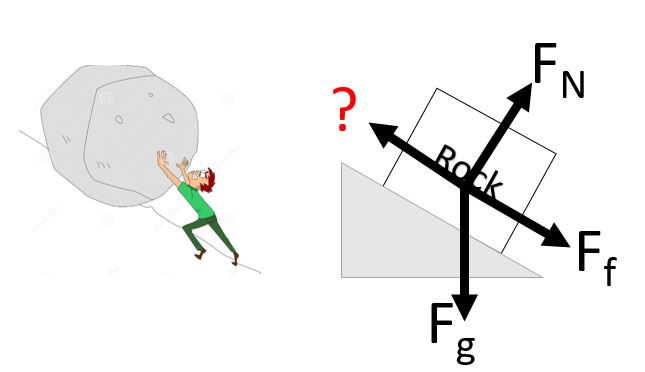
Name the missing force...
a)
applied force
b)
weight force
c)
lift
d)
normal force
16.
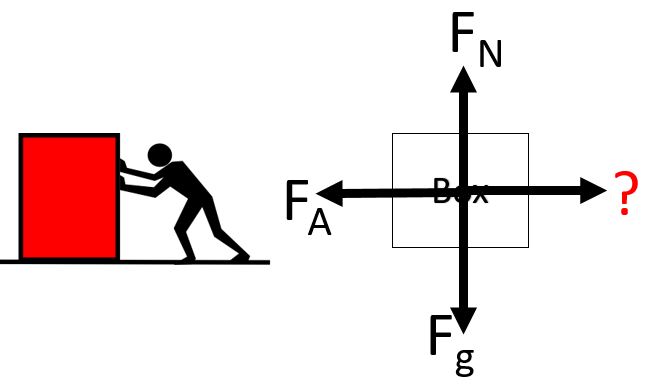
Name the missing force...
a)
frictional force
b)
weight force
c)
thrust
d)
buoyant force
17.

What is the net force?
a)
5000 N right
b)
4000 N right
c)
40 N left
d)
4000 N left
18.

What is the net force in this diagram?
a)
8N right
b)
2 N right
c)
8N left
d)
2N left
19.
What makes a rolling ball stop moving?
a)
gravity
b)
friction
c)
a balanced force
20.
If there are two forces going in the same direction how would you find the net force?
a)
Subtract
b)
Add
c)
Neither
d)
Multiply
21.

Name the missing force....
a)
weight force
b)
normal force
c)
frictional force
d)
tension force
22.
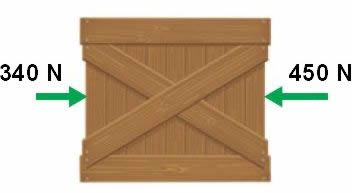
What happens when unbalanced forces act on an object at rest?
a)
the object remains at rest
b)
the object begins moving in an unpredictable direction
c)
the object begins moving in the direction of the net force
d)
the object begins moving opposite to the direction of net force
23.

When a cannon fires a cannonball we observe Newton's third law. Which force is the reaction force?
a)
The cannon moving forward
b)
The cannonball moving forward
c)
The cannon moving backward
d)
The cannonball moving backward
24.
What is the acceleration of an object traveling at a constant velocity?
a)
10 m/s2
b)
0 m/s2
c)
250 m/s2
d)
20 m/s2
25.

What is the magnitude (size) and direction of the net force?
a)
5 N to the Right
b)
5 N to the Left
c)
10 N to the Right
d)
4 N to the Left
26.
What is Newton's First Law
a)
F=ma
b)
Every force applied has an equal and opposite reaction reaction force
c)
An object at rest stays at rest, an object in motion stays in motion, unless acted on by an unbalanced force
d)
Friction
27.

Sally experiences-
a)
Rolling Friction
b)
Sliding Friction
c)
Fluid Friction
d)
Static Friction
28.
Friction is a force that acts in an ___________ direction of movement.
a)
similar
b)
opposite
c)
parallel
d)
west
29.
How far will a person go if they jog for 2 hours at a speed of 12 km/hr?
a)
6 km
b)
0.5 km
c)
10 km
d)
24 km
30.

The graph represents
a)
no motion
b)
constant velocity
c)
acceleration
d)
negative acceleration
31.
65 miles per hour North is an example of an objects what?
a)
Speed
b)
Velocity
c)
Average Speed
d)
Constant Speed
32.

Students are exploring the relationship between velocity and acceleration. This graph shows the acceleration of a remote-controlled toy car. Which statement is TRUE based on the graph?
a)
Segment AB and Segment CD show positive acceleration.
b)
Segment OA and Segment DE show positive acceleration.
c)
Segment OA and Segment BC show constant speed.
d)
Segment BC and Segment EF show constant speed.
33.

Students performed several trials using the laboratory setup shown. Students were also given this hypothesis: If friction increases, then the rolling distance of a marble will decrease. What should be changed to best test this hypothesis?
a)
Height of the ramp
b)
Height of the ramp and roughness of the ramp
c)
Roughness of the ramp
d)
Height and length of the ramp
34.
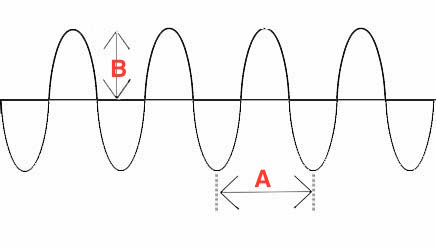
What property of this wave is represented by the letter "A"
a)
amplitude
b)
crest
c)
trough
d)
wavelength
35.
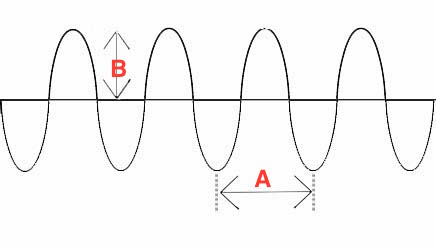
What property of the wave is represented by the letter "B"?
a)
amplitude
b)
crest
c)
trough
d)
wavelength
36.
The highest point on a wave is:
a)
the crest
b)
the trough
c)
the top
d)
the coast
37.
The type of waves that require medium to pass:
a)
Mechanical Waves
b)
Electromagnetic Waves
38.
The number of wavelengths that pass a point each per second is:
a)
frequency
b)
period
c)
longitudinal
d)
transverse wave
39.
When the frequency of a wave increases, what happens to the wavelength?
a)
The wavelength is not directly affected by the frequency of a wave.
b)
The wavelength increases.
c)
The wavelength decreases.
d)
More specific information is needed to form a conclusion about the wavelength.
40.
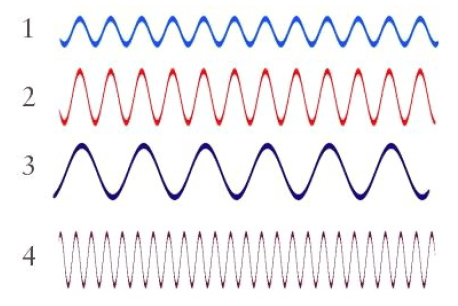
Which wave in the diagram has the greatest frequency?
a)
1
b)
2
c)
3
d)
4
41.
Electromagnetic waves include the following except
a)
radio waves
b)
X-rays
c)
doing the wave at a football game
d)
microwaves
42.
When a wave strikes and object and bounces off. (example echo)
a)
medium
b)
refraction
c)
reflection
d)
interference
43.
When a wave bends as it passes through at an angle from one medium to another.(example: pencil in a glass of water-)
a)
medium
b)
refraction
c)
reflection
d)
interference
44.
A wave has frequency of 5 Hz and a speed of 25 m/s. What is the wavelength of the wave?
a)
25 m
b)
125 m
c)
5 m
d)
25 m/s
45.

What is A in this image?
a)
amplitude
b)
compression
c)
rarefaction
d)
trough
46.

What kind of wave is pictured below?
a)
compressional wave
b)
transverse wave
c)
sound wave
d)
mechanical wave
47.

Which of the following represents refraction?
a)
A
b)
B
c)
C
d)
D
48.

The bouncing back of a wave when it hits a surface through which it can NOT pass is called —
a)
rarefaction
b)
reflection
c)
diffraction
d)
refraction
49.

Which term best represents what happens when two wave pulses meet as they approach each other on a string?
a)
constructive interference
b)
destructive interference
c)
absorbed interference
d)
static interference
50.

In ___________, the two colliding wave combine amplitude/energy
a)
Constructive Interference
b)
Doppler Effect
c)
Reflection
d)
Refraction
51.
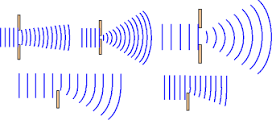
a)
Diffraction
b)
Interference
52.
Hotter stars appear to be what color?
a)
Red
b)
Blue
c)
Yellow
d)
Green
53.
What determines the color of a star?
a)
It's size
b)
It's temperature
c)
It's composition
d)
They are all the same color
54.
What fuel do stars use?
a)
Oxygen
b)
Hydrogen
c)
Carbon
d)
Iron
55.
At what stage in a stars life cycle are elements heavier than iron form?
a)
Red Giant
b)
Supernova
c)
Black Hole
d)
Main Sequence
56.
In the death of a large mass star gravitational collapse is so complete that no energy or matter can escape. This is called a...
a)
Neutron Star
b)
Black Hole
c)
Black Dwarf
d)
Supernova
57.
Which best describes a main-sequence star?
a)
Unstable
b)
Relatively, Very Hot
c)
Balanced forces
d)
Relatively, very small
58.
H-R diagrams measure both a star's ______ and _______.
a)
mass and color
b)
absolute magnitude and tempurature
c)
brightness and composition
d)
location and type
59.

Which star has the lowest luminosity?
a)
A
b)
B
c)
C
d)
D
60.

Which star has the lowest temperature?
a)
A
b)
B
c)
C
d)
D
61.

Which star is considered a Main Sequence Star?
a)
A
b)
B
c)
C
d)
D
62.
Our sun is currently in this star stage
a)
Protostar
b)
Nebula
c)
Main Sequence
d)
I have literally no idea
63.

Which type of star has the shortest life span?
a)
the smallest ones
b)
the middle sized ones
c)
the most massive ones
64.

All stars begin as ...
a)
red giants
b)
nebulae
c)
supernova
d)
white dwarf
65.
What is responsible for bringing the particles together when a star is first born?
a)
Electrostatic Attraction
b)
Heat Energy
c)
Cosmic Radiation
d)
Gravity
66.
Main sequence stars spend their time
a)
fusing Hydrogen (H) into Helium (He)
b)
fusing Helium (He) into Hydrogen (H)
c)
fusion Iron (Fe) into Hydrogen (H)
d)
fusing Hydrogen (H) into Iron (Fe)
67.
The process that all stars perform is called?
a)
nuclear fission
b)
nuclear fusion
c)
mass expulsion
d)
star tectonic motion
68.

In the diagram given, what happens as we move to the left?
a)
Stars Get Larger
b)
Stars get Colder
c)
Stars get hotter
69.

Look at the H-R diagram. Which star is
sort of cool, dim (not too much light), and red?
sort of cool, dim (not too much light), and red?
a)
Betelguse
b)
Sirius B
c)
Procyon B
d)
Barnard's star
70.
Balance this reaction: ____ BaS + ____ PtF2 ---> ____ BaF2 + ____ PtS
a)
1,1,1,1
b)
1,2,1,1
c)
1,1,1,2
d)
2,1,1,1
71.
What are the coefficient used to balance the equation below?
__Ag2O →__ Ag +___O2
__Ag2O →__ Ag +___O2
a)
2,4,1
b)
1,1,1
c)
2,1,2
d)
2,2,2
72.
What is the little number after an element in a chemical equation called.
Example: H2
Example: H2
a)
Coefficient
b)
Subscript
c)
Atom
d)
Equation
73.
What does the Law of Conservation of Mass state?
a)
Matter cannot be gained or lost in a chemical reaction.
b)
Matter can only be lost in a chemical reaction.
c)
Matter can only be gained in a chemical reaction.
d)
Matter can be gained and lost in a chemical reaction.
74.
What is the arrow in a chemical equation...
H2 + O --> H2O
H2 + O --> H2O
a)
Reactants
b)
Products
c)
Yields
d)
Chemical Equation
75.
When balancing equations a ____ can be placed to the left of a formula of a substance to make the equations balanced
a)
charge
b)
subscript
c)
random number
d)
coefficient
76.
Mg + ___ HCl → MgCl2 + H2
a)
1
b)
2
c)
3
d)
4
100 %

