wayground logo

Free Printable Worksheets

Font size

S
M
L
XL
Worksheets

IPC review 1

Total questions: 79

Worksheet time: 2hrs 34mins

Name
Class
Date
1.
What two types of measurements make up DENSITY
a)
Mass and Volume
b)
Temperature and Mass
c)
Grams and Centimeters
d)
Volume and Weight
2.
Look at this image.  Which object has the LOWEST density in water? How
a)
The Ping Pong Ball because it floats to the top 
b)
The bolt because it has sunk to the bottom
c)
The soda cap because it is not just full of air like the Ping Pong ball
3.
Jack has a rock. The rock has a mass of 14g and a volume of 2cm3. What is the density of the rock?
a)
7 mL
b)
7 g/cm3
c)
28 g/cm3
d)
1/7 g/cm3
4.
If an object has a density of .6 g/mL and you put it into water, will it sink or float?  
a)
sink
b)
float
5.
If an object has a density of 3.6 g/mL and you put it into water, will it sink or float?  
a)
sink
b)
float
6.
Frank has an eraser. It has a mass of 4g, and a volume of 2cm3. What is its density?
a)
8 g/cm3
b)
2 g/cm3
c)
1/2 g/cm3
d)
24 g/cm3
7.
What units are used to measure mass?
a)
g
b)
cm3
c)
g/cm3
d)
cm3/g
8.
What is the formula for density?
a)
density = mass x volume
b)
density = mass / volume
c)
density = mass + volume
d)
density = mass - volume
9.
Calculate the density of the cube.
a)
2 g/cm3
b)
4 g/cm3
c)
6 g/cm3
d)
8 g/cm3
10.
What is this tool to get mass?
a)
triple beam balance
b)
ruler
c)
thermometer
d)
graduate cylinder
11.
Which units of measurement are used for volume?
a)
grams
b)
centimeters
c)
grams/milliliter
d)
milliliter
12.
What units are used to measure Density?
a)
cm3/g
b)
g
c)
g/cm3
d)
cm3
13.
What is this tool to get volume?
a)
triple beam balance
b)
ruler
c)
thermometer
d)
graduate cylinder
14.
a)

15 cm3

b)

50 cm3

c)

150 cm3

d)

180 cm3

15.
a)

303.4 g

b)

370.4 g

c)

373.0 g

d)

373.4 g

16.

When you put an object in a graduated cylinder of water and measure how much the water level changed what is this process called?

a)

Relative Density

b)

Displacement

c)

Density

17.
What is the volume of Object X?
a)

10.0 ml

b)

15.0 ml

c)

20.0 ml

d)

25.0 ml

18.
What is the volume of the fish?
a)

18.0 ml

b)

6.0 ml

c)

38.0 ml

19.
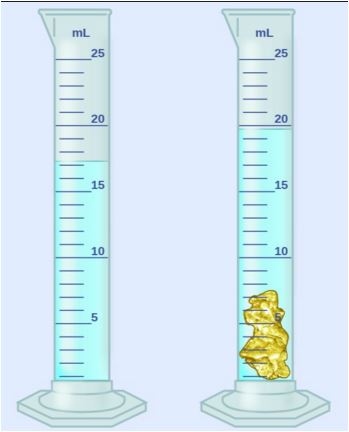
An irregularly shaped piece of gold was lowered into a graduated cylinder holding a volume of water equal to 17 ml. The height of the water rose to 20 ml. If the mass of the gold was 27 g, what was its density?
a)
9 g/mL
b)
10.5 g/mL
c)
6.5 g/mL
d)
8 g/mL
20.
How much water has been displaced in the image shown?
a)
40 mL
b)
65 mL
c)
20 mL
d)
25 mL
21.
The amount of space something takes up
a)
density
b)
volume
c)
mass
d)
matter
22.

A crayon has a mass of 10.0 g and volume of 5.0 mL. What is the density?

a)

30 g/mL

b)

15 g/mL

c)

1.0 g/mL

d)

2.o g/mL

23.
True or False:  The density of a specific type of material never changes.  
a)
True
b)
False
24.
You can measure ______ with grams.
a)
mass
b)
volume
c)
conductivity
d)
melting point
25.
What is the formula for density?
a)
density = mass x volume
b)
density = mass / volume
c)
density = mass + volume
d)
density = mass - volume
26.
What is the density of water?
a)
0 g/ml
b)
1 g/ml
c)
10 g/ml
d)
100 g/ml
27.
What is the volume of the fish?
a)
18.0 cm3
b)
6.0 cm
c)
38.0 cm3
d)
32.0 mL
28.

A block of aluminum occupies a volume of 15 mL and has a mass of 40.5 g. What is its density?

a)

.37 g/mL

b)

605.5 g/mL

c)

2.7 g/mL

d)

25.5 g/mL

29.
Density is...
a)
the amount of mass in an object
b)
the amount of space an object takes up
c)
the amount of mass in a given space
d)
the weight of an object
30.

Jack has a rock. The rock has a mass of 14g and a volume of 2cm3. What is the density of the rock?

a)

7 mL

b)

7 g/cm3

c)

28 g/cm3

d)

1/7 g/cm3

31.
Which box has a higher density?  
a)
Box A
b)
Box B
c)
cannot be determined
d)
they are the same
32.

As part of a classifying elements lab Joe was finding the density of different samples. One sample had a mass of 26.4 and a volume of 12 mL. What element is it?

a)

Sulfur

b)

Carbon

c)

Boron

d)

Krypton

33.
If you are given the density and volume of an item, how would you calculate its mass?
a)
D = M/V  SO..
M = D/V
b)
D = M/V  SO...
M = V/D
c)
D = M/V SO...
M = D x V
34.
If you know the density and the mass of an object, what equation would you use to calculate its volume?
a)
V = D/M
b)
V = M/D
c)
V = M x D
d)
V = l x w x h
35.

A piece of copper has a mass of 89g and a volume of 10.0 cm3. What would be the density of the copper?

a)

0.89 g/cm3

b)

89 g/cm3

c)

8.9 g/cm3

d)

890 g/cm3

36.

Use the density chart to identify the substance. If the substance has a volume of 5 cm3 and a mass of 52.5.

a)

lead

b)

aluminum

c)

silver

d)

water

37.

In the picture, a can of Pepsi sunk and a can of Diet Pepsi are put into water. The Pepsi must be

a)

more dense than water

b)

less dense than water

c)

it has no density

d)

it has a density of 1 g/mL

38.

If the volume of the Coke and Diet coke is 380 cm3, The mass of the coke must be...

a)

equal to to 1 g

b)

less than 380 g

c)

more than 380 mL

d)

more than 380 g

39.

We can use density to identify substances because it is a

a)

Chemical property

b)

Physical Property

c)

Characteristic Physical Property

d)

Materialistic Property

40.
What units are used to measure Density?
a)
cm3/g
b)
g
c)
g/cm3
d)
cm3
41.

when an object is compressed so that its mass is packed into a smaller space, its density

a)

increases

b)

decreases

c)

remains constant

42.
Calculate the density of the cube.
a)
2 g/cm3
b)
4 g/cm3
c)
6 g/cm3
d)
8 g/cm3
43.

A. gasoline 0.7 g/ cm3

B. lead 11.3 g/ cm3

C. mercury 13.6 g/ cm3

D. Paraffin(wax) 0.87 g/ cm3

E. platinum 21.4 g/ cm3

Which will not sink in water?

a)

A & B

b)

C & E

c)

B & C

d)

A & D

44.
If an object has a density of .6 g/mL and you put it into water, will it sink or float?  
a)
sink
b)
float
45.
A piece of copper has a mass of 89g and a volume of 10 cm3.  What would be the density of the copper?
a)
0.89 g/cm3
b)
89 g/cm3
c)
8.9 g/cm3
d)
890 g/cm3
46.

Why does ice float

a)

Liquid water is less dense than solid water.

b)

Solid water is less dense than liquid water.

c)

Gaseous water is less dense than solid water.

d)

Liquid water is less dense than gaseous water.

47.
Frank has a paper clip. It has a mass of 9g and a volume of 3cm3. What is its density?
a)
3 g/cm3
b)
1/3 g/cm3
c)
27 g/cm3
d)
39 g/cm3
48.

In this picture, what is true?

a)

Box A has a lower volume

b)

Box B has a greater volume

c)

The boxes have the same mass

d)

The boxes have the same volume

49.

The unit for mass is...

a)

Meters (m)

b)

Milliliters (mL)

c)

Degrees Celsius (C)

d)

Kilogram (kg) / Gram(g)

50.

A scientist wants to find the mass of an object. What tool will the scientist use?

a)

Balance Scale

b)

Ruler

c)

Thermometer

d)

Graduated Cylinder

51.

The unit for volume is...

a)

Milliliters (mL)

b)

Grams (g)

c)

Meters (m)

d)

Degrees Celsius (C)

52.

In science, the unit for temperature is...

a)

Degrees Fahrenheit (F)

b)

Degrees Celsius (C) and Degrees Kelvin (K)

53.
What is the correct SI unit for mass?
a)
Kilograms
b)
newtons
c)
pounds
d)
grams
54.
What prefix is represented by the following symbol:  k
a)
hecto
b)
kilo
c)
deci
d)
deka
55.

What SI unit is used to measure length?

a)

meters

b)

liters

c)

centimeters

d)

kilograms

56.
What is the volume of the liquid in this graduated cylinder?
a)
58.8ml
b)
58.0ml
c)
58ml
d)
62ml
57.

Which options shows the correct conversion between grams and milligrams?

a)

85g = 8500mg

b)

85g = 8.5mg

c)

85g = .85mg

d)

85g = 85000mg

58.

What is the main purpose of a line graph?

a)

to compare two things

b)

To show change over time

c)

to have an independent variable

d)

so you don't have to read words

59.

Which variable should be on the x axis?

a)

dependent variable

b)

independent variable

c)

control variable

60.

The independent variable is the ONE thing you _____

a)

change

b)

keep the same

c)

experiment with

d)

investigate

61.

Which variable should be on the y axis?

a)

the dependent variable

b)

the independent variable

c)

the control variable

62.
Convert from meters to cm:  9 meters
a)
900 cm
b)
90 cm
c)
0.9 cm
d)
0.09 cm
63.
Convert 17 m to cm:
a)
0.17 cm
b)
0.017 cm
c)
1,700 cm
d)
170 cm
64.

The amount of matter an object has is the...

a)

Density

b)

Mass

c)

Volume

d)

Temperature

65.

The unit for mass is...

a)

Meters (m)

b)

Milliliters (mL)

c)

Degrees Celsius (C)

d)

Kilogram (kg) / Gram(g)

66.

A scientist wants to find the mass of an object. What tool will the scientist use?

a)

Balance Scale

b)

Ruler

c)

Thermometer

d)

Graduated Cylinder

67.

The amount of space an object takes up is...

a)

Mass

b)

Density

c)

Volume

d)

Temperature

68.

The unit for volume is...

a)

Milliliters (mL)

b)

Grams (g)

c)

Meters (m)

d)

Degrees Celsius (C)

69.

The volume of a rectangular object (such as a cube) is measured by...

a)

Length x Width x Height

b)

Water Displacement Method

70.

A suitcase has a length of .5 meters, a width of .2 meters, and a height of 1 meter. What is the volume (in m^3) of the suitcase?

a)

1 m^3

b)

1.7 m^3

c)

.3 m^3

d)

.1 m^3

71.

The water displacement method is used to find the volume of...

a)

Regular-shaped objects

b)

Irregular-shaped objects

72.

A scientist fills a beaker to 300 mL. The scientist drops an irregular-shaped object into the beaker. The water level rises to 400 mL. What is the volume of the object?

a)

400 mL

b)

700 mL

c)

.75 mL

d)

100 mL

73.

How compact an object is is its...

a)

Density

b)

Mass

c)

Volume

d)

Temperature

74.

The equation for density is...

a)

D = m x v

b)

D = a / t

c)

D = m / v

d)

D = m + v

75.

The unit for density is...

a)

g

b)

m/s

c)

m

d)

g/mL

76.

What is the density of an object with a mass of 50 g and a volume of 10 mL?

a)

500 g/mL

b)

5 g/mL

c)

.2 g/mL

d)

60 g/mL

77.

If an object is more dense than water, it will...

a)

Sink

b)

Float

78.

The measurement of the average kinetic energy (motion) of the particles in matter is the...

a)

Mass

b)

Volume

c)

Density

d)

Temperature

79.

In science, the unit for temperature is...

a)

Degrees Fahrenheit (F)

b)

Degrees Celsius (C) and Degrees Kelvin (K)