
 Worksheets
Semester 2 Review
Total questions: 79
Worksheet time: 1hrs 16mins
2 Mg + O2 → 2 MgO
2 Mg + O2 → 2 MgO
2 Al + 6 HCl → 2 AlCl3 + 3 H2
CaC₂(s) + H₂O(l) --> C₂H₂(g) + Ca(OH)₂(aq)

Percent yield=(________)÷(________)×100%
A homogeneous mixture made up of solutes in a solvent is called a
Solutions
Suspension
Colloid
A substance that cannot be dissolved into a solution is called
soluble
insoluble


How many grams of Pb(NO3)2 are soluble in 100 g of water at 65 ºC?
80 grams
100 grams
40 grams
90 grams


The solubility graph below shows the amounts of four substances that will dissolve in 100 grams of water at various water temperatures.
Which substance has 80 grams of solute dissolved in 100 grams of water at 50 C?
Potassium Bromide, KBr
Ammonium Chloride, NH4Cl
Potassium Chloride, KCl
Lithium Hydroxide, LiOH
This type of mixture contains two or more substances that are NOT uniform meaning they are visibly distinguishable.
homogeneous
heterogeneous
Which term describes a solution in which there is LESS than the maximum amount of solute that can be dissolved in a given amount of solvent?
Unsaturated
Saturated
Supersaturated
Homogenous
Which term describes a solution that CONTAINS THE MAXIMUM AMOUNT of solute that can be dissolved in a given amount of solvent?
Unsaturated
Saturated
Supersaturated
Homogenous
Which term describes a solution in which there is MORE than the maximum amount of solute that can be dissolved in a given amount of solvent?
Unsaturated
Saturated
Supersaturated
Homogenous
A type of mixture where the particles are larger than those in a solution but not heavy enough to settle out.
Homogeneous mixture
Colloid
Suspension
Compound
Which of the following is NOT a way to speed up the dissolving of a solute?
agitation
increase in temperature
increase in surface area
larger solute particles
A heterogeneous mixture in which the particles will settle out if left undisturbed
Colloids
Suspensions
Miscible
Immiscible
Which of the following terms is the substance that does the dissolving in solution
Miscible
Immiscible
Solute
Solvent

What term is used to describe two liquids that do not mix but separate into layers based on density?
miscible
liquid
immiscible
gas
The process of changing a gas to liquid is called __________
Freezing
Melting
Evaporation
Condensation

What will occur when the substance changes from 0o C to 100oC at a constant pressure of 30 atm? (Diagram A)
condensation
vaporization or boiling
melting
freezing

What is point A?
triple point
critical point
equilibrium point
normal melting point
What change occurs from E to F?
According to the Kinetic Molecular Theory a liquid's (SELECT ALL THAT APPLY)
particles are held close together by intermolecular forces
particles are in constant motion
particles are vibrating in place and closely packed
particles are not moving

Refer to the picture of water sticking to the side of a test tube; this is occurring because of:
Adhesion
Cohesion
The tendency of molecules of the same kind to stick to one another is


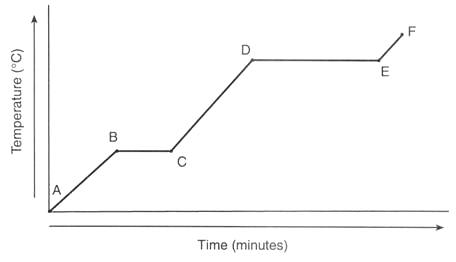
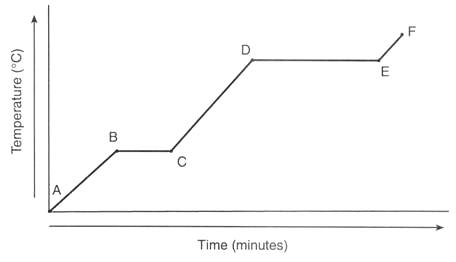


On this heating curve of water, point B is known as:
zero point
melting point
boiling point
point of no return

On this heating curve of water, point D is known as:
boiling point
freezing point
melting point
solid/liquid transition

This symbol indicates that the reaction is a ____________reaction.
reversible
completion
double displacement
synthesis
For the reaction...
SO2 + O2 ⇌ SO3
If the concentration of SO2 is increased, the equilibrium of the reaction will ___________.
shift left
shift right
not shift either direction
For the reaction...
N2 (g) + 3 H2(g) ⇌ 2 NH3 (g)
If the pressure in the system is increased, which substance(s) will increase in concentration?
N2
H2
N2 and H2
NH3
2SO2(g)+O2(g)⇌2SO3(g)
If O2(g) is removed, the reaction will
shift right
shift left
NOT shift
2SO2(g)+O2(g)⇌2SO3(g)
If SO3(g) is removed, the reaction will
shift right
shift left
NOT shift
H2(g)+Cl2(g)⇌2HCl(g)
If Cl2(g) is removed, the reaction will
shift right
shift left
NOT shift
H2(g) + Cl2(g) ⇌ 2 HCl(g) + energy
What will happen to the equilibrium if the temperature is increased?
equilibrium shifts right
equilibrium shifts left
equilibrium will NOT shift
A complete reaction is one in which
All the reactants convert into products
the reactants convert into products and the products reform into reactants.
Half reactants convert into products
A chemical reaction where the reactants form products that, in turn, react together to give the reactants back is called a
reversible reaction
irreversible reaction
decomposition reaction
completion reaction
For the reaction...
H2 (g) + Cl2 (g) ⇌ 2 HCl (g) + heat
If the temperature is cooled, the _________ reaction will be favored.
forward
reverse
forward and reverse
Le Chatelier's Principle states that:
a disturbing force must be applied to a system in order for it to reach equilibrium.
when a system at equilibrium is disturbed, a new equilibrium constant is established.
when a chemical system at equilibrium is disturbed, the system shifts in order to minimize the effect.
when a chemical system is at equilibrium it is no longer possible to alter the system.
Which symbol is used to indicate that REACTANTS are favored in a reversible reaction?



