wayground logo

Free Printable Worksheets

Font size

S
M
L
XL
Worksheets

Final Exam Review Quizziz

Total questions: 80

Worksheet time: 2hrs 2mins

Name
Class
Date
1.

A man walks 5 miles forwards, 6 miles backwards and then 2 miles forwards. What is his displacement?

a)

1 mile forward

b)

13 miles

c)

3 miles forward

d)

1 mile

2.
Displacement is distance combined with
a)
direction
b)
speed
c)
velocity
d)
magnitude
3.

The ball below moved from position 1, to position 2, and then finally to position 3. What is the ball's displacement?

a)

4 meters, left

b)

10 meters, left

c)

4 meters, right

d)

10 meters, right

4.

A runner races in the 100 meter dash. It takes her 10 seconds to finish. What is her average speed?

a)

10 m/s

b)

1000 m/s

c)

100 seconds

d)

10 seconds

5.
Dave runs a 400 m race with a speed of 4 m/s. What time will it take him to finish the race?
a)
400 minutes
b)
100 minutes
c)
100 seconds 
d)
.25 seconds 
6.
Using the graph provided, how long did it a ball to roll 30 cm?  What was the average speed of the ball?
a)
35 seconds, 1.17 cm/s
b)
30 seconds, 1 cm/s
c)
30 seconds, 1.17 cm/s
d)
35 seconds, 1 cm/s
7.

In order to find the Time, you must

a)

divide the distance by the speed (distance/speed)

b)

multiply the distance by the speed (distance/speed)

c)

Neither of the Above

8.
Determine the speed at 20 seconds based on the information shown in the graph.  Speed = distance/time
a)
2 m/s
b)
10 m/s
c)
20 m/s
d)
.5 m/s
9.
At 60 seconds, how far had this object traveled? 
a)
0 m
b)
10 m
c)
20 m
d)
40 m
10.
How many times does this object STOP moving?
a)
None
b)
Once
c)
Twice
d)
Three times
11.
A negative acceleration means that your object is _____. 
a)
not accelerating
b)
not moving
c)
speeding up 
d)
slowing down 
12.

A positive acceleration means that your object is _____.

a)

not accelerating

b)

not moving

c)

speeding up

d)

slowing down

13.
A roller coasters accelerates from an initial velocity of of 6.0 m/s to a final velocity of 70 m/s over 4 seconds.  What's the acceleration?
a)
24 m/s2
b)
18 m/s2
c)
16 m/s2
d)
16 m/s
14.
A car starts from rest at a stop light and reaches 20 m/s in 3.5 s. Determine the acceleration of the car.
a)
2.2m/s2
b)
7.0m/s2
c)
5.7m/s2
d)
70m/s2
15.

The equation for acceleration is...

a)
b)
c)
d)
16.
Determine the motion of the car.
a)
at rest 
b)
moving at constant speed
c)
speeding up
d)
slowing down
17.
Which graph demonstrates the greatest positive speed?
a)
A
b)
B
c)
C
d)
D
18.
A drag racer accelerated from 0 m/s to 200 m/s in 5 s.  What was the acceleration?
a)
0 m/s
b)
40 m/s2
c)
-40 m/s2
d)
40 m/s
19.

Acceleration is defined as

a)

the change in velocity over time

b)

the change in position over time

c)

the change in time over velocity

d)

the change in time over distance

20.

A 600kg spacecraft leaves Jupiter and travel to Earth. What is it's mass on Earth ?

a)

23 Kg

b)

23 N

c)

600Kg

d)

600 N

21.
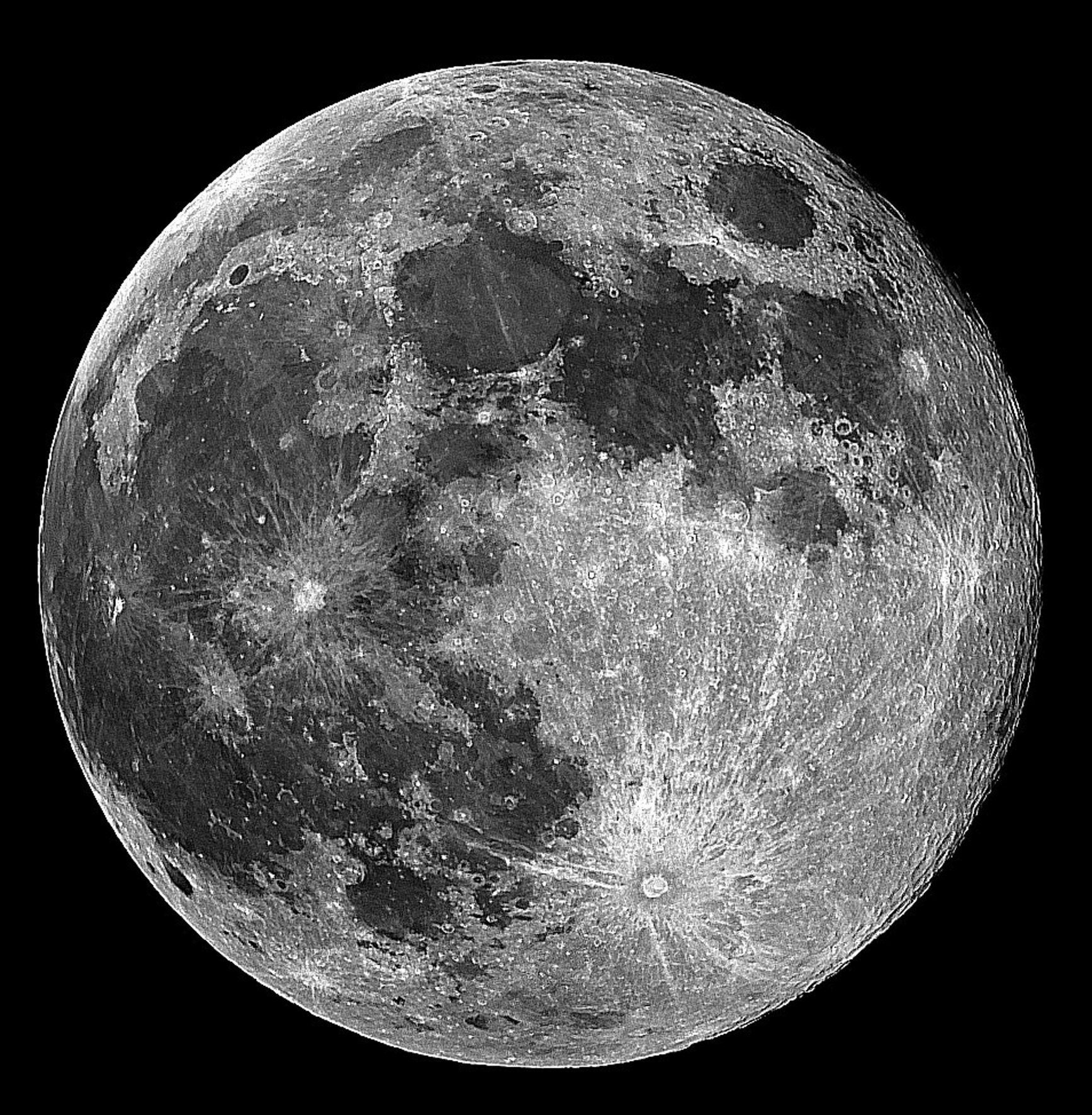
Why would you weigh less on the moon compared to Earth?
a)
less air
b)
less sunlight
c)
more gravitational pull
d)
less gravitational pull
22.

A young South African girl has a mass of 40.0 kg. What is her weight in newtons?

a)

400 N

b)

392 m/s

c)

4.08 N

d)

4.08 m/s

23.
What is the definition of "weight"?
a)
measure of the force of gravity on your body
b)
the time it takes to get on a ride 
c)
the amount of matter in an object
d)
the size of an object
24.

Gravity on Earth is equal to _____.

a)

9.8 m/s2

b)

9.8 m/s

c)

9.8 N

d)

9.8 kg

25.
What is Newton's First Law known as? The Law of
a)
Friction
b)
Mass
c)
Inertia
d)
Gravity
26.
What is Newton's First Law
a)
F=ma
b)
Every action has an equal and opposite reaction
c)
An object at rest stays at rest, an object in motion stays in motion. 
d)
Friction 
27.
The tendency of an object to resist a change in its motion
a)
acceleration
b)
inertia
c)
mass
d)
frame of reference
28.
Why is the net force 0 in the image?
a)
Because the elephants are the same size
b)
Because they are both pulling the same amount of force in opposite directions
c)
Because they are elephants
d)
Because they are pulling away from each other.
29.

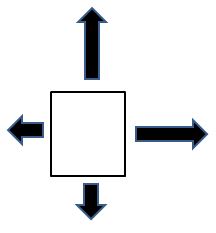
This object would be moving (pick all that are correct):

a)

up

b)

down

c)

left

d)

right

30.
8 N to the left , and 4 N to the right. Find the net force. Is this balanced? 
a)
12 N Right  No
b)
4 N Left  No
c)
12 N Right  Yes
d)
4 N Left  Yes
31.
What is the net force?
a)
5 N
b)
45 N to the left
c)
5 N to the right
d)
45 N to the right
32.

Which of the following is the best example of Newton's First Law of Motion?

a)

Jessica's body flies forward after she hits the brakes

b)

Jessica drives a car

c)

Jessica is at a road crossing

d)

Jessica is sleeping

33.
If I slowly roll a ball down the hallway, why does it eventually stop?
a)
Because of Newton's First Law
b)
Friction and Air Resistance
c)
Inertia
d)
It wouldn't stop, it would keep going until it hits a wwall.
34.
friction is a force that acts 
a)
in the same direction as the motion
b)
opposite to the direction of the motion
c)
opposite to the applied forces
d)
the same direction as the applied force
35.

Your car has a mass of 2500 kg and a force of 5000 N. How fast will it accelerate?

a)

20 m/s2

b)

2 m/s2

c)

0.5 m/s2

d)

120 N

36.

A 20 kg bike accelerates at 10 m/s2. What was the force?

a)

25 Newtons

b)

20 Newtons

c)

200 Newtons

d)

10 Newtons

37.

You push on a tree with 20 N of force. If the tree doesn't move, the tree is pushing back on you with _____of force.

a)

20N

b)

10N

c)

40N

d)

70N

38.

If an object was accelerating at 10 m/s2, and a force of 10 newtons was required to accelerate it, what was the object's mass?

a)

1kg

b)

10kg

c)

5kg

d)

2kg

39.

What is Newton's 2nd Law?

a)

F=ma

b)

Every action has an equal and opposite reaction

c)

An object at rest stays at rest, an object in motion stays in motion.

d)

Friction

40.

In the gif, the woman flops on the beanbag causing the cat to be tossed off. What would have happened if the pet was a gerbil instead

a)

The gerbil would have flown farther and faster

b)

The gerbil would have flown closer and slower
41.
If a force of 26 N is exerted on two balls, one with a mass of 0.52 kg and the other with a mass of 0.78 kg, which ball will have the greater acceleration?  (F=ma)
a)
The one with a mass of .78 kg will have the greatest acceleration.
b)
The one with a mass of .52 kg will have the greatest acceleration.
c)
They will both accelerate at the same rate.
42.
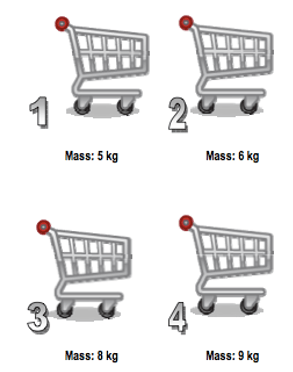
A force of 90N is applied to each cart below, which one will accelerate the fastest?
a)
Cart 1
b)
Cart 2
c)
Cart 3 
d)
Cart 4
43.
A basketball with a mass of 0.60 kg is accelerated with a force of 10.8 N. If resisting forces are ignored, what is the acceleration of the basketball to the nearest m/s2?
a)
16 m/s2
b)
17 m/s2
c)
18 m/s2
d)
19 m/s2
44.

An elevator accelerates upward at 4.0 m/s2, as illustrated in the diagram below:

The passenger has a mass of 50 kg. Calculate the force the floor exerts on the passenger.

a)

700 N

b)

0 N

c)

300 N

d)

500 N

45.

Your friend pushes you for making fun of him/her. What is the reaction force?

a)

You pushing back on your friend

b)

You pushing on the ground

c)

There is no reaction force

d)

Your friend pushing on the ground

46.

When you jump up, you push the earth downwards. Why can't you tell that the earth has moved?

a)

The force of you jumping up doesn't actually push the earth down.

b)

The earth has much more mass so it doesn't move at all

c)

The earth is firmly rooted

d)

The earth has much more mass so you can't tell that it moved

47.

When you hit a tennis ball with a racket...

a)

The ball exerts more force on the racket

b)

The ball and racket exert the same force on each other

c)

The racket exerts more force on the ball

d)

It depends on how hard you hit it

48.

How is this an example of Newton’s Third law?

a)

Only the ball is using the head

b)

They are both exerting an equal force on each other

c)

Only the head is pushing the ball

49.
For every action, there is an equal and opposite reaction.
a)
Newton's
1st
Law of Motion
b)
Newton's
2nd
Law of Motion
c)
Newton's
3rd
Law of Motion
50.
Newton's third law states that any action will have a(n) _______ and ______ reaction
a)
Equal and similar
b)
Equal and opposite
c)
Equal and different
d)
Greater and opposite
51.

A person is pushed forward into their seat belt when a car stops. Which law is this?

a)

Newton's 1st Law

b)

Newton's 2nd Law

c)

Newton's 3rd Law

52.
Which of Newton's laws are illustrated with a rocket launch?
a)
1st Law, the Law of Inertia. 
b)
2nd Law, the Law of Acceleration.
c)
3rd Law, the Law of Action Reaction
d)
The Law of Conservation of Mass
53.

When the force on a car is doubled, the acceleration is doubled.

a)

Newton's 1st Law

b)

Newton's 2nd Law

c)

Newton's 3rd Law

54.

You push against a wall and the wall is pushing back on you.

a)

Newton's 1st Law

b)

Newton's 2nd Law

c)

Newton's 3rd Law

55.

Which law best explains why more force must be applied to the bowling ball to make it accelerate at the same rate as the tennis ball.

a)

Newton's 1st Law

b)

Newton's 2nd Law

c)

Newton's 3rd Law

56.
Which one needs a greater net force to move, a kilogram of feathers or a kilogram of iron? 
a)
feathers 
b)
iron
c)
same
d)
depends on their friction
57.

If you double the mass of an object but apply the same force apply on it, the acceleration will __________________.

a)

double

b)

cut in half

c)

the same

d)

zero

58.

A car speeding up to get through a yellow traffic light is an example of .... (select all that apply)

a)

balanced Forces

b)

unbalanced Forces

c)

acceleration

59.

Two factors that determine work are...

a)

Force

b)

Mass

c)

Velocity

d)

Distance

60.

Units of force are...

a)

Newtons

b)

Grams

c)

Joules

d)

Meters

61.

Units of work are...

a)

Newtons

b)

Grams

c)

Joules

d)

Meters

62.

If you push a cart with a force of 60 N for 2 m... how much work have you done?

a)

120 J

b)

30 J

c)

120 N

d)

30 N

63.

What is the formula for work?

a)

Force = work × distance

b)

Distance = force × work

c)

Work = force × distance

d)

Work = force × mass

64.

Work is

a)

having a job

b)

movement

c)

energy transfer

d)

energy transfer to an object

65.

If the object does not move then what is happening

a)

nothing

b)

work

c)

power

d)

no work is being done on the object

66.

You are traveling along a freeway at 65 mi/h; your car has kinetic energy. You suddenly skid to a stop because of congested traffic. What happened to the kinetic energy your car just had?

a)

It is all in internal energy in the road

b)

It is all in internal energy in the tires

c)

Some of it has transformed to internal energy for the tires and the road, and some of it transferred away by sound energy and thermal energy into the air.

d)

It was destroyed

67.

In the equation PE = mgh, what does the “g” mean?

a)

Acceleration due to gravity

b)

Force of gravity

c)

Weight of the object

68.

How much power is required to raise a 200-kg crate a vertical distance of 2 m in a time of 4 s?

a)

400 W

b)

1000 W

c)

1600 W

d)

4000 W

69.
How much work is done in holding a 15 N sack of potatoes while waiting in line at the grocery store for 3 minutes?
a)
15 J
b)
45 J
c)
0 J
d)
5 J
70.

A pendulum bob swings from potential C to D as indicated in the diagram. There is no friction or air resistance. Which of the following is not true?

a)

Kinetic Energy decreases from C to D

b)

Potential Energy decreases from C to D

c)

The Total Energy stays constant from C to D.

d)

The bob is fastest at point C.

71.

A hockey puck sliding across the ice on a flat surface slows down. Why is this? 

a)

Kinetic Energy is converted in Potential Energy

b)

Kinetic Energy is converted into heat

c)

Potential Energy is converted into heat

d)

Potential Energy is converted into Kinetic Energy.

72.

Pikachu pushes a cat and does 200 J of work. If he applies a a constant force of 20 N, how far does he push the car for?

a)

180 m

b)

4000 m

c)

10 m

d)

220 m

73.

Pikachu pushes a 2 kg cat and does 200 J of work. How much kinetic energy does the cat gain?

a)

200 J

b)

400 J

c)

100 J

d)

0 J

74.
A girl on a motorbike passes by at a speed of 15 m/s. Her mass is 40 kg. What is her kinetic energy
a)
300 Joules
b)
600 Joules
c)
950 Joules
d)
4500 Joules
75.
Calculate the potential energy of a roller coaster at the top of a 72 m hill that has a mass of 112 kg.
a)
79,027 J
b)
790,720 J
c)
7,020 J
d)
790,700 J
76.
There is a bell at the top of a tower that is 45 m high. The bell has a mass of 20 kg. Calculate the potential energy of the bell. 
a)
8,820 Joules
b)
900 Joules
c)
2 Joules
d)
65 Joules
77.

What is potential energy?

a)

moving energy

b)

stored energy

c)

renewable energy

d)

non renewable energy

78.

What is kinetic energy?

a)

moving energy

b)

potential energy

c)

stored energy

d)

renewable energy

79.
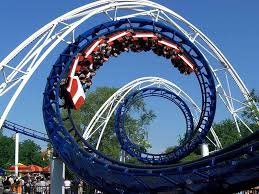
When is the potential energy the greatest in a roller coaster?
a)
a. at the bottom of the first hill
b)
b. at the top of the first hill
c)
c. at the top of the second hill
d)
d. at the bottom of the second hill
80.
After an energy conversion, you end up with the same total amount of energy as the original amount of potential energy. Which of the following laws explains this rule?
a)
a. law of energy changes
b)
b. law of conservation of energy
c)
c. law of power and energy
d)
d. law of potential energy