wayground logo

Free Printable Worksheets

Font size

S
M
L
XL
Worksheets

Electricity and Magnetism

Total questions: 92

Worksheet time: 1hrs 25mins

Name
Class
Date
1.

This device converts mechanical energy into electrical energy. It creates electricity.

a)

Electric Generator

b)

Electric Motor

c)

Electromagnet

d)

Voltmeter

2.

A material that allows the free flow of electric charges.

a)

Conductor

b)

Insulator

c)

Semiconductor

3.

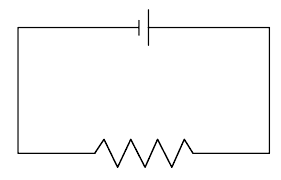
What type of circuit is shown in the picture?

a)

Series circuit

b)

Parallel circuit

c)

Open circuit

4.

In a series circuit, if one device goes out, the other devices

a)

remain on

b)

go out

5.

Describe one way you can make an electromagnet stronger.

a)

Reduce the size of the iron core

b)

Decrease the current

c)

Decrease the energy source

d)

Increase the number of loops in the wire

6.

When an electric current can travel along more than one path, it is traveling in a—

a)

Open circuit

b)

Series circuit

c)

Closed circuit

d)

Parallel circuit

7.

The magnetic field is strongest at

a)

the north pole only

b)

in the middle

c)

at both poles

d)

at the south pole only

8.

Which direction will the electricity travel?

a)

Neutral to positive

b)

Positive to negative

c)

Negative to positive

d)

Neutral to negative

9.

The buildup of charges on an object is called

a)

Current electricity

b)

Static electricity

c)

Electromagnetism

d)

Magnetic field

10.

What type of circuit is shown in the picture?

a)

parallel circuit

b)

open circuit

c)

series circuit

11.

What type of material does not allow electrons to flow easily?

a)

Semiconductor

b)

Conductor

c)

Insulator

d)

Circuit

12.

What is the effect of changing the wire in a circuit from a thick wire to a thin wire?

a)

The overloaded bulb will blow out.

b)

The bulb brightness stays the same.

c)

The bulbs become dimmer.

d)

The bulbs become brighter.

13.

What is a circuit?

a)

The buildup of electric charges

b)

A complete, closed path through which electric charges flow

c)

Opposition to the flow of charge

d)

Electric potential

14.

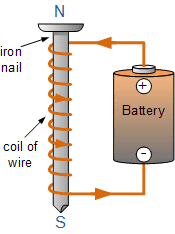
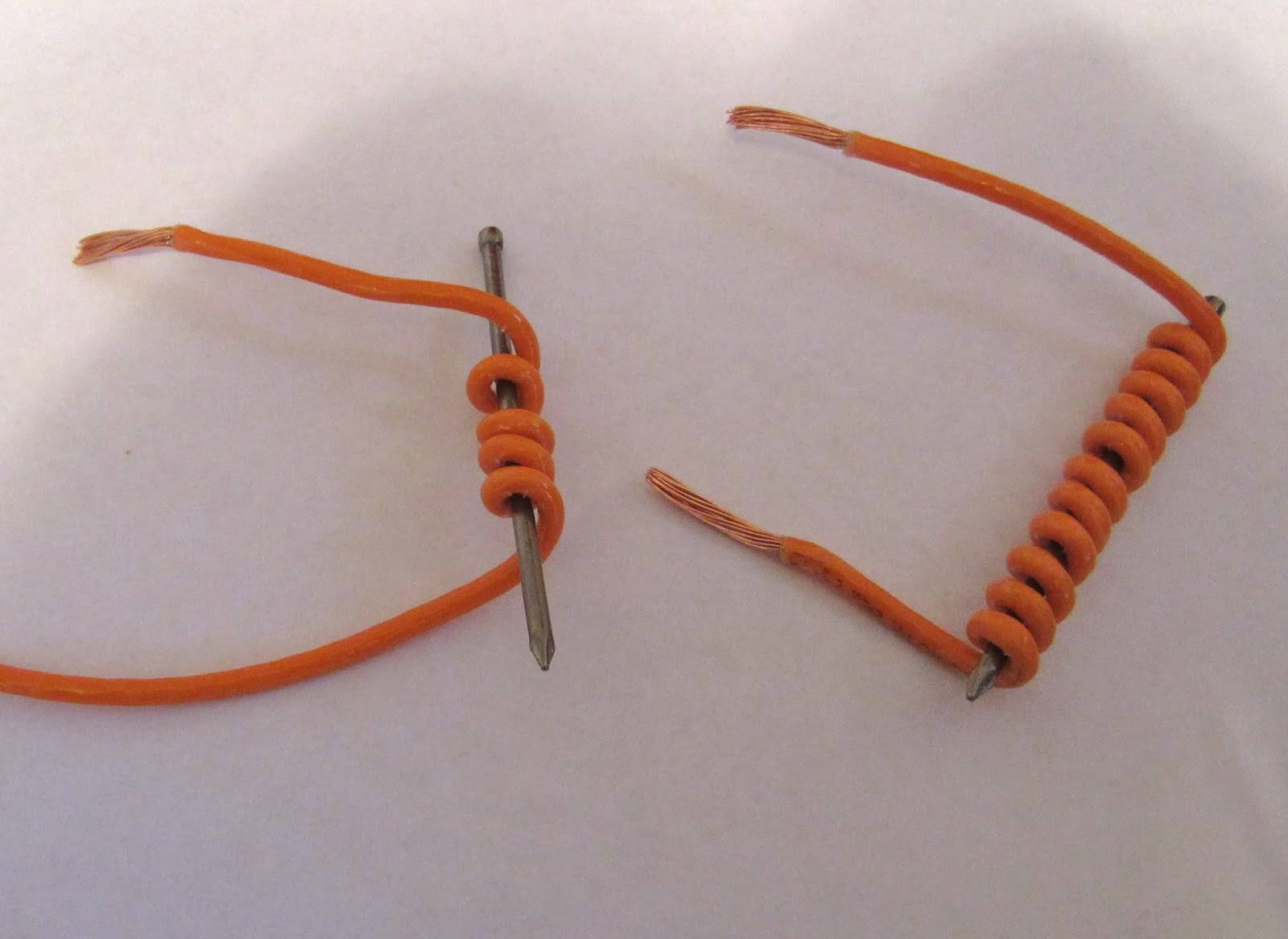
An iron nail wrapped with copper wire and attached to a battery makes —

a)

Permanent magnet

b)

Electromagnet

c)

Compass

d)

Metal magnet

15.
Does this represent attraction or repulsion?
a)
attraction
b)
repulstion
16.
Does this show attraction or repulsion? 
a)
attract
b)
repel
17.
What part of a circuit stops the current?
a)
wire
b)
switch
c)
battery
d)
light
18.
What material is a good conductor?
a)
copper
b)
wood
c)
rubber
d)
plastic
19.
What material is an insulator?
a)
coper
b)
silver
c)
gold
d)
plastic
20.
What is true about magnets?
a)
opposite poles repel
b)
opposite poles attract
c)
only the north pole picks up nails
d)
only the north pole works
21.
Which item sticks to a magnet?
a)
rubber band
b)
paper clips
c)
craft sticks
d)
plastic straws
22.
A material through which electrons can easily flow. 
a)
insulators
b)
conductors
23.
A type of circuit where each component is connected, one after the other, in a SINGLE loop. 
a)
series circuit
b)
parallel circuit
24.
The CENTER of an atom made up of protons and neutrons. 
a)
atoms
b)
electrons
c)
nucleus
d)
neutrons
25.
Name the following symbol used in the drawing of a circuit. 
a)
battery
b)
switch
c)
motor
d)
light bulb
26.
This is an example of...
a)
series circuit
b)
parallel circuit
27.
This is an example of...
a)
crazy hair
b)
static electricity
c)
lightning
d)
insulator
28.
An electric current can move along more than one path in a.....
a)
Series circuit
b)
Parallel circuit
29.

The motion of electrons is called

a)

power

b)

induction

c)

current

d)

amps

30.

A circuit with an open switch has it's switch in the ________ position

a)

On

b)

Off

31.

A device that protects a circuit by from having too much current is called a

a)

switch

b)

short

c)

fuse or breaker

d)

resistor

32.

Voltage is

a)

the potential electrical energy or push that makes electrons flow

b)

causes a short circuit with electrical energy

c)

is the term used for rate of charge flow

d)

Wastes energy by allowing current to flow

33.

the relationship between voltage, current, and resistance is called __________ Law

a)

Newton's

b)

Murphys

c)

Ohm's

d)

Faraday's

34.

A laptop is plugged into a 120 V outlet and uses 60 ohm's of resistance. How much current is running though it?

a)

120 Amps

b)

60 Amps

c)

2 Amps

d)

20 Amps

35.

A SERIES circuit has 3 light bulbs. You remove 2 of the lightbulbs from the circuit and now have a complete circuit with 1 light bulb. Will the remaining light bulb be brighter, dimmer, or stay the same?

a)

Brighter

b)

Dimmer

c)

Stay the same

36.

A current in a series circuit

a)

decreases to zero

b)

stays the same at all points

c)

is strongest in the largest resistor

d)

is weakest in the largest resistor

37.

A parallel circuit has ________ pathway(s) and a series circuit has ____________ pathway(s)

a)

multiple, a single

b)

a single, multiple

c)

multiple, multiple

d)

a single, a single

38.

A north pole of a magnet is attracted to a ...

a)

South pole of a magnet

b)

North pole of a magnet

39.

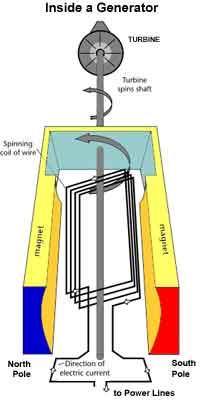
A generator converts.....

a)

Mechanical Energy to Chemical Energy

b)

Mechanical Energy to Nuclear Energy

c)

Electrical Energy to Sound Energy

d)

Mechanical Energy to Electrical Energy

40.
Generators are devices that convert _____ energy into _____ energy.
a)
chemical; mechanical
b)
mechanical; electrical
c)
electrical; mechanical
d)
potential; kinetic
41.

In a _______ a spinning turbine moves magnets which generates an electric current.

a)

Motor

b)

Generator

42.
What device is made of coils of wire with an electrical current passing through it in order to generate a magnetic field?  
a)
Electromagnet 
b)
Generator
c)
Electron Magnet 
d)
Motor
43.
What happens to the strength of an electromagnet as you add more coils around it?
a)
Increases
b)
Decreases
c)
Stays the same
d)
Stops completely
44.

What can you do to make electromagnets stronger?

a)

Increase number of coils of wire.

b)

Increase number of batteries used.

c)

Both A and B.

d)

Neither A nor B.

45.

What is produced by moving a permanent magnet through a coil of copper wire?

a)

electricity

b)

electromagnet

c)

light

d)

sound

46.
Electric motors are devices that convert _____ energy into  _____ energy.
a)
electrical; mechanical
b)
mechanical; electrical
c)
chemical; potential
d)
mechanical; kinetic
47.
When John plugs in a toy and turns it on, a marble is carried up to the top of a slide. At the top, a marble is released and it goes down a slide. What kind of energy transformation occurs to make this toy work?
a)
chemical to heat
b)
electrical to chemical
c)
sound to electrical
d)
electrical to mechanical
48.
In large generators in power plants, ___________ rotate inside a coil of wire to produce an electric current.
a)
Wind
b)
Water
c)
Magnets
d)
Circuits
49.
A coil of wire that has a soft iron core and that acts as a magnet when an electric current is in the coil is call a(n)
a)
Ferromagnet
b)
Electromagnet
c)
Permanent magnet
d)
Temporary magnet
50.

Which of the following represents the force of magnetism?

a)
b)
c)
d)
51.
What size resistor would produce a 3 Amp current flow with a 12 Volt battery
a)
1 Ohm
b)
3 Ohms
c)
4 Ohms
d)
12 Ohms
52.
What is current measured in?
a)
Ω (Ohms)
b)
V (Volts)
c)
A (Amps)
d)
W (Watts)
53.
What is resistance measured in?
a)
Ω (Ohms)
b)
V (Volts)
c)
A (Amps)
d)
W (Watts)
54.
What is Resistance?
a)
The flow of electrons
b)
Electric potential difference
c)
A battery
d)
The ability to reduce the flow of electrons
55.
Electricity that flows in a closed path is called a
a)
path
b)
current
c)
circuit
d)
light
56.
What is the Voltage of a circuit that has a resistance of 5 Ω and a current of 2 A?
a)
25 V
b)
10 V
c)
2.5 V
d)
0.4 V
57.
The mathematical relationship among Voltage, Current, and Resistance
a)
Faraday's Law
b)
Tesla's Law
c)
Edison's Law
d)
Ohm's Law
58.
Current times Resistance equals
 (I X R)
a)
Power
b)
Voltage
c)
Amperage
d)
Ohm
59.

Voltage divided by Resistance

(V / R)

a)

Current

b)

Power

c)

Ohms

d)

Watts

60.
If the Voltage is increased and the resistance stays the same, Current will
a)
Increase
b)
Decrease
c)
Stay the same
d)
X
61.
If the Voltage stays the same and Resistance is increased, Current will 
a)
Increase
b)
Decrease
c)
Stay the same
d)
X
62.
How many Volts would we need to produce a current flow of 8 Amps through a 6 Ohm resistor
a)
12 volts
b)
24 volts
c)
1.3333
d)
48 volts
63.
This circuit has a 24 volt battery and the resistor is 8 ohms. How many amps are running through the circuit?
a)
3 Amps
b)
192 Amps
c)
2 Amps
d)
4 Amps
64.
What word means how hard it is for electrons to flow through.
a)
Current
b)
Voltage
c)
Resistance
d)
Power
65.
To complete a circuit the switch must be
a)
unattached
b)
open
c)
closed
d)
It depends
66.
What size resistor would produce a 3 Amp current flow with a 12 Volt battery
a)
1 Ohm
b)
3 Ohms
c)
4 Ohms
d)
12 Ohms
67.
What would the circuit resistance be if a 7.5 Amp draw was present with the engine running and the charging system producing 15 Volts
a)
15 Ohms
b)
4 Ohms
c)
0.3333 Ohms
d)
2 Ohms
68.
What voltage is needed to cause a 2A current flow through a 10Ω resistor?
a)
5V
b)
0.2V
c)
20V
d)
200V
69.
What voltage is needed to cause a 50A current flow through a 10Ω resistor?
a)
15V
b)
500V
c)
500 kV
d)
0.2V
70.

What is the current in a circuit with 6 ohms of resistance and a battery containing 24 Volts?

a)

1/4 A

b)

144 A

c)

4 A

d)

0.4 A

71.

Solve for total Current in the circuit shown

a)

25 Amps

b)

35 amps

c)

25 milliamps

d)

35 milliamps

72.
What resistance is needed to cause a 50A current flow because of a 500V battery?
a)
10Ώ
b)
c)
2500Ώ
d)
550Ώ
73.
When distance increases, electrostatic force ____________; we call this relationship ____________ proportional
a)
decreases;directly
b)
decreases;inversely
c)
increases;inversely
d)
increases;directly
74.
What variable is a Coulomb the unit for?
a)
Charge
b)
Force
c)
Distance
d)
Mass
75.
What variable do "Newtons" represent?
a)
Electrostatic Charge
b)
Force
c)
Distance
d)
Mass
76.
What happens to the force between two charged objects if you double the distance between them and double the magnitude of one charge?
a)
4X
b)
6X
c)
1/2X
d)
1/6X
77.
If each of the charges doubles, what happens to the force?
a)
Quadruples
b)
Doubles
c)
Stays the same
d)
Reduced by half
78.
If the distance doubles, what happens to the force?
a)
Reduced by half
b)
Reduced by 1/4
c)
Stays the same
d)
Quadruples
79.
Electrostatic force F is directly proportional to:
a)
r^2 (distance squared)
b)
q1
c)
q2
d)
both q1 and q2
80.
When distance increases, electrostatic force ____________; we call this relationship ____________ proportional
a)
decreases;directly
b)
decreases;inversely
c)
increases;inversely
d)
increases;directly
81.

The graph shows the relationship between the force of interaction and the magnitude of charge. What type of relationship is this?

a)

Direct

b)

Indirect

c)

Inverse

d)

Reverse

82.

Recap:

Coulomb’s law states that the force between two charged objects will __________ when the magnitude of the object’s charge increases.

Coulomb’s law also states that the force between two charged objects will __________ when the distance between objects increases.

a)

increase; increase

b)

increase; decrease

c)

decrease; increase

d)

decrease; decrease

83.
A material in which electrons are not able to move easily 
a)
Circuit 
b)
Insulator 
c)
Resistance 
d)
Conductor
84.

The image shows two charged particles with a force of 2.4 N. What would you predict the force of interaction would be when the magnitude of charge on q2 doubles?

a)

9.6 N

b)

4.8 N

c)

1.2 N

d)

.6 N

85.

What is the total resistance of this circuit?

a)

0.18 Ω

b)

5.45 Ω

c)

60 Ω

d)

6000 Ω

86.

What is the total resistance of this circuit?

a)

0.012 Ω

b)

85.9 Ω

c)

400 Ω

d)

150 Ω

87.

What is the total resistance of this circuit?

a)

0.068 Ω

b)

14.6 Ω

c)

400 Ω

d)

200 Ω

88.

What is the total resistance of this circuit?

a)

200 Ω

b)

100 Ω

c)

0.063 Ω

d)

15.8 Ω

89.

What is the total resistance of this circuit?

a)

100 Ω

b)

200 Ω

c)

0.063 Ω

d)

15.8 Ω

90.

What is the total resistance of this circuit?

a)

25 Ω

b)

75 Ω

c)

100 Ω

d)

18.75 Ω

91.

What is the total resistance of this circuit?

a)

100 Ω

b)

1.09 Ω

c)

22.44 Ω

d)

33 Ω

92.

What is the total resistance in this circuit?

a)

2.86 Ohms

b)

32 Ohms

c)

35 Ohms

d)

0.35 Ohms