
 Worksheets
Physical Science NCFE Review
Total questions: 90
Worksheet time: 1hrs 19mins
Mass, relative density, solubility, color, texture, state of matter, conductivity, etc.
Physical state
Chemical properties
Physical Properties
Inferences


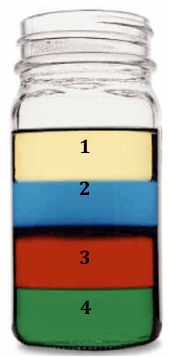
A homogeneous mixture that is cloudy/milky and shows light scattering.
colloid
suspension
solution

The chart shows the density of five gases. A gas has a volume of 4.52 L. If its mass is 8.05 g, what is the identity of the gas?
helium
neon
argon
krypton

Four different liquids will be separately poured into a single beaker. The liquids are ethanol, milk, oil, and water. The density for each liquid at room temperature is listed in the table below. How will the liquids be arranged from bottom to top in the beaker?
milk, water, oil, ethanol
milk, water, ethanol, oil
water, milk, oil, ethanol
water, oil, ethanol, milk
Which substance is most likely classified as a colloid?
soft drink
oxygen gas
water
fog

This chart lists the densities of various gemstones. A gemstone has a mass of 6.24 g and a volume of 1.98 cm3. What is the identity of the gemstone?
opal
diamond
garnet
topaz
Which situation provides the best evidence that a chemical reaction is taking place?
a metal strip bends when heated
a solution freezes in the freezer
two solutions mixed in a beaker produce a solid
a chemical completely dissolves in a water and the temperature of the solution remains constant
A teacher wants to demonstrate a chemical reaction to her students. Which activity would best demonstrate a chemical reaction?
placing a metal in an acid to create a gas
measuring the densities of liquid water and ice
melting a solid piece of aluminum
filling a balloon with helium gas
An atom has 29 protons, 29 electrons, and 35 neutrons. What is the mass number of the atom?
29
35
64
93
How many protons are there in an atom of Boron?
4
5
11
10
Which describes an atom with an atomic number of 9?
10 protons, 9 neutrons
9 protons, 10 neutrons
4 protons, 5 neutrons
3 protons, 3 neutrons

Which of the following best describes the atom shown in the Bohr diagram?
It has 6 electrons
It has a positive charge.
It has 6 valence electrons.
It has a full outermost energy level.
Which groups are the most chemically reactive?
Alkali Metals (1) & Halogens (17)
Alkali Metals (1) & Transition Metals (3-12)
Transition Metals (3-12) & Halogens (17)
Metalloids (13-15) & Noble Gases (18)
If an atom has 10 protons and 12 neutrons what is the mass number?
22
10
12
2

What do the dots on this diagram represent?
valence electrons
all electrons
protons
neutrons
How many valence electrons does Fluorine (F) have?
7
9
17
18

Which element is represented by this electron dot diagram?
boron (B)
Sulfur (S)
phosphorus (P)
bromine (Br)
Which two elements have the same number of valence electrons?
C and O
Na and Mg
Cl and F
Ga and Ge
How many valence electrons are in a neutral atom of nitrogen (N)?
2
3
5
15
Which of these elements is the most chemically reactive?
beryllium (Be)
calcium (Ca)
strontium (Sr)
radium (Ra)

This diagram represents a neutral atom of fluorine-19. Which best describes the structure of fluorine-19?
2 electrons in the first energy level; 7 electrons in the second energy level
2 electrons in the first energy level; 8 electrons in the second energy level
9 protons and 9 neutrons in the nucleus
10 protons and 9 neutrons in the nucleus
Which pair of elements has the most physical and chemical properties in common?
Ge and Se
K and Kr
Al and Ga
Ba and Bi
The three main types of nuclear radiation are alpha, beta, and gamma. Which of the following lists these types of radiation from highest penetrating power to lowest penetrating power?
alpha, gamma, beta
beta, alpha, gamma
beta, gamma, alpha
gamma, beta, alpha
Which of the following statements accurately describes alpha particles in terms of charge and mass?
Alpha particles are positively charged and less massive than beta particles.
Alpha particles are negatively charged and
less massive than beta particles.
Alpha particles are positively charged and
more massive than beta particles.
Alpha particles are negatively charged and
more massive than beta particles.
NH3 + O2 ----> NO + H2O
Mg + __HCl ---> MgCl2 + H2
Which of the following is an ionic compound:
CH4
I2
CO
LiBr
The proper formula for magnesium hydroxide:
Mg(OH)2
Mg2OH
MgOH2
Mg2OH2
Table salt (NaCl) is which type of chemical bond?
Ionic
Covalent
Metallic
What is the name of Mg(OH)2?
Magnesium Hydroxide
Magnesium Dihydride
Magnesium Dihydroxide
Magnesium Hydride
Which of the following is the correct formula for Lithium Phosphate?
Li3P
Li3PO4
Li3Po4
Li4PO
What type of bond is P4S10?
Ionic
Covalent
Both
Metallic
The ions for K and N will form what compound?
KN
K2N3
K3N
KN3
Electrons are being shared between atoms in a certain compound. Which elements could most likely form this compound?
Iron (Fe) and oxygen (O)
Sulfur (S) and chlorine (Cl)
Lithium (Li) and fluorine (F)
Aluminum (Al) and iodine (I)
Which of these elements is the most chemically reactive?
beryllium (Be)
calcium (Ca)
Strontium (Sr)
radium (Ra)

This chart shows the effects of several solutions on litmus paper. Which information can be determined from the litmus paper tests?
Solutions 1 and 5 are both acids.
Solutions 2 and 8 are both neutral.
Solutions 3 and 6 are both bases.
Solutions 4 and 7 are both acids.
A jogger travels 5000 m in 1200 seconds. Calculate the jogger’s average speed in m/s. Choose correct formula:
v = d/t or a = vf - vi /t
0.24 m/s
3,800 m/s
3.17 m/s
4.17 m/s
A car starts from a stoplight and is traveling with a velocity of 10 m/sec east in 20 seconds. What is the acceleration of the car? Choose correct formula:
v = d/t or a = vf - vi /t
-0.5 m/s2
0.5 m/s2
2 m/s2
200 m/s2

This graph represents the motion of a cart. How does the speed of the cart compare when t = 6 s and t = 12 s?
The speed of the cart at 6 s is greater than when time equals 12 s.
The speed of the cart at 6 s is less than when time equals 12 s.
The speed of the cart is 2 m/s at 6 s and 12 s.
The speed of the cart os 0.5 m/s at 6 s and 12 s
A ball at rest is dropped and hits the ground in 1.5 s with a final speed of 15 m/s. How would the acceleration and final speed of the ball be affected if it were dropped from a greater height on Earth? (Ignore friction.)
Its final speed would remain the same because its rate of acceleration would remain the same.
Its final speed would increase because its rate of acceleration would remain the same.
Its final speed would remain the same because its rate of acceleration would decrease.
Its final speed would increase because its rate of acceleration would increase.

The graph represents the motion of a cart. What is the average speed of the cart?
0.83 m/s
1.17 m/s
5 m/s
65 m/s
Why does the weight of an object change with increasing elevation on Earth?
The mass of the object decreases with higher elevation.
The force of gravity acting on the object increases with higher elevation.
The force of gravity acting on the object decreases with higher elevation.
The mass of the object increases with higher elevation.

The diagram shows a board on top of two bricks with a cylinder on top of the board. The board exerts an upward force of 50 N. Which best explains this situation?
The board has a weight of 50 N
The cylinder has a weight of 50 N
The combined weight of the two bricks is 50 N
The combined weight of the bricks, board, and cylinder is 50 N
A 100 kg student kicks a 1.4 kg ball with a force of 450 N. What force does that ball apply on the student?
4.5 N
300 N
450 N
675 N
A large rock has a mass of 750 kg. What is its weight?
76.5 N
740.2 N
759.8 N
7,350 N

This diagram shows a 40-kg object being pulled in one direction while friction acts on it in the opposite direction? What is the net force on the object?
160 N
140 N
120 N
20 N
A 1,500-kg truck has a net force of 4,200 N acting on it. What is the truck’s acceleration?
6,300,000 m/s/s
2,700 m/s/s
2.8 m/s/s
0.36 m/s/s
Why does a student’s hand feel cold when holding an ice cube?
Heat flows from the ice cube to the hand.
Heat flows from the hand to the ice cube.
Cold flows from the hand to the ice cube.
Cold flows from the ice cube to the hand.
Which describes the kinetic energy of a ball in free fall?
The kinetic energy remains the same while the velocity increases.
The kinetic energy decreases because the velocity increases.
The kinetic energy increases because the velocity increases.
The kinetic energy remains the same while the velocity decreases.
It takes 6.0 seconds for a pulley system to lift a crate weighing 300. N to a height of 5.0 meters. How much power is required to life the crate?
360 W
250 W
10 W
0.1 W
An object has a mass of 12.8 kg and a velocity of 8.4 m/s. What is the kinetic energy of the object?
53.8 J
107.5 J
451.6 J
903.2 J
Calculate the KE of a moving 4 kilogram object traveling at a velocity of 3 m/s. KE=21mv2
18 J
36 J
24 J
48 J

Where would this tossed baseball have the least amount of kinetic energy?
point W
point X
point y
point z
Where would this tossed baseball have the greatest amount of kinetic energy?
point W
point X
point y
point z
A ball with a mass of 5 kg is dropped from a resting position of 10 m above the ground. What is the potential energy of the ball just before it is dropped?
0J
49J
98J
490J
A 5000N block is lifted 10 m. How much work was done? (W=Fxd)
50000 J
5000 J
500 J
50 J
How much power is required to do 180 J in 2.4 s? P=W/t
7.5 W
178W
75 W
430 W
How do radio waves and visible light waves differ?
Radio waves have a shorter wavelength than visible light waves.
Radio waves move faster than visible light waves.
Radio waves have a lower frequency than visible light waves.
Radio waves have more energy than visible light waves.
If the velocity of a sound wave remains constant and its frequency increases, which characteristic of the wave will decrease?
amplitude
wavelength
energy
speed

How does the energy of ultraviolet radiation compare to the energy of microwaves?
Ultraviolet radiation has less energy than microwaves, because ultraviolet radiation has a lower frequency.
Ultraviolet radiation has more energy than microwaves, because ultraviolet radiation has a higher frequency.
Microwaves have less energy than ultraviolet radiation, because microwaves have shorter wavelengths.
Microwaves have more energy than ultraviolet radiation, because microwaves have longer wavelengths.
If a wave has a frequency of 0.4 Hz and a wavelength of 15 m, what is its velocity?
0.2 m/s
6.0 m/s
38 m/s
60 m/s
Which is true of infrared waves?
They have shorter wavelengths than X-rays
They give off more energy than gamma rays
They have longer wavelengths than ultraviolet waves
They have higher frequencies than visible light waves
A flashlight bulb connected to a 6 V battery draws 0.5 A current. What is the power used by the flashlight?
1.25 W
3 W
6.5 W
12 W

This diagram represents a closed circuit with three light bulbs and a 10-volt battery. If bulb 3 burns out in the circuit, what will most likely happen?
bulb 1 and bulb 2 will continue to glow
bulb 1 and bulb 2 will not glow as brightly
bulb 1 will glow but bulb 2 will not glow
bulb 1 and bulb 2 will not glow
A series circuit has a current of 3 A. The circuit contains a 12 Ω resistor. What is the voltage of the circuit?
0.25 V
4 V
15 V
36 V

This diagram represents a closed circuit. How much current flows through this circuit?
0.5 A
2 A
18 A
72 A
How does a step-down transformer alter the amount of voltage from a power line to a building?
It increases output voltage by increasing the number of wire turns in the secondary coil
It decreases output voltage by decreasing the number of turns in the secondary coil.
It increases output voltage by decreasing the number of wire turns in the secondary coil.
It decreases output voltage by increasing the number of turns in the secondary coil.
How would decreasing the diameter of the wires in a circuit influence the resistance and flow of electrons in the circuit?
It would decrease the resistance, causing fewer electrons to flow through the circuit.
It would increase the resistance, causing fewer electrons to flow through the circuit.
It would decrease the resistance by allowing more electrons to flow through the circuit.
It would increase the resistance by allowing more electrons to flow through the circuit.
A copper wire is connected across a constant voltage source. Which change will cause an increase in the current flowing through the wire?
an increase in the length of the wire
an increase in the resistance of the wire
an increase in the diameter of the wire
an increase in the insulation around the wire
What makes an electromagnet stronger?
greater number of loops
smaller number of loops
decreasing the current
decreasing the voltage

Which diagram correctly shows how electrically charged balls will act?


This diagram represents a closed circuit with three light bulbs and a 10-volt battery. If bulb 3 burns out in the circuit, what will most likely happen?
bulb 1 and bulb 2 will continue to glow
bulb 1 and bulb 2 will not glow as brightly
bulb 1 will glow but bulb 2 will not glow
bulb 1 and bulb 2 will not glow

