
 Worksheets
Unit 4 Test Review: Properties of Matter and Bonds
Total questions: 87
Worksheet time: 2hrs 50mins
(a) properties change the composition of the substance.

Reactivity is what type of property?
Physical
Chemical
How tightly packed matter is in an object.
Volume
Density
Mass
Mixture



Color is what type of property?
Physical
Chemical
Properties of matter that can be measured or observed without changing the basic nature of the matter.
Chemical properties
property
matter
Physical properties
A characteristic or quality
material
matter
property
solid
Anything that takes up space and has mass
property
matter
solid
liquid


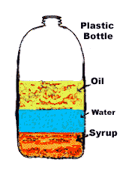


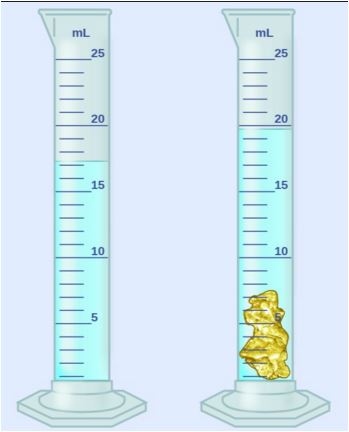
Find the volume if a substance has a density of 19.3g/cm3 and a mass of 10g.
.52cm3
193cm3
1.93cm3
29.3cm3


Which diagram shows the MOST dense object?
left
center
right

The density of a material is 2 g/cm3. The volume is 24 cm3 . What is the mass?

A wood block is cut in half. Answer the following questions :
a) What happens to its volume?
b) What happens to its mass?
c) What happens to its density (calculate the density before and after cutting)
Which of the following properties of an object DOES NOT CHANGE if you cut it in three equal parts?
its mass
its volume
its density
its weight
263.5 g/cm3
2.804 g

Use the density chart to identify the substance. If the substance has a volume of 5 cm3 and a mass of 52.5.
lead
aluminum
silver
water
Which substance has the weakest intermolecular forces [IMF]?
Substance A, boiling point of 75 °C
Substance C, boiling point of 25 °C
Substance B, boiling point of 105 °C
Substance d, boiling point of 45 °C
Melting and boiling points depend on thermal energy and the strength of ________
intramolecular forces
intermolecular forces
polar covalent bonds
metallic bonds
intramolecular forces are
within molecules
between molecules
among molecules
not related to molecules
Intermolecular forces are
chemical bonds within molecules
forces of attraction between molecules
forces of attractions within a molecule

What type of force?
intermolecular
intramolecular

What type of force?
intermolecular
intramolecular

What type of bond/force?
intramolecular force
intermolecular force
ionic bond
covalent bond

Based on the table, which substance has the strongest intermolecular forces?
Sample 1
Sample 2
Sample 3
Sample 4
Which is stronger: Inter or Intra molecular forces?
Intra because they are inside
Inter because they are inside
Intra because they are between
Inter because they are between
If a compound has a HIGH melting point, it will have _____ forces.
Stronger
Weaker
Strength doesn't matter for melting point
Inter-molecular Forces are _______ molecules
within
between
The mass of the NaCl sample is 20 g
Physical Property
Chemical Property
Copper conducts electricity
Physical Property
Chemical Property
Baking soda reacts with vinegar
Physical Property
Chemical Property
Which type of bond is formed from the sharing of electrons?
ionic bond
covalent bond
Ionic compounds are usually formed from _____.
two nonmetals.
a metal and a nonmetal.
two metals.
Which of the following is NOT TRUE about covalent compounds?
They have low melting and boiling points.
They are formed from 2 nonmetals.
They can conduct electricity when dissolved in water (aqueous).
Compounds composed of a ______________ and _____________ like the compound CaCl2 , are ionic compounds.
metal ... metal
nonmetal ... nonmetal
metal ... nonmetal

What property is describing an ionic compound?
shares electrons
high melting point
weak bonds
made up of nonmetals.
When dissolved in water, the solution is a good conductor of electricity.
ionic compounds
covalent compounds
When dissolved in water, the solution does NOT conduct electricity.
ionic compounds
covalent compounds
Viscosity can be described as...
a physical property of liquids
a physical property of solids
a chemical property of liquids
High viscosity can be described as...
a liquid that flows quickly
a liquid that flows slowly
What is Viscosity?
A fluids colour.
A fluids temperature.
A fluids resistance to flow.
Which of these factors affects Viscosity?
Temperature
Colour
Taste
A substance that flows quickly has __________.
low viscosity
high viscosity
Liquids with very low viscosity ,flow very _______________________.
fast
not at all
slow
whenever it wants
strong intermolecular forces
weak intermolecular forces

