wayground logo

Free Printable Worksheets

Font size

S
M
L
XL
Worksheets

Atomic History & Nuclear Reactions

Total questions: 88

Worksheet time: 1hrs 13mins

Name
Class
Date
1.
In the symbol 20682Pb what does 206 stand for?
a)
Mass number
b)
Atomic number
c)
Atomic mass
d)
Number of protons
2.
The process of the production of lighter nuclei from heavier nuclei is called
a)
mass energy
b)
magneticism
c)
fusion
d)
fission
3.
When a nucleus undergoes nuclear decay by gamma rays, the atomic number of the element....
a)
remains the same
b)
  decreases by one.
c)
increases by one.
d)
increases by two.
4.
The process of the production of lighter nuclei from heavier nuclei is called
a)
mass energy
b)
magneticism
c)
fusion
d)
fission
5.
A helium nucleus with two protons and two neutrons is called a(n) ____.  
a)
alpha particle
b)
electroscope
c)
beta particle
d)
gamma ray
6.
The splitting of a nucleus into smaller nuclei is
a)
fusion
b)
fission
c)
decay
d)
gamma radiation
7.
Two or more nuclei combine to form one larger nucleus in the process of nuclear _____.
a)
Fusion
b)
Fission
c)
Tracing
d)
Decay
8.
In the equation,  146C --> 147N + 0-1B, the _______ decay of radioactive carbon-14 results in the creation of a new nitrogen-14 atom.
a)
Radioactive
b)
Beta
c)
Alpha
9.
Solve this equation for beta decay.
2760Co = ___ + -10e
a)
2556Mn
b)
2860Ni
c)
2358V
d)
2759Co
10.
Solve this equation for beta decay.
614C = ___ + -10e
a)
410Be
b)
714N
c)
210He
d)
613C
11.

What is the symbol for an alpha particle?

a)

42He

b)

0-1e

c)

0+1 e

d)

10n

12.
Solve this equation for alpha decay.
85209At = ___ + 24He
a)
83205Bi
b)
86209Rn
c)
81207Tl
d)
85208At
13.
Solve this equation for alpha decay.
88226Ra = ___ + 24He
a)
86222Rn
b)
89226Ac
c)
84224Po
d)
88225Ra
14.
Gamma rays have a _____ charge
a)
0
b)
+1
c)
-1
d)
+2
15.
Balance the following equation:
146C --> 0-1e + ________
a)
145B
b)
146C
c)
147N
d)
42He
16.
If Gadolinium-150 goes through alpha decay, the resulting element has a new atomic mass of _____.
a)
150
b)
148
c)
146
17.

If we start off with element 5024X after an gamma decay we get an element(product) that looks like...

a)

5124X

b)

5023X

c)

5024X

d)

5025X

18.
What makes something radioactive?
a)
elements with an atomic number above 81
b)
an unstable nucleus
c)
contaminated sewage
d)
It decays over time
19.

A radioactive nuclide has a ____ stable nucleus than a non-radioactive nucleus of the same element.

a)

more

b)

less

c)

identical

d)

small

20.
Has a mass of 4 and a charge of +2
a)
Alpha
b)
Beta
c)
Gamma
21.
Has the symbol
a)
Alpha
b)
Beta 
c)
Gamma
22.
This is the symbol for a(n)
a)
alpha particle
b)
beta particle
c)
gamma particle
23.
Takes two small nuclei and combines them into a larger nucleus
a)
fission
b)
fusion
24.
The splitting of a nucleus into smaller nuclei is
a)
fusion
b)
fission
c)
half-life
d)
gamma radiation
25.
How is nuclear fusion different from nuclear fission?
a)
In fusion, the product is a larger atomic nucleus.
b)
Fission produces energy but fusion does not.
c)
Fusion produces energy but fission does not.
d)
In fission, the product is a larger atomic nucleus.
26.
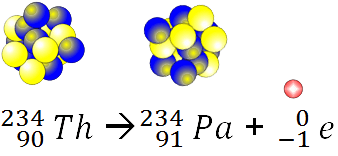
Which type of nuclear radiation is being emitted here?
a)
Alpha
b)
beta
c)
gamma 
d)
none
27.
This is an example of ---
a)
Radioactive Decay
b)
Nuclear Fission
c)
Nuclear Fusion
d)
Fossil fuel reaction
28.
Which type of nuclear radiation is being emitted here?
a)
alpha
b)
beta
c)
gamma
d)
none
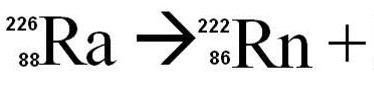
29.
What particle completes this reaction?
a)
alpha particle
b)
beta particle
c)
gamma particle
d)
neutron
30.

Why does alpha decay occur?

a)

The nucleus is too large to be stable

b)

The proton to neutron ratio is unstable

c)

The nucleus is in an excited state. This usually follows other types of decay.

31.

Why does beta decay occur?

a)

The nucleus is too large to be stable

b)

The proton to neutron ratio is unstable

c)

The nucleus is in an excited state. This usually follows other types of decay.

32.

Why does gamma decay occur?

a)

The nucleus is too large to be stable

b)

The proton to neutron ratio is unstable

c)

The nucleus is in an excited state. This usually follows other types of decay.

33.

Which scientist was the first person responsible for proposing the idea of atoms?

a)

Democritus

b)

John Dalton

c)

Ernest Rutherford

d)

J.J. Thomson

e)

Niels Bohr

34.

Which scientist was the first person responsible for proposing the discovery of the electron?

a)

Democritus

b)

John Dalton

c)

Ernest Rutherford

d)

J.J. Thomson

e)

Niels Bohr

35.

Which scientist was the first person responsible for proposing the discovery of the nucleus?

a)

Democritus

b)

John Dalton

c)

Ernest Rutherford

d)

J.J. Thomson

e)

Niels Bohr

36.

Which scientist claimed that the atom was a small, dense, solid sphere?

a)

Democritus

b)

John Dalton

c)

Ernest Rutherford

d)

J.J. Thomson

e)

Niels Bohr

37.

Which scientist's model is referred to as the Plum Pudding Model?

a)

Democritus

b)

John Dalton

c)

Ernest Rutherford

d)

J.J. Thomson

e)

Niels Bohr

38.

Which scientist's model is referred to as the Planetary model?

a)

Democritus

b)

John Dalton

c)

Ernest Rutherford

d)

J.J. Thomson

e)

Niels Bohr

39.

Which scientist proposed the idea that the electrons orbited the nucleus on fixed paths with designated energies?

a)

Democritus

b)

John Dalton

c)

Ernest Rutherford

d)

J.J. Thomson

e)

Niels Bohr

40.

Which scientist proposed that the atom was indivisible using the word "atomos"?

a)

Democritus

b)

John Dalton

c)

Ernest Rutherford

d)

J.J. Thomson

e)

Niels Bohr

41.

Which model of the atom is the most up to date model?

a)

The Billiard Ball Model

b)

The Plum Pudding Model

c)

The Planetary Model

d)

The Wave Mechanical Model

e)

The Nuclear Model

42.

Which model of the atom describes the location of electrons as probable within a dense "cloud" surrounding the nucleus of an atom?

a)

The Billiard Ball Model

b)

The Plum Pudding Model

c)

The Planetary Model

d)

The Wave Mechanical Model

e)

The Nuclear Model

43.

Which scientist claimed that compounds consist of atoms in a fixed ratio?

a)

Democritus

b)

John Dalton

c)

Ernest Rutherford

d)

J.J. Thomson

e)

Niels Bohr

44.

Which scientist performed the Cathode Ray Experiment?

a)

Democritus

b)

John Dalton

c)

Ernest Rutherford

d)

J.J. Thomson

e)

Niels Bohr

45.

Which scientist performed the Gold Foil Experiment??

a)

Democritus

b)

John Dalton

c)

Ernest Rutherford

d)

J.J. Thomson

e)

Niels Bohr

46.

Showed the atom was mostly empty space, and that the nucleus was small, dense, and positively charged.

a)

Rutherford

b)

Thomson

c)

Bohr

d)

Democritus

47.

The area of probability of finding an electron.

a)

Alpha

b)

Orbital

c)

Cathode

d)

Nucleus

48.

Who discovered that the atom had an small, dense, positively charged center?

a)

Ernest Rutherford

b)

J.J Thomson

c)

Robert Millikan

d)

John Dalton

49.
What can you conclude from the fact that scientists continue to update the atomic model?
a)
New information about atoms continues to be discovered
b)
Old information about atoms is completely useless
c)
Scientists did not have any information about atoms until a few years ago
d)
Scientists still have no idea what atoms look like
50.

Who named the positive center of the atom the "nucleus?"

a)

Democritus

b)

Dalton

c)

Thomson

d)

Rutherford

51.

Which scientist discovered that the atom has parts - which means it can be divided?

a)

Democritus

b)

Dalton

c)

Thomson

d)

Rutherford

52.

In the atomic model nicknamed the "plum pudding" model, what do the plums represent?

a)

the nucleus

b)

the atom

c)

the electrons

d)

the positive material

53.
Subatomic particles with a positive charge
a)
neutrons
b)
atomic mass
c)
protons
d)
isotopes
54.
A tiny but very dense, positively charged portion of the atom that holds most of the atomic mass
a)
Electron Shells
b)
Orbitals
c)
Electron Cloud
d)
Nucleus
55.
Discovered the electron within the atom
a)
Thomson
b)
Chadwick 
c)
Schrodinger & Heisenberg
d)
Dalton
56.
Discovered the nucleus of the atom through the Gold Foil Experiment
a)
Rutherford
b)
Chadwick
c)
Thomson
d)
Dalton
57.
Created the Planetary Model of the atom
a)
Bohr
b)
Dalton
c)
Rutherford
d)
Chadwick
58.

Calculation used to find the number of neutrons in an atom

a)

Mass Number - Atomic Number

b)

Atomic Number - Atomic Mass

c)

Atomic Mass - Electrons

d)

none of these

59.
These particles have a mass of 1 amu
a)
protons and neutrons
b)
protons and electrons
c)
neutrons and electrons
60.
What subatomic particles are located in the electron cloud?
a)
quarks
b)
protons
c)
electrons
d)
neutrons
61.
Which is an electron?
a)
A
b)
B
c)
C
62.
Which item on this element square is the chemical symbol?
a)
Copper
b)
29
c)
Cu
d)
63.546
63.
What is the number of protons that the element in this image contain?
a)
14
b)
7
c)
15
d)
18
64.
An atom of the element with atomic number 6 always has _____.
a)
six protons in its nucleus
b)
an atomic mass of six
c)
more than six neutrons
d)
six electron clouds
65.
What are subatomic particles? 
a)
the nucleus 
b)
electron cloud
c)
positive charge
d)
electrons, protons, and neutrons
66.
How many protons does an atom with an atomic number of 28 and a mass number of 40 have?
a)
28
b)
68
c)
12
d)
40
67.
The following element has _______________ neutrons.
a)
15
b)
16
c)
31
d)
46
68.
The Bohr model below depicts which element?
a)
Scandium
b)
Titanium
c)
Calcium
d)
Potassium
69.
The following picture represents which atomic model?
a)
JJ Thomson
b)
John Dalton
c)
Ernest Rutherford
d)
Schrodinger & Heisenberg
70.
The following picture represents which atomic model?
a)
Niels Bohr
b)
Democritus
c)
Schrodinger & Heisenberg
d)
JJ Thomson
71.

Who was the Greek philosopher who called the smallest particle of matter as "atom"?

a)

Democritus

b)

Aristotle

c)

J.J Thompson

d)

Einstein

72.
Subatomic particles that are neutral in charge
a)
Neutrons
b)
Protons
c)
Nucleus 
d)
Electrons
73.

The conversion of atoms of one element to atoms of another is known as ____________ .

a)

transmutation

b)

transuranium

c)

quark

d)

fission

74.

How do scientists perform transmutations?

a)

by bombarding atomic protons with high energy particles.

b)

by bombarding atomic nuclei with high energy particles.

c)

by splitting atoms and adding protons.

d)

by splitting electrons to release their energy.

75.

The conversion of atoms of one element to atoms of another is known as ____________ .

a)

transmutation

b)

transuranium

c)

quark

d)

fission

76.

A transmutation reaction changing one element in to another element must always involve a(n) ___________ .

a)

decrease in the number of neutrons

b)

increase in the number of neutrons

c)

change in the number of electrons

d)

change in the number of protons

77.

What are the two types of transmutation?

a)

Artificial and natural

b)

Gamma and beta

c)

Gamma and alpha

d)

Alpha and beta radiation

78.

How is the alpha particle written in a nuclear equation?

a)

42He

b)

24He

c)

0-1e

d)

00γ

79.
What particle completes this reaction?
a)
alpha particle
b)
beta particle
c)
gamma particle
d)
neutron
80.
Complete the nuclear equation and determine the type of decay that is occurring in this reaction. 
a)
alpha
b)
beta
c)
gamma
d)
none
81.
What is the missing isotope that will balance the following nuclear equation?
94Be  +  11H →  _____  +  42He
a)
105B
b)
105Ne
c)
63Li
d)
63C
82.

Transmutations occur through natural spontaneous nuclear decay or artificially created transmutations.

a)

True

b)

False

83.

Artificial transmutations are performed by

a)

bombarding atomic nuclei with electrons.

b)

bombarding atomic nuclei with high energy protons, neutrons, or alpha particles.

c)

combining radioactive elements in a chemical reaction.

d)

Removing valence electrons from elements to create an ionic bond.

84.

Elements with atomic numbers greater than ____ are called _____________ elements.

a)

92

b)

90

c)

Transmutational

d)

Transuranium

85.

All transuranium elements are radioactive.

a)

True

b)

False

86.

Most often transmutations will not occur unless the bombarding particles are moving at

a)

Slow speeds.

b)

Moderate speeds.

c)

Extremely high speeds.

d)

Transmutations occur when bombarded with high energy particles at any speed.

87.

In particle accelerators, charged particles can be accelerated to speeds very close to the speed of light.

a)

True

b)

False

88.

In the current model of the atom, protons and neutrons are made up of even smaller particles called ___________ .

a)

Quacks

b)

Quarks

c)

Quecks

d)

Quicks