wayground logo

Free Printable Worksheets

Font size

S
M
L
XL
Worksheets

Unit 1 Matter Review

Total questions: 90

Worksheet time: 1hrs 10mins

Name
Class
Date
1.

A student leaves a bowl of ice cream on a table, where it turns to a liquid. The student places the liquid ice cream back into the freezer overnight. How do the motion of the particles in the ice cream change when it is placed in the freezer?

a)

the particles slow down and move closer together

b)

the particles speed up and move closer together

c)

The particles slow down and move farther apart

d)

the particles speed up and move farther apart

2.

Which statement best describes a gas?

a)

a gas has particles that are close together but can slide past one another

b)

a gas has particles that have large distances between them and move freely

c)

a gas has particles that are close together but move freely

d)

a gas has particles that have not space between them and do not move

3.

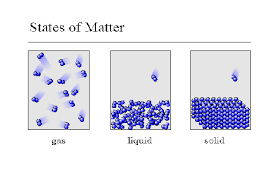
A student sketches the particles of a particular substance in the three states of matter. Which state of matter is shown by each sketch.

a)

A is solid, B is liquid, and C is gas

b)

A is gas, B is solid, and C is liquid

c)

A is liquid, B is gas, and C is solid

d)

A is liquid, B is solid, and C is gas

4.

The diagram shows the particle vibration of an unknown substance in a container. Which substance can likely be represented by the motion of the particles in the diagram?

a)

ice

b)

oil

c)

water

d)

water vapor

5.

A substance changed from one state to another. The image shows its particle motion in the first state and the second state. How is the transition between State 1 and State 2 best described?

a)

solid state to liquid state

b)

liquid state to solid state

c)

liquid state to gaseous state

d)

gaseous state to solid state

6.

Which grouping of the three phases of chlorine is listed in order from left to right for decreasing distance between chlorine molecules?

a)

gas, liquid, solid

b)

solid, liquid, gas

c)

liquid, gas, solid

d)

gas, solid, liquid

7.

When a chemical change occurs, the substances you start and finish with have

a)

the same chemical properties

b)

different chemical properties

8.

The amount of MATTER in an object is called _____________.

a)

volume

b)

density

c)

cubic

d)

mass

9.

Baking a cake is an example of a _______________ change.

a)

physical

b)

chemical

c)

mechanical

d)

dense

10.
A solid has a definite volume and shape.
a)
True
b)
False
11.
A physical property can be measured without changing the identity of the substance.
a)
True
b)
False
12.
One chemical property that can be measured in a substance is its reactivity with water. What is another chemical property?
a)
density
b)
flammability
c)
malleability
d)
solubility
13.
Matter is made up of particles. Which of the following statements is true about these particles.
a)
The particles that make up solids do not move.
b)
The particles that make up liquids do not move.
c)
The particles that make up all matter are constantly in motion.
d)
Only the particles that make up gases are constantly in motion.
14.
Which of the following statements describes a liquid?
a)
A liquid has both a definite shape and a definite volume.
b)
A liquid has neither a definite shape nor a definite volume
c)
A liquid has a definite shape but not a definite volume.
d)
A liquid has a definite volume but not a definite shape.
15.
A beaker containing a certain substance has heat applied to it. The particles that make up the substance begin to move farther apart from each other. What change of state could be occurring to the substance in the beaker?
a)
The substance is changing from a gas to a liquid.
b)
The substance is changing from a gas to a solid.
c)
The substance is changing from a liquid to a solid.
d)
The substance is changing from a liquid to a gas.
16.
The law of conservation of mass states that mass cannot be created or destroyed. To what type of change does this law apply?
a)
physical changes only
b)
chemical changes only
c)
both physical and chemical changes
d)
only mass that is not undergoing change
17.
A beaker containing ice and water is placed on a warm hotplate. Will the ice in the beaker undergo a physical or chemical change?
a)
a physical change because it will change state
b)
a chemical change because it will change state
c)
a physical change because it will form a new substance
d)
a chemical change because it will form a new substance
18.
Evaporation is the change of state from a gas to a liquid.
a)
True
b)
False
19.
A physical property can be measured without changing the identity of the substance.
a)
True
b)
False
20.
One chemical property that can be measured in a substance is its reactivity with water. What is another chemical property?
a)
density
b)
flammability
c)
malleability
d)
solubility
21.
a)

a

b)

b

c)

c

d)

d

22.

Liquid to solid is

a)

freezing

b)

Melting

c)

Boiling

d)

Steaming

23.

Solid to a liquid is

a)

freezing

b)

boiling

c)

steaming

d)

melting

24.

Solid to Gas is

a)

condensation

b)

sublimation

c)

evaporation

d)

deposition

25.

Gas to liquid is

a)

Condensation

b)

sublimation

c)

deposition

d)

evaporation

26.

Boiling is....

a)

liquid rapidly changes to a gas

b)

solid rapidly changes to a gas

c)

gas rapidly changes to a liquid

d)

solid rapidly changes to a liquid

27.
At higher temperatures
a)
particles in an object have less energy
b)
particles in an object move faster
c)
a gas contracts
28.

Particles in a ______________________ move quickly and are far apart.

a)

gas

b)

solid

c)

liquid

29.

Particles of a liquid

a)

are tightly packed together and stay in a fixed position.

b)

are free to move around one another but still touch.

30.

When a substance is heated, particles will

a)

Move further apart

b)

Get larger

c)

Move closer together

d)

Be unaffected

31.
What term describes a solid changing to a gas?
a)
Deposition
b)
Sublimation
c)
Evaporation
d)
Freezing
32.
What do you get when you join any atoms together? 
a)
a molecule
b)
a bigger atom
33.
What is dry ice?
a)
the liquid form of carbon dioxide
b)
the solid form of carbon dioxide
34.
Molecules move most quickly in a ...
a)
solid
b)
gas
35.
Molecules vibrate the slowest in a ...
a)
solid
b)
gas
36.
The 3 State of Matter are?
a)
Idaho, Texas, and Florida
b)
Matter, Mass, and Weight
c)
Solids, Liquids, and Gas
d)
Steel, Copper, and Brass
37.

A characteristic of a type of matter that can be observed or measured

a)

Description

b)

Physical Property

c)

Investigation

38.

A physical property that describes how hot or cold an object is

a)

Mass

b)

Volume

c)

Temperature

d)

Texture

39.

How an object feels

a)

Texture

b)

Color

c)

Shape

d)

Volume

40.

Measurable physical properties

a)

Temperature, Mass, Texture, Volume

b)

Temperature, Mass, Volume, Length

c)

Mass, Texture, Color, Length

41.

Observable Physical Properties of Matter

a)

Volume, Temperature, Mass, Length

b)

Volume, Color, Texture, Mass

c)

Color, Texture, Sink or Float, Mass

d)

State of Matter, Sink or Float, Color, Texture

42.

A student leaves a bowl of ice cream on a table, where it turns to a liquid. The student places the liquid ice cream back into the freezer overnight. How do the motion of the particles in the ice cream change when it is placed in the freezer?

a)

the particles slow down and move closer together

b)

the particles speed up and move closer together

c)

The particles slow down and move farther apart

d)

the particles speed up and move farther apart

43.
What is the name of this element?
a)
Helium
b)
Hydrogen
c)
Argon
d)
Silver
44.
What is the name of this element?
a)
Lithium
b)
Boron
c)
Carbon
d)
Neon
45.
What is the mass number of this atom?
a)
1
b)
3
c)
4
d)
7
46.
What is the atomic number of this atom?
a)
2
b)
4
c)
6
d)
none of the above
47.
What's a valence electron?
a)
electrons in the second energy level
b)
electrons in the outermost energy level
c)
the atomic number
d)
electrons in the first level
48.

A __________ is a subatomic particle with a positive charge.

a)

proton

b)

neutron

c)

electron

d)

nucleus

49.

This is the location of electrons in an atom.

a)

nucleus

b)

protons

c)

orbitals

d)

neutrons

50.

How many valence (outer) electrons does an Oxygen atom have?

a)

2

b)

6

c)

8

d)

16

51.

A __________ is a subatomic particle with a negative charge.

a)

proton

b)

neutron

c)

electron

d)

nucleus

52.

What is the atomic number of this element?

a)

17

b)

18

c)

35

d)

35.453

53.

How many electrons can fit on the 1st energy level (orbital) for any Bohr Model?

a)

2

b)

6

c)

8

d)

10

54.

A __________ is a subatomic particle with a neutral charge.

a)

proton

b)

neutron

c)

electron

d)

nucleus

55.

If an atom of Phosphorus has 16 neutrons, what is it's mass number?

a)

15

b)

16

c)

30.974

d)

31

56.

Protons + Neutrons =

a)

the average atomic mass

b)

mass number

c)

number of electrons

d)

APE MAN

57.
Remember to use your Periodic Table of Elements to help you identify which Bohr Model is pictured...
a)
calcium
b)
sulfur
c)
aluminum
d)
boron
58.
The positive particles of an atom are 
a)
electrons 
b)
positrons 
c)
neutrons 
d)
protons 
59.
Particles in an atom that are neutral and have no charge are 
a)
negatrons 
b)
electrons 
c)
neutrons 
d)
protons 
60.
An atoms overall charge is 
a)
positive 
b)
depends on its mood 
c)
neutral 
d)
negative 
61.
The smallest particle of any particular type of matter is known by which of the following terms?
a)
Compound
b)
Atom
c)
Chemical
d)
Element
62.
all matter is made of what 
a)
energy 
b)
atoms 
c)
electrons 
d)
compounds 
63.
If an atom has 3 electrons, how many protons does it have?
a)
1
b)
2
c)
4
d)
3
64.
The subatomic particle with a negative charge is the
a)
electron
b)
proton
c)
neutron
d)
nucleus 
65.
If the number of protons equal the number of _____, the atom will have no charge
a)
protons
b)
neutrons
c)
electrons
d)
nucleus
66.
What is the atomic number?
a)
the number of protons
b)
the number of protons and neutrons
c)
the number of neutrons
d)
the number of protons and electrons
67.
What is the mass number?
a)
the number of protons
b)
the number of protons and neutrons
c)
the number of neutrons
d)
the number of protons and electrons
68.
An atom with an unequal number of protons and electrons is said to have (a) ___.
a)
no charge
b)
balance
c)
charge
d)
unbalance
69.
Ions are: 
a)
atoms with a positive or negative charge
b)
atoms with no charge
c)
atoms with ONLY a positive charge
d)
atoms with ONLY a negative charge
70.
Two atoms of the same element but with different mass numbers are called________
a)
electrons
b)
isotopes
c)
variables
d)
electron cloud
71.
How many neutrons does the isotope of lithium have?
a)
8
b)
3
c)
4
d)
5
72.
How many protons does this isotope of titanium have?
a)
48
b)
22
c)
26
d)
70
73.

What does malleable mean?

a)

ductile

b)

shiny

c)

elastic

d)

can be hammered into different shapes

74.

Ductility means

a)

breaks easily

b)

process of turning to liquid when heated

c)

stretchable

d)

able to be drawn out into a long thin wire without breaking

75.
What is the ability of a substance to be rolled or pounded into a thin sheet?
a)
Malleability
b)
Ductility
c)
Conductivity
d)
Solubility
76.
What is the ability of a substance to allow heat, sound, or electricity to flow through it?
a)
Malleability
b)
Ductility
c)
Solubility
d)
Conductivity
77.
What is the ability of a substance to dissolve into another substance?
a)
Malleability
b)
Ductility
c)
Solubility
d)
Conductivity
78.
What are properties that can be observed WITHOUT changing the make-up, or identity, of the matter?
a)
State of Matter
b)
Physical Properties
c)
Ductility
d)
Solubility
79.

any characteristic of matter that you can observe without changing the identity of the substances that make it up

a)

physical property

b)

chemical property

c)

periodic table

d)

conglomerate

80.

the mass per unit volume of a substance

a)

mass

b)

weight

c)

volume

d)

density

81.
Highly reactive non-metals in second to last column on periodic table
a)
noble gases
b)
metalloids
c)
alkali metals
d)
halogens
82.
Unreactive gases in last column of periodic table
a)
halogens
b)
alkali metals
c)
noble gases
d)
metalloids
83.
Electrons in the outermost orbit or shell
a)
quarks
b)
molecules
c)
valence
d)
compounds
84.
A 500-gram block of solid cheese is melted in a pot. Which is most likely the mass of the cheese after it is melted?
a)
500 grams, because the cheese does not gain or lose mass just because it was melted
b)
499 grams, because some of the cheese evaporates as it melts
c)
502 grams, because the cheese absorbs heat as it melts
85.
Jamie weighs a glass of water and observes its weight to be 12 ounces. Jamie then adds 6 ice cubes to the glass of water. Each ice cube weighs one ounce. After all of the ice cubes have melted, what will be theapproximate weight of the glass of water?
a)
b)
12 
c)
18 ounces
86.
A 55-gram egg is placed in a pot. After the egg is boiled, which is most likely the mass of the egg?
a)
50 
b)
55 
87.
Bob puts 200 grams of ice into a pitcher with 900 grams of water. He gets distracted and comes back later to find that the ice has melted in the water. How many grams of water does Bob now have in the pitcher?
a)
200 g
b)
700 g
c)
1,100 g
88.
12g of Carbon react with 16g of Oxygen, how much carbon monoxide (CO) is formed? 
a)
28 g
b)
4g
c)
30g
d)
12g
89.

The law of conservation of mass says substances can neither be _______ nor ___________.

a)

Built; torn down

b)

Blended together; separated

c)

Created; destroyed

d)

Condensed; extracted

90.

Which of the following describes a chemical reaction?

a)

Oxygen interacts with iron to form rust

b)

Ice melts into water

c)

Carbon dioxide freezes to make dry ice

d)

Rocks split apart over many years due to weathering