wayground logo

Free Printable Worksheets

Font size

S
M
L
XL
Worksheets

Atomic Structure and the Periodic Table

Total questions: 85

Worksheet time: 1hrs 2mins

Name
Class
Date
1.
What do the following properties describe? : shiny, ductile, good conductor, high melting point
a)
metal
b)
nonmetal
c)
metalloid
2.
Which is an example of a metal?
a)
Radon
b)
Oxygen
c)
Aluminium
d)
Carbon
3.
Which is an example of a nonmetal?
a)
Platinum
b)
Carbon
c)
Silver
d)
Lead
4.
Which element is located at Period 5, Group 2? 
a)
Niobium
b)
Strontium
c)
Nitrogen
d)
Phosphorus
5.
Elements in the periodic table are arranged in order by their ...
a)
atomic number
b)
atomic mass (mass number)
c)
metal, nonmetal, or metalloid properties
6.
Periods run VERTICALLY on the periodic table, from top to bottom.
a)
True
b)
False
7.
ATOMIC NUMBER is the number of protons AND electrons.
a)
True
b)
False
8.
How many proton are in this element?
a)
238
b)
92
c)
146
9.
How many electrons are in this element?
a)
238
b)
92
c)
146
10.
How many neutrons are in this element?
a)
238
b)
92
c)
146
11.
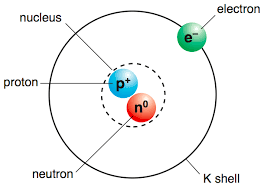
Which of the following are located in the nucleus and have a positive charge?
a)
Electron
b)
Proton
c)
Neutron
12.
Which of the following are located outside the nucleus and have a negative charge?
a)
Electron
b)
Proton
c)
Neutron
13.

What is the center of an atom called?

a)

Nucleus

b)

Proton

c)

Electron

d)

Neutron

14.

What is does the center of an atom contain?

a)

Nucleus and Protons

b)

Protons and Neutrons

c)

Electrons and Neutrons

d)

Neutrons and Nucleus

15.

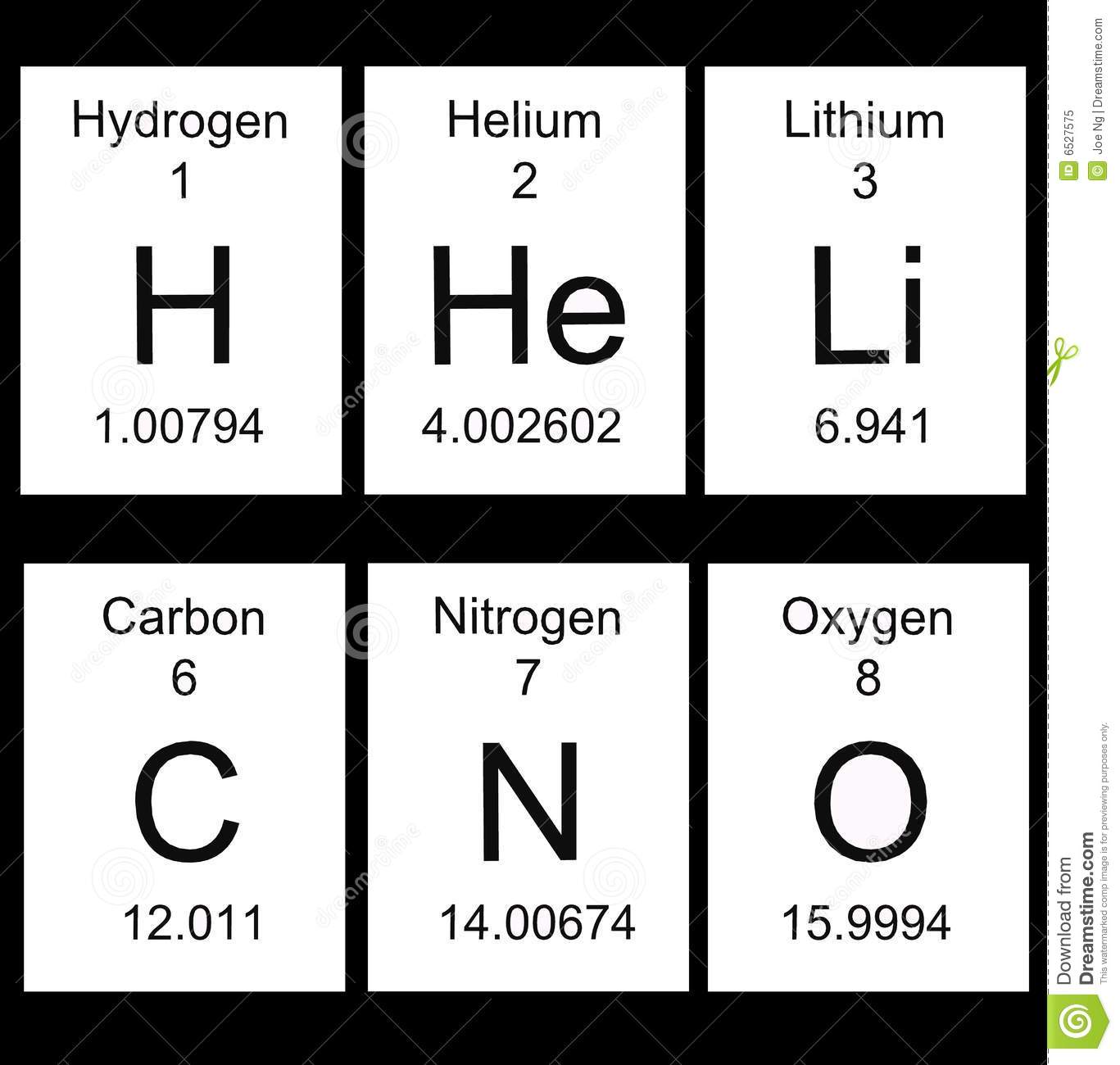
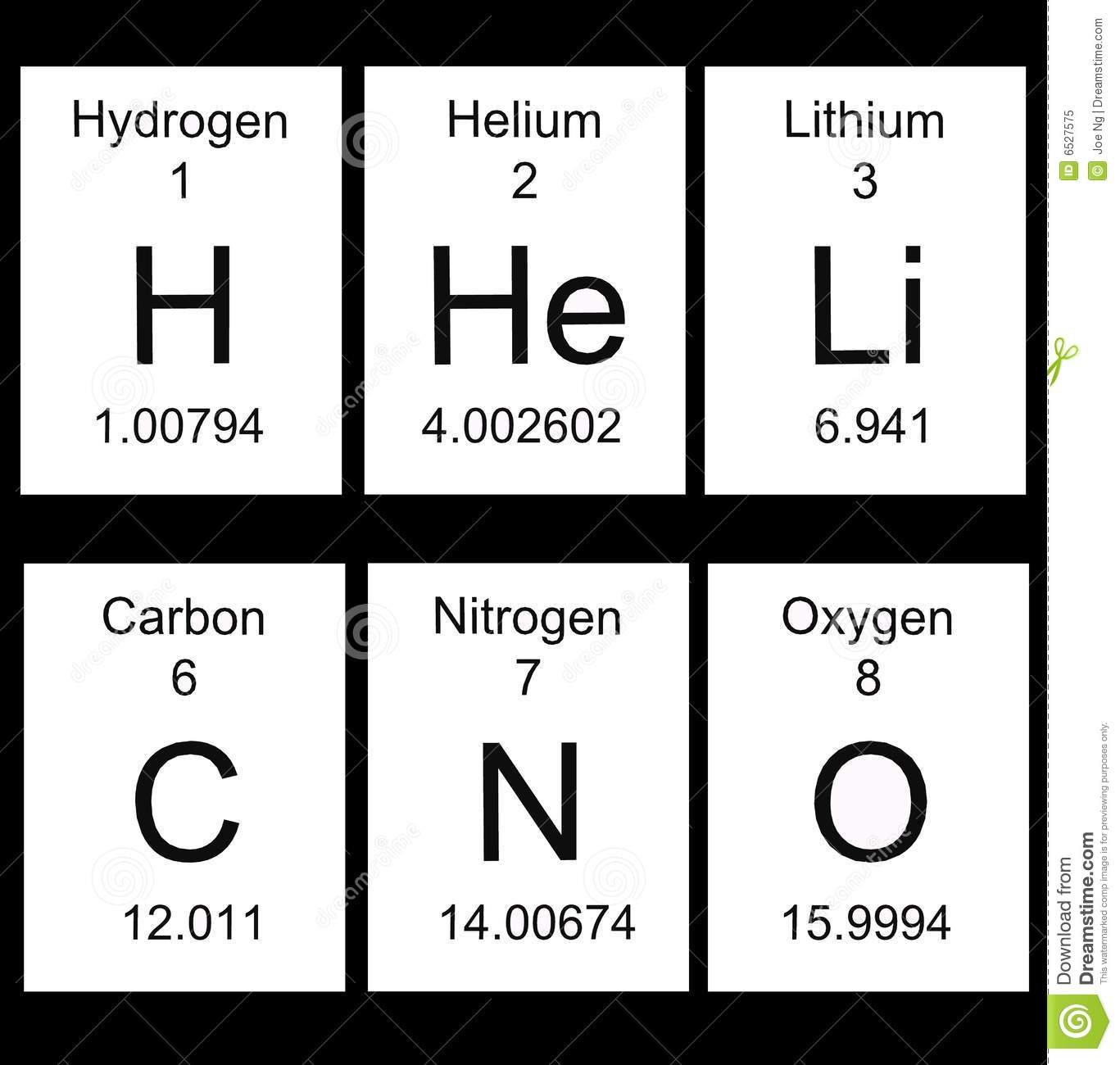
What does the number 2 represent?

a)

Element Symbol

b)

Element Name

c)

Atomic Number

d)

Atomic Mass

16.

What does the word "Helium" represent?

a)

Element Symbol

b)

Element Name

c)

Atomic Number

d)

Atomic Mass

17.

What does letter "HE" represent?

a)

Element Symbol

b)

Element Name

c)

Atomic Number

d)

Atomic Mass

18.

What does the number 4.00 represent?

a)

Element Symbol

b)

Element Name

c)

Atomic Number

d)

Atomic Mass

19.

What does the atomic number tell you?

a)

The Atomic Mass

b)

The number of protons and electrons

c)

The number of protons and neutrons

d)

The Atomic Number

20.

How do you find the number of neutrons in an atom?

a)

Atomic mass - atomic number

b)

Atomic mass + atomic number

c)

Atomic number - atomic mass

d)

Atomic mass

21.

How many neutrons in the element Helium?

a)

1

b)

4

c)

2

d)

0

22.
What subatomic particle is electrically neutral (no charge)?
a)
Proton
b)
Ion
c)
Neutron
d)
Electron
23.
Which subatomic particles contribute the most to the mass of an atom?
a)
Protons, Neutrons, Electrons
b)
Protons only
c)
Protons and Electrons
d)
Protons and Neutrons
24.
The proton number of an atom is equal to the _________________ of the atom.
a)
mass number
b)
atomic mass number
c)
atomic number
d)
neutron number
25.
an atom with atomic number 6 would have how many protons 
a)
6
b)
12
c)
3
d)
cannot be determined 
26.
This particle determines what element you have - the elements identity.
a)
electron
b)
proton
c)
neutron
d)
valence shell
27.
What are valence electrons?
a)
electrons on the first orbital always
b)
nucleus
c)
the outermost shell
d)
the number of electrons on the outermost orbital
28.
What charge does the nucleus have and why?
a)
positive - the neutrons do not have a charge
b)
positive - the neutrons and protons are positively charged particles
c)
neutral - the neutral charge dominates the positive charge
d)
neutral - electrons cancel out the positive charge of the atom
29.
An element with a mass number of 10 and an atomic number of 6 has how many protons?
a)
5
b)
8
c)
6
d)
10
30.
a)
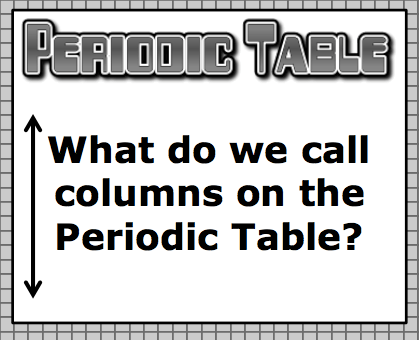
Periods
b)
Groups
31.
a)
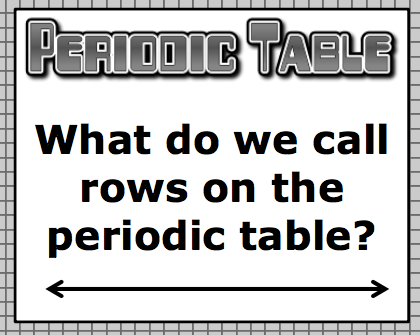
Periods
b)
Groups
32.
a)
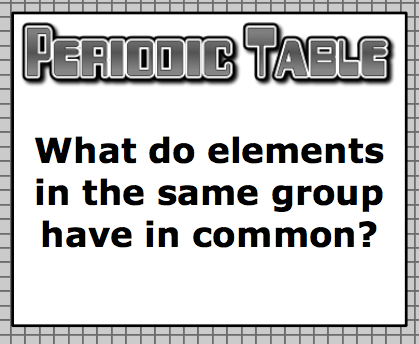
Periods
b)
Groups
33.

Who gave us the word “atom?”

a)

Mendeleev

b)

Dalton

c)

Thomson

d)

Democritus

34.
Which one of the following symbols represents an element?
a)
CO
b)
He
c)
HF
d)
NO
35.
An atom with an unequal number of protons and electrons is said to have (a) ___.
a)
no charge
b)
balance
c)
charge
d)
unbalance
36.
What is the mass number?
a)
the number of protons
b)
the number of protons and neutrons
c)
the number of neutrons
d)
the number of protons and electrons
37.
The smallest particle of any particular type of matter is known by which of the following terms?
a)
Compound
b)
Atom
c)
Chemical
d)
Element
38.
The smallest particle of any particular type of matter is known by which of the following terms?
a)
Compound
b)
Atom
c)
Chemical
d)
Element
39.

Magnesium is classified as a _________

a)

Non-metal

b)

Metalloid

c)

Alkali metal

d)

Alkaline metal

40.
What is the atomic number for an element with three protons?
a)
2
b)
1
c)
3
d)
6
41.
True or False? Neutrons have a negative charge
a)
True
b)
False
42.
a)
energy levels
b)
valence electrons
c)
protons
d)
neutrons
43.
a)
energy levels
b)
valence electrons
c)
protons
d)
neutrons
44.
a)
Group 1
b)
Group 17
c)
Group 18
d)
Group 2
45.
a)
Metals
b)
Nonmetals
c)
Metalloids
46.
a)
Metals
b)
Nonmetals
c)
Metalloids
47.
a)
Metals
b)
Nonmetals
c)
Metalloids
48.
a)
Metals
b)
Nonmetals
c)
Metalloids
49.
a)
Metals
b)
Nonmetals
c)
Metalloids
50.
How did Mendeleev arrange the elements?
a)
alphabetical 
b)
density
c)
melting point
d)
atomic mass
51.
The number at the bottom of each square on the periodic table is the ...
a)
atomic number
b)
atomic mass
c)
chemical symbol
d)
element name
52.
The number at the top of each square on the periodic table is the ...
a)
atomic number
b)
atomic mass
c)
Chemical Symbol
d)
Element Name
53.
The atomic number tells you what?
a)
number of electrons
b)
number of protons
c)
number of neutrons
d)
both electrons and protons in an atom.
54.
Which group of the periodic table is composed of inert (not reactive)  gases?
a)
alkali metals
b)
alkaline earth metals
c)
halogens
d)
noble gases
55.
Which is a halogen?
a)
Helium
b)
Chlorine
c)
Oxygen
d)
Neptune
56.
Which is an alkali metal?
a)
Magnesium
b)
Iron
c)
Sodium
d)
Europium
57.
A horizontal row of elements in the periodic table.
a)
column
b)
group
c)
period
58.
A vertical column in the periodic table.  Elements share similar properties.
a)
row
b)
group
c)
period
59.
A proton is....
a)
A negatively charged subatomic particle
b)
A positively charged subatomic particle
c)
A neutrally charged subatomic particle
d)
The only subatomic particle located in the nucleus
60.
A neutron has a charge of
a)
+2
b)
No charge
c)
-1
d)
+1
61.
In the modern periodic table elements are arranged by:
a)
atomic mass
b)
atomic number
c)
valence electrons
d)
number of isotopes
62.
How many electrons does Oxygen need to fill its outer shell?
a)
3
b)
4
c)
1
d)
2
63.
How many Valance electrons does Iodine Have?
a)
6
b)
16
c)
7
d)
17
64.
The period for Bromine is ___________.
a)
3
b)
2
c)
4
65.
An element's identity is determined by the number of
a)
electrons.
b)
protons.
c)
neutrons.
d)
valence.
66.
Group 18 elements are known as the _____ _____ and have full valence shells.
a)
royal gases.
b)
supreme solids.
c)
noble gases.
d)
legit liquids.
67.
What period and group is Silver (Ag)? 
a)
Period 2, Group 1
b)
Period 3, Group 16
c)
Period 5, Group 11
d)
Period 2, 14
68.
The elements in this group only have 1 valence electron and include Li, Na, and K. 
a)
Group 11
b)
Group 1
c)
Group 3
69.
How many electrons do atoms need to be stable?
a)
1
b)
2
c)
6
d)
8
70.
What is the mass of a neutron?
a)
1 amu
b)
0 amu
c)
same as electron
d)
doesn't have any mass
71.
What is the formula to solve for the neutron?
a)
Mass + Atomic Number= Neutrons
b)
Mass x Atomic Number = Neutrons
c)
Mass - Atomic Number = Neutrons
d)
Mass + Number of Protons = Neutron
72.
Where is the neutron located?
a)
In the loose nucleus with the electron
b)
In the dense nucleus with the protons
c)
In the electron cloud
d)
The nucleus floats on orbitals
73.
How many neutrons does the an element with an atomic number of 3 and a mass of 6.9 contain?
a)
6.9
b)
4
c)
3
d)
7
74.
How many neutrons does oxygen have?
a)
16
b)
15.99
c)
8
d)
Doesn't contain any neutrons
75.
What element is this?
a)
Helium
b)
Hydrogen
c)
Argon
d)
Silver
76.
What element is represented in this Bohr Model? 
a)
Carbon
b)
Hydrogen
c)
Aluminum
d)
Lithium
77.
How are electrons arranged in an atom?
a)
In groups of five
b)
In energy levels
c)
By color
d)
By shape
78.
An element with five valence electrons is
a)
phosphorus
b)
oxygen
c)
beryllium
d)
rubidium
79.
How many electrons are in the outer (valence) shell of Chlorine (Cl)?
a)
1
b)
3
c)
6
d)
7
80.
What's a valence electron?
a)
electrons in the second energy level
b)
electrons in the outermost energy level
c)
the atomic number
d)
electrons in the first level
81.
all matter is made of what 
a)
energy 
b)
atoms 
c)
electrons 
d)
compounds 
82.
the central region of an atom where its neutrons and protons are is its 
a)
nucleus 
b)
electron cloud
c)
core 
d)
center 
83.

Ernest Rutherford discovered

a)

electrons

b)

neutrons

c)

electron orbits

d)

nucleus

84.

J.J. Thompson discovered

a)

the nucleus

b)

neutrons

c)

electrons

d)

Atomic Theory

85.

Neutrons were discovered by

a)

Neils Bohr

b)

James Chadwick

c)

Henry Mosley

d)

Ernest Rutherford