
 Worksheets
Periodic Table, Conservation of Mass, Nuclear Reactions
Total questions: 83
Worksheet time: 1hrs 7mins
Name
Class
Date
1.
10 g of a solid chemical reacts with a 10 g of a liquid chemical, the reaction bubbles and changes the color of the liquid. The colored liquid weighs 13 g, what can be concluded?
a)
The gas produced from the bubbles weighed 5 g
b)
The bubbles were evidence of 7 g of matter being destroyed
c)
The gas produced weighed 7 g
d)
The gas produced weighed 13 g
2.
All chemical equations create or destroy matter, which is why scientists weigh their reactants so they can see how much was created or destroyed
a)
True
b)
False
3.
A system that only exchanges energy with its surroundings; mass is conserved.
a)
Open System
b)
Closed System
4.
What is the law of conservation of mass?
a)
Matter changes when reacted or changed.
b)
The mass of all reactants are changed during a physical or chemical change
c)
The mass of the reactants is the same as the mass of the products
d)
The mass of the products is different than the mass of the reactants.
5.
True or false: The law of conservation of mass means that the number of atoms of the products is more than the number of atoms in the reactants.
a)
True
b)
False
6.
What will weigh more when a chemical change is complete? The reactants before the chemical reaction, or the product after the reaction is complete?
a)
They both will weigh the same
b)
The product always weighs more than the reactant
c)
The reactant will weigh more than the product
d)
They both will loose mass after the reaction
7.
The total amount of matter (atoms) before and after a chemical reaction (change), remains the same.
a)
True
b)
False
8.
What is a closed system?
a)
a system where none of the reactants or products are allowed to escape
b)
compounds made of thousands of repeating smaller molecules
c)
the output, or result of a chemical reaction
d)
occurs when the atoms and molecules of two or more substances rearrange to form new substances
9.
Suppose a reaction were to happen in an open container in a lab. During the reaction, the scientist observes the chemicals bubble, and produce a gas. During the analysis the scientist notices that the reactants weighed 20 g when he started, and the product weighed 18 g. Explain what happened.
a)
His chemical reaction defied the law of conservation of mass
b)
The product destroyed mass during the reaction
c)
The reactants created matter during the reaction
d)
The gas that was produced was not able to be weighed since the container was open.
10.
What does the principle of conservation of mass mean?
a)
The total mass of the reactants is more than the products
b)
Matter is not created or destroyed
c)
The total mass of the reactants is less than the products
11.
Fill in the blank:
It is best to observe the law of conservation of mass in a _____________________ because it will ensure that the mass is the same in the beginning and end of a chemical reaction.
It is best to observe the law of conservation of mass in a _____________________ because it will ensure that the mass is the same in the beginning and end of a chemical reaction.
a)
closed
b)
open
c)
balanced
d)
rearranged
12.
In a closed system, a chemical reaction takes place. The mass of the reactants in the beginning of the reaction is 25g. What does the mass have to be in the end of the reaction in order to follow the law of conservation of mass?
a)
25g
b)
You can't tell with the given information.
c)
30g
d)
15g
13.
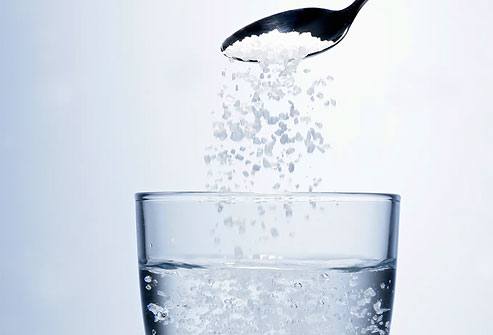
If 10 grams of water are added to 5 grams of salt, how much salt water will be made?
a)
2 grams
b)
5 grams
c)
10 grams
d)
15 grams
14.
If reaction starts with 20g of reactants it should produce
a)
a total of 40g of products
b)
a total of 10g of products
c)
a total of 80 g of products
d)
a total of 20g of products
15.

A rock weighing 60 g is broken into 2 pieces. What are possible weights for the two pieces of rock?
a)
20 g and 20 g
b)
30 g and 20 g
c)
30 g and 30 g
d)
45 g and 10 g
16.
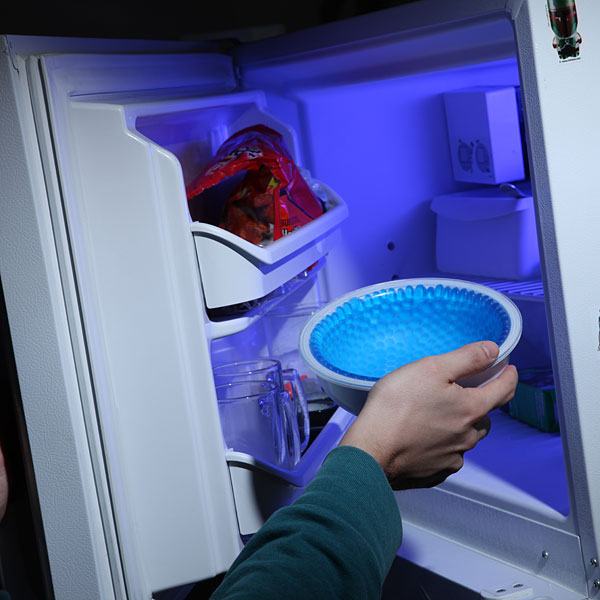
Maria fills a bowl with 200 g of water. She puts the bowl of water in the freezer, and the water freezes. Which will most likely be the mass of the frozen water?
a)
50 g
b)
100 g
c)
200 g
d)
400 g
17.
How many electrons do atoms need to be stable?
a)
1
b)
2
c)
6
d)
8
18.
The atomic number tells you what?
a)
number of electrons
b)
number of protons
c)
number of neutrons
d)
both electrons and protons in an atom.
19.
All the elements on the right side of the periodic table are called..
a)
Metals
b)
Metalloid
c)
Nonmetals
20.

Beryllium is in group number______.
a)
Group 2
b)
Group 3
c)
Group 4
d)
Group 7
21.

The period for Bromine is ___________.
a)
3
b)
2
c)
4
22.
How many Valance electrons does Iodine Have?
a)
6
b)
16
c)
7
d)
17
23.
In the modern periodic table elements are arranged by:
a)
atomic mass
b)
atomic number
c)
valence electrons
d)
number of isotopes
24.
Each column in the periodic table is called a
a)
period
b)
group
c)
cluster
d)
unit
25.
Which group of the periodic table is composed of inert (not reactive) gases?
a)
alkali metals
b)
alkaline earth metals
c)
halogens
d)
noble gases
26.

The atoms along the staircase are called
a)
metals
b)
nonmetals
c)
metalloids
d)
noble gases
27.
Which is a halogen?
a)
Helium
b)
Chlorine
c)
Oxygen
d)
Neptune
28.
Which is an alkali metal?
a)
Magnesium
b)
Iron
c)
Sodium
d)
Europium
29.
Which properties are characteristic of the Group 1 metals?
a)
high reactivity and the formation of unstable compounds
b)
low reactivity and the formation of unstable compounds
c)
high reactivity and the formation of stable compounds
d)
low reactivity and the formation of stable compounds
30.
What is a valence electron?
a)
The sum of neutrons and protons.
b)
The # of electrons in the last shell.
c)
A type of bond.
d)
A popular compound.
31.
________ run vertically and are organized by property.
a)
Section
b)
Group
c)
Period
d)
Element
32.
_________ have properties of metals and non-metals.
a)
metalheads
b)
non-metals
c)
noble gases
d)
metalloids
33.
_______ are rows on the periodic table.
a)
Section
b)
Group
c)
Period
d)
Element
34.

How many protons are in Beryllium?
a)
4
b)
9
c)
5
d)
2
35.

What does "1.00794" mean in this image?
a)
number of protons
b)
number of neutrons
c)
average number of protons and neutrons
d)
average number of valence electrons
36.
Why is water NOT on the periodic table?
a)
It is naturally occuring
b)
It is a compound, not an element
c)
It exists as a solid, a liquid, and a gas
d)
Its chemical formula doesn't fit
37.
_______ are the ROWS on the periodic table.
a)
Families
b)
Groups
c)
Periods
d)
Elements
38.
________ are the COLUMNS on the periodic table and are organized by similar properties.
a)
Classifications
b)
Groups
c)
Periods
d)
Elements
39.
Atoms with similar properties are most likely located...
a)
in the same period.
b)
in the same group.
c)
in different periods.
d)
to the right and left of each other.
40.
If an atom had the same properties as fluorine (F), it would probably be located in
a)
period 1.
b)
period 2.
c)
group 2.
d)
group 17.
41.
Mendeleev's first periodic table organized the elements by increasing atomic mass.
a)
True
b)
False
42.
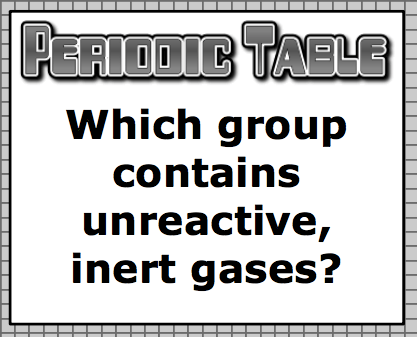
a)
Group 1
b)
Group 17
c)
Group 2
d)
Group 18
43.
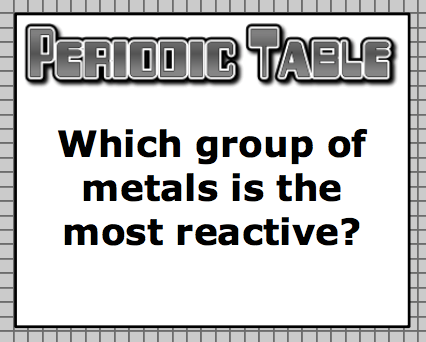
a)
Group 1
b)
Group 17
c)
Group 18
d)
Group 2
44.
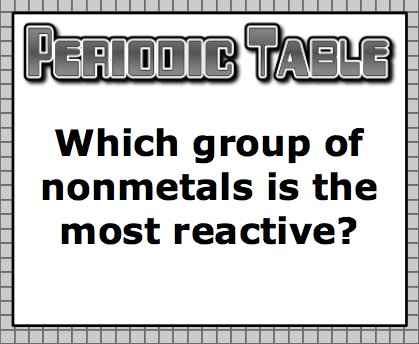
a)
Group 1
b)
Group 17
c)
Group 18
d)
Group 2
45.
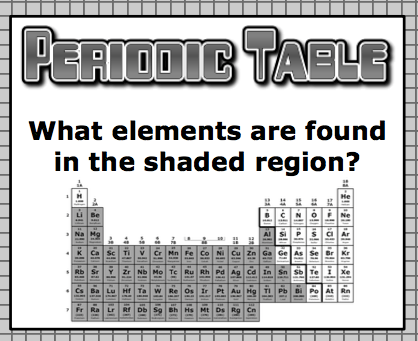
a)
Metals
b)
Nonmetals
c)
Metalloids
46.
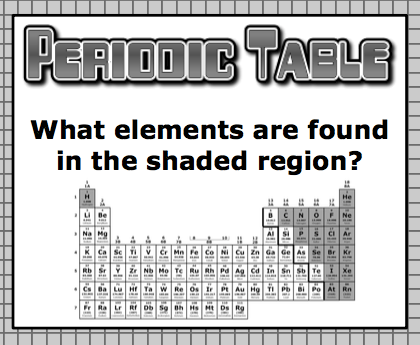
a)
Metals
b)
Nonmetals
c)
Metalloids
47.
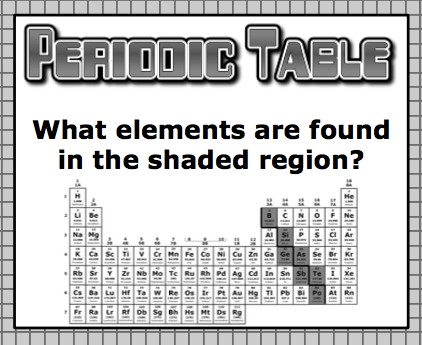
a)
Metals
b)
Nonmetals
c)
Metalloids
48.
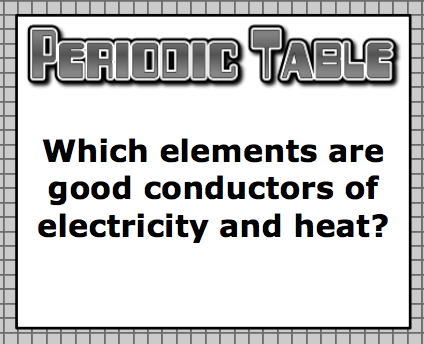
a)
Metals
b)
Nonmetals
c)
Metalloids
49.
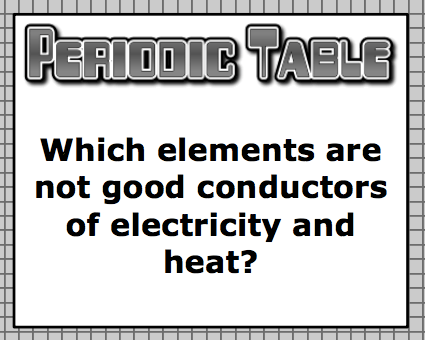
a)
Metals
b)
Nonmetals
c)
Metalloids
50.
A proton is....
a)
A negatively charged subatomic particle
b)
A positively charged subatomic particle
c)
A neutrally charged subatomic particle
d)
The only subatomic particle located in the nucleus
51.
A neutron has a charge of
a)
+2
b)
No charge
c)
-1
d)
+1
52.
What period and group is Silver (Ag)?
a)
Period 2, Group 1
b)
Period 3, Group 16
c)
Period 5, Group 11
d)
Period 2, 14
53.
The elements in this group have 5 valence electrons and include elements N, P, and As.
a)
Group 5
b)
Group 1
c)
Group 18
d)
Group 15
54.
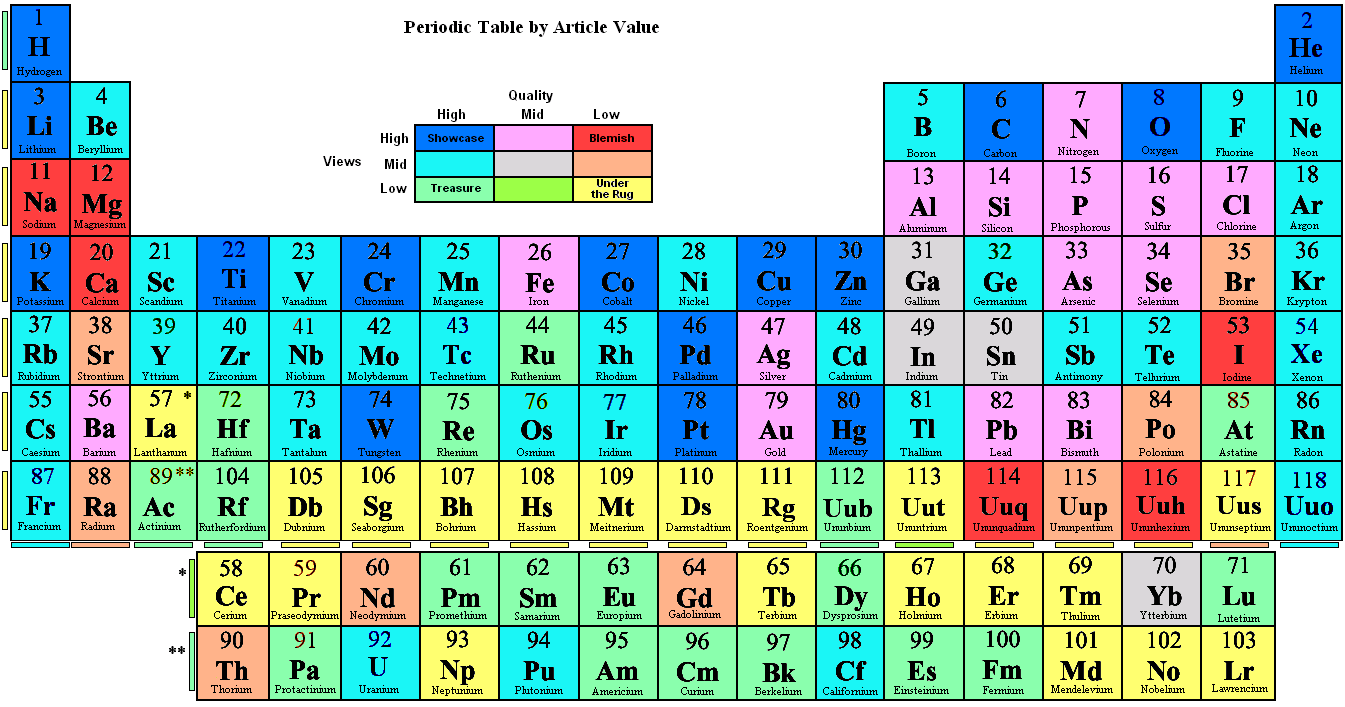
The period for Bromine is ___________.
a)
3
b)
2
c)
4
55.
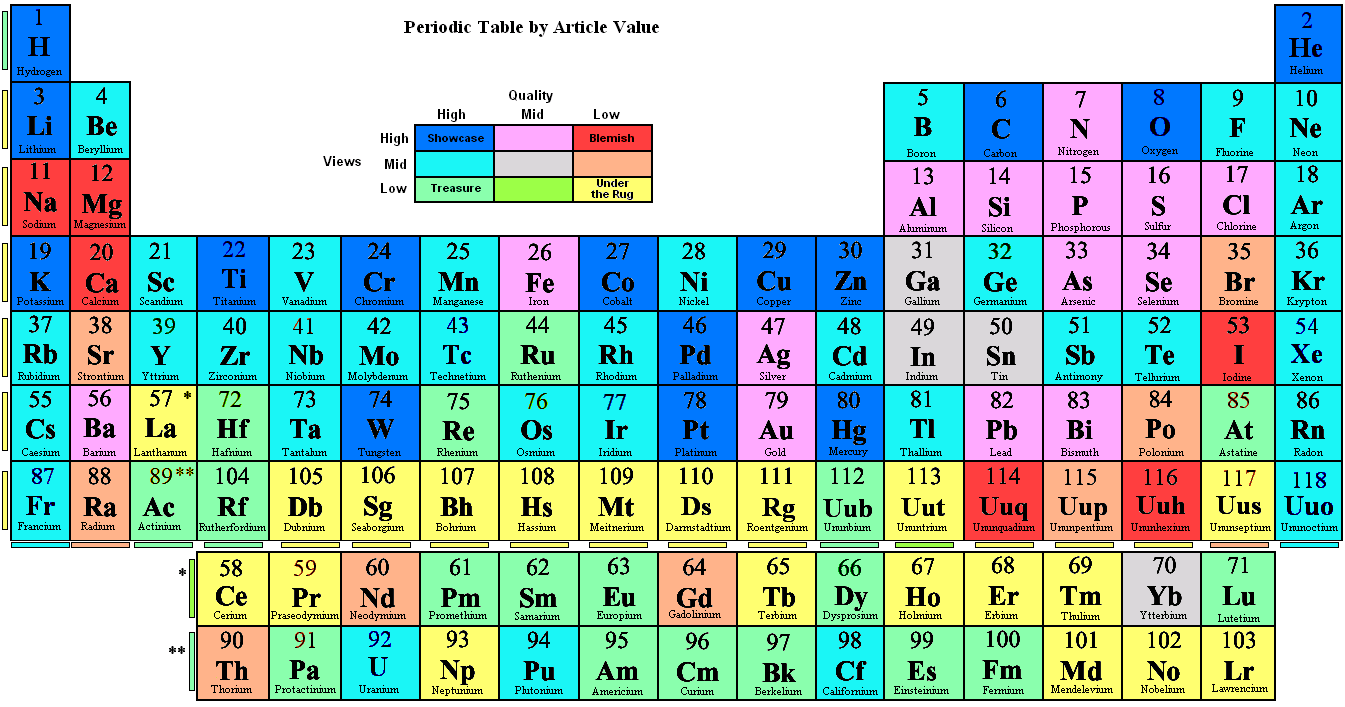
Beryllium is in group number______.
a)
Group 2
b)
Group 3
c)
Group 4
d)
Group 7
56.

The phases of the moon are __________ because they repeat in a pattern.
a)
periodic
b)
group
c)
awesome
d)
halogens
57.
Takes two small nuclei and combines them into a larger nucleus
a)
fission
b)
fusion
58.
The splitting of a nucleus into smaller nuclei is
a)
fusion
b)
fission
c)
half-life
d)
gamma radiation
59.
How do nuclear power-plants work?
a)
Fusion
b)
Half-life
c)
Fission
d)
Fusion or fission
60.
How do nuclear power-plants work?
a)
Fusion
b)
Half-life
c)
Fission
d)
Fusion or fission
61.
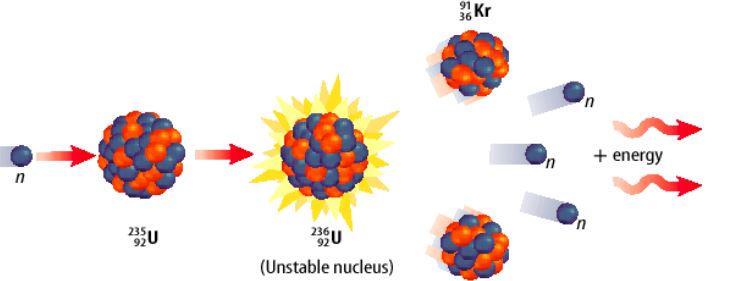
This is an example of...
a)
Fission reaction
b)
Fusion reaction
c)
Decomposition reaction
d)
Decay
62.
Where does fusion occur naturally?
a)
Underwater
b)
All around us
c)
In the radioactive waste
d)
On the sun
63.
Which atoms combine together during fusion reaction on the sun?
a)
Helium and Hydrogen atoms
b)
Hydrogen atoms
c)
Hydrogen and Lithium atoms
d)
Hydrogen and Carbon atoms
64.
An example of an uncontrolled fission reaction is _______________
a)
Nuclear power plants
b)
Radio active decay
c)
Atomic Bomb
d)
On the surface of the sun
65.
What metal gives off radiation?
a)
carbon
b)
cobalt
c)
uranium
d)
titanium
66.
How is nuclear fusion different from nuclear fission?
a)
In fusion, the product is a larger atomic nucleus.
b)
Fission produces energy but fusion does not.
c)
Fusion produces energy but fission does not.
d)
In fission, the product is a larger atomic nucleus.
67.
What are some of the outcomes of nuclear fusion?
a)
Produce larger materials from the collision of smaller materials.
b)
Release energy.
c)
Produce smaller materials from the collision of larger materials.
d)
Produce larger materials from the collision of smaller materials & Release energy
68.
In this example of nuclear fusion, the products contain an expelled __________ which also contributes to the release of energy.
a)
helium
b)
neutron
c)
proton
d)
electron
69.
In nuclear fusion, smaller atoms are forced together to create larger atoms. Does this process release, absorb or maintain energy?
a)
Absorb energy
b)
Maintain energy
c)
Release energy
70.
The product of nuclear fission includes
a)
neutrons and electrons
b)
several nuclei and neutrons
c)
several nuclei and electrons
d)
several nuclei and protons
71.
What is a chain reaction?
a)
When electrons travel are emitted causing electricity
b)
When a nuclear fission reaction occurs, the protons emitted can strike other nuclei in the sample, and cause them to split
c)
When a nuclear fission reaction occurs, the neutrons emitted can strike other nuclei in the sample, and cause them to split
d)
When a nuclear fission reaction occurs, the electrons emitted can strike other nuclei in the sample, and cause them to split
72.
_________ happens naturally due to an unstable nucleus.
a)
fission
b)
fusion
c)
radioactive decay
d)
K-capture
73.
Hydrogen is the primary fuel
a)
Fission
b)
Fusion
c)
Radioactive Decay
74.
Very high temperature and pressure is required for:
a)
Fission
b)
Fusion
c)
Radioactive Decay
75.
One advantage of nuclear energy over coal energy is ______.
a)
it is very cheap to build and maintain a nuclear power plant
b)
there is very little dangerous waste with nuclear energy
c)
the nuclear plant emits motre greenhouse gases
d)
the nuclear plant does not emit as many greenhouse gases
76.

a)
Radioactive Decay
b)
Nuclear Fission
c)
Nuclear Fusion
77.

a)
Radioactive Decay
b)
Nuclear Fission
c)
Nuclear Fusion
78.

What machine is used to detect radiation?
a)
Geiger counter
b)
Richter counter
79.
Which of these statements correctly describes how the chain reaction occurs in nuclear fission.
a)
Uranium releases electrons to create electricity
b)
When a nuclear fission reaction occurs, the electrons emitted can strike other nuclei in the sample, and cause them to split
c)
When a nuclear fission reaction occurs, the neutrons emitted can strike other nuclei in the sample, and cause them to split
d)
Protons and neutrons change to electrons because the nuclei are so big
80.
What is a benefit of nuclear fission?
a)
The ability to absorb energy
b)
The ability to release tremendous amounts of energy
c)
The ability to produce more energy than nuclear fusion
d)
There are no beneficial aspects of nuclear fission
81.
U-235 is the primary fuel
a)
Fission
b)
Fusion
c)
Radioactive Decay
82.
One disadvantage of nuclear energy is ___.
a)
it is a fossil fuel
b)
it leaves behind radioactive waste
c)
it emits large amounts of pollution into the atmosphere
d)
there are no disadvantages
83.
What are some of the outcomes of nuclear fusion?
a)
Produce larger materials from the collision of smaller materials.
b)
Release energy.
c)
Produce smaller materials from the collision of larger materials.
d)
Produce larger materials from the collision of smaller materials & Release energy
100 %

