
 Worksheets
Unit 12 Review
Total questions: 80
Worksheet time: 2hrs 26mins
In order to burn a tree log faster, we must...
Take away the oxygen
Increase the surface area (chop it up)
Put water on it
Decrease the temperature
This is a substance that increases the rate of a chemical reaction without being consumed by the reaction.
A thermometer
A match
A catalyst
A substrate
When we chew our food, we are helping speed up the digestion reaction because we are...
Increasing the temperature
Increasing the concentration
Increasing the number of particles
Increasing the surface area
A television news programme shows an explosion at a flour mill.
What could have increased the risk of such an explosion?
adding salt to the flour
employing more staff in the mill
grinding the flour more finely
opening the windows
Activation energy is
energy possessed by the reactants
energy formed during the collision between reactants
energy released during bond formation
energy required for the reactants to change into product
Which does not increase the speed of a reaction?
adding a catalyst
increasing the concentration of one of the reactants
increasing the particle size of one of the reactants
increasing the temperature
The rate of a reaction depends on temperature, concentration, particle size and catalysts.
Which statement is not correct?
Catalysts can be used to increase the rate of reaction.
Higher concentration decreases the rate of reaction.
Higher temperature increases the rate of reaction.
Larger particle size decreases the rate of reaction
How does a catalyst increase the speed of a reaction?
by increasing the collision frequency of particles
by increasing the speed of the particles
by increasing the temperature of the reaction
by lowering the activation energy

Which of the following are true about how temperature affects the rate of reaction?
I and II only
I and III only
II and III only
I, II, and III

The tangent to the curve in the plot of concentration vs time allows us to calculate
Instant rate at 300 s
instant rate at the beginning of the reaction
Average rate between 200 s and 400 s
Average rate for the reaction
Consider the hypothetical reaction of A transforming to B. Express the rate in terms of the disappearance of A.
rate = −ΔtΔ[A]
rate = ΔtΔ[A]
rate = Δ[B]Δ[A]
rate = k[A]
What will happen to the rate of reaction if the concentration of A is doubled and the concentration of B is tripled?


What is the rate law for the reaction?


1 second
3 seconds
8 seconds
15 seconds
SO2(g) + O2(g) <−> SO3(g)
If the concentration of SO2(g) is increased, the equilibrium of the reaction will ___________.
SO2(g) + O2(g) <−> SO3(g)
If the equilibrium shifts to the right, the concentration of O2(g) will ___________.
heat + N2(g) + O2(g) <−> 2NO(g)
If the heat is removed to the chemical system, the equilibrium will _______.
N2 (g) + 3 H2 (g) <−> 2 NH3 (g)
If the pressure in the system is increased, the reaction will __________________.
2SO3(g) ⇋ 2SO2(g) + O2(g)
Which is NOT a way to stress a closed chemical system at equilibrium?
change temperature
add a reactant
take away a chemical in the reaction
add a catalyst
Increasing the pressure on an equilibrium system will
shift the reaction to the side with more moles of chemicals
shift the reaction to the side with more moles of gas
shift the reaction to the side with fewer moles of gas
shift the reaction to the side with fewer moles of chemicals
What type of reactions can change products back to the reactants?
Reversible reactions
Irreversible reactions
Combustion reactions
Combination reactions
If a reversible reaction is exothermic in the forward direction, it will be ...
exothermic in the reverse direction
endothermic in the forward direction too
endothermic in the reverse direction
not involve energy in reverse direction
Increase the number of collision between the particles thus increasing the rate.

Heat + 1 N2O4 → 2 NO2
What will happen when the temperature is increased?
Position of equilibrium will shift to left and become lighter in color
Position of equilibrium will shift to right and become more brown
No change in position of equilibrium
Position of equilibrium will shift to right and become lighter in color
2SO2(g)+1O2(g) ⇌ 2SO3(g) + Heat
Increasing the pressure on the system will...
shift equilibrium right
shift equilibrium left
slow rate of reaction
have no change
N2(g) + 3H2(g) ↔ 2 NH3(g) + heat
Removing N2 will cause the equilibrium to:
Shift right
Shift left
Have no change
Speed up
2SO2(g) + O2(g) <=> 2SO3(g): ΔΗ = - 197 kJ mol -1
Which of the following will NOT shift the equilibrium position to the right?
energy + N2(g) + O2(g) <−> 2NO(g)
If O2(g) is removed, the concentration of N2 will _______.
A single sided arrow (→), indicates that a reaction is:
Reversible
Irreversible
Not reactive
For the following equilibrium reaction:
N2 (g) + 3 H2 (g) <==> 2 NH3 (g) ΔH=-386 kJ/mol
Predict the direction that the reaction will proceed, or shift, if...
The volume of the container is decreased.
right
left
no effect
For the following equilibrium reaction:
N2 (g) + 3 H2 (g) <==> 2 NH3 (g) ΔH=-386 kJ/mol
Predict the direction that the reaction will proceed, or shift, if...
The reaction is cooled.
right
left
no effect

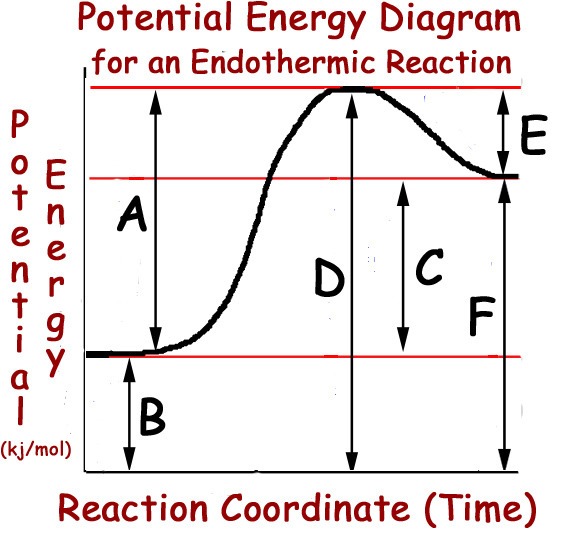
Which letter shows the activation energy
A
B
C

Which letter shows the heat change?
A
B
C
D
E

Which letter represents the reactants?
A
B
C
D
E

Which letter represents the transition state?
A
B
C
D
E

Is this showing an endothermic or an exothermic reaction?
Endothermic
Exothermic

An energy profile for a reversible chemical reaction is shown. According to this profile, the activation energy of the REVERSE reaction is equal to
When surface area is decreased the rate of reaction...
Decreases, because there are LESS possible sites for correct collisions
Increases, because there are LESS possible sites for correct collisions
Decreases, because there are MORE possible sites for correct collisions
Increases, because there are MORE possible sites for correct collisions

Which one of the following provides the correct values of the activation energy (in kJ mol-1) and the ΔH (in kJ mol-1) for the reaction

Which curve on the diagram represents the catalyzed reaction?
red curve
blue curve


Which of the following is true?
The reaction rate of the diagram on the left would be greater because there are more collisions that will happen because of greater surface area.
The reaction rate of the diagram on the right would be greater because there are more collisions that will happen because of lesser surface area.
The reaction rate of the diagram on the right would be greater because there are more collisions that will happen because of greater surface area.
The reaction rate of the diagram on the left would be greater because there are more collisions that will happen because of lesser surface area.

In which container would you expect a higher reaction rate, and why? (Note: The number of particles is the same in both containers.)
The left would have a higher reaction rate because it has a greater volume and more collisions will happen.
The right would have a higher reaction rate because it has a greater volume and more collisions will happen.
The left would have a higher reaction rate because it has a lesser volume and more collisions will happen.
The right would have a higher reaction rate because it has a lesser volume and more collisions wil happen.
In a chemical equilibrium, what happens to the concentrations of reactants and products over time?
They fluctuate
They remain constant
They decrease
They increase
Which of the following are true when a catalyst is used in a chemical reaction?
- Enthalpy of reaction is lower.
- Activation energy for the reaction is lower.
- Enthalpy of reaction is same.
- Activation energy for the reaction is lower.
- Enthalpy of reaction is the lower.
- Activation energy for the reaction is same.
- Enthalpy of the reaction is same.
- Activation energy for the reaction is same.
Consider the reaction between solid CaCO3 and aqueous HCl. The reaction will be sped up by an increase in which of the following?
I. Concentration of HCl II. Size of the CaCO3 particles III. Temperature
I only
I and III only
II and III only
I, II, and III

Which of the quantities in the enthalpy level diagram below is (are) affected by the use of a catalyst?
I only
III only
I and II only
II and III only
What happens to the rate constant (k) and activation energy (Ea) of a reaction when the temperature is increased?
k increases and Ea is unaffected
k decreases and Ea is unaffected
Ea increases and k is unaffected
Ea decreases and k is unaffected
In general, the rate of a reaction can be increased by all of the following except
Increasing the temperature
Increasing the activation energy
Increasing the concentration of reactants
Increasing the surface area of reactants

Given the reaction
S(s) + O2(g) --> SO2(g) + energy
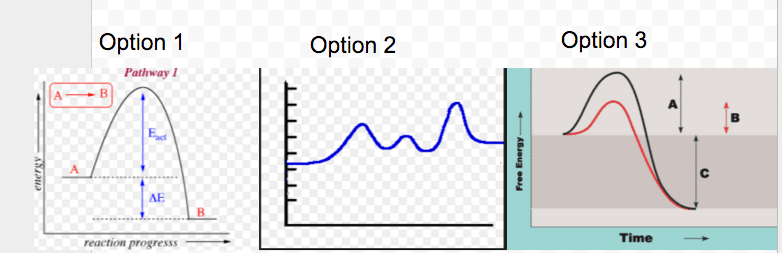
Which diagram best represents the potential energy changes for this reaction?
a
b
c
d

Given the potential energy diagram for the chemical reaction:
Which statement correctly describes the energy changes that occur in the forward reaction
The activation energy is 50kJ and the reaction is exothermic
The activation energy is 50kJ and the reaction is endothermic
The activation energy is 10kJ and the reaction is exothermic
The activation energy is 10kJ and the reaction is endothermic
H2(g) + l2(g) ↔ 2HI(g)
System shifts reactants side
H2(g) + l2(g) ↔ 2HI(g)
H2(g) + l2(g) ↔ 2HI(g) ΔH= -9.6kj/mol
2SO2(g) + O2(g) ↔ 2SO3(g) ΔH= +9kj/mol
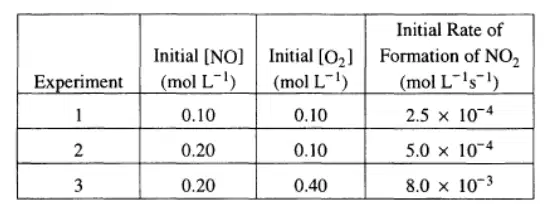
The initial-rate data in the table above were obtained for the reaction represented below. What is the experimental rate law for the reaction?
2 NO + O2 → NO2
Rate = k[NO][O2]
Rate = k[NO][O2]2
Rate = k[NO]2[O2]
Rate = k[NO]2[O2]2
CO(g) + H2O(g) ↔ H2(g) + CO2(g)
The formation of ammonia is favored by
N2(g) + O2(g) ↔ 2NO(g)
As the concentration of N2(g) increases, the concentration of O2(g) will
H2(g) + Br2(g) + heat ↔ 2HBr(g)
Which stresses will shift the equilibrium to the right?
Increasing, temperature, increasing the [H2], increasing the [Br2], decreasing the [HBr], increasing pressure
decreasing temperature, decreasing the [H2], decreasing the [Br2], increasing the [HBr]
Increasing temperature, increasing the [H2], increasing the [Br2], decreasing the [HBr]
Increasing temperature, decreasing the [H2], increasing the [Br2], increasing the [HBr]
Changes in pressure will only affect substances that are in the ______ state.
solid
gas
liquid
What are the two factors that help determine that equilibrium is reached?
Forward reaction rate is faster than the reverse and the concentrations are equal
Forward and reverse reaction rates are equal and concentrations are equal
Forward and reverse reaction rates are equal and concentrations are constant
Le Chatelier's Principle states that if a chemical system at equilibrium is stressed,
the system will adjust to increase the stress
the system will adjust to reduce the stress
the system will not adjust
Such reactions which continue in both directions are called:
Irreversible reactions
Reversible reactions
Non-reactive reactions
dynamic reactions

