wayground logo

Free Printable Worksheets

Font size

S
M
L
XL
Worksheets

KMT & Gas Laws (Graham's,Avogadro's, & Boyle's Law)

Total questions: 85

Worksheet time: 3hrs 55mins

Name
Class
Date
1.

Under what temperature and pressure conditions does a gas behave the most like and ideal gas? (Choose all that apply.)

a)

high pressure (above 1 atm)

b)

low temperature (below 273 K)

c)

standard temperature

(273 K)

d)

standard pressure (1 atm)

2.
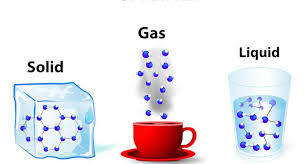
Of these three states of matter, which one has the most kinetic energy? 
a)
Solid 
b)
Liquid 
c)
Gas
3.

What state of matter exists at A, B, and C?

a)

Solid, Liquid, Gas

b)

Gas, Liquid, Solid

c)

Solid, Gas, Liquid

d)

Liquid, Solid, Gas

4.

Approximately, what is the temperature and pressure at the triple point for this substance?

a)

500C and 300 atm

b)

2000C and 300 atm

c)

-150C and 6 atm

d)

1500C and 1.5 atm

5.

Which states of matter are fluid?

a)

gases and liquids

b)

liquids and solids

c)

gases only

d)

liquids only

6.
The movement of gas molecules is greatly affected by _________.
a)
the shape of the container
b)
size of the container
c)
temperature of the container
7.
The energy of an object as it is in motion is defined as
a)
Kinetic Theory
b)
Kinetic energy
c)
Potential energy
d)
Electric energy
8.
Gas molecules can easily be compressed  because ___________. 
a)
gas molecules are soft
b)
gas molecules are far apart
c)
gas molecules follow the shape of the container
9.

The kinetic theory states

a)

Particles won't move if you don't apply energy to it.

b)

Particles only move in liquids and gases.

c)

Particles are always in motion.

d)

At the same temperature the object that has the most mass heats quicker.

10.

If you spray air freshener on side of the room, why is there a delay for the smell to reach the other side of the room? 

a)
Attractive forces between air and air freshener particles
b)
Not enough air freshener particles
c)
Because the particles like where they are at
d)
Collisions between air and air freshener particles
11.
If you place a balloon in a freezer what happens to the size of the balloon?
a)
Doubles
b)
increases
c)
decreases
d)
stays still
12.
In which state of matter are the particles moving the least random
a)
Gas
b)
Liquid
c)
Solid
d)
Plasma
13.
In which state of matter are the particles only vibrating?
a)
Gas
b)
Liquid
c)
Solid
d)
Plasma
14.
a)
Gases do not move in straight line
b)
Most of the volume of gas is empty space
c)
Gas particles are not in constant random motion
d)
Gas particles attract each other
15.
The slower the particles in a substance move,
a)
the colder it is.
b)
the warmer it is.
c)
the more energy it has.
d)
the less energy it has.
16.
Which is NOT an assumption made by the kinetic molecular theory of gases?
a)
Gas particles are small and take up little volume
b)
Particles travel in constant, random, straight-line motion until colliding
c)
When particles collide, their total kinetic energy is decreased
d)
Particles do not attract or repel each other
17.
Gas pressure is caused by
a)
gas molecules colliding with surfaces
b)
gas molecules condensing to a liquid
c)
gas molecules hitting other gas molecule
d)
barometers
18.

Which state of matter has both definite shape and definite volume?

a)

solid

b)

liquid

c)

gas

d)

plasma

19.

Which state of matter has no definite shape and no definite volume?

a)

Gas

b)

Liquid

c)

Solid

20.

As matter changes state from liquid to solid, the atoms move ______ .

a)

CLOSER together

b)

FARTHER apart

c)

stay the SAME

21.

Which state of matter has no definite shape but does have definite volume?

a)

Gas

b)

Solid

c)

Liquid

22.

At room temperature, oxygen is in which state of matter?

a)

solid

b)

liquid

c)

gas

d)

plasma

23.

As matter changes state from liquid to solid, the atoms have ____ kinetic energy.

a)

more

b)

less

c)

the same

24.

If I heat a liquid and its temperature increases, what change occurs to motion of the molecules?

a)

The molecules move at the SAME rate.

b)

The molecules move at a SLOWER rate.

c)

The molecules move at a FASTER rate.

25.

Which state of matter is found in our Sun and other stars?

a)

solid

b)

liquid

c)

gas

d)

plasma

26.

Watch this video. Which state of matter has the least amount of energy?

a)

solid

b)

liquid

c)

gas

27.

Which of the following would have a faster rate of effusion?

a)

Helium

b)

Hydrogen

c)

Nitrogen

d)

    Oxygen

28.

Which is true about effusion?

a)

It occurs after diffusion

b)

Describes the combustibility of a gas

c)

Ability of a gas to mix with other gases

d)

Ability of a gas to escape through a tiny opening

29.

Which of the following gas particles will diffuse fastest if all of these gases are at the same temperature and pressure?

a)

SO2

b)

Cl2

c)

N2O

d)

Hg

30.

Why would O2  effuse faster than CO2 in the same room?

a)

Oxygen has more energy

b)

Oxygen has a higher temperature

c)

Carbon dioxide has a greater molar mass

d)

It will effuse the same because the temperature is fixed

31.

At the same temperature, which molecule travels faster, O2 or N2 ? How much faster?

a)

1.85 times

b)

  1.75 times

c)

   1.17 times

d)

1.07 times

32.
The rate of effusion of water vapor is 0.391 and the rate of effusion of propane is 0.251 at the same temperature and pressure.  What is the molar mass of propane? (write the formula and show your work)
a)
44.0 g/mol
b)
6.63 g/mol
c)
0.37 g/mol
d)
28.2 g/mol
33.
Which of the following gases will effuse most slowly under the same physical conditions?
Don't forget to check for diatomics!
a)
Hydrogen
b)
Chlorine
c)
Ammonia (NH3)
d)
Bromine
34.
Use Graham’s Law to calculate fast O2 gas will effuse compared to Cl2
a)
O2 effuses 1.5x faster than Cl2
b)
O2 effuses 0.11x as fast as Cl2
c)
O2 effuses 1.1x faster than Cl2
d)
O2 effuses 0.15x as fast as Cl2
35.

Which image is inconsistent with Avogadro's law?

a)

A

b)

B

c)

C

d)

D

36.

Which image is inconsistent with Avogadro's law?

a)

A

b)

B

c)

C

d)

D

37.

Which image would have the formula A3 ?

a)

A

b)

B

c)

C

d)

D

38.

Which image would have the formula AB ?

a)

A

b)

B

c)

C

d)

D

39.

Which image would have the formula AB4 ?

a)

A

b)

B

c)

C

d)

D

40.

Which image would have the formula AB2 ?

a)

A

b)

B

c)

C

d)

D

41.
Molar volume of any gas at STP
a)
22.4 L
b)
2.24 L
c)
6.02 x 10²³ L
d)
224 L
42.
If 3.25 mol of Ar occupies 100. L at a particular temp and pressure, what volume does 14.15 mol of Ar occupy under same condition?
a)
435 L
b)
225 L
c)
100 L
d)
522 L
43.
A 2.00 L sample of pure oxygen gas (O2) is measured at STP.  How many moles of oxygen is this?
a)
24.4 mol
b)
0.007 mol
c)
1.44 mol
d)
0.09 mol
44.
How many molecules are there in a 110 L sample of gas at STP?
a)
8 x 10²³ molecules
b)
8 x 1024  molecules
c)
3 x 1024 molecules
d)
3 x 10²³ molecules
45.
Gases of the same volume contain the same number of molecules.  This is the description of:
a)
Boyle's law
b)
Dalton's law
c)
Charles' law
d)
Avogadro's law
46.
A sample of carbon dioxide at STP is 0.50 L.  How many grams of carbon dioxide do we have?
a)
0.48 g
b)
0.49 g
c)
1.96 g
d)
0.98 g
47.

What is the value of STP?

a)

0 K and 1 atmosphere

b)

0 C and 1 atmosphere

c)

32 F and 1 atmosphere

d)

100 C and 1 atmosphere

48.
What is the formula for Boyle's Law?
a)
P1V1=P2V2
b)
P1V1/P2V2
c)
P1V2=P2V1
d)
P1/V1=P2/V2
49.
When Pressure increases then the Volume must...
a)
Increase
b)
decrease
50.
When Volume increases then Pressure must...
a)
Increase
b)
Decrease
51.
What is the new volume of the gas if the pressure on 350 L of oxygen at 720 mm Hg is decreased to 600 mm Hg?
a)
420 L
b)
29.16 L
c)
4200.0 L
d)
291.6 L
52.
A gas occupies 4.98 L at 2.6 atm of pressure. What volume does it occupy at 1.8 atm pressure?
a)
12.9 L
b)
0.72 L
c)
7.2 L
d)
3.44 L
53.
A gas at a volume of 4 liters is at a pressure of 2 atm. The volume is changed to 16 Liters, what must the new pressure be?
a)
2 atm
b)
12 atm
c)
10 atm
d)
0.5 atm
54.
The pressure on a sample of gas is increased from 1.0 atm to 3.0 atm. If the new volume is 0.52 L, find the original volume.
a)
0.52 L
b)
1.56 L
c)
0.173 L
d)
1.00 L
55.
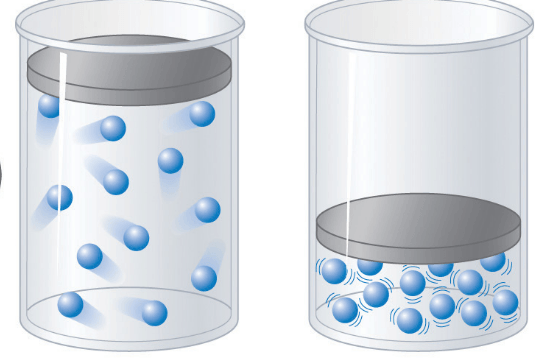
Which container will have a lower pressure?
a)
left
b)
right
c)
they both have the same pressure
d)
I don't know
56.
What type of relationship to pressure and volume have?
a)
direct
b)
inverse
c)
no relationship
d)
I don't know
57.
The relationship of which two variables are compared in Boyle's Law?
a)
pressure & volume
b)
volume & temperature
c)
temperature & pressure
d)
volume & moles (amount of gas)
58.

Find the mass in grams of 6.022 x 10236.022\ x\ 10^{23}    molecules of fluorine gas .

(a)  

59.

How many grams are in 238 moles of arsenic?

(a)  

60.

How many moles are in 98.3 grams of aluminum hydroxide?

(a)  

61.

Mass in grams of one mole of any pure substance.

a)

percent composition

b)

empirical formula

c)

molecular weight

d)

molar mass

62.

What is the molar mass of PbSO4?

a)

303.27 g/mol

b)

255.27 g/mol

c)

163.87 g/mol

d)

372.27 g/mol

63.

Which of the following dimensional analysis setups will correctly convert 27.76 g of Li to atoms of Li?

a)

A

b)

B

c)

C

d)

D

64.

How many grams are in 1.2 moles of neon?

a)

0.059 grams

b)

7.2 x 10²³ grams

c)

2.0 x 10⁻²⁴ grams

d)

24 grams

65.

Which of the following dimensional analysis setups will correctly convert 4.00x10²³atoms of cobalt to moles of cobalt? How many moles of colbalt are there?

a)

setup B : 0.664 mol Co

b)

setup A: 2.41x1047mol Co

c)

setup A : 0.664 mol Co

d)

setup B: 2.41x1047mol Co

66.
Which conversion factor should be used to solve the following, "How many moles of argon atoms are present in 11.2 L of argon gas at STP?"
a)
1 mol = 22.4 L 
b)
1 mol = 39.95 g
c)
1 mol = 6.02x10²³ atoms
d)
More than 1
67.
What are the units for molar mass?
a)
grams
b)
amu
c)
grams/mole
d)
liters
68.
How many molecules are in 2.5 mol of NaCl?
a)
1.51x10²³
b)
146
c)
4.15
d)
1.51x1024
69.

How many moles are in 6.02 x 10²³ molecules of H2O?

a)

1 mole

b)

2 moles

c)

6.02 moles

d)

602000000000000000000000 moles

70.

Which has the most particles?

a)

1 mole H2

b)

1 mole Na1+

c)

1 mole Al(OH)3

d)

These are all the same

71.

How many atoms are in 1 mole of Iodine (I)?

a)

6.022 x 10²³

b)

4.022 x 10²³

c)

6.022 x 1025

d)

4.022 x 1025

72.

How is moles abbreviated?

a)

M

b)

m

c)

mol

d)

ml

73.

What is the molar mass of Oxygen?

a)

8 grams

b)

8 moles

c)

15.999 grams

d)

15.999 moles

74.

What is the molar mass of Hydrogen?

a)

2 moles

b)

2 grams

c)

1.008 moles

d)

1.008 grams

75.

How many moles is 4 grams of silicon?

a)

4 moles

b)

0.14 moles

c)

28.085 moles

d)

1.4 moles

76.

How many moles is 19.5 grams of Sodium?

a)

19.5 moles

b)

0.85 moles

c)

22.99 moles

d)

8.5 moles

77.
The molar mass of an element is equal to its...
a)
Atomic mass
b)
Atomic number
c)
Oxidation number
d)
Valence electrons
78.
What is the molar mass of table salt (NaCl)?
a)
116.886 g/mol
b)
35.453 g/mol
c)
22.990 g/mol
d)
58.443 g/mol
79.
What is the mass of one mole of aluminum?
a)
27 g
b)
13 g
c)
54 g
d)
14 g
80.
What is the molar mass of CO2?
a)
12
b)
16
c)
32
d)
44
81.

Calculate the molar mass of Ba(C2H3O2)2

a)

255.3 g/mol

b)

237.3 g/mol

c)

228.3 g/mol

d)

196.3 g/mol

82.
How many particles are in a mole?
a)
602
b)
602 million
c)
602 moles
d)
6.02 x 10²³
83.
How many molecules are in 2.5 mol of NaCl?
a)
1.51x10²³
b)
146
c)
4.15
d)
1.51x1024
84.
How many molecules of sugar (C6H12O6) are in a mole?
a)
24 molecules
b)
180 molecules
c)
180 g
d)
6.02 x 10²³ molecules
85.
How many atoms of carbon are in 6.00g of carbon?
a)
1.20x1024atoms C
b)
6.02x10²³atoms C
c)
3.01x10²³atoms C
d)
1.50x10²³atoms C