wayground logo

Free Printable Worksheets

NEW

Font size

S
M
L
XL
Worksheets

Physical Science Exam Review

Total questions: 80

Worksheet time: 3hrs 39mins

Name
Class
Date
1.
Which of these is NOT a sign that a chemical change has occurred? 
a)
A loss of transparency 
b)
An unexpected color change
c)
A temperature change
d)
The formation of a precipitate
2.
The Law of Conservation of Mass states
a)
that matter exists in all states and reacts the same
b)
that matter can only be changed into new substances by introducing a catalyst
c)
that matter exists in the same state throughout any chemical change
d)
that matter cannot be created or destroyed and that the mass of the products must equal the mass of the reactants
3.
How many Al atoms are in this compound?         4Al2O3
a)
2
b)
8
c)
6
d)
4
4.

A substance that is formed as the result of a chemical reaction is a __________________

a)

Product

b)

Reactant

c)

Starters

d)

Enders

5.

Which of the following is an example of a chemical change?

a)

water freezes to form ice

b)

sugar dissolves in water

c)

gasoline burns in a car engine

d)

a piece of metal expands when it is heated

6.

What type of reaction is this?

a)

Exothermic

b)

Endothermic

c)

Energy Producing

d)

No way to tell

7.

When barium hydroxide and ammonium chloride react, the temperature of the mixture decreases. What kind of reaction is this?

a)

Endothermic

b)

Decomposition

c)

Exothermic

d)

Indothermic

8.

Is this diagram endothermic or exothermic

a)

Endothermic

b)

Exotermic

c)

Exothermic

d)

Endote

9.

What gives off H+ ions?

a)

acid

b)

base

10.

A high pH is a base.

a)

true

b)

false

11.

How many grams of KCl are needed to make a saturated solution in 100 g of water at 90°C?

a)

80

b)

45

c)

52

d)

20

12.

In terms of saturation, how would you classify a Ce2(SO4)3 solution with a concentration of 20 g in 100 g of water at 60°C?

a)

Saturated

b)

Unsaturated

c)

Supersaturated

13.

______________are corrosive substances characterized as having a strong smell and a sour taste

a)

Acids

b)

Bases

14.

Jerall has an unknown substance in a beaker. He wants to determine the relative pH of the unknown substance. He places a piece of blue litmus paper into the substance, and the litmus paper turns red.

a)

Acid

b)

Neutral

c)

Base

15.

Litmus paper can be used to determine the relative pH of a substance.

a)

true

b)

false

16.

According to this chart what would be considered neutral?

a)

14

b)

1

c)

8

d)

7

17.

The thing that gets dissolved in a solution is the

a)

Solvent

b)

Solute

c)

Solution

d)

Substance

18.

When making sweet tea, the water acts as the...

a)

Solvent

b)

Solute

c)

Solution

d)

Substance

19.

If a solution has the exact amount of solute that can be dissolved at that temperature then it is considered a ______ solution

a)

Unsaturated

b)

Saturated

c)

Supersaturated

20.

If a solution has less than the maximum amount of solute that can be dissolved in a given amount of water it is considered

a)

Unsaturated

b)

Saturated

c)

Supersaturated

21.

If a solution has more than the maximum amount of solute that can be dissolved in a given amount of water (some solute falls to bottom) than it is considered

a)

Unsaturated

b)

Saturated

c)

Supersaturated

22.

Bases are substances that release hydroxide ions.

a)

True

b)

False

23.
If 10 mg of iodine 131 is given to a patient, how much is left after 24 days? The half-life of iodine-131 is 8 days.
a)
1.25mg
b)
1.25g
c)
10g
d)
10mg
24.
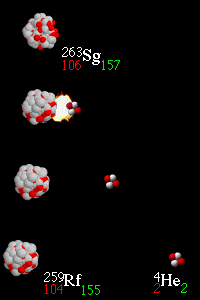
What type of decay is being illustrated in following picture? 
a)
beta decay
b)
alpha decay 
25.
The splitting of a nucleus into smaller nuclei is
a)
fusion
b)
fission
c)
decay
d)
gamma radiation
26.
One disadvantage of nuclear energy is ___.
a)
it is a fossil fuel
b)
it leaves behind radioactive waste
c)
it emits large amounts of pollution into the atmosphere
d)
there are no disadvantages
27.
Takes two small nuclei and combines them into a larger nucleus
a)
fission
b)
fusion
28.
When forces are _________ the object DOES NOT move.
a)
unbalanced
b)
balanced
c)
heavy
d)
light
29.
The sum of all forces acting on an object.
a)
Contact Force
b)
Balanced Force
c)
Unbalanced Force
d)
Net Force
30.
If a 10 kilogram object accelerates suddenly at 15 m/s^2, how much force was applied to the object?
a)
150 Newtons
b)
15 Newtons
c)
150 kilograms
d)
100 kilograms
31.
If a force of 26 N is exerted on two balls, one with a mass of 0.52 kg and the other with a mass of 0.78 kg, which ball will have the greater acceleration?  (F=ma)
a)
The one with a mass of .78 kg will have the greatest acceleration.
b)
The one with a mass of .52 kg will have the greatest acceleration.
c)
They will both accelerate at the same rate.
32.
The masses of four objects are given in this table. If all objects are struck with the same amount of force, which one will have the greatest acceleration?
a)
Object 1
b)
Object 2
c)
Object 3
d)
Object 4
33.
During which interval is the object not moving?
a)
B to C
b)
C to D
c)
D to E
d)
only at point A
34.
During which interval is the object speeding up?
a)
A to B
b)
B to C
c)
D to E
d)
E to F
35.
Acceleration occurs when an object changes its speed or ______.
a)
direction
b)
force
c)
inertia
d)
mass
36.
Which runner stopped for a rest?
a)
Albert
b)
Bob
c)
Charlie
37.
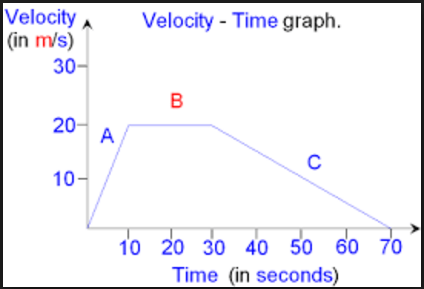
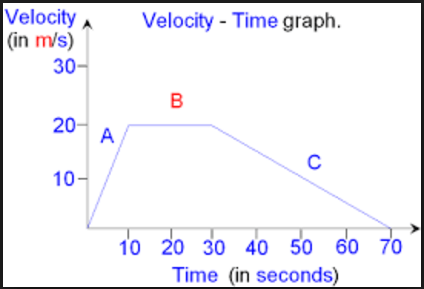
This is a velocity-time graph.  What is the object doing in segment A?
a)
Positive acceleration
b)
Negative acceleration
c)
Constant Velocity
d)
Not moving
38.
This is a velocity-time graph.  What is the object doing in segment C?
a)
Positive acceleration
b)
Negative acceleration
c)
Constant Velocity
d)
Not moving
39.

A car is driving at 50 miles per hour for 2 hours. What distance did it cover?

a)

50 miles

b)

25 miles

c)

100 miles

d)

75 miles

40.
A truck driving at 60 miles per hour travels 150 miles. How long is it driving for?
a)
9000 hours
b)
0.4 hours
c)
210 hours
d)
2.5 hours
41.
Acceleration: is the rate of change in ___________.
a)
speed
b)
distance
c)
velocity 
d)
displacement 
42.

A speedometer shows the...

a)

Average Speed

b)

Velocity

c)

Instantaneous Speed

d)

Acceleration

43.

An indicator that orients you when describing motion is the

a)

Time

b)

Reference Point

c)

Point of Motion

d)

Speed

44.

Motion is a change in....

a)

Time

b)

Speed

c)

Velocity

d)

Position

45.

What is the speed of a runner who runs 400 meters in 40 seconds?

a)

10 meters/second

b)

40 meters/second

c)

100 meters/second

d)

1,600 meters/second

46.
Which information is needed to determine how fast a truck is traveling?
a)
direction and mass
b)
distance and time
c)
size and speed
d)
time and weight
47.
What is Newtons 1st law of motion?
a)
Force= Mass multiplied by acceleration 
b)
An object at rest stays at rest unless acted on an unbalanced force. (inertia)
c)
For every action there is a equal and opposite  re-action.
d)
law of gravity 
48.
What law of motion does this picture represent?
a)
Newtons 3rd law
b)
Newtons 4th law
c)
Newtons 1st law
d)
Newtons 2nd law 
49.
What is Newtons 2nd law of motion?
a)
Pancakes 
b)
Force= Mass multiplied by acceleration
c)
For every action there is a equal and opposite  re-action.
d)
Law of gravity 
50.
For every action there is a equal and opposite...
a)
action
b)
movement 
c)
re-action 
d)
Newtons law of inertia 
51.
Mass is a measure of an object's inertia. Objects with greater mass have a greater inertia; objects with less mass have less inertia.
a)
true 
b)
false 
52.
What is the tendency of an object to resist a change in motion?
a)
coffee
b)
motion
c)
inertia
d)
gravity
53.
Which car is accelerating?
a)
A car that is not moving
b)
A  car that rounds a curve at a constant speed
c)
A car traveling  at a constant speed 
d)
A car that has a set speed of 60mph
54.

The slope of a distance vs time graph tells you?

a)

Distance traveled

b)

Speed of the object

c)

Time for the object to move

d)

The acceleration

55.

The slope of a velocity vs time graph tells you?

a)

Distance traveled

b)

Speed of the object

c)

Time for the object to move

d)

The acceleration

56.
The measure of average kinetic energy of all the particles within an object is called ____________. 
a)
temperature
b)
conduction
c)
radiation
d)
heat 
57.
In nature, heat always flows from a:
a)
cold object to a warm object.
b)
small object to a big object.
c)
warm object to a cold object.
d)
large object to a small object.
58.
Heat energy from the sun is transferred to Earth by:
a)
conduction.
b)
radiation.
c)
convection.
d)
insulation.
59.
Heat moves by ______ when it travels from one solid to another solid.
a)
radiation
b)
convection
c)
thermal energy
d)
conduction
60.
The way heat moves in liquids and gases is called _______.
a)
convection
b)
radiation
c)
conduction
d)
temperature
61.
The heat from a hot burner to a pot is transferred by ______.
a)
convection
b)
insulation
c)
radiation
d)
conduction
62.
Which direction is heat flowing in the picture?
a)
from the hand to the ice
b)
from the ice to the hand
c)
heat is not being transferred
d)
there is no way to tell
63.

What is energy?

a)

moving energy

b)

stored energy

c)

renewable energy

d)

The ability to do work.

64.

What is potential energy?

a)

moving energy

b)

stored energy

c)

renewable energy

d)

non renewable energy

65.

What is kinetic energy?

a)

moving energy

b)

potential energy

c)

stored energy

d)

renewable energy

66.
Niagara Falls is a good example of
a)
Kinetic energy being transformed into potential energy
b)
Potential energy being transformed into kinetic energy
c)
Energy being created
d)
Energy being destroyed
67.
 The law of conservation of energy states that when one form of energy is converted into another,
a)
Energy is destroyed in the process
b)
Energy is created in the process
c)
No energy is destroyed in the process
d)
Energy is lost in the process
68.
Which energy-conversion process occurs whenever coal is burned at a power station?
a)
chemical to nuclear
b)
chemical to sound
c)
chemical to electrical
d)
mechanical to electrical
69.
Which has the most kinetic energy?
a)
a basketball rolling down a hill
b)
a bus stopped at the top of a hill
c)
a dump truck driving down a hill
d)
a golf ball sitting at the top of the hill
70.

The ____________ of an object increases with its height.

a)

chemical potential

b)

kinetic

c)

thermal

d)

gravitational potential

71.
Calculate the KE of a runner that has a mass of 80 kg and is running at a velocity of 8 m/s
a)
5120 J
b)
320 J
c)
640 J
d)
2560 J
72.
if you push a cart with a force of 60 N resulting in 120 J of work.. how far did you move the cart? 
a)
7200 m
b)
0 m
c)
2 N 
d)
2 m
73.
1. A book weighing 1.0 newton is lifted 2 meters.  How much work was done?
a)
2 J
b)
0.5 J
74.
It took 50 joules to push a chair 5 meters across the floor. With what force wast the chair pushed?
a)
250N
b)
10N
75.
A set of pulleys is used to lift a piano weighing 1,000 newtons.  The piano lifted 3 meters in 60 seconds  How much power is used?
a)
16.67 watts
b)
50 watts
76.
What is the power of a kitchen blender if it can perform 3,750 joules of work in 15 seconds?
a)
56, 250 watts
b)
250 watts
77.
Frequency is defined as...
a)
Number of waves or cycles generated per second.
b)
The maximum displacement of a wave from its equilibrium position.
c)
The time interval between two consecutive waves.
d)
The distance between two identical positions on two consecutive waves.
78.

A wave machine generated waves with a wavelength of 0.080 m at a constant wave speed of 17 m/s. Calculate the frequency of the waves.

a)

212 Hz

b)

1.36 Hz

c)

0.00470 Hz

d)

16.92 Hz

e)

1.36

79.

The speed of sound in air is 340 m/s. The frequency of the sound waves generated by my voice is 720 Hz. Calculate the wavelength of sound of my voice.

a)

380 m

b)

0.472 m

c)

2.11 m

d)

244,800

e)

none of these are correct

80.

A sound wave has a wavelength of 200 m and a frequency of 6 Hz. What is its speed?

a)

1200 m/s

b)

12,280 m/s

c)

0.0031 m/s

d)

1993.8 m/s

e)

none of these are correct