wayground logo

Free Printable Worksheets

Font size

S
M
L
XL
Worksheets

Genetics and Evolution 2025

Total questions: 81

Worksheet time: 1hrs 20mins

Name
Class
Date
1.

Which of the following is considered homozygous?

a)

Hh

b)

XH Y

c)

RR

d)

SsHh

2.

A sperm cell and an egg cell are ________

a)

somatic cells

b)

gametes

c)

homozygous

d)

heterozygous

3.

An example of a genotype is

a)

Tt

b)

Tall

c)

Wrinkled

d)

50%

4.

Which genotype will only express the recessive trait?

a)

BB

b)

Bb

c)

bb

d)

AB

5.

Frogs have 26 chromosomes. How many chromosomes are in the gamete cells?

a)

26 chromosomes

b)

13 chromosomes

c)

52 chromosomes

6.

Tay-Sachs disease is a fatal recessive disease. Would two parents who are homozygous dominant be able to pass this trait to any offspring?

a)

No

b)

Yes

c)

Occasionally

7.

Gene combination of one dominant and one recessive allele.

a)

Homozygous Dominant

b)

Homozygous recessive

c)

Heterozygous

d)

Heterosexual

8.

The trait that is hidden by the dominant allele is considered.

a)

Homozygous

b)

Recessive

c)

Heterozygous

d)

Dominant

9.

The diagram used to predict the a particular cross is called a _____________.

a)

Karyotype

b)

Punnett Square

c)

Flow Chart

d)

Venn Diagram

10.

Which of the following is a phenotype in humans?

a)

GG

b)

Dimples

c)

Gg

d)

Blue Blood

11.

What is the genotypic ratio in the punnett square shown?

a)

75% Recessive

b)

75% Purple, 25% white

c)

25: 50: 25 or 1:2:1

d)

100% Heterozygous

12.

What is the missing genotype in the punnet square shown?

a)

AA

b)

Aa

c)

aa

13.

Who was known as the father of genetics?

a)

Gregor Mendel

b)

Isaac Newton

c)

Elton John

d)

Albert Einstein

14.

Offspring with 2 of the same alleles for a certain trait are called

a)

heterozygous

b)

hybrid

c)

purebred

d)

homozygous

15.

the female genotype is

a)

YY

b)

XY

c)

XX

d)

AB

16.

what is being shown in the diagram?

a)

cell division

b)

budding

c)

fetus

d)

fertilization

17.

how many chromosomes do gametes (sperm and egg) have?

a)

23

b)

46

c)

69

d)

11

18.

the study of how traits are passed from parent to offspring is called

a)

hereditology

b)

heredity

c)

geneology

d)

astrology

19.

After fertilization, how many chromosomes do human cells have?

a)

22

b)

69

c)

46

d)

98

20.

Blue print of an organism, 99.9% the same in all humans.

a)

Gene

b)

DNA

c)

Chromosome

d)

Trait

21.
Different types of a trait (i.e. red, green) (i.e. short, tall)
a)
variations
b)
differences
c)
genotypes
22.

How many males on this pedigree have the trait?

a)

1

b)

2

c)

3

d)

4

23.
In a flowering plant species, red flower color (R) is dominant over white flower color (r). What is the genotype of any red-flowering plant resulting from this species?
a)
rr
b)
R
c)
RR
d)
RR or Rr
24.
In certain rats, black fur is dominant over white fur. If two rats, both heterozygous for fur color are mated, their offspring would be expected to have 
a)
four different genotypes and two different colors
b)
two different genotypes and three different colors
c)
three different genotypes and two different colors
d)
three different genotypes and three different colors
25.
Which organisms are most likely to survive?
a)
the best adapted
b)
the fastest
c)
the strongest
d)
the most domesticated (tamed)
26.

The different forms of a gene are called

a)

factors

b)

alleles

c)

masks

d)

traits

27.

Genes provide the blueprint for making

a)

leaves

b)

cells

c)

hair

d)

proteins

28.

Why did Gregor Mendel use pea plants for his experiments on heredity?

a)

Peas taste good and are easy to cook.

b)

Pea plants look very lovely in the garden and produce beautiful flowers.

c)

Pea plants have easily observable traits, produce several generations in a year, and self pollinate.

d)

Peas are a good source of vitamin A, vitamin C, folate, thiamine, iron and phosphorus. They are rich in protein, carbohydrates, and fiber and low in fat.

29.

Genotype or Phenotype: Freckles

a)

Genotype

b)

Phenotype

30.

Genotype or Phenotype: ff

a)

Genotype

b)

Phenotype

31.
B=brown eyes
b= blue eyes
What is true about two brothers that have brown eyes?
One has genotype BB the other Bb.
a)
they have same phenotype and genotype
b)
they have different genotypes and phenotypes
c)
they have same phenotype but different genotypes
d)
they have same genotype but different phenotypes
32.
A dog gives birth to 5 puppies. What percentage of the chromosomes does each puppy share with the mother?
a)
25%
b)
50%
c)
75%
d)
100%
33.
Mark is a tall, 11 year old boy. He has a scar on his right cheek. He is intelligent and an excellent drummer. Which of his traits did he most likely inherit?
a)
height
b)
the scar
c)
his intelligence
d)
ability to play drums
34.
Which best explains why children resemble their parents?
a)
they eat same foods
b)
they have similar DNA
c)
they speak the same language
d)
they have the same interests
35.
Which will most likely cause a gene to mutate?
a)
water
b)
radiation
c)
soil
36.
Which best describes these fossils?
a)
The oldest fossils can be found on the lower layers
b)
The oldest fossils can be found at the top layers
c)
The youngest fossils are always found on the bottom layers
d)
You can not tell the age of any of these fossils
37.
Individuals that are well adapted to their environment will survive and produce:
a)
Fewer mutations
b)
Stronger genes
c)
More offspring
d)
Better traits
38.
The opossum and kangaroo both incubate their young in a pouch. This provides evidence that they---
a)
are descended from a common ancestor
b)
Have very similar skeletal structures
c)
belong to the same species
d)
must range great distances to eat
39.
Cavity in a rock made when an organism decayed
a)
cast
b)
mold 
c)
original remains
40.
Method by which a geologist can calculate the absolute age of the rock by knowing the half-life of an isotope 
a)
radiometric dating
b)
relative dating
c)
absolute dating
41.

Genetic mutations are the direct cause of which of the following?

a)

Aliens

b)

Super heroes

c)

Variations

d)

8th grade behaviors

42.

Why might it be helpful for a species to have a lot of variations?

a)

They can't be seen by predators

b)

If the environment changes, they might be better able to adapt

c)

It is helpful in asexual reproduction

d)

They don't recognize each other

43.

Changes in inherited characteristics can cause a species to change into a new one. This change over time is called?

a)

Graduation

b)

Selective Breeding

c)

Revolution

d)

Evolution

44.

One female salmon can lay hundreds of eggs. Why doesn't the salmon population increase dramatically?

a)

Salmon reproduce asexually

b)

Most offspring do not grow up to reproduce

c)

Salmon eggs don't hatch

d)

Salmon are extinct

45.
The theory of evolution by natural selection means that what is changing over time?
a)
The inherited traits of a population.
b)
The acquired traits of a population.
c)
Hair color and eye color
d)
Attractive features.
46.
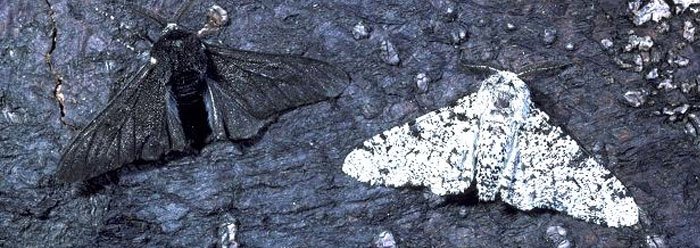
The trees these moths used to live on were white, but have been covered in soot from coal factories. Which moth will be more successful in this environment?
a)
Dark moth
b)
Light moth
c)
Both will be equally successful
d)
Neither will be successful
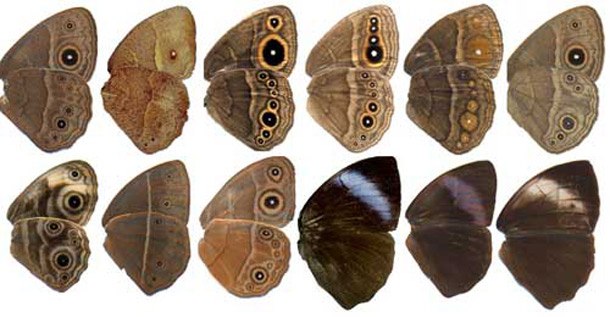
47.
These moths are all the same species. The differences between their wings is an example of ________________
a)
Natural Selection
b)
Variation
c)
Homeostasis
d)
Extinction
48.

What is the base that pairs with thymine in DNA?

a)

adenine

b)

guanine

c)

helicase

d)

nucleotide

49.

What is the base that pairs with guanine?

a)

adenine

b)

cytosine

c)

nucloetide

d)

deoxyribose

50.
The shape of DNA.
a)
double helix
b)
nucleotide
c)
DNA polymerase
d)
single stranded
51.
Which shows the correct complementary base pairing for DNA?
a)
C-A, T-G
b)
A-G, C-T
c)
C-G, U-A
d)
T-A, G-C
52.
If we think of DNA as a ladder, which parts are the steps of the ladder?
a)
the nitrogenous base pairs
b)
the phosphate-sugar backbone
c)
the genes
d)
the phospholipid bilayer
53.

Which is in order from largest to smallest structure?

a)

chromosome, DNA strand, gene, nucleotide

b)

chromosome, gene, DNA strand, nucleotide

c)

gene, DNA strand, chromosome, nucleotide

d)

DNA strand, chromosome, gene, nucleotide

54.

What are the parts of a nucleotide?

a)

phosphate, sugar, base

b)

A, T, G, C

c)

Nucleic Acids

d)

two base pairs connected

55.

One strand of DNA has how many nucleotides?

a)

millions

b)

about 20

c)

billions

d)

thousands

56.

Which of the following is correctly matches: ATT GTA CGA

a)

TAA CAT GCT

b)

ATT GTA CGA

c)

TAA GTA TCG

d)

GCC ACG TAC

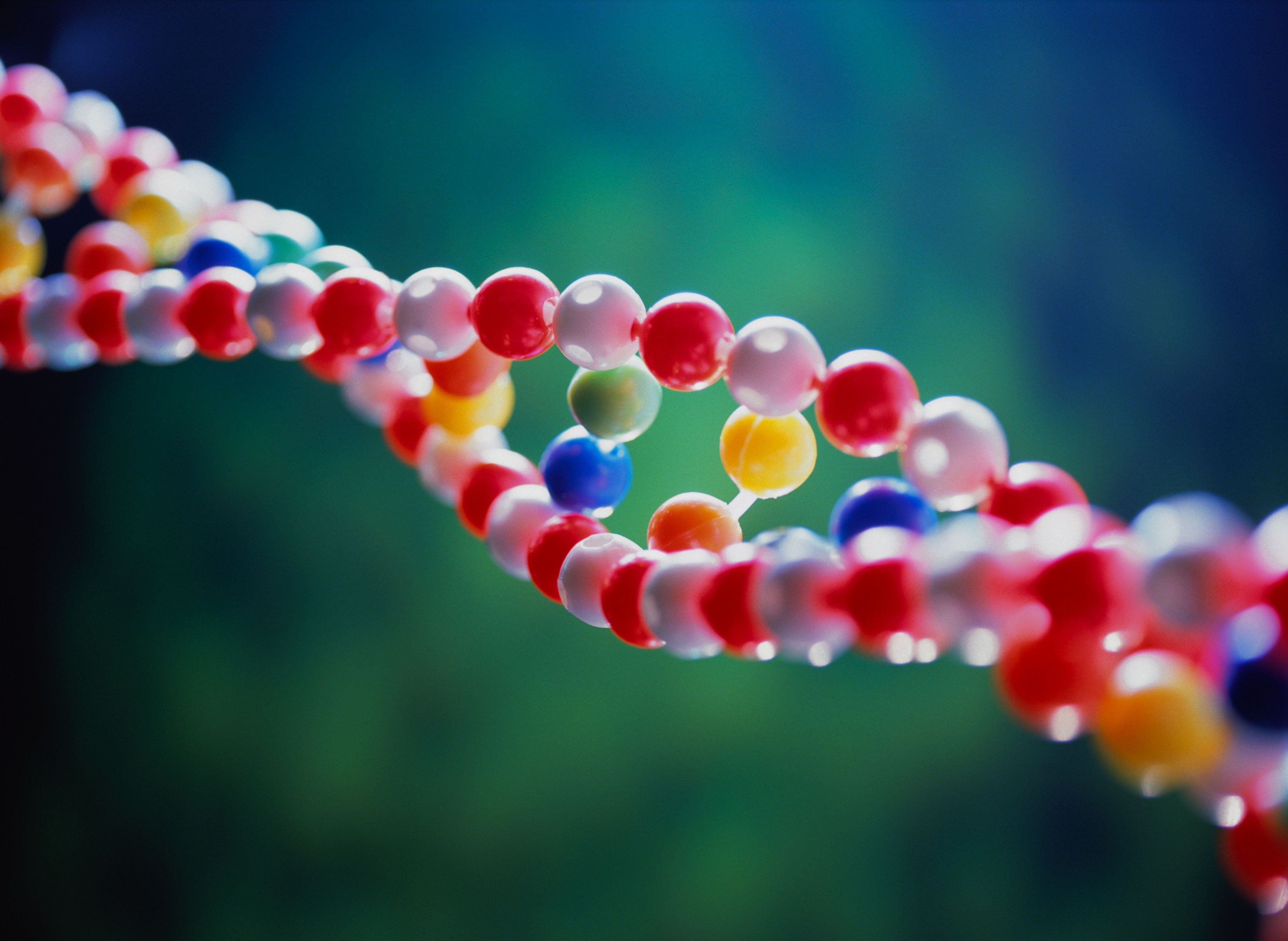
57.

What is this a picture of?

a)

nucleotide

b)

DNA strand

c)

chromosome

d)

gene

58.

DNA is a polymer (large molecule of repeated units) made of:

a)

Nucleotides

b)

Ribosomes

c)

Purines

d)

Pyrimidines

59.
Why is DNA important?
a)
it is very small and very complicated
b)
it's in everything
c)
it serves as the blueprint for traits of all living things
d)
because we eat it every day for energy
60.
What determines the code, or information, of a DNA molecule?
a)
the shape (structure) of the nitrogen bases
b)
the order (sequence) of the nitrogen bases
c)
the color of the nitrogen bases
d)
the frequency (number) of nitrogen bases
61.

What does a section of a DNA molecule code for?

a)

bases

b)

proteins

c)

amino acids

d)

phosphates

62.
Which two scientists are accredited with correctly deducing the double helix model of DNA?
a)
Watson and Crick
b)
Wilkins and Franklin
c)
Wilkins and Crick
d)
Watson and Franklin
63.

What is mitosis?

a)

a

b)

aa

c)

aaa

d)

c

64.
What phase of mitosis is shown in the picture?
a)
Prophase
b)
Anaphase
c)
Telophase
d)
Metaphase
65.
Chromatid pairs can be seen, spindle fibers form and nuclear membrane disappears
a)
Metaphase
b)
Telophase
c)
Anaphase
d)
Prophase
66.
Structure B is pointing to the _____. 
a)
chromosome
b)
centromere
c)
DNA
d)
chromatid
67.
Fruit fly body cells have 8 chromosomes. After mitosis, you would expect a resulting fruit fly daughter cell to have ...
a)
16 chromosomes.
b)
46 chromosomes.
c)
8 chromosomes.
d)
4 chromosomes.
68.
Name the previous phase.
a)
Prophase
b)
Metaphase
c)
Anaphase
d)
Telophase
69.
Which is Metaphase?
a)
A
b)
E
c)
C
d)
F
70.
The process by which the nuclear material is divided equally between two new cells
a)
mitosis
b)
cancer
c)
spindle
d)
centromere
71.

WHAT DOES MEIOSIS CREATE?

a)

CHROMOSOMES

b)

GAMETES

c)

DNA

d)

TRAITS

72.

The phase of Meiosis in which 4 daughter cells are formed:

a)

Telophase I

b)

Prophase II

c)

Anaphase II

d)

Telophase II

73.

When are homologous chromosomes separated?

a)

Anaphase I

b)

Anaphase II

c)

Telophase I

d)

Telophase II

74.
Any change in the sequence of DNA is...
a)
transgenic shift
b)
Single Genotype
c)
Monohybrid Trait
d)
Mutation
75.
Which shows a mutated segment of DNA? 
ATTCGC
a)
UAAGCG
b)
TAAGCG
c)
TAGGCG
76.
Mutations affect the ________ of a protein. Because of this the proteins ______ is affected as well. 
a)
gene, function 
b)
sequence, gene
c)
shape,function
77.
Why are insertion and deletion mutations so harmful?
a)
They change all of the codons from the mutation on down the line, which changes the amino acid sequence
b)
They insert things that an organism doesn't need.
c)
They often delete things that organisms need.
d)
Insertion and deletions are not any more harmful than substitution mutations.
78.

The bottom DNA sequence in the image has been altered by this type of mutation

a)

substitution

b)

insertion

c)

deletion

d)

translocation

79.

Mutations are SOMETIMES helpful to the organism.

a)

true

b)

false

80.

What are the three types of gene mutation?

a)

Insertion, Deletion, Subsitution

b)

Aberration, Deletion, Substitution

c)

Inversion, Duplication, Insertion

d)

Insertion, Duplication, Substitution

81.

A segment of DNA has base sequence GAC GAC CGC AAA ACA AGC. Due to deletion, the first base G is deleted. The likely effect of this on the coding of DNA segment is that

a)

the first amino acid will be different and all other will be like the original polypeptide.

b)

there will be no change in the polypeptide chain.

c)

the whole sequence of amino acids will be changed.

d)

the polypeptide chain will be two amino acids shorter