wayground logo

Free Printable Worksheets

Font size

S
M
L
XL
Worksheets

E/S Q1 Review

Total questions: 90

Worksheet time: 1hrs 16mins

Name
Class
Date
1.

You are testing how the amount you water a plant affects its growth. What would be the INDEPENDENT VARIABLE in this experiment.

a)

They type of pot you put the plants in.

b)

The amount you water each plant.

c)

The amount of sunlight the plants get.

d)

The amount the plant grows.

2.

If you were testing the time it took for objects of different sizes to reach the ground after being dropped from 30 feet in the air, which of these would be the DEPENDENT VARIABLE?

a)

The time it takes for each object to hit the ground.

b)

The size of each object.

c)

The type of object you use.

d)

The height you drop the object from

3.

The variable that is measured.

a)

Controlled Variable

b)

Dependent Variable

c)

Independent Variable

4.

The one factor that a scientist changes during an experiment.

a)

Controlled Variable

b)

Dependent Variable

c)

Independent Variable

5.
Which of the following is an observation about this picture?
a)
The boy has fallen off his bike.
b)
The boy is in a lot of pain.
c)
The boy has injuries to his knees
d)
The boy learned his lesson about wheelies
6.
Which of the following statements is an inference about the picture
a)
The vase is broken.
b)
The girls' bow is blue and purple.
c)
The girl broke the vase.
d)
The girl has blonde hair.
7.
Your teacher has asked you to explain the difference between quantitative and qualitative observations. Which statement is correct?
a)
Quantitative observations use numbers, qualitative uses the senses.
b)
Quantitative observations use the senses, qualitative uses numbers.
c)
Quantitative observations use measurement, qualitative uses numbers.
d)
Quantitative observations use colors, qualitative uses the senses.
8.
The plant has grown 4 cm since yesterday.
a)
Qualitative
b)
Quantitative
c)
Both
d)
Neither
9.
The leaves on the plant are turning brown.
a)
Qualitative
b)
Quantitative
c)
Both
d)
Neither
10.
How does increasing the slope of a ramp affect how far a marble travels?
a)
independent
b)
dependent
11.
How does watching TV during studying affect a student’s test grades?
a)
independent
b)
dependent
12.
Scientists frequently repeat the experiments of others scientists. Why is this important in science?
a)
Scientists often ask each other for help in performing experiments.
b)
Replication of experiments helps to confirm and verify results.
c)
Scientists frequently perform other scientists’ experiments in order to practice their technique.
d)
Repeating experiments is an effective way to make sure a laboratory is in optimal condition.
13.
Caira reads in a science journal that replication and repetiton are so important, but she did not understand the  difference between them. Which of the following best explains the two terms?
a)
Repetition is when a scientist repeats an experiment; replication is when a scientist conducts an experiment on genetic material.
b)
Repetition is when a scientist does the same experiment a number of times; replication is when other scientists reproduce a scientist’s experiment.
c)
Repetition is when a scientist publishes in more than one scientific periodical; replication is when another scientist reproduces another scientist’s results.
d)
Repetition is when a scientist commits an error in an experiment the first time and must repeat it; replication is when a scientist repeats an experiment to make sure it is valid.
14.
Dr. Smith has been reading about another scientist’s research in a physics journal. He plans to do these experiments himself and see if he gets the same result.
a)
repetition
b)
replication
15.
Josue goes to Silver River each week for 4 weeks and collects 5 samples of water to test the pH.
a)
repetition
b)
replication
16.
Theory or Law???  Changes with new observations.
a)
Theory
b)
Law
17.
Theory or Law???  Explanation of a wide range of observations?
a)
Theory
b)
Law
18.
Theory or Law???  Predicts what will happen in the natural world.
a)
Law
b)
Theory
19.
Theory or Law???  Makes NO attempt to explain an event.
a)
Theory
b)
Law
20.
Theory or Law???  The effect of gravity on objects?
a)
Theory
b)
Law
21.
Theory or Law???  Is a well-tested EXPLANATION for a wide range of observations and experimental results.
a)
Law
b)
Theory
22.
Theory or Law???  Is a DESCRIPTION of what a scientists expects to happen every time under a certain set of conditions.
a)
Law
b)
Theory
23.
A possible explanation to a problem that has not yet been tested. 
a)
data
b)
theory
c)
hypothesis
d)
fact
24.
A broad and comprehensive statement of what is thought to be true; it is supported by much evidence.
a)
hypothesis
b)
theory
c)
guess
d)
fact
25.
Which of the following can be used to test a hypothesis?
a)
experiment
b)
theory
c)
law
d)
variable
26.
Change from standard form to scientific notation:  450,000
a)
4.5  x  105
b)
45  x  105
c)
4.5  x  104
d)
4.5  x  106
27.
Change from standard form to scientific notation:  0.000398
a)
39.8  x  10-5
b)
3.98  x  10-5
c)
3.98  x  10-4
d)
39.8  x  10-6
28.
Change from standard form to scientific notation: 0.004078
a)
4.078  x  10-3
b)
4.078  x  103
c)
40.78  x  10-4
d)
.4078  x  10-2
29.
Change from standard form to scientific notation: 12,000,000
a)
12.0  x  107
b)
0.12  x  107
c)
1.2  x  106
d)
1.2  x  107
30.
UNDERSTANDING
If the exponent is a negative number...
a)
you will get a large number
b)
you will get a small number
31.

When we see the Andromeda galaxy, we are seeing it as it was 2.3 million years ago. Why?

a)

it takes light that length of time to travel

b)

light travels really slow in outer space

c)

light travels faster than sound

d)

it is an ancient galaxy

32.

Which does the existance of cosmic background radiation support?

a)

the Big Bang Theory

b)

the inflationary model

c)

critical density

d)

Hubble constant

33.

Our galaxy is called

a)

Centaurus A

b)

Andromeda

c)

the Milky Way

d)

Triangulum

34.

Which type of galaxy is illustrated?

a)

spiral

b)

elliptical

c)

irregular

d)

it's not a galaxy

35.

What is the origin of the cosmic background radiation?

a)

it is a remnant of the Big Bng

b)

it is emitted by radio galaxies

c)

it is dark energy

d)

it is emitted by stars

36.

Which scientist was the first to find evidence that the universe is expanding

a)

Albert Einstein

b)

Galileo Galilei

c)

Edwin Hubble

d)

Stephen Hawking

37.
If a star is being observed from Earth and it's light has shifted towards the blue side of the electromagnetic spectrum it would be...
a)
Moving towards the Earth
b)
Moving away from the Earth
c)
This is a trick question that cannot be answered
d)
It isn't a star, it is a very large blueberry.
38.
If a star is being observed from Earth and it's light has shifted towards the red side of the electromagnetic spectrum it would be...
a)
Moving towards the Earth
b)
Moving away from the Earth
c)
This is a trick question that cannot be answered
d)
It isn't a star, it is a very large blueberry.
39.
The vast majority of galaxies in our universe are moving away from us.  We know this because we observe __________ in the galaxies absorption spectra.
a)
Redshift
b)
Blueshift
c)
Turbulance
d)
Superposition
40.
What best describes the doppler effect?
a)
An apparent change in frequency of a wave due to the relative motion between a wave source and an observer
b)
When sound changes pitch
c)
When light changes color
d)
An apparent change in the amplitude of a wave due to the relative motion between a wave source and an observer.
41.
A light year is the 
a)
distance that light travels in one year
b)
Speed at which light travels 
42.
What is a galaxy?
a)
A large storm of comets. 
b)
A parallel universe that existed before the Big Bang. 
c)
A collection of stars, dust, and gas bound together by gravity 
d)
Unknown 
43.
The average distance between the earth and the sun is the 
a)
astronomical unit 
b)
Light year
44.
What do we use astronomical units to measure?
a)
distances in our solar system
b)
How far our solar system is from others in our galaxy.
c)
The distances between galaxies. 
d)
The distance from one side of the universe to the other. 
45.

Why do we use light years and astronomical units to measure distances in space?

a)

Scientists want to sound smart.

b)

Hubble discovered these units and wanted to use them.

c)

Space is too small to use km, it wouldn't make sense.

d)

Space is too big, vast, enormous to use traditional units, like miles.

46.

Which of the following scenarios would be appropriate to use light years?

a)

From the sun to Earth

b)

from Earth to Neptune

c)

from the Milky Way to its closest galaxy

d)

Asteroid Belt to the Kuiper Belt

47.
Rank the four fundamental forces of nature in order from weakest to strongest:  
a)
Electromagnetism, Gravity, Strong Nuclear, Weak Nuclear
b)
Weak Nuclear, Gravity, Electromagnetism, Strong Nuclear
c)
Gravity, Weak Nuclear,  Electromagnetism, Strong Nuclear
d)
Weak Nuclear, Electromagnetism, Gravity, Strong Nuclear
48.
The strongest of the four fundamental forces is: 
a)
Gravity 
b)
Electromagnetism
c)
Strong Nuclear 
d)
Weak Nuclear 
49.
During the phases of the Moon, the Moon appears to change shape.  This change in appearance is due to the Moon...
a)
physically changing size and shape.
b)
moving closer and then farther away from Earth.
c)
reflecting a different amount of light due to alignment with Earth and the Sun.
d)
having craters on its surface.
50.
Which moon phase is when you can't see the moon at all?
a)
Waning crescent
b)
Full moon
c)
Waxing gibbous
d)
New moon
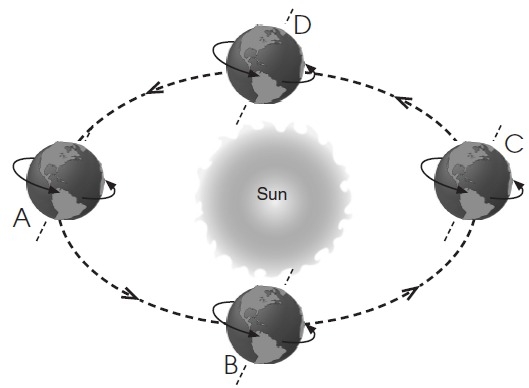
51.
What season is letter A?
a)
Winter
b)
Summer
c)
Spring
d)
Fall
52.
When the Northern Hemisphere is pointing towards the sun, what season is the Southern Hemisphere?
a)
Winter
b)
Spring
c)
Fall
d)
Summer
53.
Which moon phase is shown in this diagram?
a)
new moon
b)
first quarter
c)
full moon
d)
last quarter/3rd quarter
54.
Tides are caused by ___________
a)
wind
b)
gravitational pull of moon
c)
waves gravitation toward land
d)
rain
55.
What would be the result if the Earth's axis was not tilted but straight up and down?
a)
Nothing would change
b)
There would be no seasons
c)
Days would get longer
d)
The Equator would burn up and the poles would freeze
56.
Name the phase of the moon for letter a
a)
First Quarter
b)
Last Quarter
c)
Waxing Gibbous
d)
Waning Gibbous
57.
What Moon phase is this?
a)
Full Moon
b)
Waxing Gibbous
c)
New Moon
d)
Half Moon
58.
A[n] ______________ tide occurs when the sun is at right angles to the line between Earth and the moon. 
a)
high
b)
neap
c)
low
d)
spring
59.
A[n] ___________ tide occurs when the sun, Earth, and the moon are nearly in a line. 
a)
spring
b)
high
c)
low
d)
neap
60.
What type of tides would this arrangement of earth-moon-sun create?
a)
neap tide
b)
spring tide
c)
new moon tide
d)
full moon tide
61.
What type of tide would this arrangement of earth-moon-sun create?
a)
full moon tide
b)
new moon tide
c)
neap tide
d)
spring tide
62.
The measure of the pull of gravity on an object is ___________________.
a)
motion
b)
weight
c)
speed
d)
friction
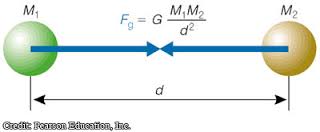
63.
Two factors effecting the magnitude of the force of gravity between 2 objects are...
a)
mass and distance 
b)
mass and matter
c)
distance and weight 
d)
weight and mass
64.
Gravity attracts all objects towards one another.
a)
False
b)
True
c)
It depends
d)
I don't care
65.
Force of gravity is directly proportional to
a)
Mass
b)
Weight
c)
Distance
d)
Time
66.
Force of gravity is inversely proportional to
a)
Mass
b)
Weight
c)
Distance
d)
Time
67.
As the product of two objects' masses increases, the pull of gravity
a)
Increases
b)
Decreases
c)
Stays the same
68.
As distance separating the objects increases the force
a)
increases
b)
decreases
c)
stays the same
69.
Complete the following statement: The farther away two planets are the _______ the gravitational force between them.
a)
more
b)
same
c)
dosen't matter
d)
less
70.
What shape is this orbit?
a)
square
b)
circle
c)
ellipse
d)
line
71.

the path a body follows as it travels around another body in space

a)

revolution

b)

rotation

c)

orbit

d)

hemisphere

72.

a cloud of gas and dust from which bodies in space are formed

a)

revolution

b)

photosphere

c)

nuclear fusion

d)

nebula

73.

The planets of the solar system formed as

a)

the center of the gas cloud cooled.

b)

planetesimals flattened into a rotating disk.

c)

planetesimals collided into one another.

d)

the sun absorbed extra gas and dust from the solar system.

74.

What happens during nuclear fusion in the sun?

a)

Helium nuclei combine to form hydrogen.

b)

Helium nuclei combine to form oxygen.

c)

Hydrogen nuclei combine to form helium.

d)

Oxygen nuclei combine to form helium.

75.
What is the closest planet to the Sun?
a)
Mercury
b)
Mars
c)
Venus
d)
Earth 
76.
One of the main differences between the outer and inner planets is __________.
a)
The inner planets all have water
b)
the inner planets are much bigger than the outer planets
c)
the outer planets are gas planets
d)
the outer planets have rings, and the inner planets don't
77.

As a nebula collapses it also begins:

a)

Expand

b)

Spin or Rotate

c)

Shake

d)

Turn to ice

78.

A nebula collapses down into a disk known as :

a)

A compact disk

b)

An irregular cloud

c)

An protostellar disk

d)

An circular disk

79.
If a planet is closer to the sun, its orbit will be _____ than one farther away. 
a)
longer
b)
slower
c)
bigger
d)
shorter
80.
An ellipse is drawn around two points called
a)
aphelion
b)
perihelion
c)
foci
d)
axis
81.
The place where a planet is closest to the Sun as it orbits the Sun is called the
a)
perihelion
b)
aphelion
82.
The place where a planet is farthest away from the Sun in its orbit around the Sun is called the
a)
aphelion
b)
perihelion
83.
What is true about the area between points A, B and the Sun, and the area between points H, I and the Sun?
a)
The area between A, B and the Sun is the largest.
b)
The area between H, I and the Sun is the largest
c)
Both areas are equal in size
d)
There is not enough information to determine the areas
84.
What has an eccentricity of zero
a)
a straight line
b)
a large ellipse
c)
a circle
d)
a small ellipse
85.
Earth and the other planets closest to the Sun are made mostly of _______
a)
gas
b)
metal
c)
water
d)
rock
86.
Kepler's 2nd Law deals with 
a)
the shape of the planets' orbits
b)
the speed/area the planet travels 
c)
the length of time it takes the planet to orbit the sun
87.
A planet moves __________ when it is farthest from the sun.
a)
faster
b)
slower
88.
The farther away a planet is from the sun, the _______ it takes it to orbit the sun once. 
a)
longer
b)
shorter
89.
The amount of matter in an object
a)
mass
b)
weight
c)
inertia
d)
gravity
90.
A satellite moves ______________when it is moved farther from the object that it orbits.
a)
more quickly
b)
more slowly
c)
at the same speed
d)
with no change in speed