wayground logo

Free Printable Worksheets

Font size

S
M
L
XL
Worksheets

24.25 Unit 3 TEST Review

Total questions: 85

Worksheet time: 1hrs 19mins
Name
Class
Date
1.
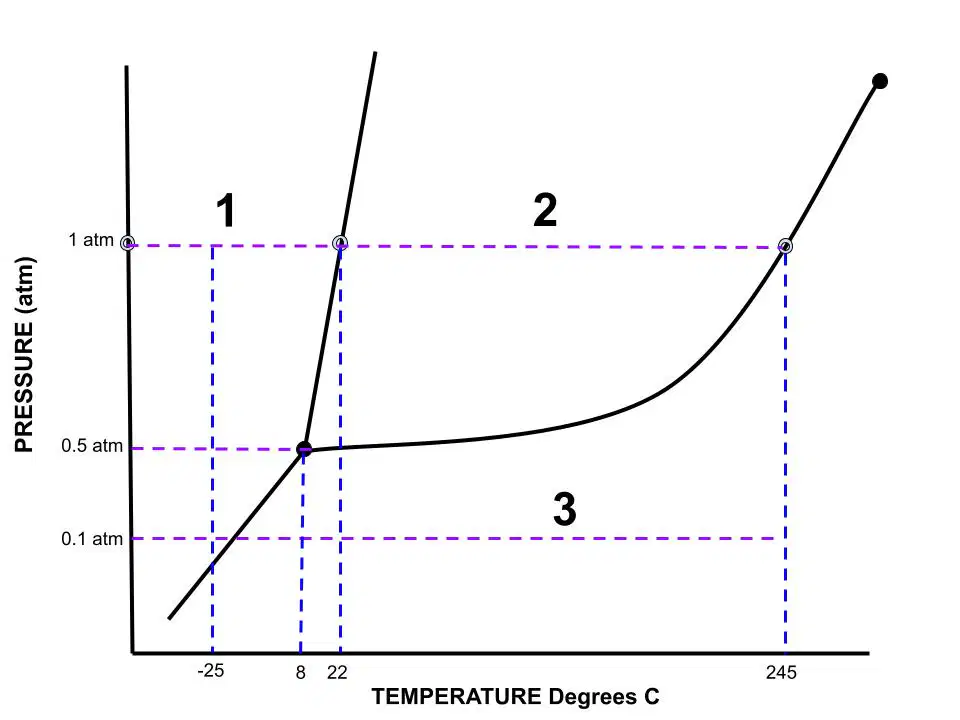
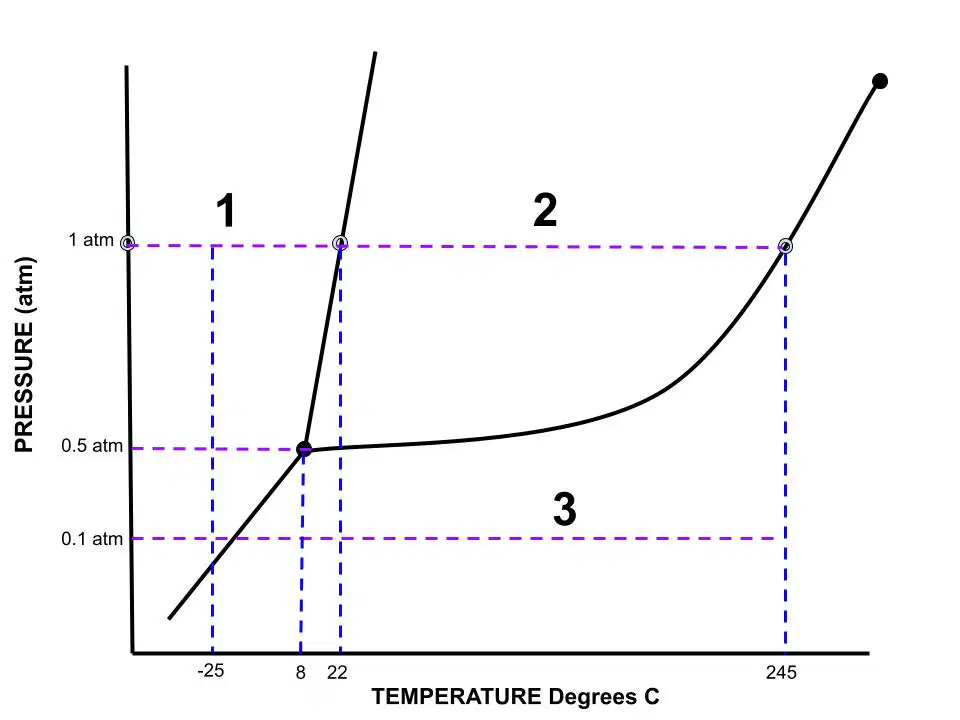
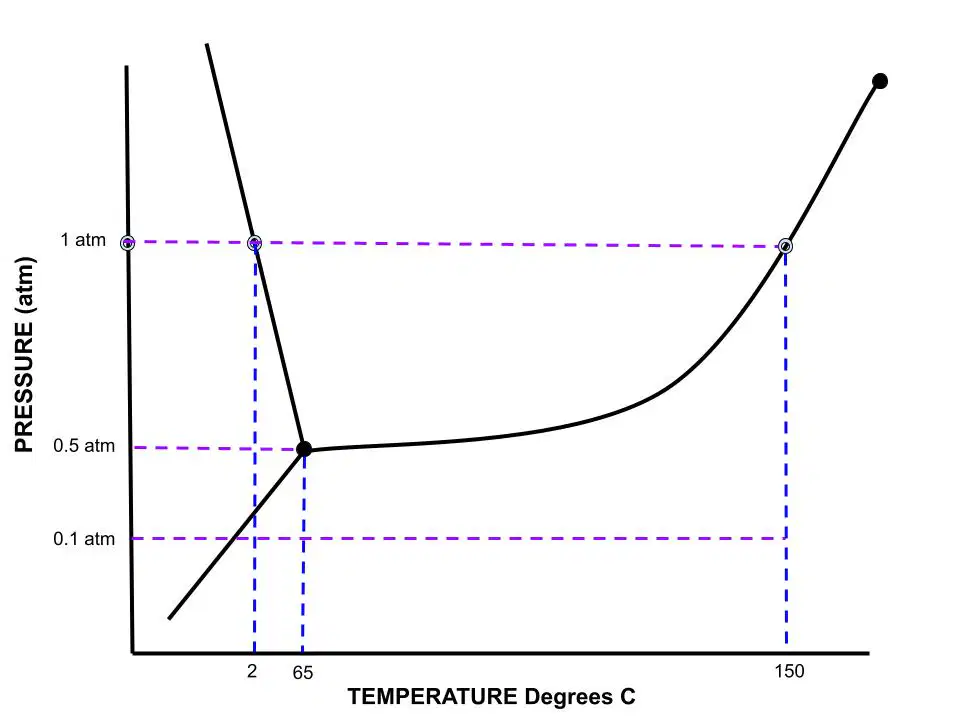
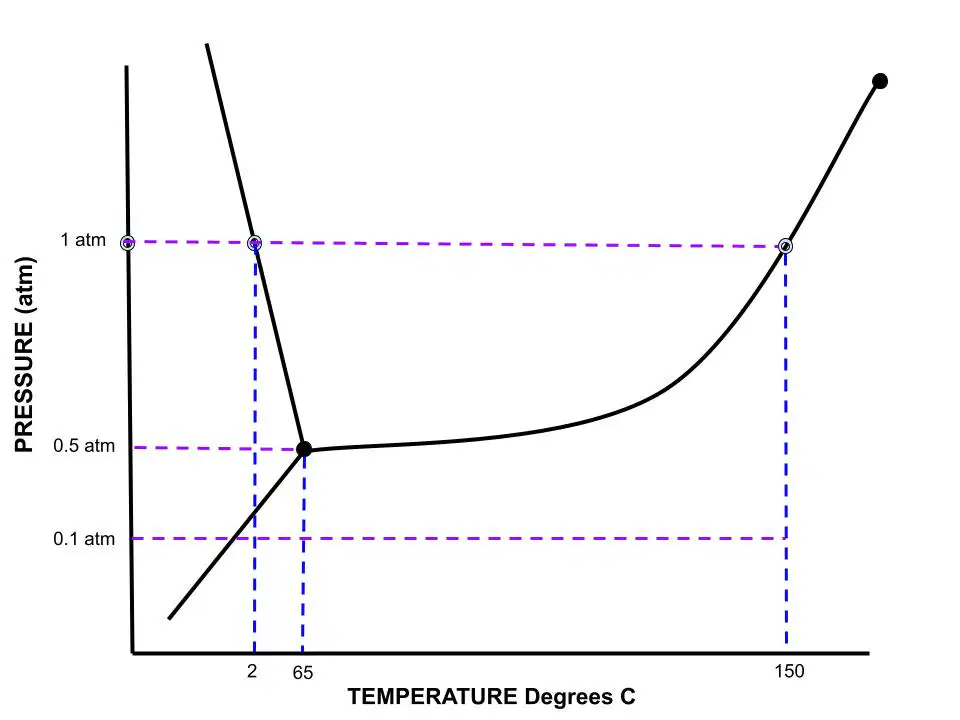
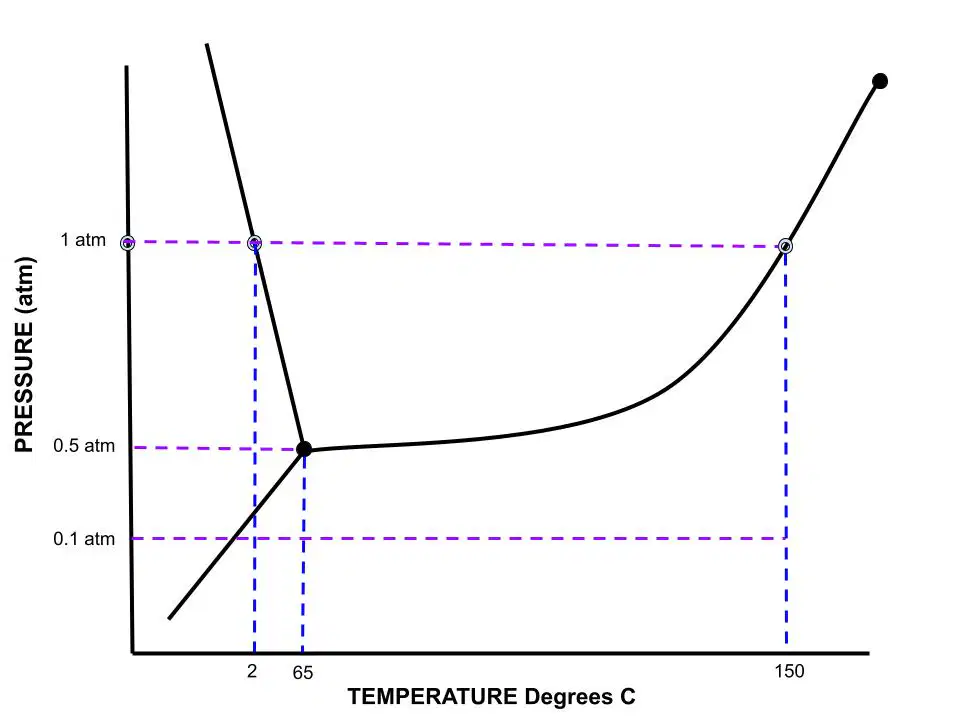
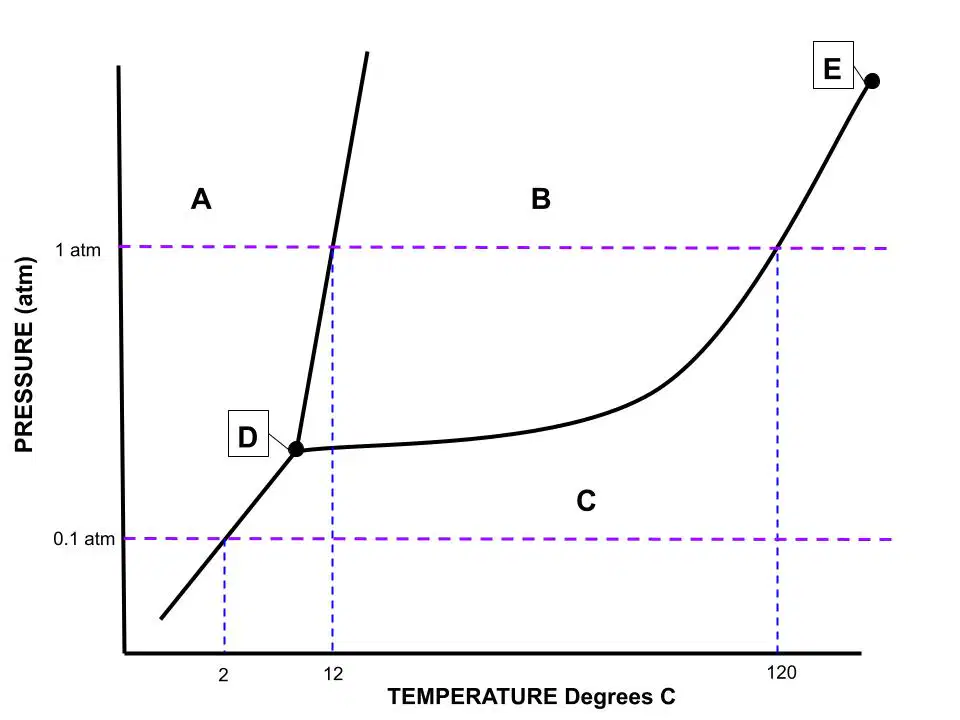
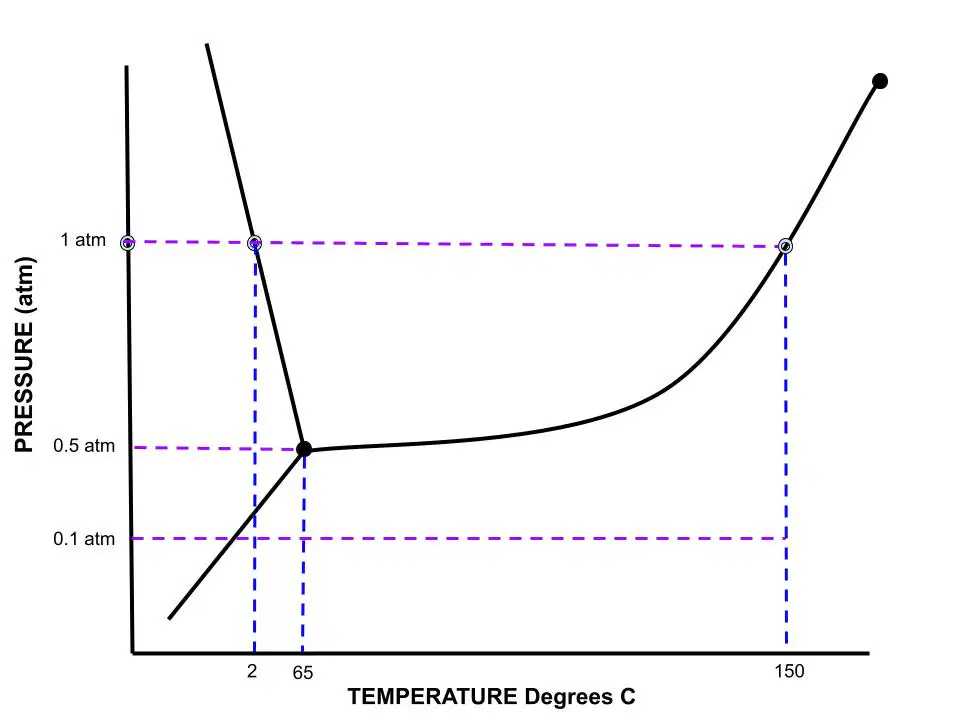
What is the normal melting point of the below substance?
a)
65 degrees C
b)
150 degrees C
c)
100 degrees C
d)
2 degrees C
2.
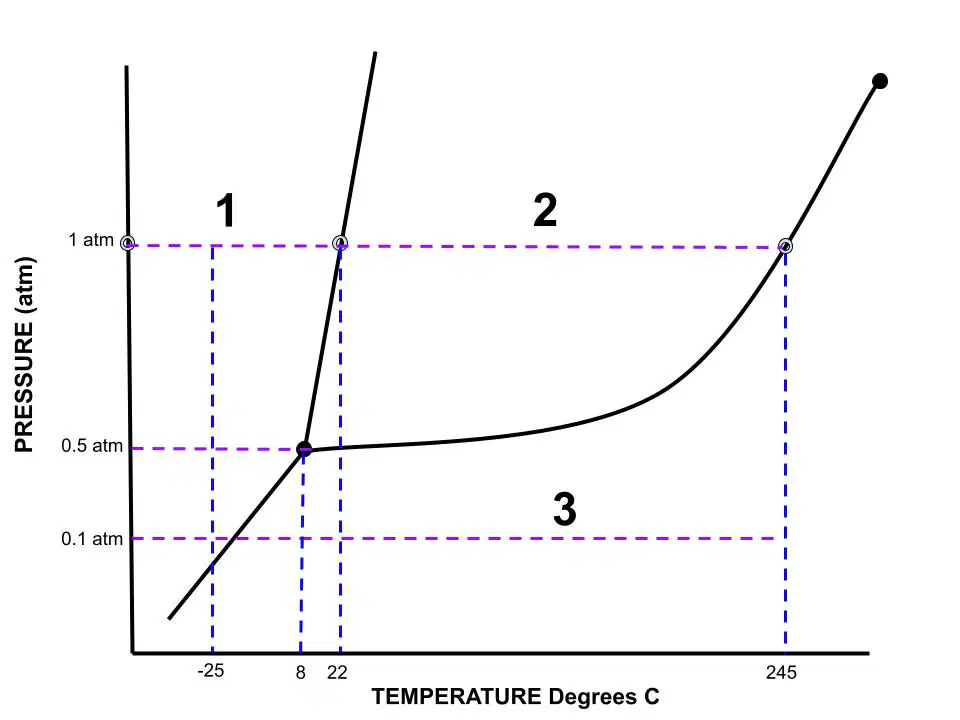
The name of the location at 0.5 atm and 8 deg C is called
a)
Critical Point
b)
Triple Point
c)
Noncritical Point
3.
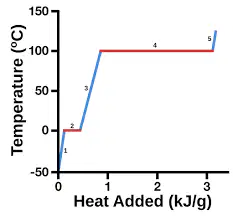
A substance at 1 atm heated from zone 1 to 2 experiences
a)
Freezing
b)
Melting
c)
Boiling
d)
Condensing
4.
What is the state of matter at 90 deg C and 1.5 atm?
a)
Plasma
b)
Gas
c)
Solid
d)
Liquid
5.
At 1 atm, what is the boiling point?
a)
65 deg C
b)
2 deg C
c)
150 deg C
d)
100 deg C
6.
What is the state of matter when we have a temp less than 65 deg C at 0.5 atm?
a)
Plasma
b)
Gas
c)
Solid
d)
Liquid
7.
At 0.1 atm, the substance heated from -25 C to 22 C experiences
a)
Freezing
b)
Condensation
c)
Melting
d)
Vaporization
e)
Sublimation
8.
A substance at 1 atm being cooled from zone 3 to 2 experiences
a)
Freezing
b)
Condensation
c)
Melting
d)
Vaporization
9.
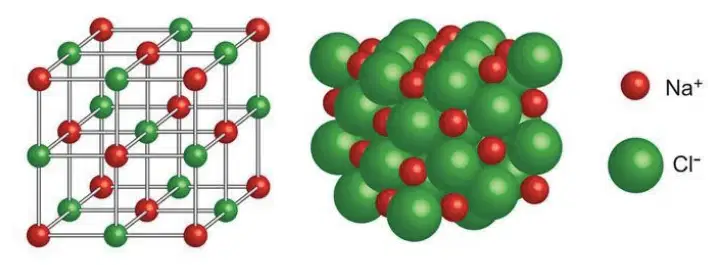
The picture of how atoms are arranged in the below substance represents a ______________________ solid.
a)
Cyrstalline
b)
Amorphous
c)
Singular
d)
Perfect
10.
Using the picture below, what is the main reason that explains why the paper clip can float on the liquid?
a)
Surface Tension
b)
Density
c)
Viscosity
d)
Fluidity
11.
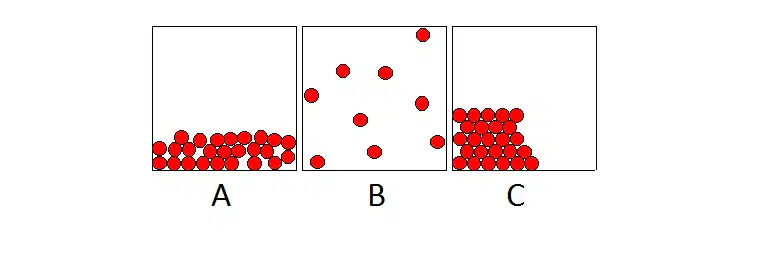
The diagram below represents a substance in three different states. Which sequence lists the particles energy level from lowest energy to highest energy?
a)
A, B, C
b)
C, A, B
c)
A, C, B
d)
B, A, C
12.
Which substance will have the GREATEST viscosity?
a)
Honey (Cold)
b)
Water (50 degrees C)
c)
Vegetable Oil (Hot)
d)
Vinegar (Room Temperature)
13.
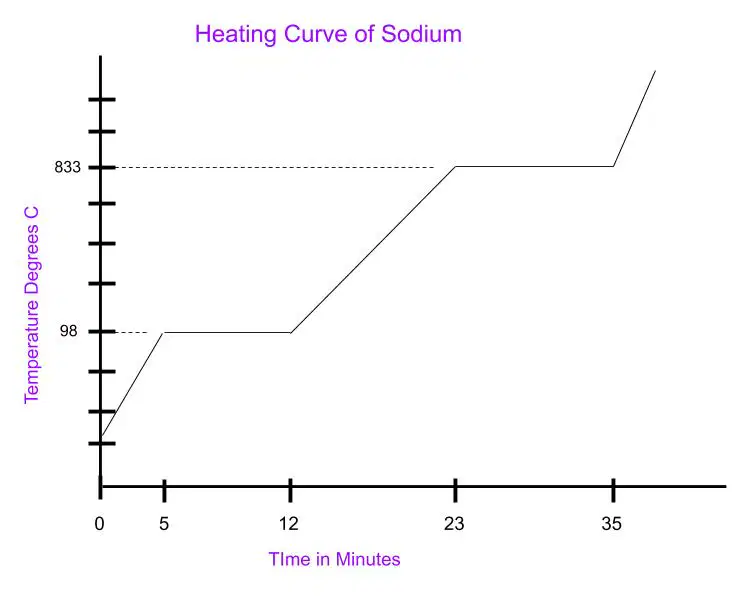
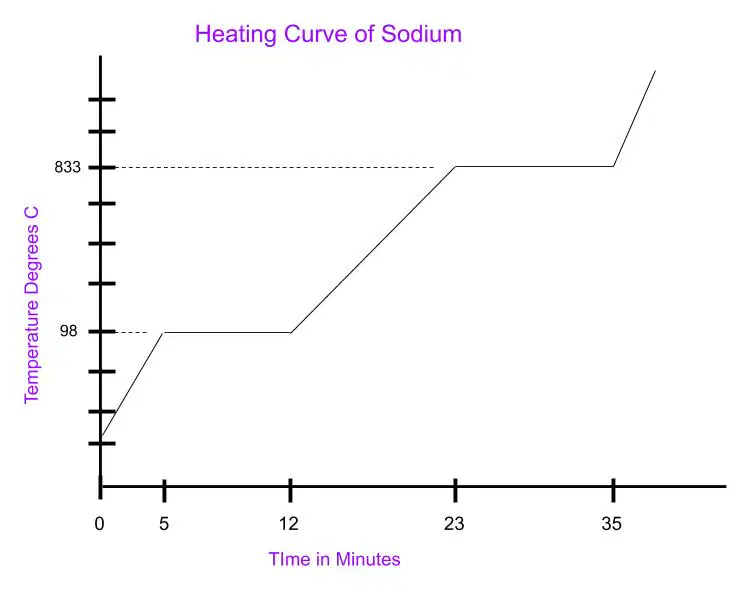
After heating sodium metal for 19 minutes, which phase of matter is present?
a)
Liquid and Gas
b)
Solid
c)
Solid and Gas
d)
Gas
e)
Liquid
14.
What phase of matter is present at 45 degrees C?
a)
Liquid and Gas
b)
Solid
c)
Solid and Gas
d)
Gas
e)
Liquid
15.
The cooling curve of an unknown substance is shown below. What temperature is the FREEZING POINT?
a)
100 deg C
b)
150 deg C
c)
200 deg C
d)
25 deg C
e)
not enough information provided
16.
As energy is added in a phase change where 2 states of matter are present, which of the following remains constant during the entire phase change?
a)
temperature
b)
volume
c)
energy
d)
none of the above
17.
Using Boyle's Law which relates pressure and volume in an inversely proportional relationship. If the pressure increases, what will change and how?
a)
Volume will change and it will decrease
b)
Volume will change and it will increase
c)
Temperature will change and it will decrease
d)
Temperature will change and it will increase
18.
Using Charles Law which relates temperature and volume in a directly proportional relationship. If the Temperature increases, what will change and how?
a)
Volume will change and it will decrease
b)
Volume will change and it will increase
c)
Temperature will change and it will decrease
d)
Temperature will change and it will increase
19.
If the volume of a container remains constant, and we increase the temperature of a gas inside of the container, what relationship will we see and how will the pressure change?
a)
The relationship is an inverse proportion and the pressure will increase.
b)
The relationship is a direct proportion and the pressure will decrease.
c)
The relationship is an inverse proportion and the pressure will decrease.
d)
The relationship is a direct proportion and the pressure will increase.
20.
If a balloon at room temperature is placed in the freezer, what will happen to its volume?
a)
The volume will decrease.
b)
The volume will increase
c)
The volume will remain the same.
21.
A toddler at the local carnival is playing with a balloon and accidently let it go where it floats upward into the sky. As it goes higher (where the air pressure is lower), what happens to the size (volume) of the balloon?
a)
The volume will increase.
b)
The volume will decrease.
c)
The volume will remain unchanged.
22.

Identify what letter A represents in the graph.

a)

Solid

b)

Liquid

c)

Gas

d)

Triple Point

e)

Critical Point

23.

Identify what letter B represents in the graph.

a)

Solid

b)

Liquid

c)

Gas

d)

Triple Point

e)

Critical Point

24.

Identify what letter C represents in the graph.

a)

Solid

b)

Liquid

c)

Gas

d)

Triple Point

e)

Critical Point

25.

Identify what letter D represents in the graph.

a)

Solid

b)

Liquid

c)

Gas

d)

Triple Point

e)

Critical Point

26.

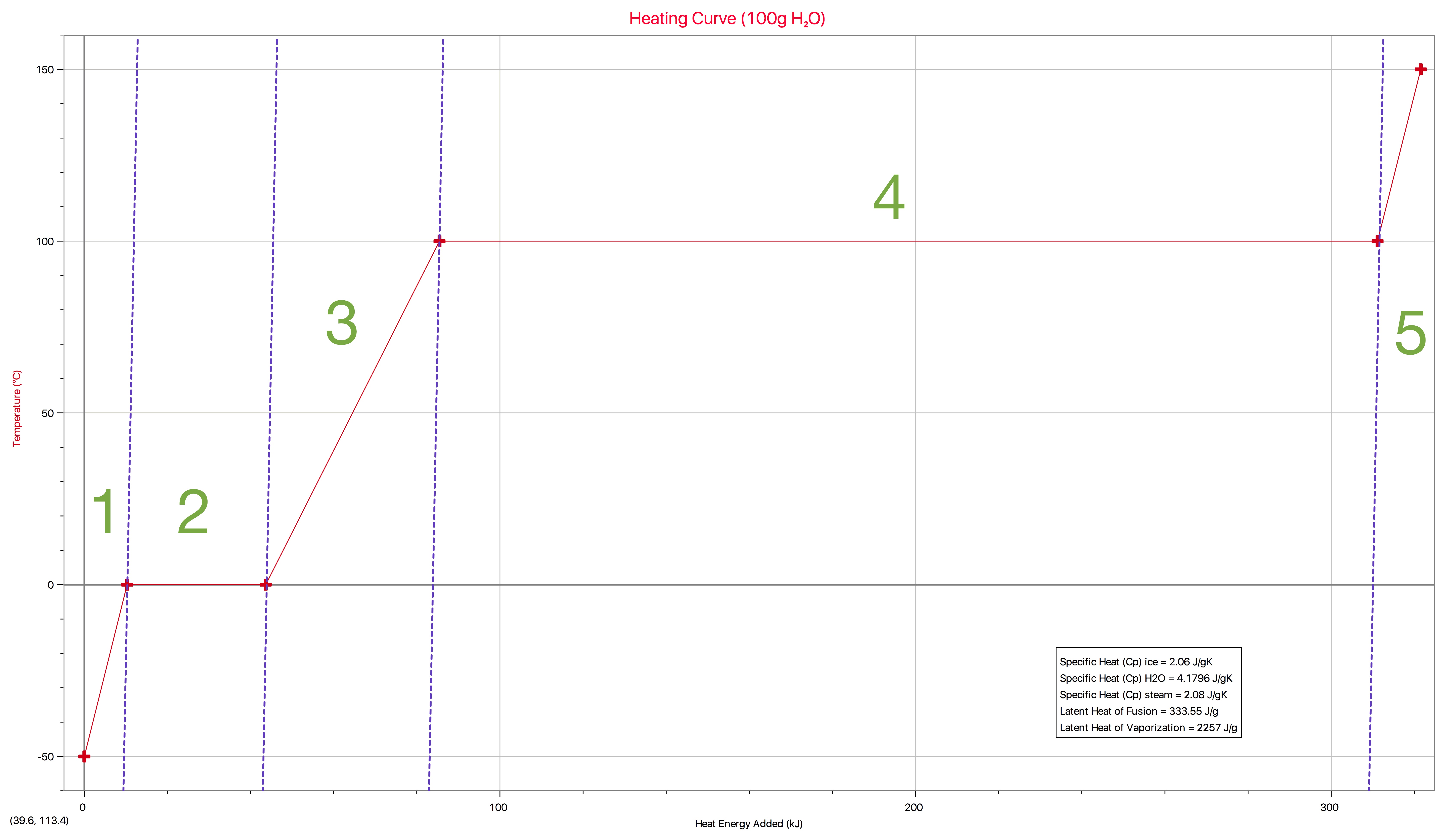
Identify which state/states of matter exist at the Point 1.

a)

Solid being heated

b)

Solid and Liquid (melting)

c)

Liquid being heated

d)

Liquid and Gas (vaporization)

e)

Gas being heated

27.

Identify which state/states of matter exist at the Point 2.

a)

Solid being heated

b)

Solid and Liquid (melting)

c)

Liquid being heated

d)

Liquid and Gas (vaporization)

e)

Gas being heated

28.

Identify which state/states of matter exist at the Point 3.

a)

Solid being heated

b)

Solid and Liquid (melting)

c)

Liquid being heated

d)

Liquid and Gas (vaporization)

e)

Gas being heated

29.

Identify which state/states of matter exist at the Point 4.

a)

Solid being heated

b)

Solid and Liquid (melting)

c)

Liquid being heated

d)

Liquid and Gas (vaporization)

e)

Gas being heated

30.

Identify which state/states of matter exist at the Point 5.

a)

Solid being heated

b)

Solid and Liquid (melting)

c)

Liquid being heated

d)

Liquid and Gas (vaporization)

e)

Gas being heated

31.
In which region(s) of the graph does a phase change occur?
a)
Region 1, 3, & 5
b)
Region 2 & 4
c)
Region 1 only
d)
Region 1 & 2
32.
In which region(s) does temperature increase?
a)
Region 1, 3, & 5
b)
Region 2 & 4
c)
Region 1 only
d)
Region 1 & 2
33.
In which region(s) does temperature remain constant?
a)
Region 1, 3, & 5
b)
Region 2 & 4
c)
Region 1 only
d)
Region 1 & 2
34.
This curve indicates what about the heat energy?
a)
heat energy is being added or absorbed
b)
heat energy is being removed
35.
In which region(s) of the graph would the substance be a solid only?
a)
Region 1
b)
Region 2
c)
Region 3
d)
Region 4
36.
In which region(s) of the graph would the substance be a solid and a liquid?
a)
Region 1
b)
Region 2
c)
Region 3
d)
Region 4
37.
In which region(s) of the graph would the substance be a liquid only?
a)
Region 1
b)
Region 2
c)
Region 3
d)
Region 4
38.
In which region(s) of the graph would the substance be a liquid and a gas?
a)
Region 2
b)
Region 3
c)
Region 4
d)
Region 5
39.
In which region(s) of the graph would the substance be a gas only?
a)
Region 2
b)
Region 3
c)
Region 4
d)
Region 5
40.
In which region of the graph would be used to find the melting of the substance?
a)
Region 2
b)
Region 3
c)
Region 4
d)
Region 5
41.
In which region of the graph would be used to find the boiling point of the substance?
a)
Region 2
b)
Region 3
c)
Region 4
d)
Region 5
42.

Given the heating curve of a solid being heated at a constant rate, what is the boiling point of this substance?

a)

20°C

b)

50°C

c)

110°C

d)

170°C

43.

Given the heating curve of a solid being heated at a constant rate, how much total time was required to boil this substance after it reached its boiling point?

a)

3 minutes

b)

4 minutes

c)

10 minutes

d)

14 minutes

44.

NaCl(s) was heated up starting at an initial temperature of 0°C. The heating curve is shown in the picture. What is the melting point of this substance?

a)

0°C

b)

801°C

c)

1000°C

d)

1465°C

45.

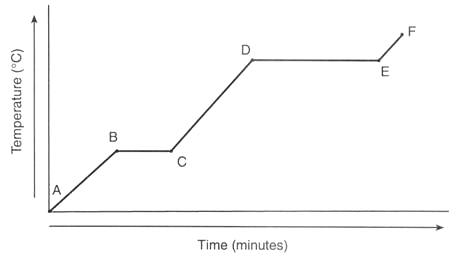
Given the heating curve for water, during which line segment could I find water in both the solid and liquid phase at the same time?

a)

AB

b)

BC

c)

CD

d)

DE

e)

EF

46.

A substance is cooled for sixteen minutes according to the cooling curve shown. What is the melting point of this substance?

a)

206°C

b)

150°C

c)

90°C

d)

50°C

47.

Heat is being removed from a substance at a constant rate starting in the liquid phase at 75°C and ending at 15°C. The graph shows the temperature change during cooling. What phase change is occurring?

a)

melting

b)

freezing

c)

boiling

d)

condensation

48.

This curve indicates what about the heat energy?

a)

Heat energy is being added or absorbed

b)

Heat energy is being released

49.

Melting and freezing occur at the same temperature!

a)

True

b)

False

c)

I don't know

50.
Water exists as a _____________ at 700 mmHg and 50 °C.
a)
solid
b)
liquid
c)
gas
d)
supercritical fluid
51.
Water exists as a _____________ at 3 mmHg and 50 °C.
a)
solid
b)
liquid
c)
gas
d)
supercritical fluid
52.
What phase change(s) may occur at pressures below 4.58 mmHg?
a)
sublimation/deposition
b)
melting/freezing
c)
all phase changes are possible at these pressures
d)
vaporization/condensation
53.
The pressure is increased on a sample of water at 0 °C from 0 mmHg to 800 mmHg.  In order, what changes occur?
a)
deposition, melting
b)
sublimation, melting
c)
condensation, freezing
d)
deposition, freezing
54.
What state of matter is X?
a)
solid 
b)
liquid
c)
gas
d)
supercritical fluid
55.
What state of matter is Y?
a)
solid 
b)
liquid
c)
gas
d)
supercritical fluid
56.
What state of matter is Z?
a)
solid 
b)
liquid
c)
gas
d)
supercritical fluid
57.
What change occurs from E to C?
a)
sublimation
b)
freezing
c)
melting
d)
boiling
58.
What is the normal boiling point of this substance?
a)
150 °C
b)
100 °C
c)
-50 °C
d)
0 °C
59.
What is the normal melting point of this substance?
a)
150 °C
b)
100 °C
c)
-50 °C
d)
0 °C
60.
What is point A?
a)
triple point
b)
critical point
c)
equilibrium point
d)
normal melting point
61.
What is point B?
a)
triple point
b)
critical point
c)
equilibrium point
d)
normal melting point
62.
Above the temperature of point B, this substance exists as a ____________.
a)
solid
b)
liquid
c)
gas
d)
supercritical fluid
63.
Below the temperature of point B, this substance can exist as a ____________.
a)
solid only
b)
liquid only
c)
gas only
d)
either a solid, liquid or gas
64.

Are the particles moving faster or slower as time goes on? (Diagram F)

a)

Faster

b)

Slower

65.

Is the substance gaining or losing energy? (Diagram D)

a)

Gaining

b)

Losing

66.

What will occur when the substance transitions from B to A? (Diagram A)

a)

condensation

b)

evaporation

c)

melting

d)

freezing

67.
What happens when thermal energy is taken away from particles?
a)
They move faster and farther apart
b)
They move slower and closer together
68.
During a phase change, the temperature
a)
increases
b)
decreases
c)
fluctuates
d)
stays the same
69.

What phase change occurs at letter F?

a)

Melting

b)

Freezing

c)

Vaporization

d)

Sublimation

70.

What phase change occurs at letter B?

a)

Deposition

b)

Melting

c)

Freezing

d)

Condensation

71.

What phase change occurs at letter C?

a)

Vaporization

b)

Sublimation

c)

Melting

d)

Condensation

72.

What phase change occurs at letter E?

a)

Freezing

b)

Deposition

c)

Condensation

d)

Melting

73.

What phase change occurs at letter A?

a)

Freezing

b)

Condensation

c)

Melting

d)

Deposition

74.
This state of matter takes both the shape and volume of it container.
a)
gas
b)
solid
c)
liquid
75.

The particles in a _____________ vibrate, are close together, and do not move freely.

a)

liquid

b)

gas

c)

solid

76.

What is an amorphous solid?

a)

solids whose particles are aligned

b)

solid whose particles are not arranged in a particular order

c)

solids that are like water

d)

solids that are like gas

77.

What is a crystalline solid?

a)

solids with irregular patterns

b)

solids with regular patterns

c)

solids that are crystals

d)

lines of crystals on the side of the road

78.

According to Boyle's Law, when Pressure increases then the Volume must...

a)
Increase
b)
decrease
79.

According to Boyle's Law, when Volume increases then Pressure must...

a)
Increase
b)
Decrease
80.

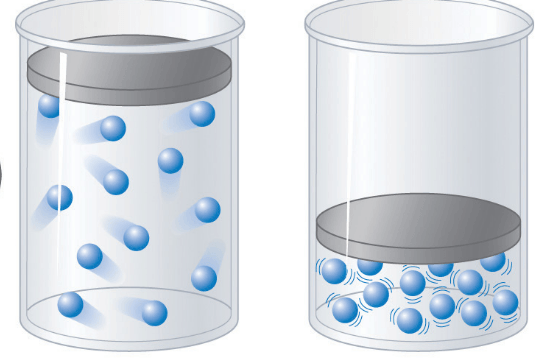
According to Boyle's Law, what type of relationship to pressure and volume have?
a)
direct
b)
inverse
c)
no relationship
d)
I don't know
81.
Which container will have a lower pressure?
a)
left
b)
right
c)
they both have the same pressure
d)
I don't know
82.

In CHARLES'S LAW, volume and temperature have a ______ proportionality.

a)

direct

b)

inverse

c)

linear

d)

exponential

83.

In CHARLES' LAW, at constant pressure, what happens to temperature of a gas when the volume doubles?

a)

The temperature also doubles.

b)

The temperature decreases to half of its original volume.

c)

The temperature doesn't change.

d)

The temperature quadruples.

84.

You go camping & roast marshmallows over a campfire. What happens to the volume of the air bubbles inside the marshmallows?

a)

volume increased

b)

volume decreased

c)

stays the same

85.
Records show that the incident of tire explosion is high during summer season.  Which of the following gives the best explanation for this observation?
a)
there are more travellers during summer vacation
b)
high temperature during summer season causes the air inside the tire to expand
c)
vehicles' tires are no well maintained
d)
there is too much air inside the tires